
How to Run a Manufacturing Plant Tour for Customers

Sarah Johnson
Product Manager at ParrotNotes with 5+ years of experience in productivity tools and AI technology.
Table of Contents
- 1.What a manufacturing plant tour is for (and what buyers look for)
- 2.Plan the manufacturing plant tour two weeks out
- 3.Build the plant tour route and a timed agenda
- 4.Decide who speaks at each stop
- 5.Safety, NDA and photo rules for a manufacturing plant tour
- 6.Capture the questions and promises made on the floor
- 7.Run the debrief and follow up within 24 hours
- 8.Turn your next plant tour into a quote that matches
Picture a Thursday morning at a sheet-metal plant. Dana, the regional sales manager, is walking a buyer and a quality engineer from an OEM past the press brakes. Over the noise, the quality engineer asks whether the plant can hold plus or minus 0.005 inches on a bracket flange. The plant manager nods and says, "Sure, we can do that."
Nobody writes it down. Three weeks later the quote goes out at the standard tolerance, and the buyer's first reply is, "That isn't what your plant manager told us."
A manufacturing plant tour is one of the strongest sales moves you have. It's also the one meeting where the best questions get asked in the worst place to take notes. You already know the floor sells better than any slide deck. What's harder is turning a two-hour walk into a quote that matches what was said.
This guide gives you a run sheet for a customer plant tour: a two-week checklist, a timed agenda, a talking-point card for each stop, the safety, NDA and photo rules to settle first, and a debrief that captures every question, spec and promise before the detail fades.
What a manufacturing plant tour is for (and what buyers look for)
A manufacturing plant tour is a planned walk through your production floor for a customer or prospect, hosted by the account owner as a sales event. Its job is to prove capability for a specific RFQ or program, let the buyer's technical people question yours, and end with agreed next steps that both sides have in writing.
That definition leaves out the public factory tour, the school visit and the open house. Those are about goodwill. A customer tour is about one deal, or one spec-in, and the person who owns the account should own the tour.
It helps to know what your visitors have been told to do. ProPurchaser's eight-step plant tour guide for buyers tells procurement teams to ask for someone from operations to lead the tour, to stop and chat with the people doing the work, and to write down everything they learned as soon as they have a moment alone.
So your guests will walk in with a checklist, ask your operators direct questions, and leave with notes. If their record of the day is better than yours, every later disagreement about tolerance, lead time or price gets settled from their notebook.
That's the gap this run sheet closes, and it's where a voice note earns its place. Talk through the tour for 10 minutes once the visitors leave, and ParrotNotes turns it into a transcript, a summary and action items. You can try ParrotNotes free before your next customer visit.
Plan the manufacturing plant tour two weeks out
Two weeks is a sensible planning window. Plant Engineering's tips for organizing a factory tour recommend telling employees at least two weeks ahead so they can adjust their work and prepare if they'll be speaking to visitors.
Set one sales objective
Write one sentence that finishes "After this tour, the customer will...". For example: "approve us as a second source for the 400-series housings" or "agree to a first-article run in November". If the tour is for a prospect you haven't qualified yet, do that first. A BANT qualification guide helps you confirm there's budget and a timeline before you ask your plant to give up half a day.
The objective decides everything else: which lines you show, who needs to be in the building, and what you leave off the route.
Ask for the customer's questions in advance
Email your contact a week ahead and ask two things. Who's coming, with job titles? And what does each person want to see or ask about?
A buyer cares about capacity, lead time and price stability. A quality engineer wants your inspection process, gauge calibration and how you handle nonconforming parts. A design engineer wants to talk tolerances and materials. When you know the questions, you can put the right expert at the right stop instead of guessing.
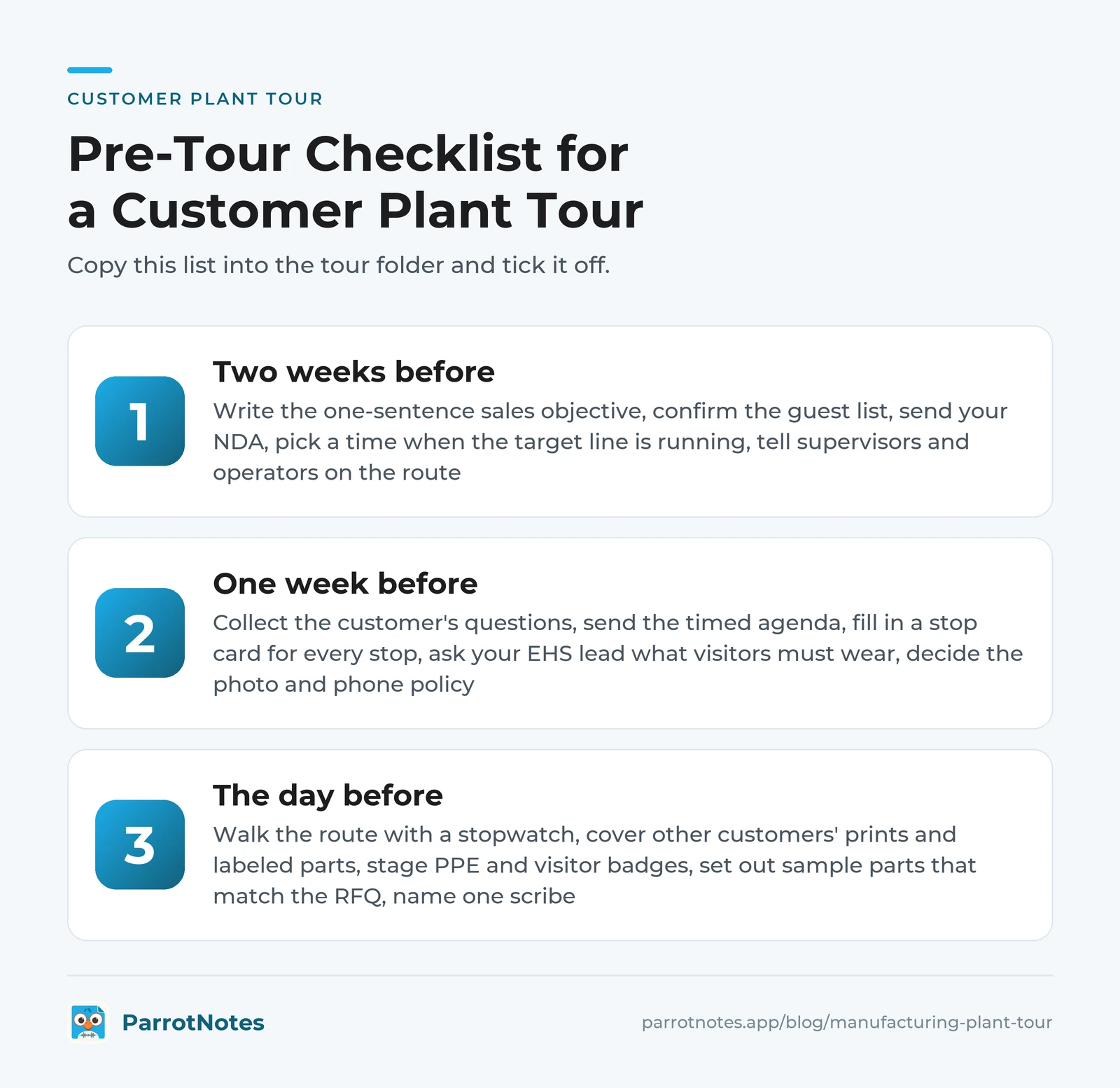
Pre-tour checklist
Copy this list into the tour folder and tick it off.
Two weeks before
- Write the one-sentence sales objective and share it with the plant manager
- Confirm the guest list with names, titles, employers and citizenship if your plant handles export-controlled work
- Send your NDA if one isn't already signed
- Pick a date and time when the target line is running
- Tell supervisors and operators on the route, and ask who's willing to speak
One week before
- Collect the customer's questions and send them to each stop owner
- Draft the timed agenda and send it to the customer
- Fill in a stop card for every stop
- Ask your EHS lead what visitors must wear and what briefing they need
- Decide the photo and phone policy and put it in the confirmation email
The day before
- Walk the route at the scheduled time with a stopwatch
- Cover or remove other customers' prints, travelers and labeled parts
- Stage PPE in the right sizes, visitor badges and any tour headsets
- Set out sample parts that match the customer's RFQ
- Name one scribe whose only job is to log questions and promises
Build the plant tour route and a timed agenda
Follow the production sequence, from receiving to shipping. Buyers are coached to expect that order, and it lets the story of a part tell itself. Cut any stop that doesn't serve the objective. Five stops you can explain well beat nine you rush.
Keep the group small. Hale Foote, president of Scandic Springs, writes in an Association of Manufacturers Bay Area article on conducting factory tours that four to six visitors per team is the maximum workable size in his plant. If eight people are coming, split them into two groups with two guides and two scribes.
Here's a 2.5-hour agenda you can adapt. Send the customer a version without the "owner" column.
| Time | Block | Owner | What happens |
|---|---|---|---|
| 9:00 | Welcome, 15 min | Account owner | Introductions, the customer's goals for the day, agenda |
| 9:15 | Safety and rules, 10 min | EHS lead | PPE, walkways, photo and phone policy |
| 9:25 | Company and capability, 15 min | Account owner | Short story of the plant, parts like theirs, sample parts |
| 9:40 | Floor tour, 60 min | Guide plus stop owners | Five stops at about 10 minutes each, plus walking time |
| 10:40 | Break, 10 min | Everyone | PPE off, coffee, scribe checks the log |
| 10:50 | Wrap-up meeting, 30 min | Account owner | Answer parked questions, confirm specs, agree next steps |
| 11:20 | Close, 10 min | Account owner | Recap who owes what by when, walk guests out |
| 11:45 | Internal debrief, 15 min | Host team | Dictate the debrief while it's fresh |
Two details make this agenda work. The wrap-up meeting happens in a quiet room, so that's where decisions get made. And the internal debrief is on the agenda with a time, so it can't get skipped when everyone rushes back to their desks.
Decide who speaks at each stop
The account owner hosts the day, but shouldn't narrate every machine. Visitors trust the person who runs the process. Let the quality lead explain the CMM room and the cell lead explain the changeover.
What you do need to control is what gets promised.
Picture Marcus, a sales engineer at a fictional injection molder. At the tool room, the customer's design engineer asks if a family mold could cut piece price by 15%. The toolmaker's honest answer is "maybe".
Instead of letting "maybe" turn into "yes" in the customer's notes, Marcus says, "Good question. Let's park that one, and I'll bring the answer to the wrap-up." The scribe logs it. At 10:50 the tooling manager joins the meeting with a real answer and two conditions attached.
Give every stop owner a card like this one, and keep copies on the scribe's clipboard.
Stop card
- Stop and time: Stop 3, press brake cell, 10:00 to 10:10
- Speaker: Cell lead, with the account owner beside them
- One message: We hold tight bend tolerances on parts like yours, and here's how we check them
- Proof to show: First-piece inspection sheet, a sample bracket, the angle gauge
- Questions they'll likely ask: Tolerance on flange length, changeover time, scrap rate on this family
- Don't promise here: Price, lead time or any tolerance tighter than the current print
- If you don't know: "Let's park that for the wrap-up." The scribe logs it
The "one message" line matters most. A visitor remembers one thing per stop. Decide what it is before they arrive.
Safety, NDA and photo rules for a manufacturing plant tour
Settle these three before the visitors reach the parking lot, and put all of them in the confirmation email so nobody is surprised at the door.
Safety and noise
Follow your plant's own EHS rules for visitors, and ask your EHS lead to give the briefing. They'll know which PPE the route requires, where visitors can stand, and what footwear to request in the invitation.
Noise shapes the whole tour. OSHA's occupational noise standard, 29 CFR 1910.95, requires employers to run a hearing conservation program when employee exposure reaches an 8-hour average of 85 decibels. NIOSH notes that sounds at 85 dBA often require you to raise your voice to be heard by someone 3 feet away.
In practice, a group of six strung out behind a guide will miss half of what's said beside a running press. That's why tour headsets exist, and why the stop card has a "don't promise here" line. Detailed conversations belong in the wrap-up room.
NDAs, photos and phones
Your customer's NDA protects their drawings. You also owe confidentiality to every other customer whose parts are on the floor. Hale Foote's advice in the AMBayArea article is simple: keep prints and specs covered, and if a sensitive part or process is running, shut it down before visitors arrive.
Decide the photo policy in advance. One workable approach is no photos on the floor, with the host offering to send approved pictures afterward. Whatever you choose, apply the same rule to your own team. If visitors can't record on the floor, you shouldn't either.
Export-controlled work
If your plant makes anything controlled under the EAR or ITAR, talk to your export compliance officer before you confirm the guest list. Under the Export Administration Regulations, technology is "released" through "visual or other inspection by a foreign person" of items that reveals controlled technology, and a release to a foreign person inside the United States counts as a deemed export. The ITAR's definition of a release uses similar wording for technical data.
This article isn't legal advice. The practical step is to collect visitor details early and let compliance decide the route, or whether an area gets screened off.
Capture the questions and promises made on the floor
Here's the part the other plant tour guides skip. Your route can be perfect and the deal can still stall if nobody remembers what was said at stop three.
Give one person the scribe job
The scribe isn't the host and isn't a speaker. They carry a pocket card or clipboard and log three things at every stop: questions the customer asked, specs anyone mentioned (tolerances, materials, volumes, dates), and promises anyone on your side made. One line each, with the name of the person who said it.
An inside sales rep or an applications engineer makes a good scribe. They'll be building the quote, so they have every reason to get the numbers right.
Don't record on the floor. Debrief right after it
A running plant floor is the wrong place for audio. It's loud, your phone policy may forbid it, and your NDA obligations to other customers don't pause for a tour. So don't try.
Instead, use the two quiet moments the agenda gives you.
The wrap-up meeting. Ask the room, "Do you mind if I record this part so we get your requirements right?" If everyone agrees, record the 30 minutes with ParrotNotes on your phone. You'll get a transcript, an AI summary and a list of action items, so the parked questions and their answers are on the record. If anyone says no, the scribe keeps writing.
The internal debrief. As soon as the visitors leave, get the host team into the conference room for 15 minutes. Open ParrotNotes, hit record, and talk through the scribe's log stop by stop. If you're a manufacturers' rep who brought the customer to a principal's plant, do the same thing in your car before you pull out of the lot. Recording keeps going with the screen off, so you can set the phone down and talk.
Want to try it on your next tour? Download ParrotNotes free and dictate your first debrief. The free plan includes 100 minutes of recording a month, up to 30 minutes per recording, with an AI summary on every recording.
The point of the debrief isn't a pretty document. It's that every promise gets an owner while people still remember making it. Our guide on how to never miss action items from sales calls covers the same habit for regular customer meetings.
Run the debrief and follow up within 24 hours
Use this template as your talking script. Read each heading aloud and answer it. The transcript becomes your tour record, and the action items become your to-do list.
Post-tour debrief template
- Tour basics: Customer, date, visitors and titles, host team, RFQ or program
- Objective check: What we wanted the customer to agree to, and where that stands
- Questions asked: Each question, who asked it, at which stop, and whether it was answered or parked
- Specs mentioned: Tolerances, materials, finishes, annual volumes, target dates, packaging, with the customer's exact numbers
- Promises we made: What was promised, who promised it, the owner and the due date
- Promises they made: Drawings, forecasts, samples or contacts the customer said they'd send
- Concerns and reactions: What impressed them, what worried them, anything they compared to another supplier
- Competitive and commercial notes: Other suppliers mentioned, price or lead-time targets
- Next step: The agreed next meeting or milestone, with a date
- Follow-up email points: The three to five items the customer should see in writing today
Send the follow-up within 24 hours, and the same day is better. Thank them, then list each promise from section 5 with its owner and date, and each item you're waiting on from section 6. ParrotNotes can draft that follow-up email from the recording, so you start from the actual conversation instead of a blank page. Edit it, check every number against the scribe's log, and send.
The payoff shows up weeks later. Salesforce reports that sales reps spend 60% of their time on non-selling tasks, and rebuilding a conversation from memory at quote time is one of the least rewarding of them. With a searchable record, you open the tour note instead.
Picture Priya, a manufacturers' rep who took a distributor's team through her principal's plant in March. In June the principal's estimator asks what finish the customer wanted on the covers. Priya searches her notes for "finish", finds the debrief, and reads back the exact spec along with who asked for it.
On ParrotNotes Pro she could ask the recording directly with AI chat: "What did we promise on lead time?" The quote goes out right the first time, and her call report to the principal takes five minutes.
If visitors are flying in from overseas, ParrotNotes Pro transcribes in 99+ languages and can translate, so a wrap-up held partly in German or Spanish still produces notes your estimator can read. Pro is $19.99 a month, or $14.99 a month billed annually, with 3,000 recording minutes a month and recordings up to 3 hours. If the wrap-up covers confidential specs, you can read about how we protect your data first.
Choosing a note tool for a whole sales team? Our comparison of the best AI note-taking apps for sales teams walks through the options.
Turn your next plant tour into a quote that matches
A manufacturing plant tour wins business when the customer leaves confident and your team leaves with a complete record. The floor builds the confidence. The record is up to you.
Here's the short version:
- Set one sales objective and build the route around it
- Send a timed agenda, and keep groups to about six people per guide
- Give every stop a speaker, one message and a "don't promise here" line
- Settle safety, NDA, photo and export-control questions before the guest list is final
- Name a scribe, park hard questions for the wrap-up, and debrief before anyone goes back to their desk
- Put every promise in writing within 24 hours
Think back to Dana and the tolerance nobody wrote down. With a scribe at the press brake and a 15-minute debrief, that promise would have had an owner by lunchtime, and the quote would have matched.
Your next customer visit is already on the calendar, or will be soon. Download ParrotNotes free, copy the run sheet above, and dictate your first post-tour debrief before the visitors' cars have left the lot.
Frequently Asked Questions
How long should a manufacturing plant tour take?
Plan on about 2.5 hours for a customer visit: 40 minutes of welcome, safety briefing and company overview, 60 minutes on the floor across five or so stops, a short break, and a 30 to 40 minute wrap-up meeting. Keep the floor portion to an hour, because the decisions happen in the wrap-up room anyway.
Who should lead a customer plant tour?
The account owner hosts the day and owns the agenda, the wrap-up and the follow-up. Process experts, such as the cell lead or quality manager, speak at their own stops because visitors trust the people who run the work. One named scribe logs questions, specs and promises so the host can focus on the customer.
Can I record a plant tour on my phone?
Follow your plant's phone and photo policy, which may forbid recording on the floor, and remember your confidentiality duties to other customers. Floor noise makes audio hard to use in any case. A better approach is to record the sit-down wrap-up meeting with everyone's permission, then dictate an internal debrief as soon as the visitors leave.
What should the follow-up email after a plant tour include?
Send it within 24 hours. Thank the visitors, then list every promise your team made with an owner and a due date, the answers to any questions you parked, the items the customer agreed to send you, and the agreed next step with a date. Keep it to one screen so it gets read.
Related Posts
Stakeholder Mapping for Complex Sales: Template and Example
Stakeholder mapping for complex sales: a fill-in template, a worked example, and 24 questions that reveal who decides. Copy the template and map your deal.
Sales Tools Every Field Rep Should Carry in 2026
Too many apps and no time between visits? See the sales tools a field rep should carry in 2026, run the four-question carry test, and print the checklist.
Sales Coaching Software: What to Look For
Buying sales coaching software for a field team? Use these 8 criteria, a 100-point scorecard, and 15 demo questions to choose a tool your reps will use.