
What Is Revenue Operations (RevOps)? What the Team Owns

Sarah Johnson
Writes about field sales, meeting notes and voice-first workflows at ParrotNotes. Every article is reviewed by the ParrotNotes product team before it goes live.

Table of Contents
- 1.What is revenue operations?
- 2.What the revenue operations team owns
- 3.Revenue operations vs sales ops, enablement, and deal desk
- 4.Who works on a revenue operations team
- 5.Who does revenue operations report to?
- 6.Do you need revenue operations yet?
- 7.A one-page revenue operations charter to copy
- 8.The revenue operations blind spot on field teams
- 9.Start with one definition
Nina runs sales at a packaging distributor. At Monday's forecast meeting, marketing reports 240 qualified leads, her reps say 60 were worth calling, and finance brings a revenue number that doesn't match her CRM dashboard. Everyone's working from real data. Nobody's working from the same data. (Nina is a composite, not a real person.)
If you lead a sales team, you've sat in that meeting. It usually gets blamed on people. More often, nobody owns the plumbing between the teams.
Revenue operations is the job of owning that plumbing. This guide explains what revenue operations is, what the team owns and doesn't own, where it reports, and how many people it takes. You'll also get two things the vendor guides leave out: a map that splits each job between RevOps and the sales leader, and a one-page charter you can copy today.
What is revenue operations?
Revenue operations (RevOps) is the function that runs the data, processes, and tools behind sales, marketing, and customer success as one system, so every team works from the same numbers and nothing gets dropped between them.
HubSpot's guide to revenue operations calls it "the business function that aligns sales, marketing, and customer success around shared data, processes, and goals." Forrester adds the partner ecosystem to that list and makes a sharper point: revenue operations is "a commercial execution strategy, not an organizational structure."
That second point matters if you're running a small team. You can practice RevOps without a department. In the Openprise 2024 State of RevOps Survey (152 operations professionals, as reported by CustomerThink), 35% said their company had a formal RevOps department, and 32.5% had a working RevOps team without one.
One search trap: "revenue from operations" is something else. That's an accounting line for the money a company earns from its core business, and it has nothing to do with this team.
Most of what RevOps reports comes from what reps capture. If your reps sell face to face, try ParrotNotes free on one customer visit and see how much more detail reaches the CRM.
What the revenue operations team owns
The work falls into four groups. HubSpot's version of these pillars is operations, enablement, insights, and tools. Here's what they mean on a normal week:
- Process: lead routing, pipeline stage definitions, handoffs between teams, deal approvals
- Data: shared definitions, CRM quality, one version of each number
- Tools: choosing, connecting, and running the sales and marketing software
- Insight: reporting, the forecast process, and the models behind territories and quotas
Survey data backs this up. In the Revenue Operations Alliance's State of Revenue Operations Report 2023, as summarized in the same CustomerThink round-up, the most common responsibilities were metrics and KPIs (89%), pipeline strategy (81.7%), tech stack management (79.3%), and go-to-market strategy (78%).
And the scope is wide. In the Openprise survey, 89% of revenue operations respondents said their team supported marketing, sales, and customer success.
The RevOps ownership map
Lists like that don't settle the argument you'll actually have, which is "whose job is this?" So here's the rule we'd use: RevOps owns the system. The sales leader owns the decision.
This split is our own suggestion, built from the responsibilities above. There's no industry standard, so change any row that doesn't fit your company.
| Job | RevOps owns | Sales leader owns | Also involved |
|---|---|---|---|
| Forecast | The process, the roll-up, the accuracy report | The number you commit to the CEO | Finance |
| Pipeline stages | Written definitions and CRM fields | Holding reps to them in reviews | Marketing, customer success |
| Lead routing | The rules and the response-time report | Which reps sell to which segments | Marketing |
| Territories | The model: accounts, potential, drive time | Who gets what, and telling them | Finance |
| Quotas | Capacity model and scenarios | The final call on each rep's number | Finance, CEO |
| Comp plan | Modeling costs, accurate payout data | Recommending the plan, explaining it to reps | Finance, HR |
| CRM | Admin, fields, data quality | CRM adoption: running your own meetings from it | IT |
| Tech stack | Evaluation, integration, renewals | Saying what reps need | IT, finance |
| Discount approvals | The deal desk process and approval matrix | Exceptions at the top of the matrix | Finance, legal |
| Sales-to-delivery handoff | The handover template and its trigger | Making sure reps fill it in | Customer success |
| Enablement | Tracking, content library, onboarding logistics | What gets taught, and the coaching | Marketing |
| Reporting | One dashboard, one definition per metric | Deciding what to do about the numbers | Every revenue team |
Read down the middle column and you'll see a pattern: every row is something that keeps working when you're on vacation. Read the next column, and every row needs a person who can be held to a result.
What RevOps doesn't own
Some things stay with the line manager, however good your RevOps hire is:
- Coaching: RevOps can show that a rep's deals stall at proposal. Only a manager can sit down and work out why.
- Deal strategy: which stakeholder to reach next is a selling call.
- Hiring and firing reps: RevOps can model capacity, not judge people.
- The target: RevOps can tell you that the number looks wrong, but you still own hitting it.
Watch for two failure modes. If RevOps only ever takes tickets ("add this field," "pull this report"), it turns into expensive CRM admin. If it starts dictating how reps sell without carrying any number, your reps will route around it.
Revenue operations vs sales ops, enablement, and deal desk
These titles overlap, and companies use them loosely. Here's the usual difference:
| Function | Focus | Serves |
|---|---|---|
| Revenue operations | Data, process, and tools across the whole revenue path | Sales, marketing, customer success |
| Sales operations | The same work, inside sales only | Sales |
| Marketing operations | Campaign systems, lead scoring, attribution | Marketing |
| Sales enablement | Content, training, and coaching support for sellers | Reps and managers |
| Deal desk | Reviewing and approving non-standard deals | Sales, finance, legal |
So RevOps isn't a new name for sales ops. Sales ops can make the sales process run very well and still hand marketing and customer success a number they don't recognize. RevOps exists to fix that gap, which is why sales ops, marketing ops, and customer success ops often move under it as a company grows.
Who works on a revenue operations team
The job titles you'll see, roughly from junior to senior:
- Revenue operations analyst: builds reports, checks data, answers "why did this number move?"
- Systems administrator: runs the CRM and connected tools
- Deal desk analyst: handles non-standard quotes, at larger companies
- Revenue operations manager: often the first hire, covering a bit of everything
- Director or VP of revenue operations: sets the agenda and works directly with the CRO, CFO, and CEO
Most teams are small. In the Revenue Operations Alliance's 2023 report, 41.4% of respondents had a team of two to four people, and 22% said they were the only person doing the work. Four in ten (40.2%) had no dedicated budget.
For a staffing benchmark, a16z's RevOps cheat sheet (February 2025) gives these ranges by number of account executives (AEs):
| Stage | AEs | RevOps headcount |
|---|---|---|
| Early stage | 0-10 | 2-3 |
| Scale-up | 11-25 | 3-5 |
| Acceleration | 26-50 | 6-7 |
| Expansion | 51-150 | 10-15 |
Treat those as a ceiling, not a target. It's a venture investor's view, the article doesn't name a data source, and the authors say that no two businesses are the same. A nine-rep distributor doesn't need three RevOps people. It might need half of one.
Who does revenue operations report to?
There's no settled answer, and the data shows it.
| Source | Sample | What it found |
|---|---|---|
| Openprise, 2024 | Revenue operations respondents (40% of 152) | 41% report to the CRO, 21% to the CFO, 10% to the COO |
| Revenue Operations Alliance, 2023 | Not stated in the round-up | 30.4% report to the CRO, 25.6% to the CEO |
| Pave, 2026 | 746 companies with RevOps staff | Operations is the top line at 40% for 501-1,000 employees; Sales (including the CRO) leads at 33% for 3,001+; Finance peaks at 20% for 51-100 |
The surveys ask different people different questions, and the Openprise figures rest on about 60 respondents, so read them as direction rather than fact. The pattern is that the reporting line moves with company size and with whether a CRO exists at all.
Here's a more useful test than copying someone's org chart: can your RevOps person tell the head of sales that a deal doesn't meet the commit definition, and have it stick? Pave makes a similar point, that the important factor is whether RevOps has enough authority to own clean data and an honest revenue story.
The structure alone won't save you. In the Openprise survey, companies with formal RevOps departments didn't report better alignment between go-to-market teams than the overall average. For how this fits around managers and territories, see our guide to sales team structure.
Do you need revenue operations yet?
You probably need someone doing this work if two or more of these sound familiar:
- Forecast meetings spend more time on whose number is right than on the deals.
- Reps or managers keep side spreadsheets because they don't trust the CRM.
- Leads or won deals sit unclaimed between two teams.
- A software renewal arrives and nobody can say who uses it.
- Changing a commission plan or territory takes weeks of manual spreadsheet work.
Needing the work isn't the same as needing a hire. In our view, a team under about 10 reps rarely needs a full-time RevOps person. It needs a name next to each job.
No RevOps team? Split the jobs by name
| Job | Who takes it | Rough time per week |
|---|---|---|
| Write and keep the definitions (lead, stage, commit) | Sales manager | 30 minutes |
| CRM admin and data checks | Sales coordinator or the most organized rep | 2 hours |
| Weekly report on one page | Finance or office manager | 1 hour |
| Discount approvals | Sales manager, using a written matrix | As needed |
| Tool list and renewal dates | Owner or office manager | 15 minutes |
The hours are our starting estimates, so adjust them after a month.
Theo manages nine reps at an HVAC parts distributor. He wrote one page defining "qualified" and "commit," gave CRM checks to his sales coordinator, and asked finance for one weekly report. Nobody's title changed.
Within a couple of months, the Monday meeting had stopped being about the numbers and started being about the deals. (Theo is a composite, not a real person.)
If your forecast is the main pain, start with how to improve sales forecast accuracy.
A one-page revenue operations charter to copy
Most RevOps arguments are really arguments about scope. Write it down before the first hire, or use it to reset the team you've got. Fill in these eight lines:
- Purpose: "RevOps exists so sales, marketing, and customer success plan from one set of numbers."
- Teams served: list them, and name one contact in each.
- What we own: copy the "RevOps owns" column from the map above, and delete what doesn't apply.
- What we don't own: coaching, deal strategy, hiring, and the sales target.
- Shared definitions: lead, qualified lead, opportunity, each pipeline stage, commit, churn. Add one sentence each, and name who can change them.
- The numbers we report: pick five or fewer. Win rate, sales cycle length, pipeline coverage, forecast accuracy, and net revenue retention are a common start. Our sales KPIs guide covers which ones to skip.
- How to ask for work: one queue, a stated response time, and a monthly priority review with the sales leader.
- How changes happen: nothing changes in the CRM or the comp data without a named owner, a date, and a note to the reps it affects.
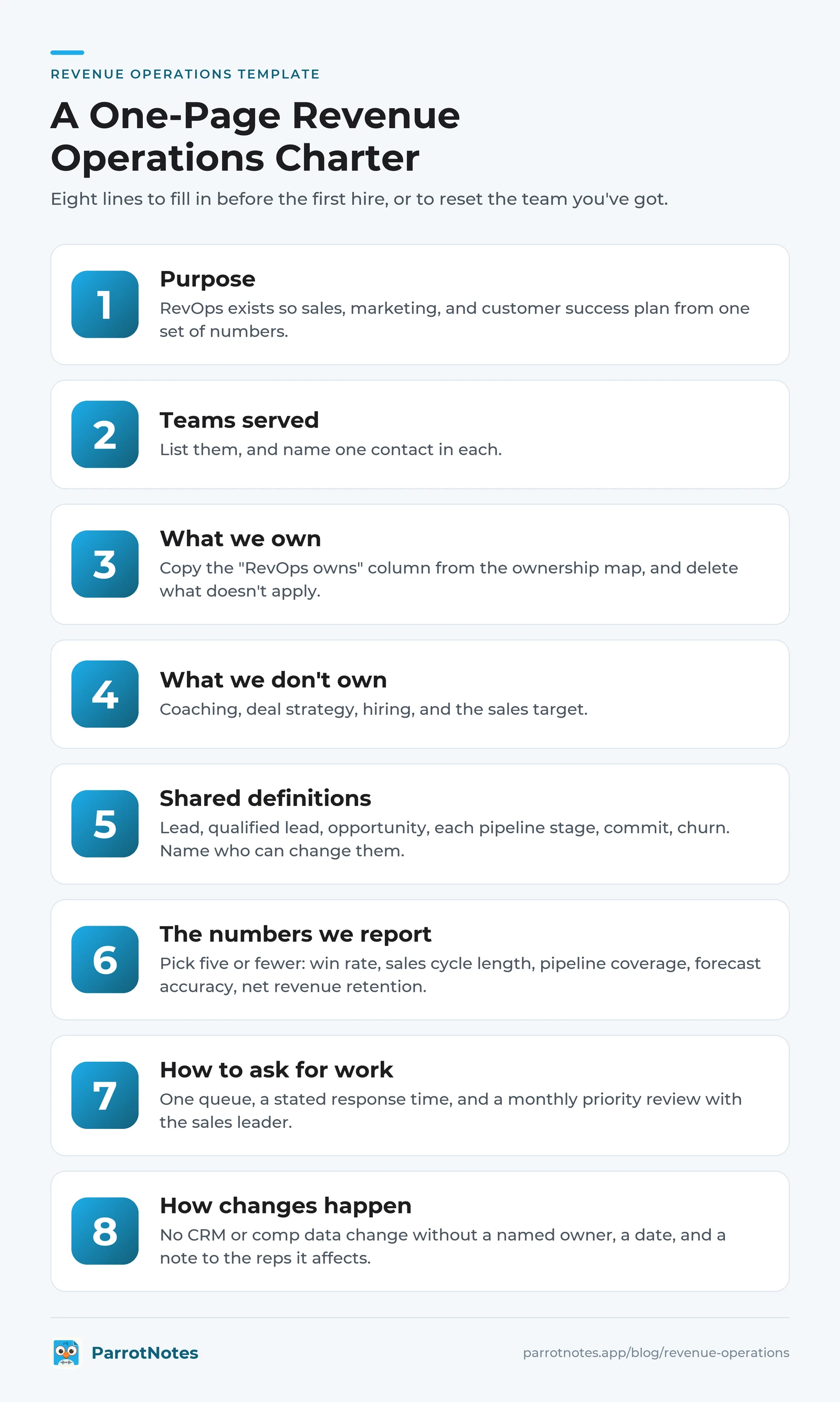
Eight lines won't align a company. They will stop the same scope fight from recurring every quarter.
The revenue operations blind spot on field teams
RevOps guides assume that deal data flows in by itself, from call software and email tracking. That's fair for an inside sales team on headsets. It's not true when the conversation happens on a factory floor.
For a field team, the CRM holds what the rep remembered in the car, typed up on Friday. Your RevOps reports are only as good as that.
Rosa sells industrial coatings. She lost a large account and logged the reason as "price," which is what she remembered. Her win-loss review went back to the transcript of the final meeting, recorded with the buyer's okay.
The buyer had said the price was workable. The delivery window was the problem. Logged as "price," that deal would have told the team to discount. Read correctly, it pointed at lead times. (Rosa is a composite, not a real person.)
That's where ParrotNotes fits. It records in-person conversations on the phone you already carry, with no bot joining, then gives you a transcript and an AI summary with action items. Your rep copies the facts into the CRM from the summary, so what reaches RevOps is what the buyer said. It works in 99+ languages on iOS, Android, and macOS.
As of November 2026, the Free plan includes 100 minutes of recording a month, a summary on every recording, and 5 AI-powered recordings. Pro is $19.99/month, or $14.99/month billed annually, with 3,000 minutes a month. Get ParrotNotes free and give your CRM something better than Friday's memory.
Start with one definition
Revenue operations sounds like an org chart decision. Mostly it's a series of small agreements about who owns what.
So here's where to start:
- Use the rule: RevOps owns the system, and the sales leader owns the decision.
- Mark up the ownership map with your own names, even if you don't have a RevOps team.
- Fill in the charter, starting with one definition your team argues about most.
- Fix what goes into the CRM before you buy anything to report on it.
Pick "commit" or "qualified" this week and write one sentence that everyone signs off on. Your next Monday meeting will be shorter. Then download ParrotNotes free so the numbers behind that definition start with what customers really said.
Frequently Asked Questions
What does a revenue operations team do?
A revenue operations team runs the data, processes, and tools behind sales, marketing, and customer success. Typical work includes CRM administration, pipeline stage definitions, lead routing, the forecast process, territory and quota models, reporting, and handoffs between teams.
What is the difference between RevOps and sales ops?
Sales operations does similar work inside the sales team only. RevOps covers the whole revenue path across sales, marketing, and customer success, so all three work from one set of definitions and numbers. Sales ops often moves under RevOps as a company grows.
Who does revenue operations report to?
There is no single standard. In the Openprise 2024 survey, 41% of revenue operations respondents reported to the CRO, 21% to the CFO, and 10% to the COO. Pave's data on 746 companies shows the line shifting with size, with Operations most common at 501-1,000 employees and Sales at 3,001 or more.
How big should a RevOps team be?
Most are small. In the Revenue Operations Alliance's 2023 report, 41.4% of respondents had a team of two to four, and 22% worked alone. Teams under about 10 reps can usually split the jobs among named people and skip a full-time hire.
Is revenue operations the same as revenue from operations?
No. Revenue operations is a team or function that runs sales, marketing, and customer success systems. Revenue from operations is an accounting line for the money a company earns from its core business.
Related Posts

What Is a Byline? Meaning, Examples and Who Gets One
The meaning of byline explained with examples: byline vs dateline, who gets one under AP and NPR rules, plus a freelancer credit email to copy. Learn more.
SDR vs BDR: What Each Role Does and Why Companies Mix Them Up
SDR vs BDR compared: what each role does, the pay employers state and why titles get mixed up, from 154 live job ads. Try ParrotNotes free for hand-off notes.

Sales Email Subject Lines: Examples by Situation and What to Avoid
Sales email subject lines for every situation: 40 short examples, what to avoid, and a five-question check. Build yours from your meeting notes. Try it free.