
Preconstruction Meeting: Agenda, Checklist and Who Attends

Sarah Johnson
Writes about field sales, meeting notes and voice-first workflows at ParrotNotes. Every article is reviewed by the ParrotNotes product team before it goes live.

Table of Contents
- 1.What is a preconstruction meeting?
- 2.Is a preconstruction meeting required? What six rulebooks say
- 3.Who attends a preconstruction meeting
- 4.Preconstruction meeting agenda (copy and adapt)
- 5.Preconstruction meeting checklist
- 6.If you're the sub or supplier rep: what to bring
- 7.Sample minutes from a preconstruction meeting
- 8.Make the first meeting count
Tanya sells storefront glazing, and she skipped the preconstruction meeting on a school addition because "it's the GC's meeting." Eleven weeks later, the superintendent called to ask where her frames were.
Her submittal hadn't gone in. The factory quoted 12 weeks. The opening was due to close in five. (Tanya is an illustration, not a real person.)
One sentence in that meeting would've caught it: "Here's my lead time, so here's the date my submittal has to go in."
You probably know a preconstruction meeting matters. The hard part is knowing who has to be there, what to cover, and what your contract requires. This guide gives you the definition, what six real rulebooks say, a timed agenda to copy, a checklist, and a back-schedule for subs and suppliers. If you're the one who loses details between the jobsite and the truck, try ParrotNotes free and talk your notes straight after the meeting.
What is a preconstruction meeting?
A preconstruction meeting (or "precon") is a meeting held after the contract is awarded and before work starts on site, where the owner, contractor, design team, subcontractors, and other affected parties settle who has authority, how work will be sequenced, and how paperwork will move.
Two terms get confused with it:
- Pre-bid meeting: held before the price is set, so bidders can ask questions.
- Preconstruction services: paid design-phase work, such as estimating and constructability review. It's a phase, not a meeting.
The purpose is practical. The Texas Department of Transportation (TxDOT) says the meeting sets lines of authority and communication, assigns responsibilities, and flags sources of misunderstanding.
Is a preconstruction meeting required? What six rulebooks say
It depends on your contract. Most guides skip this part, so here's what we found in six published documents, read in November 2026:
| Source | Who runs it | When | Rule worth knowing |
|---|---|---|---|
| TxDOT manual | Contractor schedules; Area Engineer conducts | After award and execution, before operations start | Failing to schedule and attend is not grounds for delaying working day charges |
| WisDOT CMM 226 | Region arranges; engineer leads | Early, after award and execution | Erosion control plan due at least 14 days before |
| SDDOT manual, Ch. 12 | Contractor leads; Area Office ensures minutes | Preferably more than 2 weeks before work starts | Can be held in person, virtually, or by phone |
| FAR 52.236-26 (federal) | Contracting officer | Before construction starts at the site | Optional for the government, but the contractor must attend if one is called |
| City of Philadelphia form P_057_F (marked draft) | Not stated on the form | Not stated on the form | If key parties are absent, the meeting must be rescheduled |
| Mortenson general conditions (subcontract exhibit in a published RFP) | Held with the construction manager | Before work on site | Subcontractor's PM, superintendent, and all foremen must attend |
Two things stand out. First, the leader changes: WisDOT's engineer leads, while South Dakota's contractor leads.
Second, on private work the requirement usually lives in the subcontract or the general conditions, not in a public manual. So read your own documents before you assume you can send a junior person, or skip it. This is general information, not contract or legal advice.
Who attends a preconstruction meeting
The list grows with risk. A tenant fit-out might need a handful of people, while a state highway job also needs police and utilities.
| Who | Why they're in the room | Attendance |
|---|---|---|
| Owner or owner's rep | Decisions, access, payment | Core |
| GC project manager and superintendent | Schedule, logistics, site rules | Core |
| Architect and engineer | Submittal and RFI review, field visits | Core |
| Subcontractor PMs and foremen | Sequence, scope gaps, crew rules | Core for early trades; others as the contract says |
| Material suppliers and product reps | Lead times, deliveries, submittals | When invited (TxDOT lists them) |
| Safety manager | Site safety plan, emergencies | Core on most commercial work |
| Special inspection agency, building inspector | Required inspections | Philadelphia's form makes them mandatory |
| Utilities and railroads | Relocations, shutoffs, crossings | When the work touches them |
| Fire, police, local government | Traffic, closures, emergency access | Public work, as required |
Whoever comes needs authority to commit. A 2006 National Park Service sample stresses this: only the contracting officer "may approve changes to the contract drawings and/or specification, issue Change Orders." Everyone left that meeting knowing whose word counted.
Preconstruction meeting agenda (copy and adapt)
There's no standard format, so this is our suggested 90-minute agenda for a mid-size commercial job. The timings are a starting point. Utilities go early because WisDOT's own guide excuses utilities and railroads once their part is done, and it's a fair way to treat anyone billing by the hour.
| Time | Topic | What to settle |
|---|---|---|
| 0:00 | Sign-in and introductions | Name, company, role, phone, email |
| 0:05 | Authority | Who approves changes, signs pay applications, can stop work |
| 0:15 | Utilities and outside parties | Relocations, shutoffs, inspections, contacts. Then release them |
| 0:25 | Scope and documents | Current drawing set, addenda, exclusions, gaps between trades |
| 0:35 | Schedule | Start date, milestones, work hours, long-lead items, look-ahead format |
| 0:45 | Submittals and RFIs | Who stamps, review time, log format, response dates |
| 0:55 | Money and changes | Pay application date, schedule of values, change order steps, retainage |
| 1:05 | Site logistics | Access, laydown, deliveries, parking, dust, and erosion control |
| 1:15 | Safety | Site safety plan, orientation, emergency route, incident reporting |
| 1:25 | Recap | Open items with an owner and a date; next meeting; closeout expectations |
Track what comes out of it in one place. Our free submittal log template tracks submittals by spec section, the RFI template covers the questions, and the change order template records added work. If you're unsure about the first of those, read what a submittal is. Mention closeout too: the punch list process is easier when everyone hears it on day one.
Public-work add-ons. TxDOT's Form 2796 also covers traffic control plans, DBE participation, prevailing wage and payroll, Buy America, and stormwater. WisDOT runs a separate wage and labor compliance meeting straight after the main one, which keeps the crowd from sitting through it.
Preconstruction meeting checklist
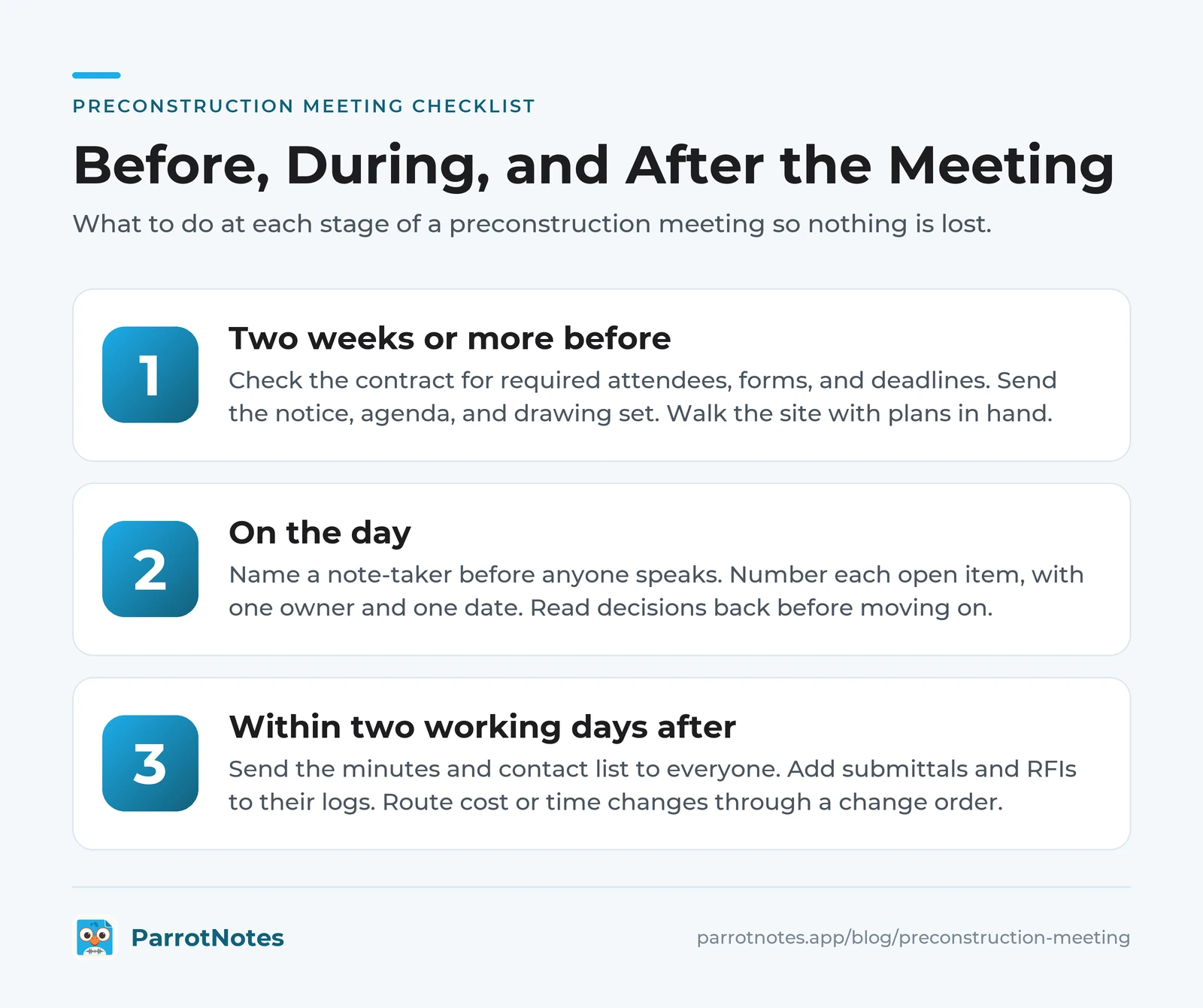
Two weeks or more before
- Check the contract for required attendees, forms, and deadlines
- Send the notice, agenda, and drawing set
- Collect the construction schedule, submittal list, sub list, and insurance certificates
- Walk the site with plans in hand (WisDOT encourages this)
On the day
- Pass round a sign-in sheet with phone and email
- Name a note-taker before anyone speaks
- Number each open item, with one owner and one date
- Read decisions back before moving on
Within two working days after
- Send the minutes and contact list to everyone, and to anyone who missed it
- Add submittals and RFIs to their logs
- Confirm any decision that changes cost or time in writing, and route it through a change order
The contractor's schedule should exist by the meeting. On jobs using the AIA A201 general conditions, it's due "promptly after being awarded the Contract."
If you're the sub or supplier rep: what to bring
This meeting is a sales call in hard hats. You get every decision-maker on the job in one room, and you can prevent the phone call Tanya got.
Bring a one-page sheet with your submittal list, your lead times, your delivery needs, and your backup contact. Then work backward from the install date. Here's the math for a fictional job, using a 14-day review period as a placeholder. Use your supplier's real lead time and your contract's real review time.
| Step | Time before next step | Date |
|---|---|---|
| Install starts | Mon, June 7, 2027 | |
| Delivery to site | 1 week | Mon, May 31 |
| Release to factory | 12 weeks | Mon, Mar 8 |
| Approved submittal back | Same day | Mon, Mar 8 |
| Submit for review (two 14-day rounds) | 4 weeks | Mon, Feb 8 |
| Start building the package | 1 week | Mon, Feb 1 |
Say "our package has to go in by February 8 to hit June 7" out loud, and get it in the minutes. Then it's a shared date, not your private worry.
Ask these before you leave:
- Who stamps submittals at the GC, and how long do they hold them?
- Who can accept a substitution?
- Where do deliveries go, and who signs for them?
- What are the receiving hours, and is there a forklift on site?
- Who gets told when the schedule moves?
Then get it on record. Omar, a fictional fastener rep, used to scribble this on a spec sheet. Now he records a three-minute recap in his truck, and his follow-up email to the PM goes out before the next stop. Download ParrotNotes to do the same from the phone you carry.
Sample minutes from a preconstruction meeting
WisDOT's written record has to include attendees, topics, plans, problems discussed, and decisions made. Here's a short filled sample for a fictional library addition, using the meeting.item numbering from our construction meeting minutes template:
| Item | Decision or open item | Owner | Due | Status |
|---|---|---|---|---|
| 1.01 | Only owner's rep R. Patel approves changes to contract sum or time | Patel | n/a | Closed |
| 1.02 | Work hours 7 a.m. to 4 p.m.; no deliveries before 7 a.m. | Super | n/a | Closed |
| 1.03 | Gas shutoff date to be confirmed with the utility | GC PM | Jan 15 | Open |
| 1.04 | Glazing package due by Feb 8 to hold June 7 install | Glazing rep | Feb 8 | Open |
| 1.05 | Architect to confirm review time for structural steel | Architect | Jan 12 | Open |
Record it instead of typing it
Typing and running a meeting at once is how item 1.04 goes missing. Ask the room first, including anyone on the phone: federal law allows recording a conversation you're part of, but some states need everyone's consent. See our guide to one-party consent states; it isn't legal advice.
With everyone's OK, put your phone on the table and press record in ParrotNotes. You get a transcript, an AI summary, and action items you can turn into numbered minutes. Pro identifies speakers and handles up to 3 hours per recording. The free plan's recordings stop at 30 minutes, so on Free, record a recap straight after the meeting instead.
Make the first meeting count
A good preconstruction meeting does four things:
- Names who can decide what
- Puts long-lead dates on the record
- Sets one route for submittals, RFIs, and changes
- Ends with numbered items that each have an owner and a date
Copy the agenda, check it against your contract, and send it two weeks ahead. If you're a sub or a rep, take the back-schedule along. Try ParrotNotes free, and capture your next precon before the details fade.
Frequently Asked Questions
What is the purpose of a preconstruction meeting?
It gets the owner, contractor, design team, and subcontractors to agree on authority, schedule, paperwork, and site rules before work starts. It's also the best moment to surface long-lead items and scope gaps while they're cheap to fix.
Who runs a preconstruction meeting?
It varies. The GC's project manager usually runs it on private work. WisDOT's engineer leads its meetings, South Dakota's contractor leads, and a contracting officer runs federal ones. Check your contract.
When should a preconstruction meeting be held?
After the contract is awarded and before work starts on site. South Dakota's manual prefers more than two weeks before the start of work, which is a sensible target on most jobs.
Do subcontractors have to attend a preconstruction meeting?
Only if the contract or the owner says so. Mortenson's published subcontract exhibit makes it mandatory for the sub's PM, superintendent, and foremen. On federal jobs, the contracting officer's notice says whether subs need to attend.
How long should a preconstruction meeting take?
Plan on about 90 minutes for a mid-size commercial job. That's our suggestion, not a rule. Small jobs need less. Large public jobs can run longer, especially with separate labor compliance sessions.
What's the difference between a preconstruction meeting and a kickoff meeting?
People often use the terms loosely. A kickoff can mean an internal handover from estimating to the project team, while a preconstruction meeting brings the outside parties together. Check which one you've been invited to.
Related Posts

What Is a Byline? Meaning, Examples and Who Gets One
The meaning of byline explained with examples: byline vs dateline, who gets one under AP and NPR rules, plus a freelancer credit email to copy. Learn more.
SDR vs BDR: What Each Role Does and Why Companies Mix Them Up
SDR vs BDR compared: what each role does, the pay employers state and why titles get mixed up, from 154 live job ads. Try ParrotNotes free for hand-off notes.

Sales Email Subject Lines: Examples by Situation and What to Avoid
Sales email subject lines for every situation: 40 short examples, what to avoid, and a five-question check. Build yours from your meeting notes. Try it free.