
What Is a Nut Graf? How to Write One, With Examples

Sarah Johnson
Writes about field sales, meeting notes and voice-first workflows at ParrotNotes. Every article is reviewed by the ParrotNotes product team before it goes live.

Table of Contents
Leah's opening scene is good. A school bus driver scrapes ice off a windshield at 5:40 a.m. while her phone buzzes with a route change. Her editor reads four paragraphs, then types one line back: "Great scene. What's the story?" (Leah is a composite, not a real reporter.)
That question is the reason the nut graf exists. You already know a strong opening pulls readers in. The nut graf is the paragraph that tells them why they should stay.
Below: where it goes, the four questions it has to answer and five steps to write one. You'll also see examples for four kinds of stories, one draft rewritten three times, and the mistakes editors flag most.
If your stories start with interviews, try ParrotNotes free. It records on your phone and gives you a transcript, so the fact you need is a search away.
What is a nut graf?
A nut graf is the paragraph that tells readers what a story is about and why it matters, usually right after the lede. "Graf" is newsroom shorthand for paragraph. You'll also see it spelled "nut graph" or called a theme paragraph, a "so what" graf or a context paragraph.
Chip Scanlan puts it simply at Poynter: it "tells the reader what the writer is up to; it delivers a promise of the story's content and message." Like a nut, the paragraph holds the kernel, the story's essential theme.
The form is tied to The Wall Street Journal. Scanlan traces it to Barney Kilgore, who as the Journal's managing editor in 1941 banned "today" and "yesterday" from leads and steered stories toward trends. Those stories opened with a person or a scene, so they needed a paragraph that turned the anecdote into news. Jack Hart, writing at Nieman Storyboard, calls it the concoction "perfected by the Journal to follow an anecdotal lede and precede the body of a story."
Where it goes in a story
It sits right after the lede, high in the story. How high depends on the kind of story.
| Story type | Lede | Where the nut graf goes |
|---|---|---|
| Feature or profile | A scene, a person or a moment | After the scene, usually paragraph 2 to 5 |
| News feature or trend story | A short anecdote | Paragraph 2 or 3 |
| Hard news | A summary lede with the main fact | Often merged into the lede, or a "why it matters" line in paragraph 2 |
| Explainer or service piece | A question or a problem | Paragraph 2, as the promise of what the reader will learn |
In hard news, the summary lede already says what happened, so the job shrinks to context: why this matters and to whom. That's the order the inverted pyramid uses. Our guide on how to write a news story shows that "why it matters" paragraph in a full example.
A simple test: a reader who quits after that paragraph should still know what the story is and why it was written.
What a nut graf must answer
Scanlan lists the jobs: it justifies the story by telling readers why they should care, it moves from the lead into the rest of the story, it often says why the story is timely, and it often includes supporting material that shows why the story is important.
Turn those jobs into four questions and check every draft against them:
- What is this story about? One clear idea, in plain words.
- Why should I care? Who it affects and how.
- Why now? The news peg: a vote, a number, a deadline, a change.
- What's the proof? One fact or figure that shows the trend is real.
A paragraph that answers all four works. Miss one, and the reader feels it, usually as the urge to stop.
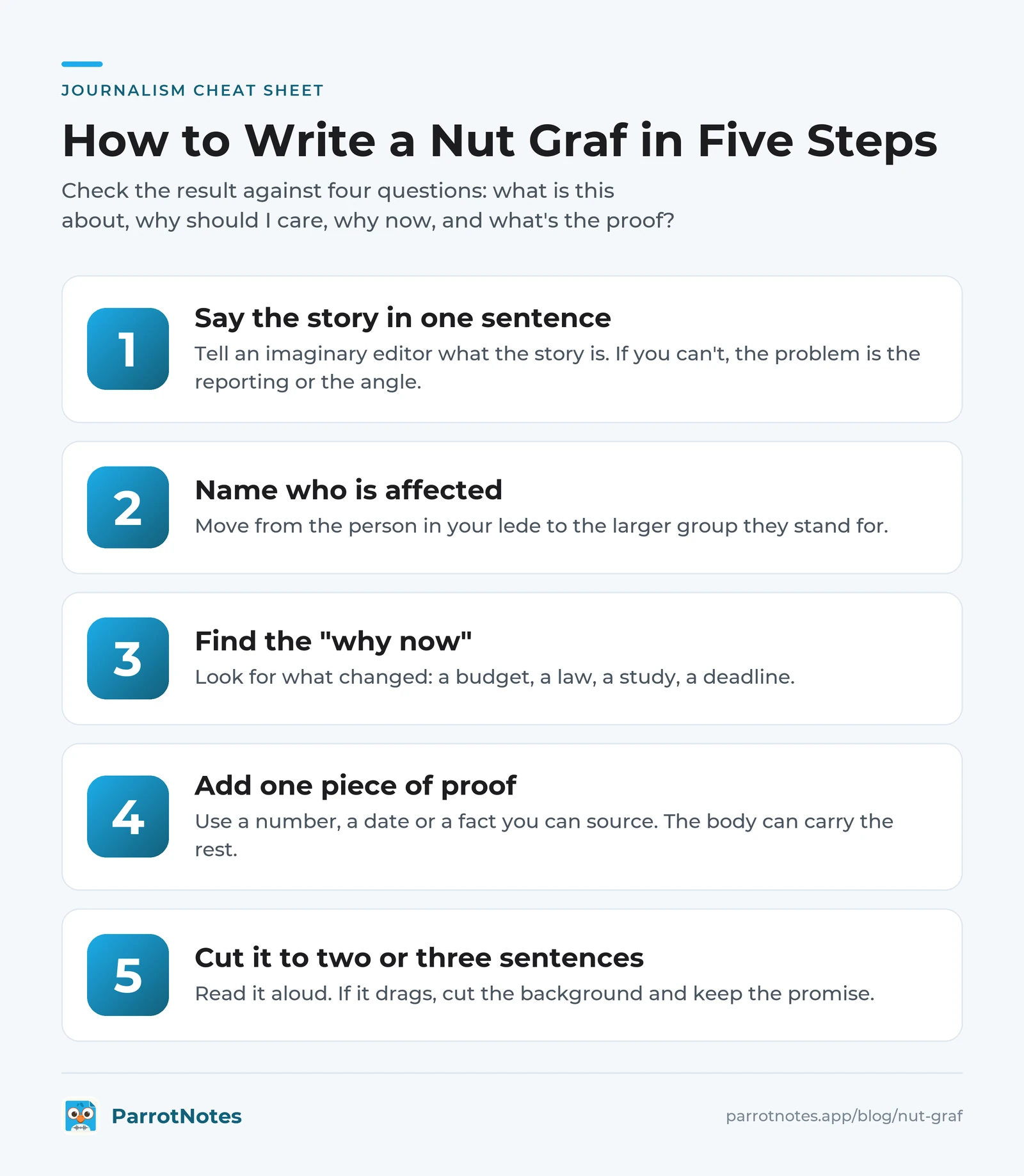
How to write a nut graf in five steps
1. Say the story out loud in one sentence
Tell an imaginary editor what the story is in a single sentence. If you can't, the problem is the reporting or the angle, not the paragraph.
2. Name who is affected
Move from the person in your lede to the larger group they stand for. One bus driver becomes every driver in the district. One bakery becomes the last four bakeries on the street.
3. Find the "why now"
Look for what changed: a budget, a law, a study, a deadline. If nothing changed, say why it still matters this week.
4. Add one piece of proof
Use a number, a date or a fact you can source. Keep it to one or two. The body can carry the rest.
5. Cut it to two or three sentences
Scanlan warns that in a news story they "shouldn't be longer than two or three paragraphs," and many editors want far less. Read it aloud. If it drags, cut the background and keep the promise.
A fill-in formula to start from, then rewrite in your own words:
[The person or scene in the lede] is one of [the larger group]. [What is changing, with one number or fact], [because of / since / after the news peg]. [What that means for readers, or the question the story will answer].
Nut graf examples
The examples below are illustrations written for this article. The people, places and numbers are fictional, and none of them quote a real publication.
Profile. Lede: a retired welder teaches teenagers in his garage on Saturday mornings.
Illustration: Ray Okafor is one of a dozen retired tradespeople the county's new apprenticeship program pays to teach. With 300 skilled jobs open at local plants and the program's first class graduating in June, the county is betting that the fastest way to train welders is to hand the job back to the people who did it.
Trend story. Lede: a couple buys a 1970s camper because it's cheaper than rent.
Illustration: The Morenos aren't alone. Two of the three RV parks near Millbrook have added year-round lots since spring, and both have waiting lists. As rents in the county climb, more working families are choosing a camper over an apartment, and the parks were never built for it.
Local government. Lede: a parent waits 40 minutes at a crosswalk meeting that ends without a vote.
Illustration: The vote she came for was delayed for the third time. The city's plan to add crossing guards at six schools is now stuck until the November budget, which means another winter of dark mornings for the 2,000 children who walk those routes.
Explainer. Lede: a freelancer's first invoice is paid four months late.
Illustration: The fix for late payment usually starts before the work does. Here is what a fair freelance contract covers and what to do when a payment slips anyway.
Each one widens the frame from one person to a group, gives a reason it matters now, and ends on what the story will deliver.
For full openings with a scene, a quote and a nut graf in place, see our feature writing examples, which annotates a complete feature opening paragraph by paragraph.
One nut graf, three drafts
Back to Leah and her bus driver, whom we'll call Martinez. Here's how her nut graf could develop. The scene and every detail are illustrations.
Draft 1: missing. After the windshield scene, Leah goes straight to the driver's history: 22 years on the job, two grandchildren, country radio. Four paragraphs in, the reader still doesn't know why this story is in the paper.
- About? No. Care? No. Now? No. Proof? No.
Draft 2: vague.
Illustration: Bus drivers face many challenges these days, and the job is harder than ever.
- About? Sort of. Care? No one in particular. Now? "These days" isn't a news peg. Proof? None.
Draft 3: working.
Illustration: Martinez is one of 41 drivers covering routes meant for 60. Since the district cut its driver pay bump in August, 19 drivers have quit, and the routes they left behind now start before sunrise. Parents in three neighborhoods are finding out at 5:40 a.m. whether a bus is coming at all.
- About? The driver shortage. Care? Parents and kids in three neighborhoods. Now? The August pay cut. Proof? 41 of 60, and 19 quits.
The third draft turns one woman's morning into a story about a district. That's the whole job.
Common nut graf mistakes
- Burying it. By paragraph nine, many readers have already gone.
- Writing a thesis, not a promise. "Bus drivers deserve better" is an opinion. A nut graf says what's happening and why it matters, and lets the reporting make the case.
- Leaving out "why now." Without a peg, the story reads like it could have run any year.
- Stuffing in background. Dates, history and job titles belong in the body.
- Promising what the story doesn't deliver. If the nut graf mentions three neighborhoods, the body has to report on all three.
- Over-quoting. Use your own words. Save the quote for the paragraph after.
Before you file, check:
- The nut graf comes within the first five paragraphs
- It answers what, why care, why now and what's the proof
- The number or fact in it is sourced and checked
- It's two or three sentences, with no background
- The body delivers everything it promises
Find the facts in your interview notes
The number, the date and the reason are usually in your interviews, scattered across an hour of tape. Finding them fast is the hard part.
Take Dev, a student reporter writing about a campus food pantry (a composite, not a real person). He knows the director said how many students used it this term, but not when. He searches his transcript for "students," finds the line, and plays the audio around it to check the number before it goes in.
ParrotNotes helps with that part (plans as of October 2026):
- Record on your phone: in-person interviews on the iPhone or Android phone you already carry
- Transcript and summary: on every recording, so the main points are easy to pull out
- Ask your recording: type "What did she say about the deadline?" and get the answer with its context
- Speaker identification (Pro): see who said what in a group interview
Always get consent before you record. Our guide on how to transcribe an interview covers the cleanup, and how to quote an interview covers checking a line against the tape. Already have an audio file? The free audio to text tool turns it into a transcript.
The Free plan gives you 100 minutes of recording a month, with recordings up to 30 minutes. Pro is $19.99 a month, or $14.99 a month billed annually, with 3,000 minutes and recordings up to three hours. Download ParrotNotes free and record your next interview with it.
Write the paragraph your editor asks for
A good nut graf answers the question every editor asks: what's the story? The essentials:
- Put it high, right after the lede, within the first five paragraphs
- Answer four questions: what it's about, why readers should care, why now and what proves it
- Widen the frame from one person to the group they stand for
- Keep it short, and make sure the body keeps its promise
Find the paragraph in your last draft that does this job and test it against the four questions. If there isn't one, write it now, the way Leah's third draft got written. Download ParrotNotes free before your next interview, so the facts you need are easy to find.
Frequently Asked Questions
What is a nut graf in journalism?
A nut graf is the paragraph that tells readers what a story is about and why it matters, usually right after the lede. It's named for the kernel of a nut: it holds the story's central idea.
Where does the nut graf go?
Right after the lede. In a feature it follows the opening scene, around paragraph two to five. In hard news it is often merged into the lede or follows it as a "why it matters" line.
How long should a nut graf be?
Usually two or three sentences. It can run longer in a long feature, but if it drags, cut the background.
What is the difference between a lede and a nut graf?
The lede draws the reader in, often with a scene or a person. The nut graf explains what the lede means: the larger story, who it affects and why it matters now.
Is it spelled nut graf or nut graph?
Both are used. "Nut graf" is the more common newsroom spelling, since "graf" is journalists' shorthand for paragraph.
Related Posts

What Is a Punch List? How to Run a Punch List Walk
What is a punch list? The meaning, who makes it, what goes on it, a 12-item sample punch list and a faster way to run the walk. Try ParrotNotes free today.

Real Estate Listing Presentation: What to Include and How to Run It
A listing presentation outline you can copy: what to include, how to run the appointment in the seller's home, how to discuss commission and what to note after.

Pipeline Coverage Ratio: How to Calculate It and What Good Looks Like
Pipeline coverage ratio explained: the formula, a worked example, why 3x depends on win rate and cycle length, and how to fix low coverage. Try it free.