
The Inverted Pyramid in Journalism: Structure and Examples

Sarah Johnson
Writes about field sales, meeting notes and voice-first workflows at ParrotNotes. Every article is reviewed by the ParrotNotes product team before it goes live.

Table of Contents
- 1.What is the inverted pyramid in journalism?
- 2.The three parts of the inverted pyramid structure
- 3.Why journalists still use it
- 4.Where the inverted pyramid came from
- 5.Inverted pyramid example: from interview transcript to story
- 6.When not to use the inverted pyramid
- 7.How interview notes and transcripts feed the pyramid
- 8.Put the news at the top
At 9:40 p.m. the page is three inches too long. The editor doesn't call the reporter. She deletes the last two paragraphs, reads the story once more and sends it. Nothing important is lost, because nothing important was down there.
That's the inverted pyramid at work. The rule is simple: the most important fact goes first. The hard part is choosing that fact from 30 minutes of interview tape.
This guide explains the inverted pyramid in journalism: its three parts, why reporters still use it, and where it came from. Then you'll see one built from a raw interview transcript, cut from the bottom to prove it holds, and rewritten as a feature to show when to drop it.
If your stories start with a recorded interview, try ParrotNotes free: it records on your phone and gives you a searchable transcript, so ranking your facts starts with reading, not rewinding.
What is the inverted pyramid in journalism?
The inverted pyramid is a way of ordering a news story so the most important information comes first and each paragraph after it matters a little less. Picture a triangle on its point: the wide top holds the news, the narrow bottom the details a reader can skip.
Purdue OWL puts it in one line: the structure means placing the most fundamental information in the lead paragraph, usually the who, what, when, where and why. Outside newsrooms, the same idea often goes by "bottom line up front," or BLUF.
The opposite is burying the lede: making the reader wade through background before they find out what happened.
The three parts of the inverted pyramid structure
| Part | What goes in it | Reader who stops here knows |
|---|---|---|
| Lede | The news: who, what, when, where, and often why | What happened and who it affects |
| Body | Quotes, numbers, reaction, the other side, in falling order of importance | Why it happened and what people think |
| Tail | Background, history, minor details, what's next | Everything, including the nice-to-have |
The lede
The lede is one or two sentences. It states the single most important fact, with a concrete subject and an active verb. "The board voted Thursday" is an event. "Evening riders on Route 14 will lose their bus" is news.
The body
The body answers the reader's next questions in order: why, who says so, how much, who disagrees. Each paragraph does one job.
The tail
The tail holds the useful but not essential: history, a minor detail, the next meeting date. Cut it and the story still stands.
Why journalists still use it
It has lasted for three reasons.
- Readers stop early. A University of Oregon journalism post says it plainly: journalists write stories knowing most readers will only make it through the first paragraph or two. The pyramid makes sure those two paragraphs carry the news.
- Editors can cut from the bottom. Print space was fixed, so a story had to survive losing its last paragraphs. Online stories have more room, Purdue notes, but the order still helps.
- It suits screens. Nielsen Norman Group recommends the same structure for web writing, because readers have little patience for content that doesn't engage them and decide fast whether to keep reading.
Where the inverted pyramid came from
Most accounts tie the form to the telegraph: lines were costly and could drop mid-message, so the vital facts went first. Chip Scanlan at Poynter writes that the telegraph sparked its development, and cites an Associated Press dispatch from April 14, 1865, that opens: "The President was shot in a theater to-night and perhaps mortally wounded."
Historians don't agree on the timing, though. Studies of 19th-century American newspapers, summarized in Wikipedia's history of the form, suggest summary ledes stayed rare for decades after the telegraph arrived. By Scanlan's account, the form was in common use by the start of the 20th century.
Inverted pyramid example: from interview transcript to story
Here's a worked example written for this article. Harlow County, its transit agency and everyone in it are invented for illustration. It isn't a real story, and the people are composites.
Marisol, a county reporter, has recorded a phone interview with the transit director, with permission. She has 20 minutes of tape and an hour to file.
Step 1: the transcript excerpt
Marisol: So what did the board decide?
Renee Castillo, transit director: It passed five to two. Starting January 5, Route 14 stops running after 7 p.m. on weekdays.
Marisol: Why?
Castillo: We have 11 driver jobs open out of 62. We can't staff the evening shift without canceling daytime trips, and daytime is where most riders are.
Marisol: How many people does this affect?
Castillo: About 900 weekday boardings after 7 p.m. We'll run an on-demand van in that zone until 10, same fare, booked by phone or app. Honestly, we'd rather run fewer buses reliably than more buses late.
Marisol: Is this permanent?
Castillo: We'll review it in June. Route 14 has run since 1998. There's a public hearing November 18.
She also has notes from Thursday's board meeting, where the two members who voted no asked for a three-month delay, and a call with Dana Whitfield, a grocery stocker who rides the 9:15 p.m. Route 14 bus home from the Northgate shopping center.
Step 2: rank the facts
Before writing, Marisol ranks every fact by one question: what does a rider need if they read only one sentence?
| Rank | Fact | Goes in |
|---|---|---|
| 1 | Route 14 weekday buses stop after 7 p.m. from Jan. 5 | Lede |
| 2 | The board voted 5-2 Thursday | Lede |
| 3 | On-demand van replaces it until 10 p.m., same fare | Body, paragraph 2 |
| 4 | Reason: 11 of 62 driver jobs open | Body |
| 5 | Castillo's quote on reliability | Body |
| 6 | About 900 weekday evening boardings affected | Body |
| 7 | Whitfield's reaction | Body |
| 8 | Two members wanted a three-month delay | Body |
| 9 | Hearing Nov. 18, review in June | Tail |
| 10 | Route has run since 1998 | Tail |
Notice the quote isn't first. "We'd rather run fewer buses reliably" is a good line, but it explains the news. It isn't the news.
Step 3: the finished story
[1. Lede] Riders on Harlow County's Route 14 will lose weekday bus service after 7 p.m. starting Jan. 5, after the county transit board voted 5-2 Thursday to cut evening trips.
[2. What replaces it] An on-demand van will serve the route's zone until 10 p.m. at the same fare, booked by phone or app.
[3. Why] The agency has 11 of its 62 driver jobs open and can't staff evening shifts without canceling daytime trips, Transit Director Renee Castillo said. "We'd rather run fewer buses reliably than more buses late," she said.
[4. Scale] The cut affects about 900 weekday boardings after 7 p.m., according to the agency.
[5. Someone affected] Dana Whitfield, who stocks shelves at a grocery store and rides the 9:15 p.m. bus home, said she'll try the van but worries about wait times.
[6. The other side] The two board members who voted no wanted to delay the cut by three months.
[7. Tail] A public hearing is set for Nov. 18, and the board will review the change in June. Route 14 has run since 1998.
Step 4: the cut test
Now play editor. Cut from the bottom and ask what a reader still knows.
| Paragraphs kept | What the reader still knows | Still a complete story? |
|---|---|---|
| 7 | Everything, including the hearing date and history | Yes |
| 5 | The cut, the van, why, how many, one rider's view | Yes |
| 3 | The cut, the replacement and the reason, with a quote | Yes |
| 1 | Who loses service, when, and that the board voted | Yes, as a news brief |
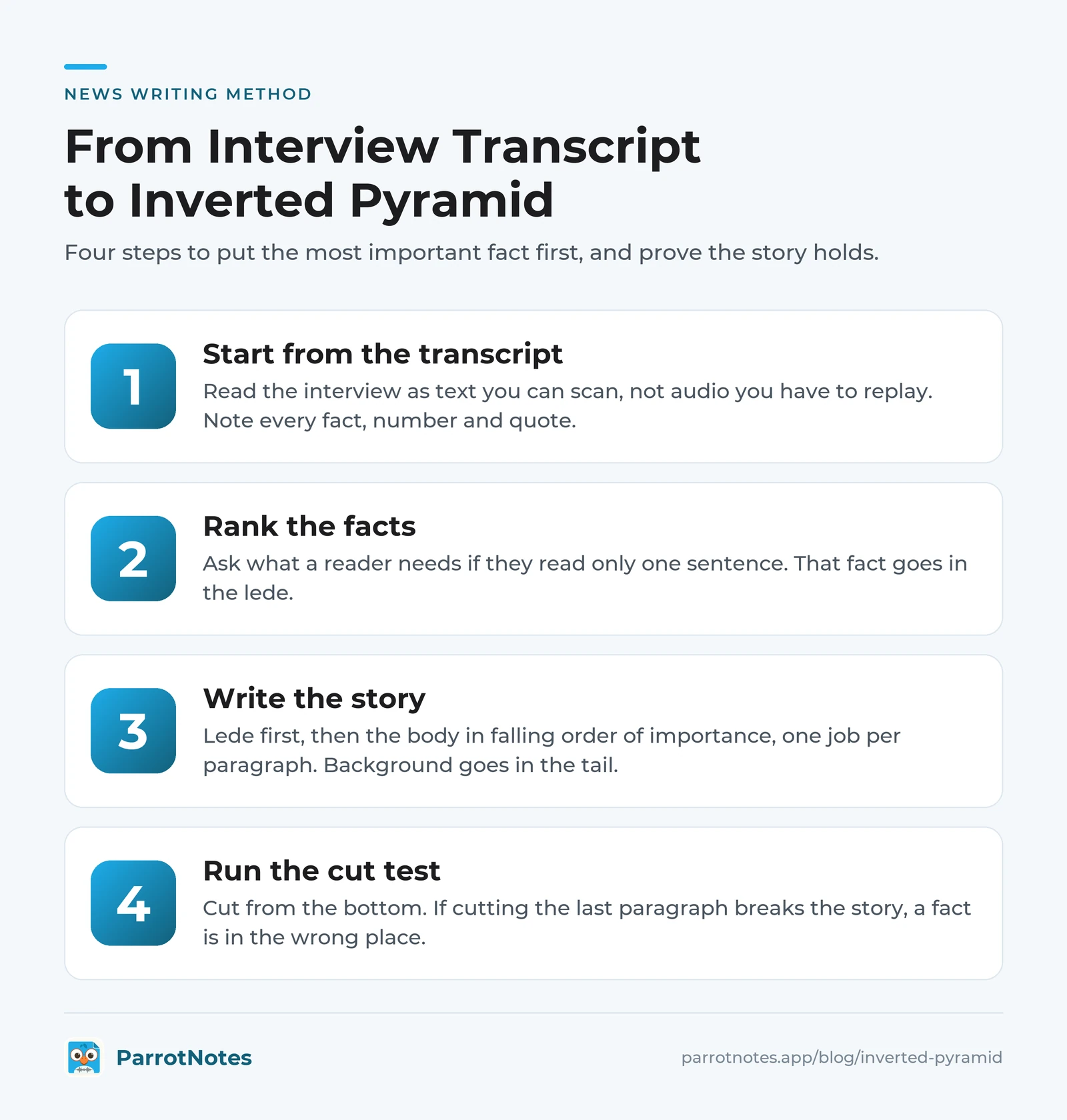
If cutting the last paragraph breaks the story, a fact is in the wrong place. If one paragraph leaves the reader confused, the lede is wrong.
For the full process from notes to filed copy, with a template and checklist, see our guide on how to write a news story.
When not to use the inverted pyramid
The inverted pyramid is built for news, when readers need the facts fast. It's the wrong shape when the reader came for the story itself:
- Features and profiles, where a scene or a person draws the reader in
- Long narrative pieces, where suspense and order of events matter
- Columns, reviews and analysis, which lead with a view or build an argument
Here's the same Route 14 material as a feature opening:
At 9:15 on a weeknight, Dana Whitfield finishes stocking shelves and walks to the Route 14 stop outside the Northgate shopping center. After Jan. 5, that bus won't come.
That opening makes you wait for the news, which a feature can do. It then needs a nut graf, the paragraph that tells readers why the story matters now. Our guide to the nut graf shows how to write one, and these feature writing examples show how the best features are built.
Many stories mix the two: a short scene, then the pyramid. The rule of thumb: if a reader would be annoyed to wait for the fact, put it first.
How interview notes and transcripts feed the pyramid
Ranking the facts is the real work of the inverted pyramid, and it's much easier when your interview is text you can scan, not audio you have to replay.
Take Owen, a student reporter covering a campus budget meeting (a composite, not a real person). One number in his 40-minute recording belongs in his lede. He searches the transcript for "million," finds it, then plays the audio around it to check the wording.
ParrotNotes helps with that part of the job (features and prices as of October 2026):
- Record on your phone: interviews on the iPhone or Android phone you carry, even with the screen locked
- Transcript and summary: an auto-summary on every recording, so your who, what, when and where are easy to pull out
- Ask your recording (Pro): type "What did she say about the vote?" and get the answer with its context
- Speaker identification (Pro): labels who said what, so quotes are attributed to the right person
- Other languages: transcription in 99+ languages, and Pro handles interviews that switch between languages
Ask for consent before you record (how to record an interview covers how), and check every quote against the audio (how to quote an interview). Already have a file? The free audio to text tool turns it into a transcript.
The Free plan includes 100 minutes of recording and five AI-powered recordings a month. Pro is $19.99 a month, or $14.99 a month billed annually, with 3,000 minutes and recordings up to three hours. Download ParrotNotes free and record your next interview with it.
Put the news at the top
The inverted pyramid comes down to a few habits:
- Rank your facts before you write, by what a reader needs first
- Lead with the news, not the meeting or the quote
- Order the body by importance, one job per paragraph
- Run the cut test: every cut from the bottom should leave a complete story
- Switch shapes for features, profiles and narrative
Cut your last story from the bottom, one paragraph at a time. If it holds, you built it right. Before your next interview, download ParrotNotes free and spend your deadline hour ranking facts, not rewinding tape.
Frequently Asked Questions
What are the three parts of the inverted pyramid?
The lede (the most important fact), the body (quotes, numbers and reaction in falling order of importance) and the tail (background and minor details an editor can cut).
Why is it called the inverted pyramid?
The story is drawn as a triangle on its point: the wide top holds the most important information, narrowing to the least important at the bottom.
Is the inverted pyramid still used today?
Yes. Most breaking news still uses it, and web writing guides recommend it because online readers skim. Features and long narrative pieces usually don't.
What is an example of an inverted pyramid lede?
"Riders on Harlow County's Route 14 will lose weekday bus service after 7 p.m. starting Jan. 5, after the county transit board voted 5-2 Thursday to cut evening trips." It says who is affected, what changes, when, and who decided, in one sentence. (The example in this guide is invented for illustration.)
Who invented the inverted pyramid?
No single person. Most accounts credit the 19th-century telegraph era. Historians disagree on when it became the norm, though it was common by the early 20th century.
Related Posts

What Is a Punch List? How to Run a Punch List Walk
What is a punch list? The meaning, who makes it, what goes on it, a 12-item sample punch list and a faster way to run the walk. Try ParrotNotes free today.

Real Estate Listing Presentation: What to Include and How to Run It
A listing presentation outline you can copy: what to include, how to run the appointment in the seller's home, how to discuss commission and what to note after.

Pipeline Coverage Ratio: How to Calculate It and What Good Looks Like
Pipeline coverage ratio explained: the formula, a worked example, why 3x depends on win rate and cycle length, and how to fix low coverage. Try it free.