
How to Write a News Story: Structure, Example and Checklist

Sarah Johnson
Writes about field sales, meeting notes and voice-first workflows at ParrotNotes. Every article is reviewed by the ParrotNotes product team before it goes live.

Table of Contents
- 1.What a news story is (and what it isn't)
- 2.The news story format: the inverted pyramid
- 3.How to write a news story in 7 steps
- 4.A news story example, from notes to finished copy
- 5.News story template
- 6.Checklist before you file
- 7.How to write a news story from an interview recording
- 8.Put the news first, every time
It's 7:10 p.m. Priya has 40 minutes of town council tape, three pages of notes and an editor who wants copy by 8. The meeting covered five agenda items. Only one of them will change anyone's week. (Priya is a composite, not a real reporter.)
Her first draft opens with "The council met Tuesday night." It comes back in two minutes.
The hard part isn't the writing. It's deciding what goes first. This guide shows you how to write a news story with the right fact at the top: the inverted pyramid, seven steps from notes to copy, and a worked example where one lede gets rewritten three times. You'll finish with a fill-in template and a checklist to run before you file.
If you report from meetings and interviews, try ParrotNotes free: it records on your phone and gives you a transcript, so the quote you need is a search away.
What a news story is (and what it isn't)
A news story reports something that just happened, or is about to, and puts the most important fact first. It answers who, what, when, where, why and how quickly, in plain language, without the writer's opinion.
A feature can open with a scene and make the reader wait. A news story can't. For the feature side, our feature writing examples guide covers scene ledes and the nut graf.
| News story | Feature | |
|---|---|---|
| Opening | The key fact, in a summary lede | A scene, a person or a question |
| Order | Most important to least important | Built like a story |
| Timeliness | Today or this week | A news peg, a trend or timeless |
| Ending | Least important detail | A kicker that lands the theme |
The news story format: the inverted pyramid
Most news stories use the inverted pyramid. Purdue OWL describes it simply: the most fundamental facts appear at the top of the story, in the lead paragraph, and each paragraph after that matters a little less than the one before.
It has lasted for two practical reasons. Readers who stop after two paragraphs still get the news, and an editor short on space can cut from the bottom without breaking the story. Online publishing has loosened length limits, Purdue notes, but the order still holds.
Top to bottom, a news story runs: headline, lede (the most important fact), a why-it-matters paragraph, the first quote, the body in falling order of importance, a little background, and an ending with what happens next.
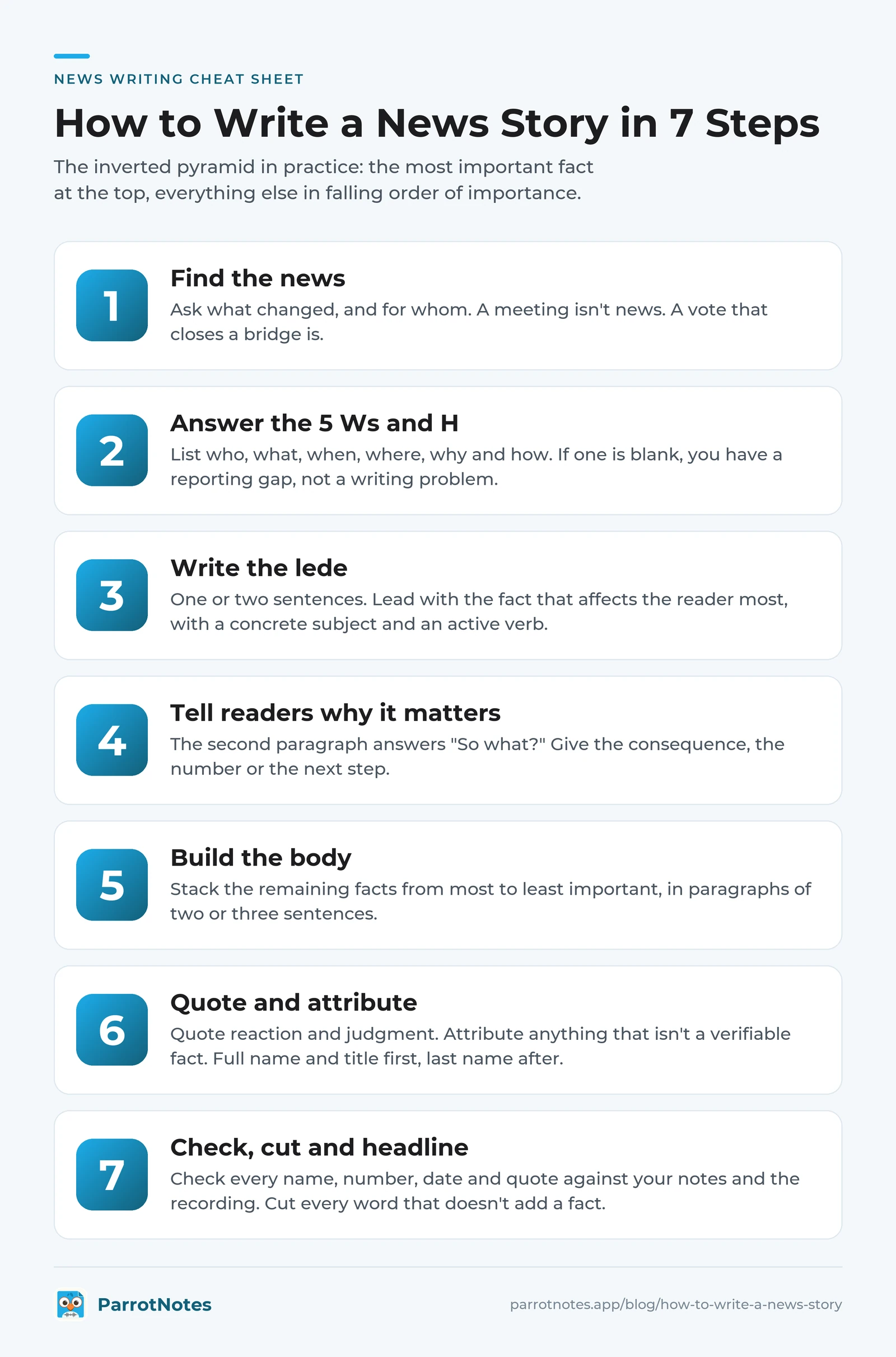
How to write a news story in 7 steps
1. Find the news
Ask what changed, and for whom. A meeting isn't news. A vote that closes a bridge is. Write the news in one sentence for yourself first.
2. Answer the 5 Ws and H before you write
List who, what, when, where, why and how. If one is blank, you have a reporting gap, not a writing problem. Make the call now, not at 7:55. The "why" usually comes from a follow-up question, so our guide on how to conduct an interview is worth a look.
3. Write the lede
Cal Poly's newswriting guidelines put it plainly: keep the lead to one or two clear and concise sentences. Lead with the fact that affects the reader most, with a concrete subject and an active verb. Leave out the meeting and anything else that slows you down.
4. Tell readers why it matters
The second paragraph answers the reader's next question: "So what?" Give the consequence, the number or the next step.
5. Build the body in order of importance
Stack the remaining facts from most to least important, in paragraphs of two or three sentences. Each paragraph does one job: a fact, a voice or context.
6. Quote and attribute
Quote reaction and judgment, not facts you can state yourself. Attribute anything that isn't a verifiable fact. Full name and title first, last name after. "Said" works every time; readers barely notice it.
Fairness matters here too. If someone is criticized, ask them to respond. The journalism code of ethics post covers the SPJ principles, and our guide to off-the-record terms explains on background and not for attribution.
7. Check, cut and headline
Check every name, number, date and quote against your notes and the recording. Cut every word that doesn't add a fact. Write the headline last. Our fact-checking guide has a claim log you can use for this pass.
A news story example, from notes to finished copy
Here's a complete worked example written for this article. Brennick, its council, the bridge and everyone quoted are invented for illustration. It's not a real report.
Priya's notes
Council mtg Tues, 4-1 vote: close Mill St Bridge to cars + trucks from Nov 3. Repairs ~5 months. Inspection rated bridge "poor." Built 1962. Cost $1.2M, state grant $800K, town pays $400K from capital reserve. Walkers + bikes can still cross. Detour via Route 9 adds about 2 miles. Ana Ruiz, public works director: "We'd rather close it on our schedule than have it closed for us." No vote: Councilmember Dale Okafor, wants work split into two phases to keep one lane open. Hal Becker, owns Becker Hardware on Mill St: worried about Saturday trade. Also on agenda: parking permits, library hours, two proclamations.
Three drafts of the lede
Draft 1, the buried lede:
The Brennick Town Council met Tuesday night at Town Hall, where members heard reports from several departments and discussed a number of items, including the Mill Street Bridge.
A meeting happened. The news is hiding in the last three words.
Draft 2, the cluttered lede:
The Brennick Town Council voted 4-1 Tuesday, after a report from Public Works Director Ana Ruiz rated the 1962 bridge in poor condition, to close the Mill Street Bridge to cars and trucks starting Nov. 3 for $1.2 million in repairs, $800,000 of it covered by a state grant.
Every fact is right. There are just too many of them, and the reader waits 16 words between "voted" and what the council actually voted for.
Draft 3, the working lede:
Drivers will lose their shortest way across the Kell River for about five months after the Brennick Town Council voted 4-1 Tuesday to close the Mill Street Bridge for repairs starting Nov. 3.
It leads with who's affected and what changes. The cost, the inspection and the dissent move down.
The finished story
Brennick to close Mill Street Bridge for five months of repairs
[Lede: the news, who it affects] Drivers will lose their shortest way across the Kell River for about five months after the Brennick Town Council voted 4-1 Tuesday to close the Mill Street Bridge for repairs starting Nov. 3.
[Why it matters: the consequence] Cars and trucks will detour along Route 9, which adds about 2 miles to the trip. People on foot and on bikes can still cross.
[First quote: the decision-maker] "We'd rather close it on our schedule than have it closed for us," said Ana Ruiz, Brennick's public works director. A state inspection this year rated the 1962 bridge in poor condition.
[Numbers: cost and who pays] The repairs will cost $1.2 million. A state grant covers $800,000, and the town will pay the remaining $400,000 from its capital reserve.
[The other side] Councilmember Dale Okafor cast the only vote against. He wanted the work split into two phases so one lane could stay open.
[Someone affected] Hal Becker, who owns Becker Hardware on Mill Street, said he's worried about Saturday trade. "Half my weekend customers come over that bridge," he said.
[Least essential: the rest of the meeting] The council also approved new parking permit rules and extended weekend library hours.
Notice what happened to the other four agenda items. Two got one sentence at the bottom, and the proclamations didn't make it at all. That's the inverted pyramid doing its job.
News story template
Copy this and fill in the brackets. Delete any line you don't need.
Headline: [Who] [does what] [to whom or where]
Lede: [Who's affected] will [what changes] after [who acted] [did what] [when], [one-line reason if short].
Why it matters: [The consequence, number or next step.]
Quote 1: "[Reaction or judgment]," said [full name], [title].
Supporting fact: [Cost, scale, timeline or source document.]
Other side: [Who disagrees] [said or did what]. [Response, if any.]
Quote 2: [Someone affected, in their words.]
Background: [How we got here, in one or two sentences.]
What's next: [Next meeting, deadline or decision.]
Checklist before you file
- The lede states the news, not the event where it happened
- The lede is one or two sentences, with a clear subject and an active verb
- Who, what, when, where, why and how are all answered somewhere
- The second paragraph tells readers why it matters
- Paragraphs are in order of importance, two or three sentences each
- Every opinion and non-verifiable claim is attributed
- Full names and titles on first reference, last name after
- Every quote matches the recording word for word
- Anyone criticized was asked to respond
- Names, numbers, dates and spellings are checked against a source
- No opinion of yours appears anywhere in the copy
- The headline matches what the story says, with nothing the story doesn't support
Our guide on how to quote an interview covers point 8 in detail, including what you can and can't trim from a quote.
How to write a news story from an interview recording
Most news stories start with a conversation: a council member after the vote, a witness, a spokesperson. You know the answer is on the tape. You just need to find it.
Take Tomás, a freelancer covering a school board (a composite, not a real person). He needs one quote on the budget gap from a 25-minute interview with the superintendent. Instead of scrubbing audio, he searches the transcript for "budget," finds the line, and plays the audio around it to check the wording before he files.
ParrotNotes helps with that part:
- Record on your phone: in-person interviews on the iPhone or Android phone you carry, even with the screen locked
- Transcript and summary: on every recording, so the 5 Ws are easy to pull out
- Ask your recording (Pro): type "What did she say about the deadline?" and get the answer with its context
- Find quotes across notes (Pro): AI search finds a line across every recording, and speaker identification labels who said what
- Other languages (Pro): transcribe and translate interviews in 99+ languages
Always get consent before you record; our guide on how to record an interview covers how to ask on tape. Already have a file? The free audio to text tool turns it into a transcript.
The Free plan gives you 100 minutes of recording a month with a summary on every recording. Pro is $19.99 a month, or $14.99 a month billed annually, with 3,000 minutes and recordings up to three hours. Download ParrotNotes free and record your next interview with it.
Put the news first, every time
Learning how to write a news story comes down to a few habits:
- Find the news before you write: what changed, and for whom
- Lead with it in one or two sentences
- Stack the rest in order of importance, and attribute every opinion
- Check every quote against the recording before you file
Print the checklist, keep the template open, and rewrite your last lede the way Priya's got rewritten. Download ParrotNotes free before your next interview, and spend the time before deadline writing, not scrubbing audio.
Frequently Asked Questions
What are the 5 parts of a news story?
The headline, the lede, the body, the quotes and the ending, usually with a "why it matters" paragraph after the lede. They follow the inverted pyramid, from most to least important.
How do you start a news story?
Start with a summary lede: one or two sentences that state the most important fact and who it affects. Lead with the news, not the event where it happened. "Drivers will lose their shortest route" beats "The council met Tuesday."
What is the inverted pyramid in news writing?
It's the standard news story format: the most important facts go at the top, in the lede, and each paragraph after that matters less than the one before.
How long should a news story be?
There's no fixed length. Ask your editor for a word count, and cut anything that doesn't add a fact, a voice or context.
Related Posts

Tactiq Review: Features, Pricing and Limits
Tactiq review from Tactiq's own pages, checked Oct 2026: capture paths, caption rules, two credit meters, plans and a 10-question fit test. Try ParrotNotes.
Superwhisper Review: Features, Pricing and Alternatives
Superwhisper review from its own pages, checked Oct 2026: plans, the free plan, lifetime math, offline limits and a 10-question fit test. Try ParrotNotes free.
Sales Performance Improvement Plan: A Template and How to Run It
A sales performance improvement plan template for field teams: diagnose the cause, set goals reps control, run weekly check-ins. Try ParrotNotes free.