
News Values in Journalism: The Criteria Editors Use, With Examples

Sarah Johnson
Writes about field sales, meeting notes and voice-first workflows at ParrotNotes. Every article is reviewed by the ParrotNotes product team before it goes live.

Table of Contents
- 1.What are news values?
- 2.The 7 news values most newsrooms use
- 3.Where news values come from: Galtung and Ruge (1965)
- 4.Harcup and O'Neill's news values update (2001 and 2017)
- 5.News values compared: the main lists side by side
- 6.How to use news values to pick a story
- 7.Finding the news value in an interview recording
- 8.The limits of news values
- 9.Use news values to make the call, then make the case
It's Monday morning and Dana has one slot on the local page. She has three possible stories: a school board vote on bus routes, a 90-year-old who just finished a marathon, and a press release about a new parking app. Her editor wants one, with a reason. (Dana is a composite, not a real reporter.)
Most reporters make that call on gut feeling. Ask them why a story is news and you'll often hear "it just is." That gut feeling has a name, though, and it has been studied for 60 years.
This guide explains news values: the criteria editors use to decide what becomes news and what gets left out. You'll get the seven values most newsrooms teach, the research behind them, a side-by-side table of the main lists, and a scoring sheet you can use on your own pitches.
If your stories start with interviews and meetings, try ParrotNotes free. It records on your phone and gives you a searchable transcript, so the line that makes the story newsworthy is easy to find again.
What are news values?
News values are the criteria journalists and editors use to judge how newsworthy an event is: whether to cover it, how big to play it and which angle to lead with. Common ones are timeliness, impact, proximity, prominence, conflict, novelty and human interest.
They aren't written rules. They're a shared shorthand. Tony Harcup and Deirdre O'Neill, two journalism researchers who have studied them for decades, describe them as "a shared shorthand operational understanding of what working journalists are required to produce to deadlines" in their 2017 study.
News values also shape more than selection. They decide the angle. The same council meeting can be a conflict story, an impact story or a follow-up, depending on which value you lead with.
The 7 news values most newsrooms use
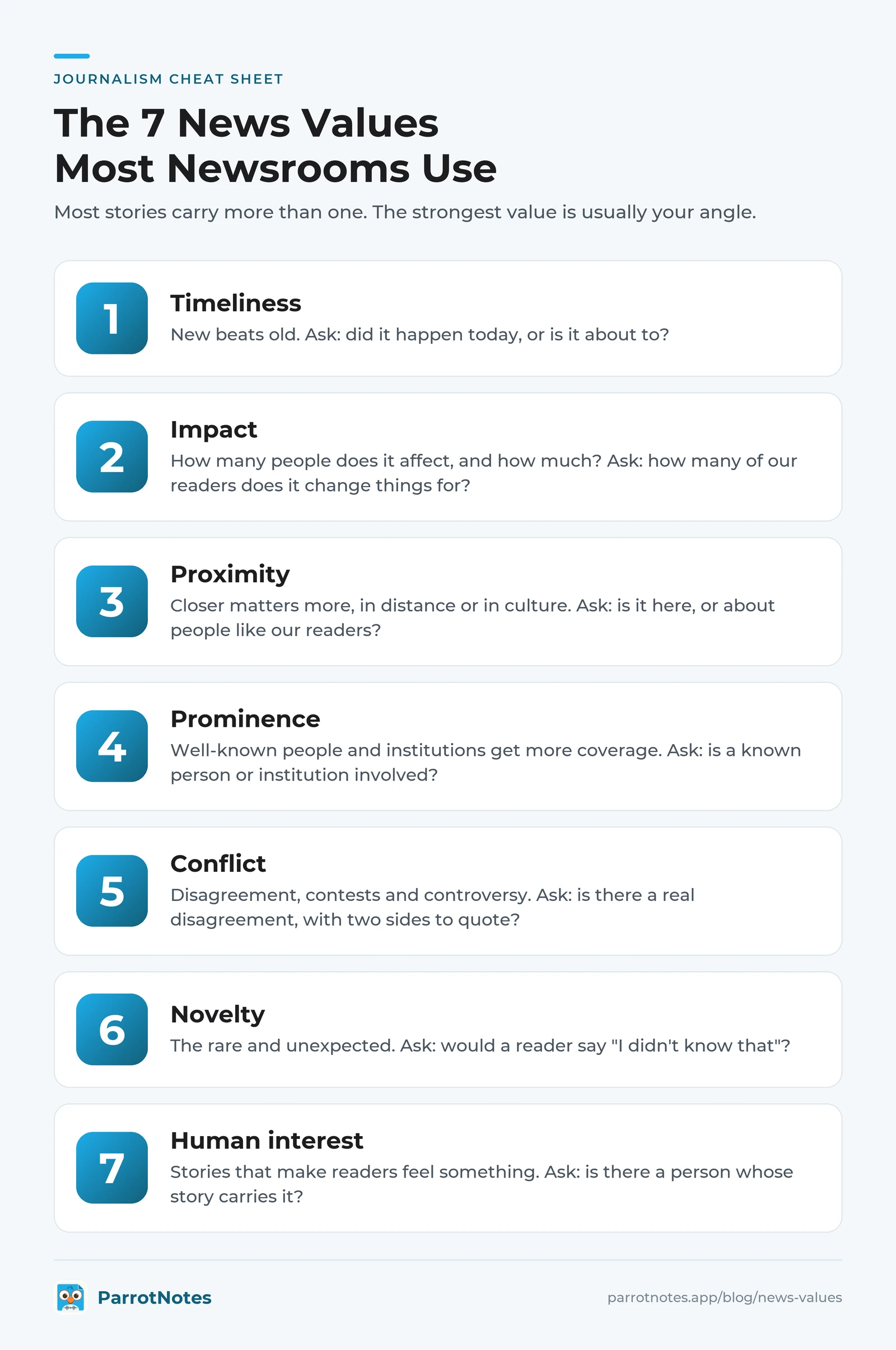
US journalism courses usually teach a short list like this one. Purdue OWL's guide to the components of newsworthiness summarises a similar set from Shoemaker and colleagues (1987). The examples below are made up to illustrate each value.
1. Timeliness
New beats old. A water main that burst this morning is news; one that burst last spring is background. Example: "Water shut off on Elm Street until 6 p.m. today."
2. Impact (consequence)
How many people does it affect, and how much? A fee increase for every household outranks a change that touches a dozen. Example: "Trash collection moves to every other week for 40,000 homes."
3. Proximity
Closer matters more, in distance or in culture. A factory closing in your town is bigger news to your readers than a larger one abroad. Example: "Local plant cuts 200 jobs." Proximity is the core of a local news reporter's beat.
4. Prominence
Well-known people and institutions get more coverage for the same action. A mayor's parking ticket is a story; yours isn't. Example: "Governor misses budget vote."
5. Conflict
Disagreement, contests and controversy draw readers: votes, strikes, lawsuits, elections. Example: "Parents push back on school start time change."
6. Novelty (the unusual)
The rare and unexpected. "Dog bites man" isn't news; "man bites dog" is. Example: "Library returns book borrowed in 1974."
7. Human interest
Stories that make readers feel something, often about ordinary people. Example: "Bus driver knows every rider's name after 30 years on route 12."
Most stories carry more than one value. A strike at the town's biggest employer is timely, local, high-impact and full of conflict. That stacking is exactly what the original researchers predicted.
Where news values come from: Galtung and Ruge (1965)
The study most often cited is by two Norwegian researchers, Johan Galtung and Mari Holmboe Ruge. Their 1965 paper, "The Structure of Foreign News," in the Journal of Peace Research, looked at how four Norwegian newspapers covered the Congo and Cuba crises of July 1960 and the Cyprus crisis of March to April 1964.
They proposed 12 factors that make an event more likely to become news:
- Frequency: events that unfold on the news cycle's timescale (a crash) beat slow trends
- Threshold: an event has to be big enough to register, and bigger is better
- Unambiguity: the clearer the meaning, the better
- Meaningfulness: culturally close or relevant to the audience
- Consonance: it fits what newsrooms expect or want to happen
- Unexpectedness: rare or surprising, within what's familiar
- Continuity: once a story is running, it keeps running
- Composition: it balances the mix of the day's news
- Reference to elite nations
- Reference to elite people
- Reference to persons: events told as the actions of named people
- Reference to something negative
They also set out three hypotheses. The more factors an event meets, the more likely it becomes news (additivity). An event weak on one factor can make up for it on another (complementarity). And an event that meets none, or very few, won't become news (exclusion).
Two cautions. The study was about foreign news in one country's press, not local reporting. And the authors themselves wrote that "no claim is made for completeness" in the list, as Harcup and O'Neill quote in their 2001 paper.
Harcup and O'Neill's news values update (2001 and 2017)
Galtung and Ruge hypothesised their list. Harcup and O'Neill tested theirs against what newspapers actually printed.
The 2001 list
In "What Is News? Galtung and Ruge revisited" (Journalism Studies, 2001), they read 1,276 page-lead news stories from the Daily Telegraph, the Sun and the Daily Mail in March 1999. They found several of the 1965 factors hard to apply ("Negative for whom?") and proposed 10 values: the power elite, celebrity, entertainment, surprise, bad news, good news, magnitude, relevance, follow-up and newspaper agenda.
The 2017 list
In "What is News? News values revisited (again)" (Journalism Studies, vol. 18, no. 12, published online in 2016), they coded 711 page-lead stories from 10 UK national dailies in November 2014. They also looked at the 25 most-shared news stories of 2014 on Facebook and Twitter.
The results show which values actually turned up most:
| News value | Page leads containing it (of 711) | Rank among the 25 most-shared stories |
|---|---|---|
| Bad news | 442 | 3rd |
| Surprise | 345 | 2nd |
| Entertainment | 332 | 1st |
| Follow-up | 221 | 4th |
| Power elite | 216 | 9th |
| Relevance | 209 | 5th |
| Magnitude | 165 | 6th |
| Celebrity | 145 | =7th |
| Good news | 137 | =7th |
| Newspaper agenda | 51 | 10th |
Source: Harcup and O'Neill (2017), Tables 2 and 3. Most stories had more than one value.
The gap is the interesting part. Bad news led in print. Online, entertainment and surprise led, and the power elite barely registered. From this they proposed 15 values, adding exclusivity, conflict, audio-visuals, shareability and drama, and renaming newspaper agenda as the news organisation's agenda.
They were careful not to oversell it, though. They wrote that "no taxonomy can ever explain everything."
News values compared: the main lists side by side
This table lines up the four lists. It was put together for this article from the primary papers. Rows match values that cover similar ground; the match is approximate, because each list defines its terms differently.
| Newsroom list (US courses) | Galtung and Ruge (1965) | Harcup and O'Neill (2001) | Harcup and O'Neill (2017) |
|---|---|---|---|
| Timeliness | Frequency | (no direct match) | (no direct match) |
| Impact | Threshold | Magnitude | Magnitude |
| Proximity | Meaningfulness | Relevance | Relevance |
| Prominence | Elite people, elite nations | Power elite, celebrity | Power elite, celebrity |
| Conflict | Something negative | Bad news | Bad news, conflict |
| Novelty | Unexpectedness | Surprise | Surprise |
| Human interest | Reference to persons | Entertainment | Entertainment, drama |
| (not usually listed) | Continuity | Follow-up | Follow-up |
| (not usually listed) | Composition | Newspaper agenda | News organisation's agenda |
| (not usually listed) | Consonance, unambiguity | (dropped) | (dropped) |
| (not usually listed) | (none) | Good news | Good news |
| (not usually listed) | (none) | (none) | Exclusivity, audio-visuals, shareability |
Two things stand out. Timeliness, the first value most students learn, isn't on either Harcup and O'Neill list. And the newest additions (exclusivity, audio-visuals, shareability) are about the newsroom and the audience, not the event itself.
How to use news values to pick a story
News values help most when you have to choose. Here's a scoring sheet you can copy. Score each pitch 0 (absent), 1 (some) or 2 (strong) on each value, then add it up.
| Value | Question to ask |
|---|---|
| Timeliness | Did it happen today, or is it about to? |
| Impact | How many of our readers does it change things for? |
| Proximity | Is it here, or about people like our readers? |
| Prominence | Is a known person or institution involved? |
| Conflict | Is there a real disagreement, with two sides to quote? |
| Novelty | Would a reader say "I didn't know that"? |
| Human interest | Is there a person whose story carries it? |
| Exclusivity | Do we have it first, or alone? |
Then ask one more question the score can't answer: can we stand it up? A high score with one unverified source is a tip, not a story.
Worked example: Dana's three pitches
Back to Dana's Monday. All three pitches are invented for this example.
| Value | Bus route vote | 90-year-old marathoner | Parking app release |
|---|---|---|---|
| Timeliness | 2 (vote tonight) | 1 (race was Sunday) | 1 |
| Impact | 2 (3,000 students) | 0 | 1 |
| Proximity | 2 | 2 | 2 |
| Prominence | 1 (board members) | 0 | 0 |
| Conflict | 2 (parents oppose cuts) | 0 | 0 |
| Novelty | 0 | 2 | 1 |
| Human interest | 1 | 2 | 0 |
| Exclusivity | 0 | 2 (she called us) | 0 |
| Total | 10 | 9 | 5 |
The bus vote wins the news slot on impact and conflict. The marathoner isn't dropped, though. She scores high on novelty, human interest and exclusivity, which makes her a strong weekend feature. And the parking app is a press release with no conflict and little impact: one paragraph at most.
The score also hands Dana her angle. She leads the bus story with impact ("3,000 students could face longer rides"), not with the meeting. Our guide on how to write a news story shows how to turn that into a lede, and the inverted pyramid shows how to order everything after it.
Finding the news value in an interview recording
The strongest news value is often buried in what someone said. Take Marcus, a freelancer (a composite, not a real person), who records a 40-minute interview with a university's facilities manager about a new parking garage. At minute 31, the manager mentions that the late-night campus shuttle is being cut. That's the impact story, and it's the only line his editor will care about.
A searchable transcript makes that easy to find (our guide on how to transcribe an interview covers the manual way). ParrotNotes helps with this part:
- Record on your phone: interviews, briefings and meetings, on the iPhone or Android phone you already carry
- Transcript and summary on every recording, so the line with the news in it is easy to spot
- AI chat on a transcript: ask "What did she say about the shuttle?" and get the answer with its context
- Multilingual transcription for interviews in other languages
Always get consent before you record, and check every quote against the audio before you file, with the attribution readers need to judge it. Our fact-checking guide has a method for that pass.
As of November 2026, the Free plan gives you 100 minutes of recording a month, up to 30 minutes per recording. Pro is $19.99 a month, or $14.99 a month billed annually, with 3,000 minutes and recordings up to three hours. Download ParrotNotes and record your next interview with it.
The limits of news values
News values describe what newsrooms tend to choose. They don't say what newsrooms should choose.
Harcup and O'Neill note that news values can't explain everything. Time, staff and the audience you write for matter as much as the event. Critics they cite, such as Stuart Hall (1973), argue that news values favour the views of powerful people. A list that rewards "bad news" and "the power elite" can push slow, important stories (housing, climate, local budgets) off the page.
So use news values to explain a choice, not to avoid one. If a story matters but scores low, your job is to find the angle that makes it land: a person, a number, a deadline. The journalism code of ethics is a good check on the other side, so a high score never beats accuracy or fairness.
Use news values to make the call, then make the case
News values turn gut feeling into a reason you can say out loud:
- Seven values cover most newsroom decisions: timeliness, impact, proximity, prominence, conflict, novelty and human interest
- Galtung and Ruge's 12 factors started the research in 1965, and Harcup and O'Neill's 15 values brought it up to date
- Stories with several values win, and the strongest value is usually your angle
- A score isn't a story until you can verify it
Copy the scoring sheet, run your next three pitches through these news values, and lead with the one that wins. Still building toward a first byline? Our guide on how to become a journalist has a pitch template to put them in. Then download ParrotNotes before your next interview, so the line that makes it news is a search away.
Frequently Asked Questions
What are the 7 news values?
The seven most often taught are timeliness, impact, proximity, prominence, conflict, novelty and human interest. Lists vary: some add relevance or usefulness, and research lists such as Harcup and O'Neill's add values like exclusivity and shareability.
What are Galtung and Ruge's news values?
Galtung and Ruge (1965) proposed 12 factors: frequency, threshold, unambiguity, meaningfulness, consonance, unexpectedness, continuity, composition, reference to elite nations, reference to elite people, reference to persons and reference to something negative.
What are Harcup and O'Neill's news values?
Their 2017 list has 15: exclusivity, bad news, conflict, surprise, audio-visuals, shareability, entertainment, drama, follow-up, the power elite, relevance, magnitude, celebrity, good news and the news organisation's agenda. It updated their 2001 list of 10.
Why are news values important?
They help reporters and editors decide quickly what to cover, how big to play it and which angle to lead with. They also help you pitch: an editor hears "impact and conflict" faster than "it's interesting."
Related Posts

Warm Calling vs Cold Calling: What Changes and When Each Works
Warm calling vs cold calling: what changes on the call, a five-question warmth test, six warm-call openers, and when a cold call is still the right move.

TurboScribe Review: Free Plan, Limits and Alternatives
TurboScribe review from its own pages, checked November 2026: free plan limits, the $10 Unlimited plan, safety, fine print, alternatives. Try ParrotNotes free.

How to Transcribe Audio in Word: Upload or Record
How to transcribe audio in Word: upload or record, which accounts and devices have Transcribe, the 300-minute limit, fixes for a missing button, and an example.