
Local News Reporter: The Job, the Beat and the Tools

Sarah Johnson
Writes about field sales, meeting notes and voice-first workflows at ParrotNotes. Every article is reviewed by the ParrotNotes product team before it goes live.

Table of Contents
It's 10:40 on a Tuesday night. The city council has just voted 4 to 3 to rezone the old mill site, the meeting ran two hours over, and Dana has 50 minutes to file 600 words before the web deadline. She needs the exact words the swing-vote member used, and they're somewhere in a two-and-a-half-hour recording. (Dana is a composite, not a real reporter.)
That's the job of a local news reporter on a normal week: long public meetings, tight deadlines, and readers who'll stop you at the grocery store if you get a name wrong. If you're thinking about the job, or you just started one, you already know it's busy. This guide shows what the work involves and gives you a sample beat week to copy. You'll also see what the job pays by employer type, how people get hired, a checklist for your first 30 days on a beat, and the tools that save the most time.
If you record meetings and interviews already, ParrotNotes turns each recording into a searchable transcript on your phone, so finding that one quote takes a search, not a replay.
What a local news reporter does
A local news reporter covers one town, county or region for a newspaper, TV or radio station, or digital newsroom. They attend public meetings, read public records, build sources and interview people. Then they write or script stories about what changes life in that community: taxes, schools, zoning, police, courts and local business.
The Bureau of Labor Statistics groups reporters with news analysts and journalists. Its Occupational Outlook Handbook lists the core duties as researching assigned topics, building contacts who supply tips, interviewing sources, writing stories and checking them for accuracy. Many reporters also pitch their own ideas to editors.
What makes the local version different is scale and proximity. You might be the only reporter in the room at a school board meeting. Your sources are your neighbors. And on a small staff you'll often shoot photos, post to social media and write the web update yourself.
What a week on a local beat looks like
Most local reporters work a beat: a topic or area they own, like city hall, schools, public safety or a cluster of small towns. The beat sets the rhythm of the week, because public bodies meet on a fixed schedule.
Here's a sample beat week for a general-assignment reporter covering a small city. Your town's calendar will differ, so treat it as a template and swap in your own days.
| Day | What to check | What to grab |
|---|---|---|
| Monday | Police and sheriff logs from the weekend, court dockets for the week | Arrests and charges worth a brief, hearings to put on the calendar |
| Tuesday | City council agenda packet (posted days ahead), evening council meeting | Vote counts by name, budget figures, the quote that explains the vote |
| Wednesday | Follow-up calls from Tuesday, planning commission agenda | Reactions from both sides, project names and addresses |
| Thursday | School board or county commission meeting, public records requests | Enrollment and budget numbers, contract amounts, documents to request |
| Friday | Weekend events, business permits, a feature interview | One people story to balance the meetings, a list for next week |
Two habits make this work. First, read the agenda packet before the meeting, not during it: the story is often in a contract or staff memo on page 140. Second, keep a running list of "things to check later" so each meeting feeds the next week's stories.
When the meeting itself is the story, our guide to city council meeting minutes explains how official minutes record votes, motions and public comment, which helps you read them and spot what's missing.
How much a local news reporter makes
The BLS reports a median annual pay of $62,200 for news analysts, reporters and journalists (May 2025). The lowest 10% earned less than $36,240, and the top 10% more than $144,140. Local reporters, especially at small papers and stations, usually sit in the lower part of that range.
Pay depends heavily on who employs you. Here's the BLS median by industry:
| Employer type | Median annual pay (May 2025) |
|---|---|
| Media streaming, social networks and other content providers | $80,180 |
| Television broadcasting stations | $64,150 |
| Radio broadcasting stations | $50,290 |
| Newspaper publishers | $49,220 |
| All reporters, analysts and journalists | $62,200 |
So, how much does a local news reporter make? At a newspaper, a median of about $49,000; at a local TV station, about $64,000. Market size matters too: a reporter in a large metro usually earns more than one in a small market, which is where many people take their first job.
The BLS also counts 47,100 jobs in 2025 and projects a 6% decline from 2025 to 2035, with about 3,400 openings a year as people retire or change careers. Openings exist; they're just competitive.
The local news market in 2026
You should know the market you're entering. The Medill State of Local News 2026 report, released October 13, 2026, found:
- 238 counties are news deserts, with no locally based source of professional local news, up 26 in a year
- Nearly 1,500 counties have only one local news source left
- 170 newspapers closed or merged in the past year, about three a week
- More than 7,500 newspaper jobs were lost in the past year
- 47 million Americans have limited or no access to local news
- 75 local news startups launched in the past year, and nearly 300 over five years
The last number matters for job seekers. Shrinking print chains aren't the only employers anymore. Nonprofit and digital-only newsrooms are hiring, often for exactly the beats that legacy papers dropped.
How to become a local news reporter
There's no license, but there is a well-worn path.
- Get a degree, or the skills it signals. BLS lists a bachelor's degree as typical, usually in journalism, communications or a related field such as English.
- Report for student media. Employers prefer candidates with experience at school newspapers, radio or TV stations, according to the BLS. Clips beat grades.
- Take internships. They give you published work and editors who'll vouch for you.
- Start in a smaller market. Many reporters move from small outlets to larger ones as they build experience.
- Build a portfolio. Editors check your clips before your resume. Our guide to a journalism portfolio covers what to include.
Marcus, a composite of several early-career reporters, spent his senior year covering his county's zoning board for a weekly paper because nobody else wanted it. By graduation he had 30 bylines on land use. The daily that hired him wasn't looking for a generalist; it needed someone who could read a site plan. A dull beat done well is a strong application.
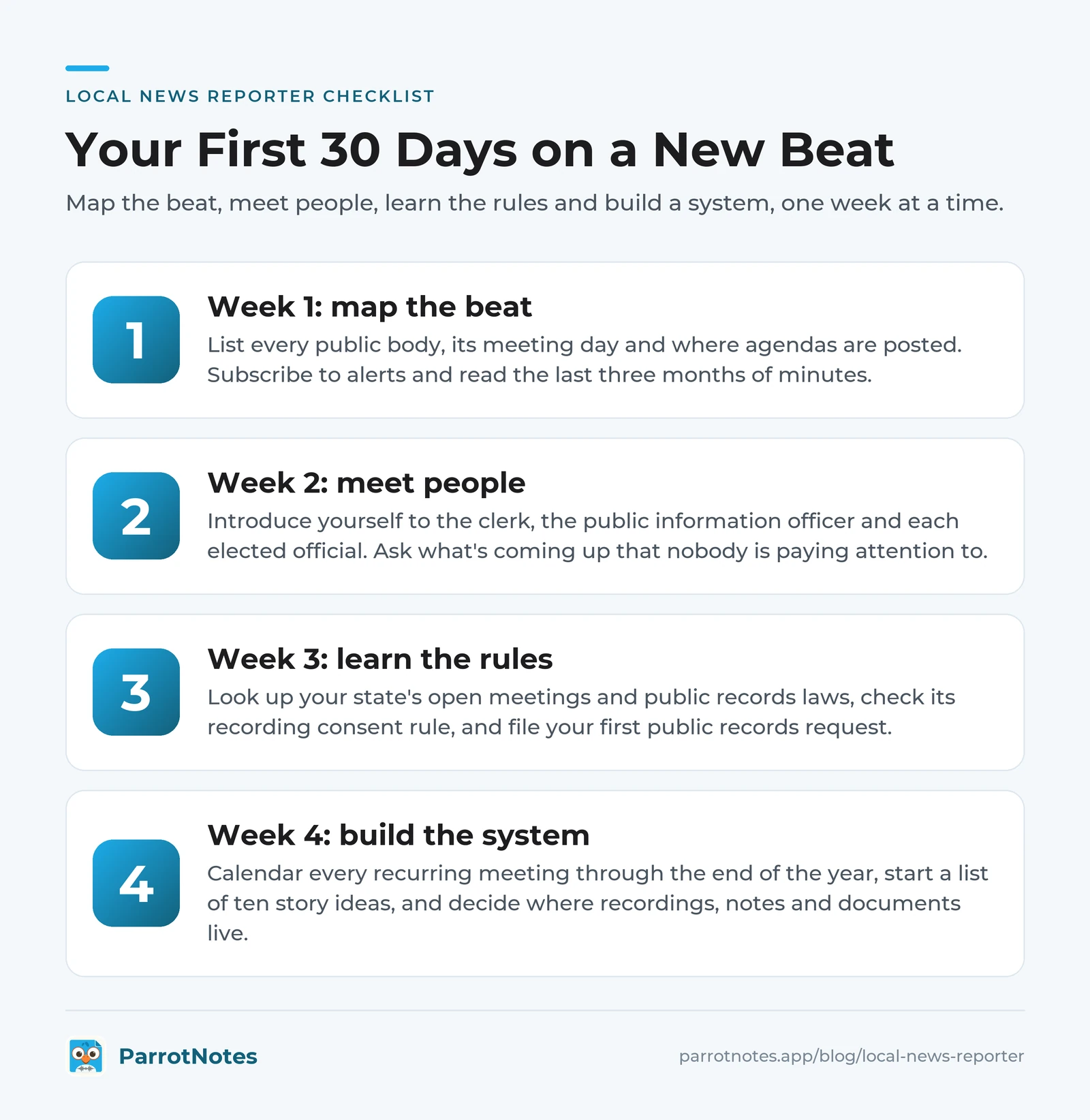
Your first 30 days on a new beat
New beats feel overwhelming because everything is unfamiliar at once. This checklist breaks the first month into steps you can tick off.
Week 1: map the beat
- List every public body you cover, with its meeting day, time and where agendas are posted
- Subscribe to agenda and minutes alerts for each one
- Read the last three months of minutes for each body
- Read your outlet's archive on the beat for the past year
Week 2: meet people
- Introduce yourself to the clerk, the public information officer and each elected official
- Ask each person, "What's coming up that nobody is paying attention to?"
- Build a contact sheet with names, titles, phone numbers and preferred times
Week 3: learn the rules
- Look up your state's open meetings and public records laws in the RCFP Open Government Guide
- Check your state's recording consent rule before you record any phone call (our guide to one-party consent states covers it)
- File your first public records request, even a small one, to learn the process
Week 4: build the system
- Set up a calendar of every recurring meeting through the end of the year
- Start a story list with at least ten ideas from your first month
- Decide where recordings, notes and documents live so you can find them again
Run this list on every new beat. It works whether the beat is schools, courts or a cluster of rural towns.
The local news reporter's tool kit
You don't need much gear, but every item should earn its place.
- A notebook and pen. Still the fastest way to capture a scene or a name spelling. Our comparison of the reporter's notebook vs voice notes shows when each one wins.
- Your phone as a recorder. It's always with you. Our guide on how to record an interview covers placement, backups and asking permission.
- Transcription. This is where the hours go. A recorded council meeting or a 40-minute interview takes far longer to transcribe by hand than to sit through.
- Public records portals and agenda alerts. Most cities and counties post agendas online; alerts mean you never miss a packet.
- A shared calendar. Every meeting, hearing and filing deadline in one place.
Picture Dana from the opening with a transcript. She records the council meeting on her phone in ParrotNotes. Back in her car, she searches the transcript for the council member's name and copies the exact sentence. Then she plays that moment of audio to confirm it, as our guide on how to quote an interview recommends, and starts writing. No scrubbing through two and a half hours of tape.
ParrotNotes works on iOS and Android. The free plan includes 100 minutes of recording a month, up to 30 minutes per recording, with an AI summary on each one. Pro, at $19.99 a month or $14.99 a month billed annually, raises that to 3,000 minutes a month and recordings up to 3 hours, which covers long meetings. If you already have an audio file, our free audio to text tool is a quick way to try transcription first.
The job, in short
Local news reporting is demanding, underpaid compared with many fields, and more needed than ever. Here's what to take away:
- A local news reporter covers one community through meetings, records, sources and interviews
- The week follows the public meeting calendar, so a beat week template keeps you ahead
- Median pay is $62,200 overall, about $49,000 at newspapers and $64,000 at TV stations (BLS, May 2025)
- Newspapers are shrinking, but startups and nonprofit newsrooms are hiring
- Your first 30 days on a beat are about mapping, meeting people, learning the rules and building a system
Start with the beat week table above and fill in your own town's meetings tonight. And when the next meeting runs long, record it with ParrotNotes so the quote you need is one search away.
Frequently Asked Questions
What does a local news reporter do?
A local news reporter covers one town, county or region. They attend public meetings, read public records, build sources, interview people, and write or script stories about local government, schools, public safety, business and community life.
How much does a local news reporter make?
The BLS reports a median of $62,200 a year for reporters, news analysts and journalists (May 2025). By employer, the median is $49,220 at newspaper publishers, $50,290 at radio stations and $64,150 at TV stations.
Do you need a degree to be a local news reporter?
Most employers expect a bachelor's degree, usually in journalism, communications or a related field such as English. Clips from student media and internships often matter as much as the degree itself.
What is a beat in local news?
A beat is the topic or area a reporter covers regularly, such as city hall, schools, courts or public safety. Owning a beat means you track its meetings, records and sources week after week, so you spot stories before anyone else does.
Related Posts

Voice to Text on Mac: Built-In Dictation and the Apps Worth Using
Set up voice to text on your Mac with built-in Dictation, change the settings that matter, and find out which voice to text Mac app is worth paying for.

Telecom Sales: Selling Business Phone and Internet Face to Face
Telecom sales guide for field reps: read the business bill with the owner, run a site survey, answer contract objections and switch lines honestly. Try it free.

Status Meeting: How to Keep Project Updates Short
Run a status meeting in 20 minutes: a run sheet, a three-line RAG update card, a notes template, and when to send it in writing. Try ParrotNotes free.