
Industrial Sales: A Practical Guide for Reps on the Road

Sarah Johnson
Writes about field sales, meeting notes and voice-first workflows at ParrotNotes. Every article is reviewed by the ParrotNotes product team before it goes live.

Table of Contents
- 1.What is industrial sales?
- 2.Who buys in industrial sales: the four people on a plant
- 3.Industrial sales salary and job outlook
- 4.What the job is like: a plant visit day
- 5.The plant visit debrief card
- 6.A week on the road: a worked example
- 7.Industrial sales mistakes the card prevents
- 8.Keep the route on the record
Picture Luis at 7:40 on a Tuesday morning, signing the visitor log at a corrugated box plant. Safety glasses on, phone in his pocket, a box of carbide inserts under his arm. The maintenance supervisor meets him at the gate and says, before they've reached the crib: "The new slitter is eating blades. And purchasing wants your quote on the 2027 blanket order by Friday."
By 8:15 Luis has walked the line, heard three more requests, and promised two things. By 9:30 he's at the next plant. By Friday, one of those promises has quietly gone missing.
That's industrial sales as it's lived: not a pitch, but a route of plants, each with its own people, parts, and promises, and a sales cycle long enough that month two matters in month fourteen.
If you searched the term to find out what the job is, the first half of this guide covers it from primary sources: what gets sold, who buys it, and what the U.S. Bureau of Labor Statistics says it pays. If you already carry a line card, the second half is yours: the plant-visit day, joint calls with distributors, call reports owed to principals, and a plant visit debrief card you can copy, shown on a worked week.
Want the card first? Skip to the eight fields below. And if you'd rather dictate it in the truck than type it at 9 PM, you can try ParrotNotes free before your next plant visit.
What is industrial sales?
Industrial sales is the selling of products and services to businesses that use them to make, move, or maintain something: a plant, a jobsite, a fleet, a utility. The customer is not a consumer and rarely one person. The buyer is a plant, and the plant has a maintenance supervisor, a purchasing agent, an engineer, and a manager who each get a say.
The U.S. Bureau of Labor Statistics files the job under wholesale and manufacturing sales representatives, who "sell goods for wholesalers or manufacturers to businesses, government agencies, and other organizations." The same page notes they are "sometimes called manufacturers' representatives or manufacturers' agents," and that scientific and technical products "include pharmaceuticals, medical instruments, and industrial equipment."
What an industrial sales rep sells
Most industrial sales falls into three buckets, and each one runs on a different clock.
| What you sell | Examples | Who usually buys | Typical cycle | What a visit looks like |
|---|---|---|---|---|
| MRO supplies (maintenance, repair, and operations) | Cutting tools, bearings, belts, fasteners, safety gear, lubricants | Maintenance, storeroom, purchasing | Days to weeks, repeating | Walk the crib, check stock, catch what's failing, quote the blanket order |
| Components and OEM parts | Motors, valves, sensors, castings, stampings, packaging | Engineering, purchasing, quality | Months: spec-in, sample, approval, production | Get on the print, hold the spec, follow the RFQ |
| Capital equipment | Machine tools, conveyors, compressors, automation cells | Plant manager, engineering, finance | A year or more, one committee | Discovery walk, requirements, demo or reference visit, budget cycle |
Many reps carry more than one bucket: MRO every week, one conveyor project on the side.
Direct, distributor, or manufacturers' rep
Who pays you, and who you report to, changes the job as much as what you sell.
- Direct rep. Employed by the manufacturer, selling its products, reporting to a sales manager.
- Distributor rep. Employed by a distributor that stocks many manufacturers' products. You sell the whole shelf, own the customer relationship, and often host the manufacturer's rep on joint calls.
- Manufacturers' rep (or agent). An independent business that represents several non-competing manufacturers, its principals, in a territory, on commission. The list of principals is the line card. The Manufacturers' Agents National Association notes that the commission rate depends on the product, the type of customer (OEM, reseller, or end user), and how much business already exists in the territory.
Whichever seat you're in, the plant sees one person: you. The people behind you see only what you write down.
Who buys in industrial sales: the four people on a plant
A plant is a buying committee that happens to share a car park. The four roles below turn up in almost every account, and the last column is what most industrial sales guides leave out: what to write down after you've talked to each of them.
| Role | What they care about | What they ask you | What to write down |
|---|---|---|---|
| Plant manager | Uptime, throughput, safety, this quarter's numbers | "What does this do to my output?" "Who else runs it?" | Their production targets, the number they're judged on, the projects they mentioned |
| Maintenance supervisor | What breaks, how fast you can get a part, whether your product survives their conditions | "How quickly can I get one?" "Will it hold up at 180 degrees?" | Failures described, part numbers, conditions, who's on nights |
| Purchasing agent | Price, terms, lead time, approved vendor status, fewer suppliers | "Are you on our AVL?" "What's the price break at 500?" | RFQ numbers, due dates, the terms they want, how they compare quotes |
| Plant or process engineer | Specs, tolerances, standards, whether it fits the process | "Is it rated for this?" "Can you hold plus or minus two thousandths?" | Every number with its unit and their name beside it |
Engineering signs off the spec, purchasing signs the order, maintenance decides whether you're called back, and the plant manager decides whether any of it happens this year. Skip one and the deal stalls where that person sits. On a capital deal with a bigger committee, a stakeholder map keeps the cast list straight.
Industrial sales salary and job outlook
Here's what the BLS reports on its wholesale and manufacturing sales representatives page, last modified August 27, 2026. The figures are for May 2025.
The median annual wage for sales representatives of technical and scientific products, the BLS line that covers industrial equipment, was $104,920. The lowest 10% earned less than $52,600 and the highest 10% earned more than $200,440. For products the BLS classes as not technical or scientific, the median was $72,080, and across the whole occupation it was $76,460.
Where you work moves the number:
| Industry (technical and scientific products) | Median annual wage, May 2025 |
|---|---|
| Merchant wholesalers, nondurable goods | $133,690 |
| Wholesale trade agents and brokers | $118,990 |
| Professional, scientific, and technical services | $108,100 |
| Manufacturing | $106,650 |
| Professional and commercial equipment and supplies merchant wholesalers | $99,920 |
The pay mix matters as much as the headline. The BLS says that "most employers use a combination of salary and commissions or salary plus bonuses," with commissions usually a percentage of sales. Ask about the split and the quota before you accept an industrial sales job.
On outlook, the BLS projects little or no change in employment from 2025 to 2035, but about 123,400 openings a year across the occupation, mostly to replace people who retire or move on. Technical and scientific reps held about 292,000 jobs in 2025.
On getting in, a high school diploma is typical for non-technical products and a bachelor's degree for technical and scientific ones. And on the road: "Some wholesale and manufacturing sales representatives have large territories and travel considerably."
What the job is like: a plant visit day
The O*NET task list for the occupation starts with the obvious ("Visit establishments to evaluate needs or to promote product or service sales") and includes two that career guides skip: "Maintain customer records, using automated systems" and "Complete expense reports, sales reports, or other paperwork." Those two are where a day on the road goes wrong.
A plant visit day runs something like this. Sign in at the gate, PPE on. Twenty minutes with maintenance in the crib, where you find out what failed this week. A walk past the line, where you notice a competitor's box on a shelf and a new machine nobody told you about.
Then ten minutes with purchasing about the blanket order. A parked truck, a bar of signal, and the next plant 40 minutes away. Repeat four to six times, and then the evening: quotes to request, samples to chase, a call report for each principal whose product came up.
Sometimes the visit runs the other way and you bring the customer to your principal's plant. That day has its own run sheet, in our guide to running a manufacturing plant tour.
Long cycles
Industrial sales cycles run long because plants change slowly. A spec-in on a component can take a season of samples and approvals, and a capital purchase waits for the budget cycle and the shutdown window. The people change faster than the project: the engineer who gave you the spec in February may be at another plant by October.
That's why a record beats a memory. When the new engineer asks "who agreed to the coating?", the answer has to be a name and a date, not a feeling.
Specs and promises heard on the floor
Nobody stops the line for you. Specs arrive as you walk: "we're running 3,200 an hour now," "it needs to survive the washdown," "can you get me the 25-millimeter version?" So do promises, from both sides: "I'll have a sample here Thursday," "I'll send you the print."
A plant floor is loud, your phone may be banned past the gate, and NDAs don't pause for a visit. So don't record on the floor. Carry a pocket card, write one line per item with the name of who said it, and turn it into a full record in the truck. When a visit turns into full technical requirements, the nine-field technical meeting record in our sales engineer guide holds every number with its unit; the card below points at it rather than repeating it.
Joint calls with distributors
If you're a manufacturers' rep or a direct rep, many of your visits are joint calls: the distributor's rep owns the relationship, you bring the product depth. If you're the distributor rep, you host them.
Joint calls fail on the split. Who sends the quote, who chases the sample, who calls the engineer back? Agree it in the car park before you go in, and confirm it in the car park after. The distributor rep needs your notes the same afternoon, because purchasing will call them, not you.
Picture Hana, a manufacturers' rep with five principals, on a joint call at a food plant. Maintenance wants a stainless gearbox for the washdown zone. Hana says she'll get the rating confirmed; the distributor rep says he'll quote it. Neither writes down who owns the drawing that engineering asked for, and when the RFQ arrives ten days later, the drawing is still with nobody.
Call reports owed to principals
A manufacturers' rep owes each principal a report on what's happening in the territory with their product: which accounts were visited, what was asked for, what the competitor is doing, what the principal needs to do next. Direct and distributor reps owe the same thing to a sales manager, usually through the CRM.
The report is easy when it's built from visit records and painful when it's built from memory on Friday night. The card below is designed so that field 7 becomes the report line, one per principal, with no rewriting.
The plant visit debrief card
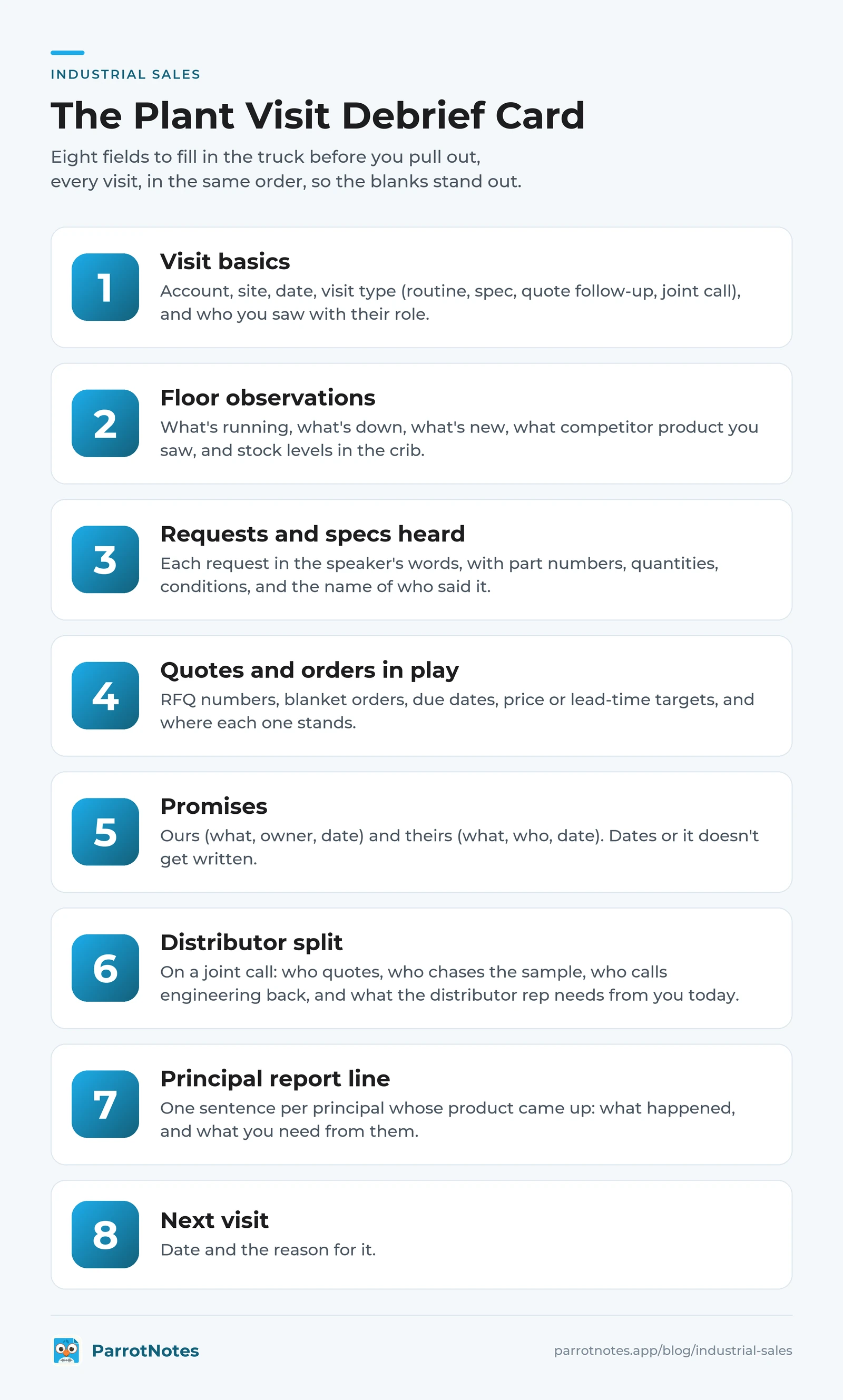
This is the record. Eight fields, one card. Copy it into your notes app, your CRM's visit-note field, or a pocket card. Fill it in the truck before you pull out, every visit, in the same order, so the blanks stand out.
- Visit basics. Account, site, date, visit type (routine, spec, quote follow-up, joint call), and who you saw with their role.
- Floor observations. What's running, what's down, what's new, what competitor product you saw, and stock levels in the crib.
- Requests and specs heard. Each request in the speaker's words, with part numbers, quantities, conditions, and the name of who said it. If it's a full requirements set, switch to the technical meeting record.
- Quotes and orders in play. RFQ numbers, blanket orders, due dates, price or lead-time targets, and where each one stands.
- Promises. Ours (what, owner, date) and theirs (what, who, date).
- Distributor split. On a joint call: who quotes, who chases the sample, who calls engineering back, and what the distributor rep needs from you today.
- Principal report line. One sentence per principal whose product came up: what happened, and what you need from them.
- Next visit. Date and the reason for it.
Three rules make it work. Field 3 uses quotation marks and names: "needs to survive the washdown" (Renee, maintenance) is a spec; "they want something tougher" is a rumor. Field 5 gets dates or it doesn't get written. Field 7 is written for the principal, not for you, so it pastes straight into the call report.
Dictate it before you pull out
The card takes 12 minutes to type and three to say. Typing gets pushed to the evening, and by then "3,200 an hour" has become "faster than before." So say it.
Stay parked, open ParrotNotes, hit record, and talk through the eight fields in order. Recording keeps going with the screen locked, so the phone sits in the cup holder. When you stop, you get a transcript, an AI summary, and a list of action items, so field 5 is already pulled out with owners attached. Recording works even when the plant car park has no signal; transcription and AI run once you're back in coverage.
Recorded a sit-down with purchasing, with their permission? Then the transcript is field 4 in their exact words. Ask before you press record, every time, and skip it if anyone hesitates.
In the United States, federal law permits recording a conversation you're part of (18 U.S.C. § 2511(2)(d)), but some states and countries require everyone's consent. This isn't legal advice: ask everyone, follow the site's phone policy, and check your NDA. A debrief you dictate alone in the truck needs none of that.
ParrotNotes can also draft the follow-up email from the recording, so the promises in field 5 reach the customer and the distributor rep in writing the same afternoon. Our follow-up email templates include one for a visit with more than one stakeholder. When a request in field 3 needs to become a written request for quote, the intake questions in our RFQ template guide catch what the plant didn't say.
Want to try it on tomorrow's route? Download ParrotNotes free. The free plan gives you 100 minutes of recording a month, up to 30 minutes per recording, with an AI summary on every recording and AI insights on five recordings a month. Pro is $19.99 a month, or $14.99 a month billed annually, with 3,000 minutes a month, recordings up to 3 hours, and AI chat for asking "what did Renee say about the washdown?" in month fourteen.
If your visits involve NDAs, you can read how we protect your data first.
A week on the road: a worked example
The week below is invented to show the card doing its job. Luis, the plants, the distributor, and the principals don't exist, and the numbers are chosen to illustrate, not to prove anything about real territories.
Luis is a distributor rep selling cutting tools and MRO across a two-county territory, with one gearbox project for a principal on the side. Eight plant stops, one joint call, five days.
| Day | Stop | Visit type | Who | What mattered |
|---|---|---|---|---|
| Mon | Halvorsen Corrugated, Plant 1 | Routine, MRO | Renee Okafor (maintenance), Dale Pruitt (purchasing) | New slitter "eating blades"; blanket order quote due Friday |
| Mon | Bright Creek Foods | Joint call with Sam Whitlock (Norden Drives, principal's rep) | Marcus Bell (maintenance), Ines Faria (plant engineer) | Stainless gearbox for washdown zone; engineering wants a drawing |
| Tue | Kestrel Machining | Spec | Owen Tate (shop lead) | Insert trial on 4140 steel; "3,200 parts an hour, I want 60 parts per edge" |
| Tue | Halvorsen Corrugated, Plant 2 | Routine, MRO | Storeroom | Crib low on cut-resistant gloves; competitor belt on the shelf |
| Wed | Redfern Plastics | Quote follow-up | Priya Menon (purchasing) | Compressor RFQ 4471 waiting on lead time from the principal |
| Wed | Ashgrove Metal Fab | Routine, MRO | Tom Lindqvist (maintenance) | Bandsaw blades only; next visit in three weeks |
| Thu | Kestrel Machining | Sample drop | Owen Tate | Delivered 10 inserts; trial results due next Tuesday |
| Fri | Bright Creek Foods | Follow-up | Ines Faria | Drawing question from Monday still open |
Here's how the Monday joint-call card reads.
Monday, Bright Creek Foods (joint call)
1. Basics. Bright Creek Foods, Line 4 washdown zone, Monday. Joint call with Sam Whitlock, Norden Drives. Saw Marcus Bell (maintenance) and Ines Faria (plant engineer). 2. Floor. Line 4 running. Current gearbox is a painted unit with corrosion at the seal. No competitor stainless units seen. 3. Requests and specs. "It has to survive the washdown, 180 degrees and caustic" (Marcus). "Send me a dimensional drawing before I'll spec anything" (Ines). 25 units if it works across both lines (Marcus). 4. Quotes in play. None yet. Ines will raise an RFQ once she has the drawing. 5. Promises. Ours: Sam to get the washdown rating confirmed by Norden's applications engineer by Wednesday; Luis to send the drawing to Ines by Wednesday. Theirs: Marcus to send a nameplate photo today. 6. Distributor split. Luis quotes and owns Ines. Sam owns the rating question and the drawing request to Norden. Luis to forward Ines's email to Sam today. 7. Principal line. Norden Drives: Bright Creek wants a stainless gearbox for a caustic washdown zone, potential 25 units; need the rating and a dimensional drawing by Wednesday. 8. Next visit. Friday, to walk Ines through the drawing.
Now watch Friday. Luis reads Monday's card in the Bright Creek car park and sees that the drawing was Sam's to request and his to send. Sam sent the rating on Wednesday, but the drawing never came. Luis calls Sam from the truck, gets the drawing before he walks in, and the visit is a spec conversation instead of an apology.
Friday evening, the call report to Norden Drives is field 7 from Monday, updated: "Bright Creek Foods: rating confirmed Wednesday, drawing delivered Friday, Ines Faria raising an RFQ for 25 stainless units next week. Need Norden's lead time at 25." The report to the compressor principal is one line from Wednesday's Redfern card: "RFQ 4471 is waiting on your lead time; purchasing has a competing quote." Two reports, four minutes, nothing rebuilt from memory.
Industrial sales mistakes the card prevents
Picture the same week with no cards. It's invented too, but these are the mistakes every industrial sales manager sees in a pipeline review.
- The spec that lost its number. "Faster than before" instead of "3,200 an hour, 60 parts per edge." The trial inserts are the wrong grade.
- The promise with two owners and no owner. Both reps assume the other has the drawing. Ines raises the RFQ with a competitor who sent one.
- The floor observation nobody kept. A competitor's belt on the shelf at Halvorsen Plant 2 was a signal in March and a lost account in June.
- The Friday-night call report. Written from memory, it says "good visit, positive." The principal learns about the 25 units when the RFQ arrives, and the lead time is wrong.
None of these is a selling mistake. They're record mistakes, and the record takes three minutes in the truck.
Keep the route on the record
Industrial sales is a job of plants, people, and long memories. The selling is done standing next to a machine, and it's won or lost on what you carry out of the gate: the number, the name beside it, and the promise with a date on it.
The short version:
- Industrial sales means selling MRO, components, or capital equipment to plants, direct, through distributors, or as a manufacturers' rep
- Four people buy on every plant, and each one needs a different line written down
- The BLS puts the median at $104,920 for technical and scientific products, with pay that depends on commission
- Fill in the eight-field plant visit debrief card in the truck, every visit, in the same order
- Let field 7 become the principal's call report so Friday takes minutes
Think back to Luis at the gate on Tuesday morning, with two promises made before 8:15. With a card, both have an owner and a date by 8:30. Download ParrotNotes free, copy the eight fields, and dictate your first plant visit debrief before you pull out of the lot.
Frequently Asked Questions
What is industrial sales?
Industrial sales is selling products and services to businesses that use them to make, move, or maintain something, such as plants, jobsites, fleets, and utilities. It covers MRO supplies, components and OEM parts, and capital equipment, sold directly, through distributors, or through manufacturers' reps. The buyer is usually a group: maintenance, purchasing, engineering, and the plant manager.
How much do industrial sales reps make?
The BLS reports a median annual wage of $104,920 in May 2025 for wholesale and manufacturing sales representatives of technical and scientific products, the line that includes industrial equipment. The lowest 10% earned under $52,600 and the highest 10% over $200,440. Most employers pay a mix of salary and commission or bonus, so the split matters as much as the median.
What is the difference between an industrial sales rep and a manufacturers' rep?
An industrial sales rep is anyone selling to plants and industrial customers, whether employed by a manufacturer or a distributor. A manufacturers' rep is one type: an independent agent who represents several non-competing manufacturers, called principals, in a territory on commission, and owes each principal regular call reports on what's happening with their product.
Is industrial sales a good career?
It pays above the all-occupations median, with the BLS reporting $104,920 for technical and scientific products in May 2025 and about 123,400 openings a year across the occupation. Employment growth is projected to be flat from 2025 to 2035, and the work involves travel, long cycles, and commission-dependent income. People who like plants, technical problems, and long relationships tend to do well.
What should an industrial sales rep write down after a plant visit?
Eight things: the visit basics and who you saw, what you observed on the floor, each request or spec in the speaker's words with their name, quotes and orders in play, promises on both sides with owners and dates, the split of work with any distributor partner, one report line per principal, and the date and reason for the next visit. Dictate it before you leave the car park.
Related Posts

Sales QBR: Agenda and Template for Sales Teams
Run a sales QBR that ends in a forecast you believe. Copy a timed 90-minute agenda, a rep's one-page prep template, and a filled-in example, all copy-ready.

How to Build a Sales Playbook From Your Team's Real Calls
Build a sales playbook from your team's real customer meetings: the sections it needs, a six-step method, a template, and one play built from three debriefs.

SaaS Sales: How It Works and How Reps Track Every Conversation
What is SaaS sales? Learn the subscription model, PLG vs sales-led, SDR/AE/CSM roles and the demo-to-renewal cycle, plus a deal log to track every call.