
HVAC Sales Training: What New Comfort Advisors Should Practice

Sarah Johnson
Writes about field sales, meeting notes and voice-first workflows at ParrotNotes. Every article is reviewed by the ParrotNotes product team before it goes live.
Table of Contents
- 1.What HVAC sales training should cover (and what it usually skips)
- 2.The HVAC sales process in seven stages, and what to practice at each
- 3.A four-week HVAC sales training plan for a new comfort advisor
- 4.The ride-along observation card
- 5.Reviewing your own visits from notes
- 6.A worked example: one visit, reviewed the same evening
- 7.HVAC sales tips: the mistakes new comfort advisors make most
- 8.Practice one stage at a time
Dana is three weeks into her first comfort advisor job. She knows the difference between a two-stage and a variable-speed system, she can read a data plate from across a basement, and she has just lost her third visit in a row. The homeowner said "we'll think about it," she said "of course," and she is now sitting in the truck with no idea which part of the last 90 minutes went wrong.
Most HVAC sales training does this to people. It's a week of product slides and a financing form, then "go run leads." Ride-alongs happen, but nobody says what to watch. Role play happens once, at the kickoff.
This guide is the part that gets skipped: what a new comfort advisor should practice, in what order, and how to find out from your own visits what to practice next. You'll get the in-home visit as a seven-stage practice frame, a four-week plan, a ride-along observation card, and a seven-question self-review you can run in the truck.
If you'd rather talk through that debrief than type it, you can try ParrotNotes free before your next appointment. First, what the training should cover.
What HVAC sales training should cover (and what it usually skips)
A comfort advisor's job is one long conversation with a walk-through in the middle. Product knowledge gets you into the house. Six other skills decide what happens at the kitchen table, and each can be practiced on its own.
| Skill | Why it matters | How to practice it |
|---|---|---|
| Setting expectations in the first five minutes | The homeowner expects a quote; you need 90 minutes and access to the attic | Rehearse the opening out loud until it takes 30 seconds |
| Discovery questions | Comfort, air quality, bills, and the hot bedroom upstairs decide the design, not the tonnage on the old unit | Ten questions on a card, asked in every role play |
| Translating findings into plain language | "Static pressure is 0.9" means nothing; "your system is breathing through a straw" does | Explain one measurement to a non-technical friend each night |
| Building and presenting options | Most homeowners choose between options, not between you and nothing | Build four options for the same house from memory |
| The money conversation | Monthly payment and total price are two different conversations | Say the numbers out loud, without flinching, twenty times |
| Asking for a decision and setting next steps | "Think about it" is where visits go to die | Practice the ask and the two follow-ups that come after a "not today" |
The gap in most programs is the third column. Everyone agrees a new advisor should "practice objection handling"; almost nobody says what to do on Tuesday at 7 AM.
There's evidence that the option-building skill in particular pays. In the 2025 Contractor of the Future study from ACCA and Farmington Consulting Group, a survey of "more than 1,000 HVACR contractors across the country," the finding was that "four or more proposal options increase close rates by 10%." The same study reports that "only 28% of contractors lead with monthly payments instead of the total price." Both are habits, and habits are built by repetition, not by a slide deck.
The HVAC sales process in seven stages, and what to practice at each
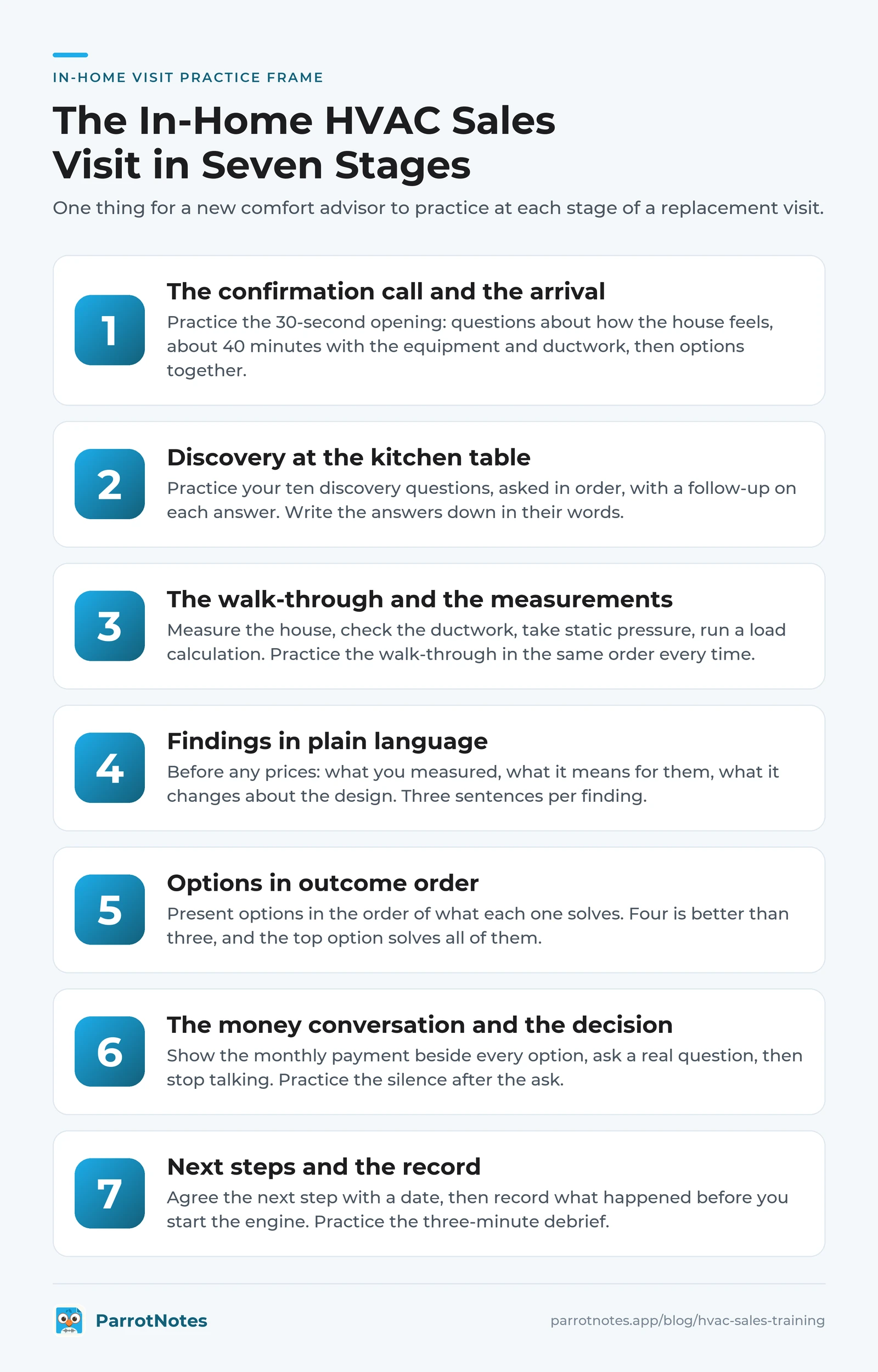
The visit has a shape, and the shape is the syllabus. Here are the seven stages of an in-home replacement visit with one thing to rehearse at each. The spoken lines are examples, not a script to recite.
1. The confirmation call and the arrival
Call the day before to confirm the time, ask who will be home, and ask for a clear path to the equipment. At the door: name, company, shoe covers, and a sentence about how the visit will go.
Practice: the 30-second opening. "I'll ask you some questions about how the house feels, then I'll spend about 40 minutes with your equipment and ductwork, then we'll sit down and look at options together. Does that work?"
2. Discovery at the kitchen table
Before you touch anything, sit down. Ask about rooms that never get comfortable, noise, dust, humidity, the bills, how long they plan to stay in the house, and what happened with the old system. Write the answers down in their words.
Practice: your ten discovery questions, asked in order, with a follow-up on each answer. "You said the back bedroom is always hot. Is that summer only, or all year?"
3. The walk-through and the measurements
This is where a new advisor earns trust or loses it. Measure the house, check the ductwork, take static pressure, look at the return and the attic insulation, photograph the data plate and the electrical panel. Run a load calculation rather than matching the old tonnage.
ENERGY STAR's quality installation guidance for homeowners puts it plainly: "Oversized equipment may cycle too frequently, resulting in less comfort and a shortened lifespan," and the contractor should use "the actual characteristics of your home to determine the equipment that is right-sized for your home," not "a 'rule of thumb.'" On ducts: "Leaky ducts waste energy dollars. They can also reduce airflow, resulting in reduced comfort."
Practice: the walk-through in the same order every time, so nothing gets missed when the homeowner follows you around with questions.
4. Findings in plain language
Back at the table, before any prices, tell them what you found and what it means for the problems from stage 2. Connect the hot bedroom to the undersized return. Connect the high bills to the split supply trunk in the attic.
Practice: three sentences per finding: what you measured, what it means for them, what it changes about the design.
5. Options in outcome order
Present options in the order of what each one solves, not from cheapest to most expensive. Four is better than three. Every option answers a problem from discovery, and the top option solves all of them.
Practice: building four options for the same fictional house from memory, and saying what each one fixes before saying what it costs.
6. The money conversation and the decision
Show the monthly payment beside every option. Then ask a real question: "Which of these feels like the right fit for the house?" Then stop talking.
Practice: the silence after the ask. New advisors tend to fill it fast. Time yourself.
7. Next steps and the record
Whether they signed or not, agree the next step with a date: install scheduling, a call on Thursday, a revised option by email tonight. Then, before you start the engine, record what happened. The rest of this article is built on that record.
Practice: the three-minute debrief, covered below.
A four-week HVAC sales training plan for a new comfort advisor
Here is a practice plan for the first month, built around ride-alongs and the seven stages. It assumes one senior advisor is willing to have you in the truck; if nobody is, ask, because it is the most useful thing your company can give you.
Week 1: ride along and take notes
Ride on every visit your mentor runs. Say nothing at the table. Use the ride-along observation card below on each visit and dictate what you saw in the truck afterwards. Each evening, build the options you would have presented for that house and compare them with your mentor's.
Week 2: own the first half of the visit
Run stages 1 to 3 yourself: the confirmation call, the arrival, discovery, and the walk-through. Your mentor takes over at stage 4. After each visit, note the questions your mentor had to ask in stage 4 that you hadn't covered. Those are next week's practice.
Week 3: run full visits with a mentor in the room
Run all seven stages with your mentor present and silent unless asked. Role play the money conversation every morning before the first appointment, using yesterday's real options. Dictate the debrief after every visit and run the seven-question self-review below.
Week 4: run alone, debrief every visit
Run your own leads. Keep the debrief and the self-review on every visit, and pick one stage a week to work on based on what the self-reviews show. Meet your mentor or manager weekly with the records in front of you, not your memory of them.
The ride-along observation card
New advisors ride along and watch the homeowner, because that's where the drama is. Watch the advisor instead. Here are ten things to watch on every ride-along, one line each. Fill it in during the visit or dictate it straight after.
- The opening: how long it took, and whether the homeowner agreed to the plan for the visit.
- Who was in the room: both decision-makers, or a one-legger, and what the advisor did about it.
- Discovery questions asked: list them. Then list the ones you would have asked that weren't.
- Homeowner's own words: the three phrases they used to describe the problem.
- Walk-through order: what the advisor checked, in what order, and what they photographed or measured.
- How findings were explained: one example of a measurement turned into plain language.
- Options: how many, in what order, and which discovery problem each one answered.
- The money moment: total or monthly first, how the advisor asked for a decision, and how long the silence lasted.
- Objections: the exact words, and what the advisor said back.
- The close or the next step: what was agreed, with what date, and what the advisor recorded before leaving.
Picture Dana in week one, riding with Marcus, who has run in-home visits for eleven years. On the third visit she notices that Marcus asks "how long do you plan to stay in the house?" before anything about equipment, and that his top two options are pitched to the answer. She had never asked that question. It becomes the first item on her own card.
Reviewing your own visits from notes
Here is the habit that separates advisors who improve from advisors who plateau: after each visit, they can say what happened at each stage. Not a feeling. A record.
The three-minute dictated debrief
Before you start the engine, open ParrotNotes, hit record, and talk through the seven stages in order: how the opening went, who was home, what they said the problem was, what you found, which options you built and in what order, how the money conversation went, what was agreed and when. Name each stage as you go so the summary is organized the same way every time.
Recording continues with the screen locked, so the phone sits in the cup holder while you talk. When you stop, you get a transcript, an AI summary, and the action items pulled out, with the Thursday call and the revised option already on the list. Recording works even in a driveway with no signal; transcription and AI run once you're back in coverage.
The seven-question self-review
Read the summary and answer these seven questions, one per stage. Yes or no, then one line.
- Did the homeowner agree to the plan for the visit in the first five minutes?
- Did I ask all ten discovery questions, and can I quote the homeowner's own words for the main problem?
- Did I measure and check everything on the walk-through, in order?
- Did I explain each finding in plain language before any prices came up?
- Did I present at least four options, in outcome order, each tied to a discovery problem?
- Did I show the monthly payment beside every option, ask a real question, and stay quiet?
- Did I leave with a next step and a date, and is it in my action items?
The first "no" from the top is the stage you practice this week. Not all seven. One.
This is self-coaching, and it works because the record is fresh. Our guide to AI sales coaching for field teams covers what a rep can do with the same-day record and what still needs a manager. If you run a team of advisors, our sales coaching software guide has a scorecard for choosing a tool, and once you have a season of debriefs you can build a sales playbook from what your best advisors say at the table.
A word on recording in someone's home
The debrief is you, alone, in the truck. It needs nobody's permission. Recording the kitchen-table conversation itself is a different matter: ask the homeowner first, every time, and don't if they hesitate. In the United States, federal law permits recording a conversation you're part of (18 U.S.C. § 2511(2)(d)), but some states require everyone's consent and rules differ by country. This isn't legal advice; when in doubt, dictate the debrief afterwards. You can read how we protect your data if a homeowner asks where a recording goes.
Want to run the self-review on tomorrow's first visit? Download ParrotNotes free. The free plan gives you 100 minutes of recording a month, up to 30 minutes per recording, with an AI summary on every recording and AI insights on five recordings a month. Pro is $19.99 a month, or $14.99 a month billed annually, with 3,000 minutes a month, recordings up to 3 hours, and AI chat for asking "what did the Hendersons say about the back bedroom?" three weeks later.
A worked example: one visit, reviewed the same evening
Everything below is invented to show the method. Dana and the homeowners don't exist, and the numbers are chosen to illustrate, not to prove anything.
It's Dana's week four. A Tuesday afternoon lead at a 1998 two-story with a 3-ton system that failed on Sunday. Both homeowners are home. The visit runs 95 minutes and ends with "we need to think about it."
Here is her debrief, dictated in the driveway, as ParrotNotes summarized it:
Opening. Explained the plan, they agreed, about a minute. Both home. Discovery. Asked seven of the ten questions. Skipped the humidity question and the how-long-are-you-staying question. Her words: "the upstairs is an oven by four o'clock." Bills around $310 in July. Walk-through. Did the full order. Static pressure 0.9. One 14-inch return for the whole house. Attic supply trunk has a visible split near the air handler. Data plate and panel photographed. Findings. Explained the return and the split trunk. Forgot to connect the split trunk to the July bill. Options. Three options. Cheapest first because he asked "what's the basic one?" and I answered. Money. Showed total price only. Asked "what do you think?" He said "we need to think about it." I said "of course" and started packing up. Next step. Said I'd email the proposal tonight. No date for a call.
Her self-review that evening: question 1 yes, question 2 no. The rule says stop there, but she reads on and sees the pattern: three options in price order, total price only, no real question, no dated next step. Four "no" answers out of seven, all in stages 5 to 7.
What she practices the next morning: the ten questions in order, and four options for last night's house with the top one solving the return, the trunk, and the upstairs oven together. What she does at 8 AM: calls the homeowners, asks for ten minutes on Thursday to walk through a fourth option that fixes the upstairs, and gets it.
HVAC sales tips: the mistakes new comfort advisors make most
Six mistakes that show up in most new advisors' first month. Each maps to a stage, so the fix is a practice item, not a personality change.
- Presenting before diagnosing. Picture Ray, who priced a like-for-like 4-ton swap at the table before he had been in the attic. The attic had a crushed return. The homeowner's brother-in-law found it a week later, and Ray found out when the review went up. Stage 3 before stage 5, every time.
- Matching the old tonnage. The old system was sized by rule of thumb in 1998. Run the load calculation.
- One or two options, cheapest first. Options are how homeowners decide. Four, in outcome order.
- Total price only. Show the monthly payment beside every option, and say both numbers out loud.
- "Of course" after "we need to think about it." Ask what they want to think through. Then answer it.
- No dated next step and no record. An open proposal is 90 minutes you've already spent. Send the follow-up email the same day, put the call on the calendar, and keep the debrief so Thursday's call starts from what they said. Our guide to never missing action items after sales calls has the full post-visit routine.
Practice one stage at a time
HVAC sales training doesn't fail because the content is wrong. It fails because "practice more" never becomes "practice this, tomorrow, at this stage of the visit."
The short version:
- The in-home visit has seven stages, and each one has something specific to rehearse
- Spend the first month on ride-alongs with the ten-point observation card, then own the visit half at a time
- Dictate a three-minute debrief before you leave the driveway, every visit, in stage order
- Run the seven-question self-review and practice the first "no"
Think back to Dana in week three, sitting in the truck with no idea what went wrong. Three weeks later she has a record, one thing to practice, and a Thursday appointment. Download ParrotNotes free, copy the seven questions, and dictate your first visit debrief before your next appointment ends in "we'll think about it."
Frequently Asked Questions
What should HVAC sales training include?
HVAC sales training for a comfort advisor should cover the in-home visit stage by stage: setting expectations at the door, discovery questions, a full walk-through with a load calculation, findings in plain language, four options in outcome order, the monthly-payment conversation, and the decision and next steps. Product knowledge matters, but the conversation skills are what get practiced.
How long does it take to train a new HVAC comfort advisor?
A good HVAC sales training program gives the first month a structure: a week of ride-alongs, a week running the first half of the visit, a week running full visits with a mentor present, and a week running alone with a debrief after every visit. Advisors keep improving long after that, and the ones who improve fastest review their own visits from a record rather than from memory.
How do you practice HVAC sales without a customer?
Role play the seven stages one at a time with a colleague, using yesterday's real house: the 30-second opening, the ten discovery questions, one measurement explained in plain language, four options built from memory, and the silence after the ask. Ten minutes each morning on one stage beats an hour once a quarter.
Is there free HVAC sales training?
Yes, in the sense that the practice plan, the ride-along card, and the self-review in this article cost nothing and work with any company's sales process. Paid courses exist and can be worth it for a team, but the habits that move a close rate are built on real visits, reviewed the same day, whichever program you use.
Related Posts

What Is B2B Sales? A Plain Guide for New Reps
What is B2B sales? A plain-English guide for new reps: B2B vs B2C, the seven-stage cycle, who does what, a first-30-days checklist and a jargon decoder.
Solar Sales: How Closers Keep Track of Every Household
What solar sales is, how closers work, and an eight-field household record for every in-home consultation, plus the follow-up and referral rhythm. Copy it.

Sales Pitch Examples for In-Person Meetings
Eight sales pitch examples written for meetings in the room: structure, filled-in script, when each works, and a 90-second debrief to capture the reaction.