
Dental Sales Rep: Managing a Territory of Practices

Sarah Johnson
Writes about field sales, meeting notes and voice-first workflows at ParrotNotes. Every article is reviewed by the ParrotNotes product team before it goes live.
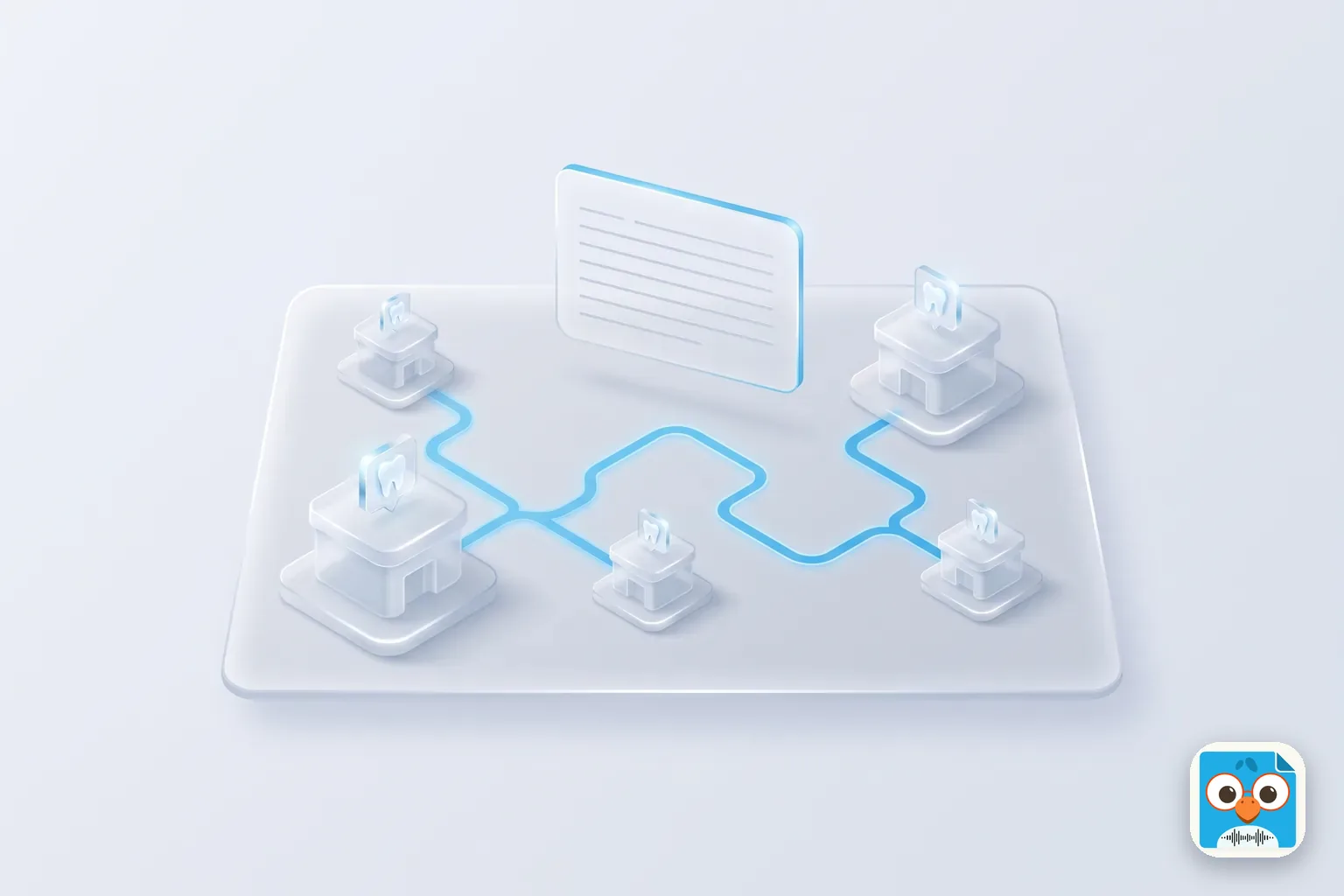
Table of Contents
- 1.What a dental sales rep does (the short version)
- 2.Where a dental sales rep's visit notes live
- 3.Tiering a dental sales territory of 200 practices
- 4.The 90 seconds between patients
- 5.The practice profile card: ten fields per practice
- 6.Demo and lunch-and-learn follow-up
- 7.The quarterly buying rhythm of a dental sales rep
- 8.The end-of-day debrief in the car
- 9.Walk in knowing more than the last rep did
It's 11:40 AM and Priya is at her third practice of the morning. The lead hygienist has 90 seconds before her next patient: "Is the prophy paste still on back order? And what happened with the sterilizer thing you mentioned?" Priya remembers the paste. She can't remember which sterilizer, or whether she promised a quote or a demo.
If you're a dental sales rep, you know that hallway. You cover a few hundred practices, every conversation happens between patients, and the details that decide the quarter are spoken to you in doorways. Priya is invented; the hallway isn't.
This guide is for the working rep, with one short section on what the job is for anyone deciding whether to apply. The rest is a system for running a dental sales territory: tiering the practices, using the 90-second window, keeping a ten-field card per practice, following up on demos and lunch-and-learns, working the quarterly buying rhythm, and debriefing in the car.
One habit runs through all of it: say what happened before you drive. If your company allows a personal voice note for that step, ParrotNotes turns a two-minute spoken debrief into a transcript, a summary, and a list of action items. Read the policy section first.
What a dental sales rep does (the short version)
A dental sales rep sells consumable supplies, equipment, and technology to dental practices for a distributor or a manufacturer. Distributor reps carry a broad catalog (gloves, composites, impression materials, chairs, sterilizers, imaging) and become the practice's main buying contact. Manufacturer reps carry one company's line and work alongside the distributor rep to get it chosen. Both spend the day driving between practices, meeting dentists and office staff between patients.
The market is large and changing shape. The American Dental Association's Health Policy Institute counts 205,088 professionally active dentists in the U.S. in 2025, and its dental practice research reports 135,665 dental practice establishments (Census data, 2023). Ownership is shifting: 72.5% of dentists were private practice owners in 2023, down from 84.7% in 2005, and 16% were affiliated with a dental support organization (DSO) in 2024.
Among dentists up to ten years out of school, ADA News reported in November 2025, more than one in four are DSO-affiliated. That figure matters more to the working dental sales rep than to the job seeker: in a DSO practice, the person in the hallway often can't sign for the chair.
For the career numbers, the Bureau of Labor Statistics doesn't publish a dental-only figure. Its Occupational Outlook Handbook counts the job among wholesale and manufacturing sales representatives, with a May 2025 median of $76,460 across the group and $104,920 for reps selling technical and scientific products, a category that includes medical instruments. The BLS projects about 123,400 openings a year through 2035 and notes that some reps "have large territories and travel considerably." For the general field role hour by hour, see our outside sales rep guide.
One thing to say plainly, once. A dental sales rep's conversations are with the practice, about the practice's purchases: what it uses, what it owns, what it plans to buy. Patient information is no part of that, and it never goes in a visit note, typed or spoken. Every example in this guide is written that way.
Where a dental sales rep's visit notes live
Your company's compliance policy decides where notes about a practice may be kept. Many distributors issue a CRM and a company phone and expect every visit logged there; some allow personal notes, some don't. Read the policy before you change any habit, and ask when it's unclear. That includes any personal app, ParrotNotes included.
Whatever tool you use, don't record inside a practice: patients are within earshot in every hallway. The debrief in this guide has one voice on it, yours, alone in a parked car. Our medical device sales guide applies the same rule to a stricter setting, and the pharmaceutical sales rep guide has seven questions to send your compliance contact.
Tiering a dental sales territory of 200 practices
A territory of 200 practices can't be visited evenly. Ten stops a day across 20 working days is 200 visits a month, which sounds like once each, until you subtract lunch-and-learns, installs, and service calls. Tiering decides who gets a dental sales rep's time before the calendar decides it.
The four tiers
Score every practice on four things: what it buys from you now, how much of its total spend that is (share of wallet), what equipment it's likely to replace in the next 18 months, and whether the people you meet can buy. Then sort:
- Tier A, grow and protect: high spend or high potential, an equipment conversation open, decision-maker on site. Every two weeks.
- Tier B, develop: steady consumables buyer, room to grow share, no equipment decision yet. Monthly.
- Tier C, maintain: small or loyal-elsewhere accounts, worth a regular face. Every eight weeks, with a call in between.
- Tier D, watch: DSO sites where purchasing sits elsewhere, practices closing or selling, accounts that said no twice this year. Quarterly, because ownership changes.
The worksheet, with the arithmetic
Here's the worksheet for a 200-practice dental sales territory. Change the counts to match yours; the method is the same.
| Tier | Practices | Cadence | Visits per month | Share of your visits |
|---|---|---|---|---|
| A | 30 | Every 2 weeks | 60 | 35% |
| B | 60 | Monthly | 60 | 35% |
| C | 80 | Every 8 weeks | 40 | 24% |
| D | 30 | Quarterly | 10 | 6% |
| Total | 200 | 170 | 100% |
That's 170 planned visits a month, or 8.5 a day over 20 working days. If your day holds seven stops, the tiers tell you where to cut: move ten Tier B practices to Tier C and you drop to 165 without touching an A. Re-tier once a quarter; a Tier C practice that mentions a new associate is a Tier B practice by the next visit.
The route cycle
Group the tiers geographically into a three-week loop, so every Tier A practice falls on the route twice, every Tier B once, and half the Tier Cs once. Reps interviewed by Dentaltown described running their territories on two- and three-week cycles for the same reason: an office learns which day is "rep day," and the calls stop arriving at random.
The 90 seconds between patients
A dental practice runs on a schedule you can't move, so a dental sales rep plans the visit around it. The three windows are before the first patient (7:30 to 8:00 AM), lunch, and the last half hour of the day. Everything else is a hallway conversation, and it lasts as long as the gap between patients.
Use the window well by knowing who to ask what:
- Office manager: orders, back orders, invoices, budget, the promo. In most independent practices the ordering decision sits here.
- Dentist: equipment, technology, clinical materials. Two questions maximum, and only if they come out of the operatory.
- Lead hygienist: hygiene consumables, polishing and fluoride products, the scaler on its last legs.
- Lead assistant: sterilization, disposables, the supply closet's real state.
Then ask three things, in this order: "Anything short this week?" (the order), "Anything on your mind for the next few months?" (the equipment conversation), and "What should I bring next time?" (the reason to come back). Confirm what you owe before you leave, out loud: "So that's the sterilizer quote by Thursday and samples of the new composite."
Don't open the laptop, and don't write while they talk. Look at the person, then write in the car.
The practice profile card: ten fields per practice
Here's the part to copy. A dental sales rep who keeps these ten fields per practice, updated after every visit, walks in knowing more than the last rep did. Keep it in the CRM if your company requires that; the fields are the point, not the tool.
| # | Field | What goes in it | Example (Riverside Family Dental, invented) |
|---|---|---|---|
| 1 | Practice and ownership | Independent, group, or DSO; who can sign for what | Independent, two owners; Dr. Okafor signs for equipment |
| 2 | People | Dentists, office manager, lead hygienist, lead assistant, who places orders | Dr. Okafor, Dr. Lin; OM Teresa (orders Tuesdays); hygienist Bea; assistant Sam |
| 3 | Order rhythm | How and when they order, monthly budget band | Online, Tuesday mornings; about $4,000 a month in consumables |
| 4 | Current suppliers | Who else they buy from, and for what | Composites and impression material from a competitor; everything else from us |
| 5 | Equipment inventory and age | Chairs, imaging, sterilizers, handpieces, CAD/CAM, with year | 4 chairs (2015); pan (2018); 2 sterilizers (2012, 2019); no CAD/CAM |
| 6 | Next likely purchase | What and when, in their words | "Sterilizer number one won't see another year." Target: Q4 |
| 7 | Service history and open issues | Repairs, complaints, back orders | Chair 3 hydraulics repaired May; prophy paste on back order since Sept 10 |
| 8 | Promises I made | What, to whom, by when | Sterilizer quote to Teresa by Thursday; composite samples for Dr. Lin |
| 9 | Promises they made | Next order, decision date, who else to meet | Teresa to send the September usage list; Dr. Okafor "after the CE weekend" for the sterilizer |
| 10 | Visit preferences | Best time, rep day, lunch rules, parking | Thursdays before 8 AM; lunch-and-learns on the last Friday; park behind the building |
Fields 8 and 9 are where the quarter is won. Field 1 is where DSO territories differ: if the practice belongs to a group with central purchasing, write the regional contact's name and how the site requests an exception, because the hallway conversation still decides what gets requested.
Nothing about a patient goes on this card. Not a name, not an appointment, not "the crown case Dr. Lin mentioned." The card describes the practice as a business, which is all a dental supply rep needs.
Demo and lunch-and-learn follow-up
A lunch-and-learn is 45 minutes with the whole team in one room, which happens nowhere else in a dental sales rep's week. The mistake is treating the lunch as the event. The event is the three follow-ups in the 24 hours after it.
The three follow-ups after a lunch-and-learn
- The thank-you with the summary, to the office manager and the dentist, the same afternoon: what the team asked about, what you're sending, and the one date. Our guide to the follow-up email after a sales call has the template.
- The samples or the quote, within 24 hours, addressed to the person who asked. A hygienist who asked about a fluoride varnish gets the samples with her name on them, not a box at the front desk.
- The next step booked: a demo date, a trial period, or the next lunch. If you leave with nothing on the calendar, the lunch was catering.
The equipment demo
Picture Marcus, who ran a CAD/CAM demo at a two-dentist practice in April. Neither dentist could decide, so Marcus sent a quote email with four parts: the price with the promotion and its end date, the monthly financing option, the install timeline with training days, and the trade-in on their old scanner. He logged one objection in field 8: "Dr. Patel wants to know how many crowns a month makes it pay."
He brought that number to the next visit, then a reference practice's name, then a second demo for the associate who'd been out. The order came in October. Marcus is invented, but the timeline is typical of dental equipment sales: a demo starts a quarter-long conversation, and the dental sales rep who keeps the record is the one still in it at the end. The objection handling guide covers logging the pushback.
The quarterly buying rhythm of a dental sales rep
Practices buy consumables weekly and equipment in waves: quarterly distributor promotions, manufacturer trade-in offers around the big meetings, and a year-end cluster when owners ask their accountants what to put in service before December 31. Plan the territory in 13-week blocks:
- Weeks 1 to 2: re-tier the list. Every field 6 entry becomes a line in your equipment pipeline with a target quarter.
- Weeks 3 to 10: the route. Every Tier A practice gets a lunch-and-learn or demo this quarter; every Tier B gets one offered.
- Weeks 11 to 12: the promo push. Go back to every field 6 entry targeted at this quarter with the offer in hand.
- Week 13: the sweep. Clear every field 8 promise, update every field 9 date, and send office managers next quarter's order calendar.
The fourth quarter is different. Year-end equipment decisions land in November and December, so the demos that feed them happen in September and October. If field 6 says "Q4" on twelve practices, September is when you book twelve demos.
Want the debrief habit that keeps the fields current? Download ParrotNotes free and try it after your next route day. The workflow is in the next section.
The end-of-day debrief in the car
Ten stops a day means ten sets of promises, and by 5:00 PM the first three have blurred into the last three. The fix is a short spoken debrief after each stop, before the engine starts: two minutes per practice, in the order of the card's fields.
The dental sales rep's six-line script
- Practice, date, who I saw. "Riverside Family Dental, September 25, Teresa and Bea."
- What's short and what's ordered. Fields 3 and 7.
- Equipment and timing. Anything said about age, breakdowns, or plans, in their words. Fields 5 and 6.
- What I promised. Item, person, date. Field 8.
- What they promised. Item, person, date. Field 9.
- Changes to the card. A new office manager, a new associate, a changed rep day. Fields 1, 2, and 10.
About 90 words, no patient in it, and every promise now has a date.
Where ParrotNotes fits
If your company allows a personal voice note for the debrief, ParrotNotes is built for that minute. Stay parked, tap record, and say the six lines; recording continues with the screen off. When you stop, you get a transcript, an AI summary, and your action items with dates, and it can draft the follow-up email to the office manager from what you said. Label the note with the practice name, and search finds "sterilizer" across a quarter of debriefs when field 6 comes due.
Recording works with no signal in a basement garage; transcription and AI run once you're back in coverage. The free plan covers 100 minutes of recording a month, up to 30 minutes per recording, with an AI summary on every recording and 5 AI-powered recordings a month. Pro is $19.99 a month, or $14.99 a month billed annually, for 3,000 minutes, recordings up to 3 hours, all AI features, and AI semantic search across every note. ParrotNotes encrypts data in transit and at rest, as its security page sets out.
Picture Dana, a dental sales rep on a Friday, eleven stops behind her, debriefing in a supermarket parking lot. At stop seven, the front desk had mentioned in passing that Teresa, the office manager who'd ordered every Tuesday for six years, was leaving at the end of the month. Dana said it into the debrief, and the action item came back: "Meet the new office manager before October 1; re-confirm the Tuesday order routine." Without the debrief, she'd have remembered it the Tuesday the order didn't arrive.
Dana is invented; the Tuesday order that doesn't arrive is every dental supply rep's story. The rest of the carry kit is in our sales tools for field reps guide.
Walk in knowing more than the last rep did
Running a dental sales territory well comes down to four habits: tier the practices so your time goes where the growth is, use the 90 seconds between patients to ask three questions and confirm what you owe, keep a ten-field card per practice with no patient in it, and debrief in the car before the next stop so fields 8 and 9 stay true.
Start with the tiering worksheet this week and the card on your Tier A practices. Then check your company's policy on where a dental sales rep's notes may live. If it allows a personal voice note, download ParrotNotes free and run the six-line debrief after tomorrow's first stop. Priya's sterilizer question gets an answer, and Teresa's replacement gets a visit before the first Tuesday order goes missing.
Frequently Asked Questions
What does a dental sales rep do?
A dental sales rep sells consumable supplies, equipment, and technology to dental practices on behalf of a distributor or a manufacturer. The day is spent visiting practices in an assigned territory, taking and troubleshooting orders with the office manager, discussing equipment with the dentist, running lunch-and-learns and demos, and recording each visit so the next one starts where the last one ended.
How much does a dental sales rep make?
The Bureau of Labor Statistics doesn't publish a dental-only figure. It counts the job among wholesale and manufacturing sales representatives, with a May 2025 median of $76,460 across the group and $104,920 for technical and scientific products, which include medical instruments. Most distributor and manufacturer roles pay a base plus commission, so the split matters as much as the headline.
How many practices does a dental sales rep cover?
It varies by company, product line, and geography, so treat any single number with care. This guide's worksheet uses 200 practices as a worked example: 30 in Tier A every two weeks, 60 in Tier B monthly, 80 in Tier C every eight weeks, and 30 in Tier D quarterly, about 170 planned visits a month.
Do dental sales reps deal with patient information?
No. A dental sales rep's conversations are with the practice about the practice's purchases: supplies, equipment, service, and budget. Patient information is no part of the job and never belongs in a visit note, typed or spoken. If a patient comes up in a hallway conversation, let it pass.
Can a dental sales rep use a voice note app for visit notes?
Only if the company's compliance policy allows it. Many distributors require every visit logged in the company CRM, and some restrict personal apps. Ask before using any personal app, ParrotNotes included, and never record inside a practice, where patients are within earshot. A debrief spoken alone in a parked car, with no patient in it, is the use this guide describes.
Related Posts
What Is an RFQ? A Seller's Guide to Requests for Quote
What is an RFQ? A seller's guide: when buyers issue a request for quote, what it contains, how to respond and win, plus a response checklist and worked example.

How to Transcribe Voice Notes Into Organized Text
Learn how to transcribe voice notes into organized text: capture rules, three transcription routes, four note templates, and a weekly review. Try it free.

Staff Meeting Agenda Template: Three Formats That End on Time
Copy a staff meeting agenda template for a weekly team, a monthly all-staff or a small office, with time boxes and owners, then run it so it ends on time.