
Medical Device Sales: A Day in the Field and How Reps Stay Organized

Sarah Johnson
Writes about field sales, meeting notes and voice-first workflows at ParrotNotes. Every article is reviewed by the ParrotNotes product team before it goes live.
Table of Contents
- 1.What medical device sales is, and who this guide is for
- 2.A day in medical device sales, hour by hour
- 3.The rules that decide what a medical device sales rep may write down
- 4.What goes where: a routing table for medical device sales reps
- 5.The five-line post-case debrief
- 6.Staying organized across a territory: the weekly rhythm
- 7.Where ParrotNotes fits for a medical device sales rep
- 8.Keep the note small and the routing right
At 5:40 AM, Priya is in a hospital loading dock with two instrument trays and a coffee. She's three years into medical device sales, covering trauma and orthopedics, and the first of three cases starts at 7:00. Before she checks in at the vendor kiosk, she opens both trays and counts every plate and screw against the set list.
By 11:30, the third case is done. A scrub tech mentioned, in passing, that a driver felt like it stripped. The surgeon asked for longer plate sizes next time. Her phone shows a text from another hospital: a credential expires on Friday.
Priya is invented, and so is everyone else named here. The morning isn't. Every medical device sales rep knows the pattern: hours of attention on someone else's procedure, then a hallway full of details that matter and nowhere to write them.
This guide is for reps already doing the job, not for people deciding whether to apply. You'll get an honest day in the life of a medical device sales rep, the rules that govern what you may write down, a routing table for everything you hear, a five-line post-case debrief, and a weekly rhythm that keeps trays, credentials, and follow-ups from slipping.
One thing first. Your company's compliance policy decides what you may note and where. Nothing here overrides it, and none of this is legal advice.
What medical device sales is, and who this guide is for
A medical device sales rep sells and supports implants, instruments, disposables, or capital equipment to hospitals, surgery centers, and clinics for a manufacturer or distributor. Unlike most field sales, the rep is often present while the product is used: standing in an operating room, at the surgeon's request, to answer technical questions about the system on the table.
If you came for the career numbers, here's the short version. The Bureau of Labor Statistics doesn't publish a device-only figure. It counts the job among sales representatives of technical and scientific products, a group whose products "include pharmaceuticals, medical instruments, and industrial equipment." The BLS Occupational Outlook Handbook puts that group's median annual wage at $104,920 in May 2025.
For the working rep, every case day produces things you'll need later: sizes to restock, loaners due back, a request from the OR educator. If your company allows a personal voice note for your own logistics, ParrotNotes turns a one-minute spoken list into a transcript, a summary, and action items. Read the policy section before you try it.
A day in medical device sales, hour by hour
A capital equipment rep has a calendar of demos and committee meetings; an ortho or spine rep has a calendar of cases. The day below is the case coverage version, because it generates the most detail with the least time to capture it.
5:30 AM: trays, loaners, and the trunk
Case days start before the hospital's day shift. If the procedure uses loaner instrument sets, they reached sterile processing the day before, and the rep checks that they came back complete. Consigned implants stored at the hospital get a look for the sizes the surgeon is likely to need. Anything short comes from trunk stock, the product a rep carries in the car for exactly this reason.
7:00 AM: in the OR, at the surgeon's request
Reps don't wander into operating rooms. The American College of Surgeons statement on health care industry representatives says a rep's presence is "at the discretion of the operating surgeon," that the patient "should be informed of the presence and purpose" of the rep, and that reps "should not scrub in or be involved in direct patient contact."
So the job in the room is narrow: confirm the right sizes and accessories are available, answer questions about settings and instrument sequence, and stay out of clinical decisions. Nothing gets written down in the OR, and phones stay away.
Between cases: where the detail leaks
The 20 minutes between cases is where a rep's real information arrives. The surgeon wants longer plate sizes stocked. The circulating nurse asks about the new tray configuration.
A scrub tech says a driver felt like it stripped, and the OR coordinator mentions an add-on case Thursday. None of it gets written down, because you're moving trays to the next room.
Afternoon: territory reality
After the last case, the day turns into ordinary field sales with extra paperwork. Implant usage from the morning gets documented for billing, by lot and catalog number. Replenishment orders go in so the consigned sets are whole again. Loaners get scheduled back to sterile processing for the next case.
Then the drive: a surgery center count, a visit to a surgeon's office, a value analysis meeting where the hospital reviews a product you want to introduce. Somewhere on the highway, the morning's requests blur.
Evening: the phone that doesn't stop
Case schedules change overnight. Trauma adds a 6:00 AM case, a surgeon's office changes tomorrow's approach, which changes the sets, and a credential needs a new document uploaded this week. Most of it lands after 6:00 PM, on details that were spoken hours earlier.
The rules that decide what a medical device sales rep may write down
In other trades a longer note is a better note. A device rep's note is a company record that a hospital, an auditor, or a lawyer may read later.
So the skill isn't writing more. It's knowing which kind of information belongs in which system. Four sets of rules touch an ordinary case day.
The AdvaMed Code of Ethics. The Revised and Restated AdvaMed U.S. Code of Ethics, the medtech industry's voluntary code, took effect on November 1, 2025. Section VII allows "modest meals and refreshments" that are "subordinate in time and in focus" to a business or educational discussion, only for health care professionals who "actually attend," and never as a "dine & dash" drop-off or for "an entire office staff where everyone does not attend the meeting."
Section XII allows "reasonable quantities" of evaluation product, says the terms of an evaluation "should be set in advance in writing," and encourages "taking periodic inventory of consigned devices." Section XIII says representatives "should enter and be present in the clinical setting only at the request of and under the supervision of a Health Care Professional."
Open Payments. CMS calls Open Payments "a national disclosure program" for payments that reporting entities, "including drug and medical device companies," make to covered recipients such as physicians. Under 42 CFR 403.904, manufacturers report each transfer of value by nature. The list of natures includes food and beverage (CMS's example: "the salesperson and physician meet for lunch, and the salesperson pays for the meal"), education, travel and lodging, and "long-term medical supply or device loan." Your attendee list and your evaluation paperwork feed a public database, so they have to be right.
Medical device reporting. FDA's 21 CFR Part 803 requires manufacturers to report deaths, serious injuries, and certain malfunctions involving their devices within 30 calendar days, and within 5 work days when the event needs remedial action. The clock can start with you. A manufacturer is "considered to have become aware of an event when any of your employees becomes aware of a reportable event." That includes a scrub tech's remark about a stripped driver. Your company gives you a short internal deadline to pass complaints on. Learn it.
Vendor credentialing. Hospitals screen outside reps before allowing them into patient care areas, and the specifics vary by facility. Here's one written example. Ohio State's Wexner Medical Center vendor access policy requires reps to register in its vendor management system at least five business days before a first visit and annually after that, with immunization evidence, a background check, and training modules for perioperative areas. In its ORs, vendors "leave the OR/procedural area when patient arrives" and may return once the patient is draped and "prior patient consent has been granted." Photographs and videos are prohibited, and so is taking documents with patient-specific information.
Company policies differ as much as hospital ones. One company allows free-text case notes in the CRM and screens them; another allows none. Read yours before changing any habit, and ask when it's unclear.
What goes where: a routing table for medical device sales reps
Trouble with case notes usually comes from putting true information in the wrong place. This table sorts what a device rep hears on a case day by where it belongs. Mark it up against your company's procedures.
| What you heard or did | Where it belongs | What stays out of your note |
|---|---|---|
| Case details: facility, surgeon, procedure type, system and sizes used, what went well or slowly | Case log in the approved CRM or case-tracking system | Patient name, MRN, date of birth, diagnosis, or anything that identifies the person on the table |
| Implants and disposables used, by lot and catalog number | Implant usage record or billing sheet, filed inside your company's deadline | Copies of patient labels, photos of the sticker sheet |
| Trunk stock, consigned sets, loaners, expiring product | Inventory system, consignment agreement, loaner schedule | Informal transfers ("borrowed two screws from set B") |
| A surgeon, nurse, or tech mentions a device problem, malfunction, or injury | Your company's complaint or MDR channel, the same day | Your own theory of the cause, clinical detail, patient identifiers |
| Evaluation or demo product left with a customer | Evaluation agreement in writing, with dates and no-charge documentation | "Left a few for them to try" |
| A request: sizes to stock, an in-service, a tray change, a purchasing question | Case log plus your task list, with a due date | Promises you can't keep |
| Lunch, in-service meal, or any transfer of value | Expense and attendee record (Open Payments) | Staff who weren't at the presentation |
| Credentials, route, own to-dos, replenishment reminders | Credentialing platform, your calendar, or a personal note | Nothing sensitive here, so keep it wherever you'll see it |
| Anything that could identify a patient | Nowhere | Names, initials, ages, dates of birth, room numbers, "the 7:00 AM case" paired with any of these |
The "nowhere" row
Surgical teams talk about patients all day, and you're in the room. Your job is to let it pass through you without landing in any note, typed or spoken. Complaints have their own channel with its own rules about what to collect, and that channel, not your case log, is where an event's detail belongs. ParrotNotes makes no HIPAA claim, and neither should any note you keep.
The five-line post-case debrief
Here's the part to copy. It takes about 60 seconds after the last case, once you're out of the building. Type it into the CRM, use approved dictation, or speak it as a personal voice note if your policy allows. Stay parked while you do it.
The script
- Where and what. Facility, surgeon, procedure type, system used, date. No patient identifiers.
- What was used and what's short. Implants and sizes consumed, sets that need restocking, loaners due back and when.
- What the team asked for. Sizes to stock, a tray change, an in-service, a purchasing question, in neutral words.
- What I routed. A flag only: "complaint reported at 11:40," "eval request sent to sales ops," "lunch logged with attendees." The detail lives in those systems, not here.
- Next. The next case with this surgeon, what to bring, and each follow-up with a due date.
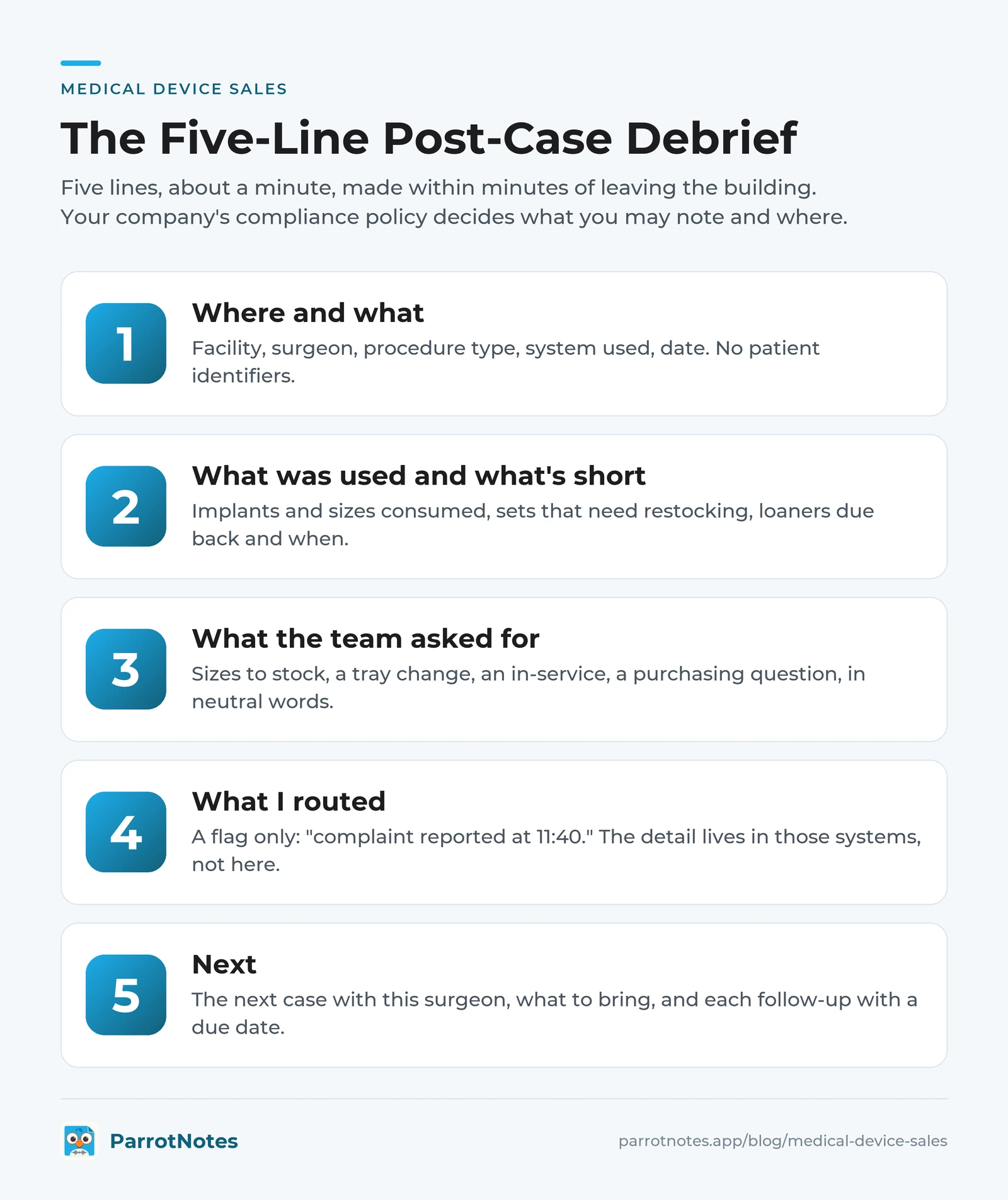
Line 4 is what makes this a device debrief. It shows you did the right thing without copying the sensitive part into a second place.
The red-flag word check
Before you save, scan the note for words that mean it's carrying something it shouldn't. It takes 10 seconds.
- Patient words: "patient," a name that isn't a clinician or staff member, an age, a date of birth, a room number, an MRN
- Complaint words: "failed," "stripped," "broke," "bent," "revision," or any description of what happened to a device during a case
- Claim words: "works better than," "fewer complications," an off-label use, or anything not in your approved materials
- Deal words: "promised," "in return," "will switch," or anything linking a meal, an evaluation, or a loan to future purchases
- Opinion words: "difficult," "slow," "hates us," and any joke
If a flagged word shows up, don't reach for a synonym. Move the information to the channel where it belongs, then leave a flag on line 4.
A risky case note, rewritten
This example is invented. The product, the hospital, and the people don't exist.
Before, typed at 9:45 PM from memory:
"Great day with Dr. R. Three cases, second one was a 54-year-old with a bad distal radius, the T15 driver stripped mid-case but we got through it. Dr. R said if we sort out the longer plates he'll move his volume over. Brought lunch for the whole floor."
Four sentences, four problems: a patient identified, a possible device complaint buried in a sales note, a stocking request tied to future volume, and a meal the AdvaMed Code wouldn't allow if the whole floor wasn't in the meeting. A clean note can't fix a call that went wrong. If any of that happened, tell your manager or compliance contact.
After, spoken in the parking garage at 11:50 AM:
"Sept 22, Mercy General, Dr. R, three distal radius cases, small-fragment system. Used sizes 8, 10 and 12 plates; set 2 needs restock; loaner set 3 back to SPD by Wednesday for Thursday's add-on. Team asked for longer plate sizes in consignment and an in-service for the new circulating nurses. Complaint reported through the product complaint line at 11:40, no detail here. Lunch logged with the four attendees. Next: confirm longer sizes stocked by Sept 29, book in-service with the OR educator, bring the sizing guide Thursday."
About 90 words, and every sensitive item sits in its own system with a flag pointing to it.
Staying organized across a territory: the weekly rhythm
The debrief handles one case day. A territory needs a rhythm that catches the things that expire: credentials, consigned product, loaner windows, and evaluation periods.
- Daily: tray and trunk check before the first case; five-line debrief after the last; implant usage and replenishment orders the same day
- Weekly: one consignment count; expiring-product sweep of the trunk; credential check for anything due in the next 30 days; expense and attendee reconciliation for the week's meals
- Monthly: evaluation products due back, against the written terms; loaner sets on the schedule for the month's booked cases; every open request on line 5 closed or re-dated
- Quarterly: annual credential renewals coming up, per facility; Open Payments detail for anything your company will report
Picture Marcus, a spine rep with cases at four hospitals. In March, a TB test result lapsed at one of them, and he found out at the check-in kiosk at 6:15 AM on a case day. Marcus spent the morning in the lobby. Now every credential expiry sits in his calendar 30 days ahead, and the weekly check takes two minutes.
The habit behind all of this is the owner-and-due-date rule from our guide on how to never miss action items from sales calls, and the debrief grew out of the two-minute debrief script for field reps.
Where ParrotNotes fits for a medical device sales rep
ParrotNotes is a personal voice-note app. It doesn't replace your CRM, your inventory system, or your complaint channel, and your company decides whether a personal app may hold anything about a case, a surgeon, or a product. Ask compliance before you use one, ParrotNotes included. If the answer is no, respect it.
Whatever tool you use, never record inside a hospital, an OR, a surgery center, or a clinic. Patients and their information are within earshot, and the facility and your employer have their own rules.
The law varies too. Federal law, at 18 U.S.C. 2511(2)(d), permits recording where "one of the parties to the communication has given prior consent." California Penal Code section 632 is stricter, penalizing recording a confidential communication "without the consent of all parties."
Rules differ by state and country, and this isn't legal advice. Outside the building, ask before recording anyone.
Even with a strict policy, your week holds plenty of work with no surgeon, product, or patient in it. Start there:
- The route. Talk through tomorrow's cases and stops on the drive home, and get it back as a list.
- Your own to-dos. "Restock sizes 12 and 14, loaner set 3 to SPD by Wednesday, upload TB result before Friday, expense report Sunday."
- Credential renewals. Say each facility's expiry dates once, then search "expires" a month later.
- Training and team meetings. Regional meetings, product training, and in-service rehearsals, when the organizer allows recording and everyone has agreed.
If your policy does allow a personal debrief, the five-line script is built for it. Tap record in the parking garage and talk for a minute (recording continues with the screen off). You get a transcript, an AI summary, your action items, and a drafted follow-up email for the OR educator or the surgeon's office. Search finds "loaner set 3" a month later.
The free plan covers 100 minutes of recording a month, up to 30 minutes per recording, with an AI summary on every recording and 5 AI-powered recordings a month. Pro is $19.99 a month, or $14.99 a month billed annually, for 3,000 minutes and recordings up to 3 hours. ParrotNotes encrypts data in transit and at rest, as its security page sets out, and makes no HIPAA claim.
Policy says yes? Download ParrotNotes free and try the five-line debrief after your next case day. Our guide to the follow-up email after a sales call turns the debrief into the email, and the pharmaceutical sales rep call notes guide applies the same routing idea to that trade's rules.
Keep the note small and the routing right
Good notes in medical device sales are short, neutral, and made within minutes of leaving the building. They say where you were, what was used, what the team asked for, what you routed, and what's next. Everything sensitive lives in the system built for it, and patient details live nowhere. Start this week: ask compliance which apps, if any, may hold a personal debrief, then run the five-line script after your next three case days.
Whether you've been in medical device sales for ten weeks or ten years, the habit matters more than the tool. If your policy allows a personal voice note, ParrotNotes turns a one-minute debrief into a transcript, a summary, and a list of next steps. Download ParrotNotes free and try it after your next case.
Frequently Asked Questions
What does a medical device sales rep do all day?
A medical device sales rep sells and supports implants, instruments, or equipment for a manufacturer or distributor. On a case day that means checking trays and trunk stock before dawn, giving technical support in the OR at the surgeon's request, documenting implant usage by lot number, restocking consigned sets, and handling schedule changes in the evening.
Do medical device sales reps go into the operating room?
Often, yes, but only at the surgeon's request and under hospital rules. The American College of Surgeons says reps should not scrub in or have direct patient contact, and that the patient should be informed of their presence. Hospitals credential reps before allowing OR access, and some require reps to leave the room when the patient arrives.
Can a medical device rep keep case notes in a personal app?
Only if the company's compliance policy allows it. Employers in this industry often restrict where case details may be written, and notes kept outside the CRM can still be read in an audit. Personal logistics with no surgeon, product, or patient detail, such as routes, to-dos, and credential renewals, are the safe place to start.
What should a rep do when a surgeon mentions a device problem?
Report it through the company's complaint channel the same day, inside the internal deadline. Under 21 CFR Part 803, a manufacturer is considered aware of a reportable event when any employee becomes aware of it, and reports are due to FDA within 30 calendar days, or 5 work days when remedial action is needed. Leave only a flag in your case note.
Related Posts

Voice Notes on iPhone: Everything You Can Do With Them
Voice notes on iPhone can do more than record. Learn to capture, tidy, transcribe, sync, and share them, and which iPhone voice tool fits each job. Try it free.

Sandler Pain Funnel Questions (With a Note-Taking Template)
The 8 Sandler pain funnel questions as Sandler publishes them, what to write down at each one, a note-taking template and a worked call. Copy it free.

Sales Meeting Agenda: Templates for Weekly Team Meetings
Running a weekly sales meeting that produces nothing? Copy four sales meeting agenda templates for field teams, plus a rep prep card and a record-ready run.