
Pharmaceutical Sales Rep: How to Keep Call Notes Between Visits

Sarah Johnson
Writes about field sales, meeting notes and voice-first workflows at ParrotNotes. Every article is reviewed by the ParrotNotes product team before it goes live.

Table of Contents
- 1.What a pharmaceutical sales rep does all day, and where notes fit
- 2.Why call notes are harder for a pharmaceutical sales rep
- 3.What goes where: a routing table for every pharmaceutical sales rep
- 4.The six-line debrief for a pharmaceutical sales rep
- 5.Where to keep notes: seven questions for compliance
- 6.A between-visits rhythm for a full call day
- 7.Keep the note small and the routing right
It's 10:40 AM on a Tuesday, and Maya, a pharmaceutical sales rep, has made three calls since 8:00. At the second office, a cardiologist gave her 90 seconds between patients and asked for the new dosing card. At the third, the office manager told her lunches now have to be booked six weeks out.
By the time she parks at the fourth office, the lunch rule is still clear. The dosing card request has blurred. Was that Dr. Patel, or the practice down the road?
Maya is made up, and so is everyone else named in this article. The blur is real. Every pharmaceutical sales rep knows it: a minute or two with a prescriber, five with the front desk, and then you're driving again.
You can't fix it by writing everything down, either. In this trade, what you write, and where you write it, is governed by rules that don't apply to a rep selling software or roofing.
This guide is for the pharmaceutical sales representative already in the job, not for people weighing up the career. You'll get the rules explained from the primary documents, a routing table for everything you hear, a six-line debrief, a risky note rewritten, and seven questions for your compliance team.
One thing first. Your company's compliance policy decides what you may note and where. Nothing here overrides it, and none of this is legal advice.
What a pharmaceutical sales rep does all day, and where notes fit
A pharmaceutical sales rep visits physicians, nurse practitioners, pharmacists, and other health care professionals (HCPs) on behalf of a drug manufacturer. The rep presents approved information about the company's medicines, answers questions that fall inside the label, delivers samples where that's permitted, and records each interaction in the company's system of record.
If you're here for the career numbers, the Bureau of Labor Statistics doesn't publish a pharma-only figure. It counts the job among sales representatives of technical and scientific products, a group whose products "include pharmaceuticals, medical instruments, and industrial equipment." The BLS Occupational Outlook Handbook puts that group's median annual wage at $104,920 in May 2025.
For the working rep, every stop produces something you'll need later: access rules from the front desk, requests from the HCP, a signed sample receipt. The car is where that detail leaks away, and a one-minute habit before you start the engine closes the gap. If your company allows a personal voice note for that step, ParrotNotes turns a spoken debrief into a transcript, a summary, and a list of action items. Read the policy section below before you try it.
Why call notes are harder for a pharmaceutical sales rep
In other field sales, a longer note is a better note. A pharmaceutical sales rep's note is a company record that an auditor, a regulator, or a lawyer may read years later. So the skill isn't writing more. It's knowing which kind of information belongs in which place.
The rules that sit around every conversation
Five sets of rules touch an ordinary office call. Here's what each one means for your notes.
The PhRMA Code. The voluntary PhRMA Code on Interactions with Health Care Professionals was last updated in August 2021 and took effect on January 1, 2022. Section 2 allows occasional meals with a presentation when the meal is "modest as judged by local standards," and says meals from field reps should be "limited to in-office or in-hospital settings." Section 10 rules out pens, note pads, and mugs, and section 11 caps educational items at "$100 or less."
FDA rules on promotion. Section 1 of the code says promotional materials should "be consistent with all other Food and Drug Administration (FDA) requirements." Scientific information on unapproved uses is a separate channel. FDA's January 2025 final guidance on communications to health care providers about unapproved uses covers "firm-initiated communications." That's a company process, not something a rep improvises in a hallway.
Open Payments. CMS calls Open Payments "a national disclosure program." Its list of payment categories includes food and beverage, and its example is a drug salesperson buying a physician lunch. Your attendee list feeds a public database, so it has to be right.
Sample rules. Under 21 CFR 203.31, a rep can leave a drug sample only against a written request signed by the licensed practitioner, and the recipient signs a receipt on delivery. Manufacturers must also inventory the samples their reps hold at least once a year.
Adverse events. 21 CFR 314.80 requires drug companies to report each serious and unexpected adverse drug experience "as soon as possible but no later than 15 calendar days from initial receipt." The clock can start with you, which is why your company gives you a short deadline to pass one on. Check yours.
Why your CRM has so few text boxes
If your call page is mostly dropdowns, that was a choice. Veeva, which sells CRM software to life sciences companies, explains why in its March 2026 guide for compliance teams, Saying Yes to Free Text in CRM.
From the mid-2000s, the guide says, compliance leaders limited free text because "user-generated call notes and narrative documentation could be used as evidence against companies in government enforcement actions and private litigation."
It's just as blunt about what happened next. Field users "turned to other tools: personal notes applications, calendar entries, email drafts, and other unsanctioned systems." Those notes didn't escape oversight: "Documentation that exists outside of CRM remains discoverable."
So a private note about an HCP isn't private in the way you'd hope.
Your company's policy decides
Policies differ. One company allows free-text call notes in the CRM and screens them. Another allows none. Read yours before you change any habit, and ask when it's unclear. The routing table and the debrief below work inside an approved CRM just as well as anywhere else.
What goes where: a routing table for every pharmaceutical sales rep
Trouble with HCP call notes tends to come from putting true information in the wrong place. This table sorts what you hear on a call by where it belongs. Mark it up against your own company's procedures.
| What you heard or did | Where it belongs | What stays out of the call note |
|---|---|---|
| On-label discussion, the HCP's questions and reactions, materials you used | Call record in the approved CRM | Opinions about the HCP, guesses about why they prescribe |
| A request: reprint, dosing card, follow-up visit | Call record, plus your task list | Promises you can't keep |
| A question about an unapproved use | Medical inquiry, routed to Medical Information or an MSL | Your own answer, or your summary of the science |
| A side effect or product complaint the HCP mentions | Your company's safety or quality reporting channel, inside its deadline | Clinical detail written into a sales note |
| Samples left | Sample record, with the signed request and receipt | Anything informal ("left a few extra") |
| Lunch or another meal | Expense and attendee record | Guests who weren't there for the presentation |
| Office logistics: rep days, lunch booking, best time to call | Account notes, where your system allows | Personal details about staff |
| Anything that could identify a patient | Nowhere | Names, initials, ages, dates, "the patient from this morning" |
Veeva's guide sorts the same way. Off-label questions belong in a medical inquiry, "not buried in a sales note," and adverse events go in a pharmacovigilance or quality report, "not a call note."
The "nowhere" row
HCPs talk about their patients. It's their whole day. The guide puts it plainly: "A physician may mention a patient's diagnosis, a side effect one of their patients experienced, or other identifying clinical details."
Your job is to let that pass through you without landing in any note, typed or spoken. The federal privacy rule's list of identifiers at 45 CFR 164.514(b)(2) shows how little it takes. It includes names, every element of a date except the year, geographic units smaller than a state, and "any other unique identifying number, characteristic, or code."
Whether that rule binds you directly is a question for your compliance team. The working rule is simpler: if a patient comes up, it doesn't go in a note. A possible adverse event goes through the safety channel, which has its own rules on what to collect.
The six-line debrief for a pharmaceutical sales rep
Here's the part to copy. These post-call notes run to six lines, take about 60 seconds, and follow the routing table. Type it into the CRM, use approved dictation, or speak it as a personal voice note if your policy allows. Stay parked while you do it.
The script
- Who, where, and what kind of call. HCP and role, office, date, and call type: detail, lunch presentation, or sample drop.
- What I covered. The product and the approved materials you used, named the way your company names them.
- What they asked or said. On-label questions and reactions, in neutral words. "Asked about titration per label" is enough.
- What I owe them. Each request, with a due date.
- What I routed. A flag only: "medical inquiry submitted" or "safety report made at 1:15 PM." The detail lives in that system, not here.
- Next call. Your objective for the next visit, plus access notes ("no reps on Fridays," "lunches book six weeks out").
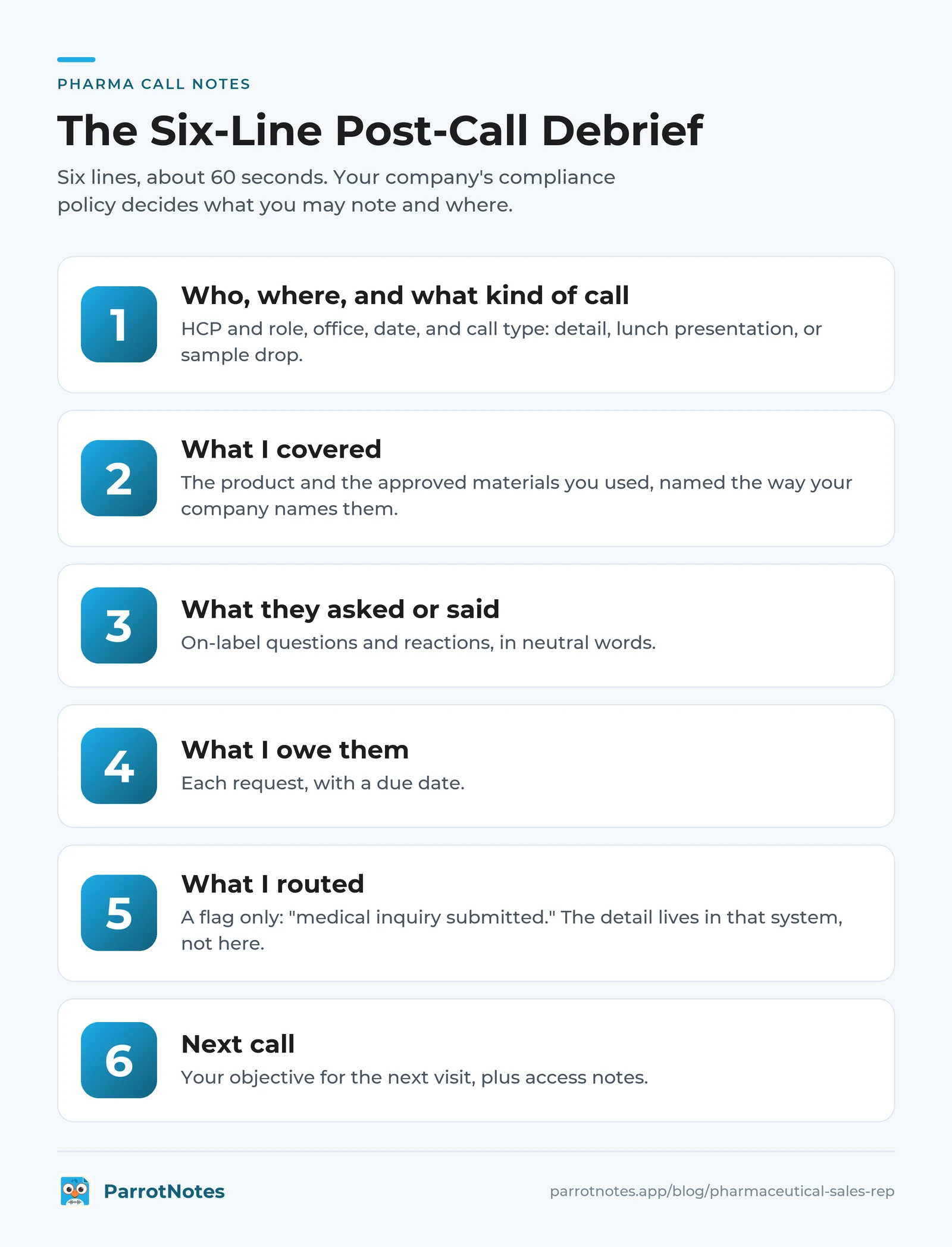
Line 5 is what makes this a pharma debrief. It shows you did the right thing without copying the sensitive part into a second place.
The red-flag word check
Before you save, scan the note for words that signal it's carrying something it shouldn't. It takes 10 seconds.
- Patient words: "patient," an age, a date, a room number, or any name that isn't an HCP or staff member
- Off-label words: a use, dose, or population that isn't in the label
- Safety words: a side effect, a reaction, "stopped taking it," or a product complaint
- Comparison words: "works better than," "safer than," or any claim that isn't in your approved materials
- Deal words: "promised," "in return," "will switch," or anything that links a meal or item to prescribing
- Opinion words: "difficult," "lazy," "hates us," and any joke
The deal words matter more than they look. Section 13 of the PhRMA Code says nothing should be offered in a way that would "interfere with the independence of a health care professional's prescribing practices." A note that reads like a trade reads like a violation, even if the lunch was a plain lunch.
If a flagged word shows up, don't reach for a synonym. Move the information to the channel where it belongs, then leave a flag on line 5.
Before and after: fixing a risky note
This example is invented. The product, the HCP, and the call don't exist.
Before, typed at 9:30 PM from memory:
"Dr. P loved the lunch, says she'll switch her patients over. Mentioned a 67-year-old diabetic man she saw Monday who got dizzy on it. Asked if it works for [an unapproved use]. Told her I've heard good things."
Four sentences, four problems. The first links a meal to prescribing. The second could identify a patient, and it buries a possible adverse event in a sales note. The third is an off-label question with no inquiry behind it. The fourth is the rep answering it.
That last problem can't be fixed by better writing. A clean note doesn't repair a call that went wrong. If it happened, tell your manager or compliance contact.
After, written in the car at 1:20 PM:
"Sept 15, in-office lunch presentation. Dr. P and two NPs attended, sign-in sheet filed. Covered efficacy and safety sections of the core visual aid. Dr. P asked about titration per label; answered from the prescribing information. Unsolicited question on an unapproved use: did not discuss, medical inquiry submitted. Possible adverse event mentioned: reported to the safety line at 1:15 PM, no detail recorded here. I owe: dosing card by Sept 22. Next call: confirm card received, cover the formulary update."
It's about 75 words, and it tells any future reader what happened. Every sensitive item sits in its own system, with a flag pointing to it.
Where to keep notes: seven questions for compliance
A pharmaceutical sales rep shouldn't guess at the policy. Send these seven questions to your compliance contact or your district manager, and keep the answers.
- Is the CRM the only place I may record anything about an HCP interaction?
- May I keep personal notes, typed or spoken, that name an HCP or a product? If yes, in which apps and on which devices?
- Which dictation or AI transcription tools are approved for call notes?
- What may a free-text field contain, and what must never appear in one?
- How fast must I pass on an adverse event or a product complaint, and through which channel?
- How do I log a question about an unapproved use?
- How long are my notes kept, and who can read them?
Seven short answers will do more for your note habit than any app.
Don't record inside the clinic
Whatever tool you use, don't record conversations in a practice, a hospital, or a pharmacy. Patients and their information are within earshot, and the clinic and your employer have their own rules.
The law varies too. Federal law, at 18 U.S.C. 2511(2)(d), permits recording where "one of the parties to the communication has given prior consent." States can be stricter. California Penal Code section 632 penalizes recording a confidential communication "without the consent of all parties."
Rules differ by state and country, and this isn't legal advice. Outside the clinic, ask permission before you record anyone. Inside it, leave the recorder off. The debrief in this guide has one voice on it: yours, alone in a parked car, saying what you remember.
Where ParrotNotes fits
ParrotNotes is a personal voice-note app. It doesn't replace your CRM, and your company decides whether a personal app may hold anything about an HCP call. If the answer is no, respect it. Your day still holds work with no HCP, product, or patient in it:
- The morning plan. Talk through your route and priorities, and get them back as a list.
- Your own to-dos. "Expense report by Friday, order sign-in sheets, book the car service."
- Meetings and training. District meetings and workshops, when the organizer allows recording and everyone has agreed.
If your policy does allow a personal debrief, the six-line script is built for it. Tap record and talk for a minute (recording continues with the screen off). You get a transcript, an AI summary, your action items, and a drafted follow-up email. Label each note, and search finds "dosing card" a month later.
The free plan covers 100 minutes of recording a month, up to 30 minutes per recording, with an AI summary on every recording and 5 AI-powered recordings a month. At one minute a call, that's 100 debriefs. Pro is $19.99 a month, or $14.99 a month billed annually, for 3,000 minutes and recordings up to 3 hours.
ParrotNotes encrypts data in transit and at rest, as its security page sets out. It makes no HIPAA claim, so treat the "nowhere" row as a bright line: patient details never go in.
Policy says yes? Download ParrotNotes free and try the six-line debrief after tomorrow's first call.
A between-visits rhythm for a full call day
This rhythm borrows from the two-minute debrief script we built for field reps in general, tightened for a pharmaceutical sales rep's day.
- Before the first call: read yesterday's line 6 for each office on today's route
- After every call: six lines, parked, before the engine starts
- Same day, no exceptions: adverse events, product complaints, and medical inquiries, through their own channels
- End of day: check that each call is logged inside your company's deadline
- Friday: clear line 4 across the week, so no promise rolls into Monday
Picture Andre, a specialty pharma rep with a ride-along on Thursday. His district manager watches him finish a call, sit in the car, and say six lines in under a minute. At the next office, Andre opens with, "You asked for the dosing card on the 15th. Here it is." The manager's feedback that afternoon is one line long.
The Friday sweep is where promises get rescued. Our guide on how to never miss action items from sales calls covers the owner-and-due-date habit. To see how another trade documents its conversations, read the commercial real estate broker's call log.
Keep the note small and the routing right
Good pharma call notes are short, neutral, and written within minutes of the call. They say who you saw, what you covered, what you owe, and what you routed elsewhere. Everything sensitive lives in the system built for it, and patient details live nowhere.
Start tomorrow. Send the seven questions to your compliance contact, then run the six-line debrief after your first three calls. See what you still remember at 5:00 PM.
The habit matters more than the tool, whether you've been a pharmaceutical sales rep for ten weeks or ten years. If your policy allows a personal voice note, ParrotNotes turns a one-minute debrief into a transcript, a summary, and a list of next steps. Download ParrotNotes free and try it before your next visit.
Frequently Asked Questions
What does a pharmaceutical sales rep do?
A pharmaceutical sales rep visits physicians, nurse practitioners, pharmacists, and other health care professionals for a drug manufacturer. The rep presents approved product information, answers questions inside the label, delivers samples where permitted, routes medical and safety questions to the right teams, and logs each call in the company's system.
Can a pharmaceutical sales rep keep call notes in a personal app?
Only if the company's policy allows it. Employers in this industry commonly restrict where call details may be written, and notes kept outside the CRM can still be read in an audit or a lawsuit. Ask your compliance team which apps and devices are approved before you note anything about an HCP or a product.
What should never go in a pharma call note?
Anything that could identify a patient, your own answer to an off-label question, clinical detail about a side effect, unapproved comparisons, and wording that links a meal to prescribing. Route those to the medical inquiry, safety, or expense systems, and leave only a flag in the note.
Should a pharma rep record conversations with HCPs?
No. Patients and their information are within earshot in a clinic, the practice and your employer have their own rules, and recording-consent law varies by state. Note what you remember afterwards, alone, and keep patient details out.
Related Posts
Sales Engineer: The Role and How to Document Technical Meetings
What a sales engineer does, what the role pays (BLS data), and a technical meeting record that keeps specs, units and promises intact. Copy the template.
Nurse Educator Guide: Record In-Services Staff Can Revisit
A working nurse educator's kit: what to record and what never to, a consent script, a session plan, and a one-page revisit sheet staff will use. Try it free.
Meeting Notes Template: Simple Formats That Work
Copy a meeting notes template that fits your meeting: six simple formats with filled-in examples, a shorthand key and a 10-minute routine for sending notes.