
Store Visit Checklist for Field Reps and Managers

Sarah Johnson
Writes about field sales, meeting notes and voice-first workflows at ParrotNotes. Every article is reviewed by the ParrotNotes product team before it goes live.
Table of Contents
- 1.What a store visit checklist is for
- 2.The store visit checklist at a glance
- 3.The field rep's store visit checklist (copy this)
- 4.The manager's store visit checklist, scored 0 to 2
- 5.Match the store visit checklist to the visit type
- 6.After the visit: carry the open items forward
- 7.Four ways a store visit checklist fails
- 8.Make the next store visit start where this one ended
Tomas walked into store 318 on a Tuesday in March and saw the same thing he'd seen four weeks earlier: no endcap for his brand's spring promo, and the case stacker still sitting in the back room. He'd "noted it" last time. The note was a line in his phone that said "318 endcap?" and nothing else. (Tomas and the store are a composite, not a real customer.)
Nobody owned it, so nothing happened. That's the gap a store visit checklist closes. It isn't a form for the sake of a form. It's a list that makes sure you look at the same things in every store, ask for what you saw, and leave with an owner and a date for each problem.
This guide gives you two versions you can copy: a 30-item checklist for field reps who call on stores they don't run, and a 12-line scored checklist for managers who visit stores on their own or with a rep. You'll also get a table that tells you which sections to run for each type of visit, so a 20-minute call doesn't turn into a 90-minute audit.
If the notes are the part that slips, try ParrotNotes free: record a short recap in the parking lot and get a summary and action items back.
What a store visit checklist is for
Two different people search for a retail store visit checklist, and they need different lists.
| Field rep (brand, broker or distributor) | Manager (district, area or field sales) | |
|---|---|---|
| Runs the store? | No. Visits as a guest of the department manager | Sometimes (retail area manager) or visits with a rep |
| Main question | Is my product on the shelf, priced and promoted? | Is this store, or this rep, up to standard? |
| Typical visit | Several stores a day, 20 to 45 minutes each | Fewer, longer visits |
| Output | Findings, owners, dates, one sale | A score, three fixes, a follow-up date |
The rep's list is about the shelf and the conversation. The manager's list is about standards and patterns across stores. Both fail the same way: findings that never get an owner.
The store visit checklist at a glance
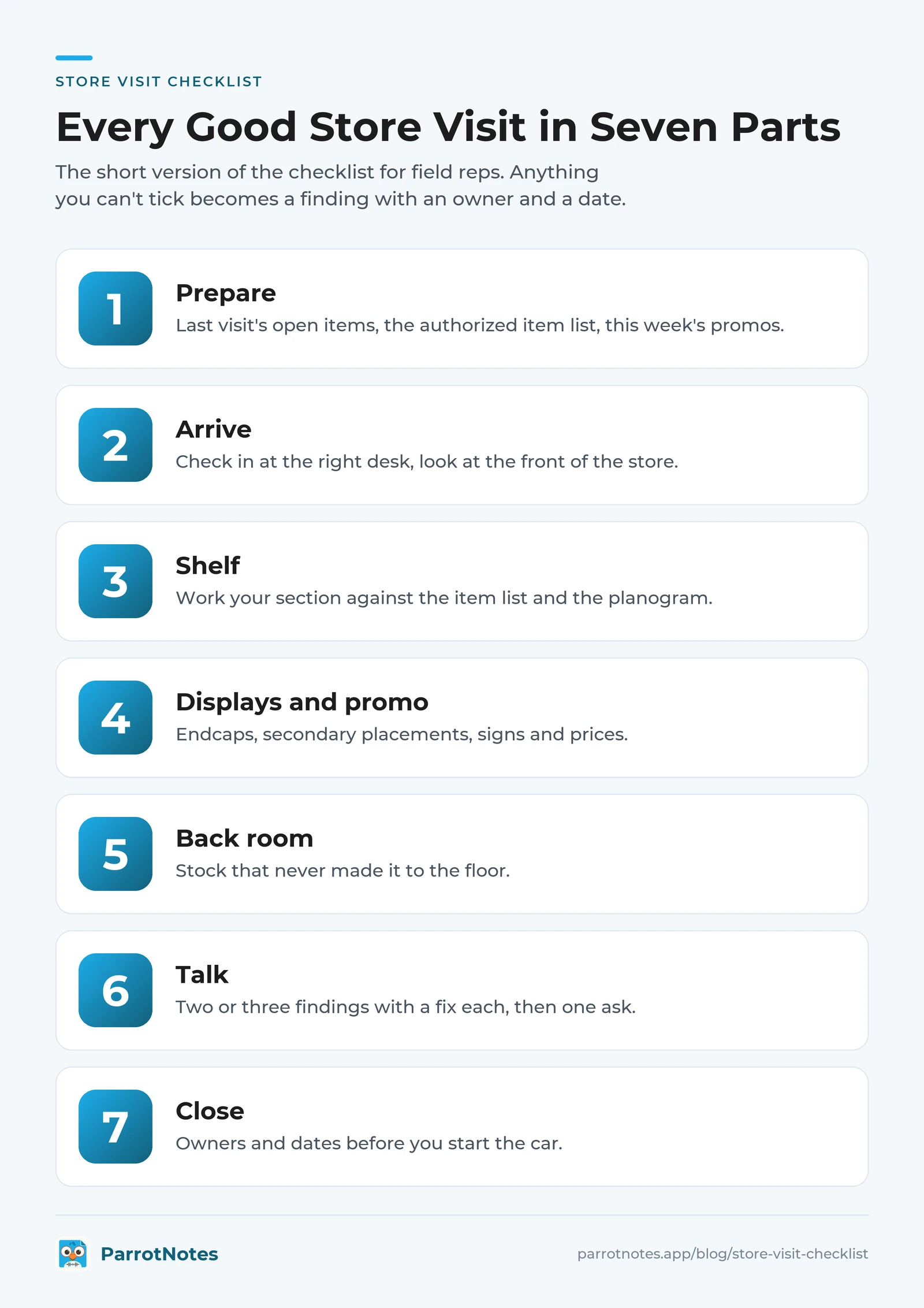
Every good store visit runs in the same seven parts. If you only remember the short version, remember this:
- Prepare: last visit's open items, the authorized item list, this week's promos.
- Arrive: check in at the right desk, look at the front of the store.
- Shelf: work your section against the item list and the planogram.
- Displays and promo: endcaps, secondary placements, signs and prices.
- Back room: stock that never made it to the floor.
- Talk: two or three findings with a fix each, then one ask.
- Close: owners and dates before you start the car.
The full checklists below expand each part.
The field rep's store visit checklist (copy this)
Copy this store visit checklist template into a notes app, a spreadsheet or your CRM's visit form. Tick what you did; anything you couldn't tick becomes a finding.
Before the visit (5 minutes, the night before or in the lot)
- Read last visit's open items for this store
- Pull the authorized item list for your section
- Check the ad calendar: what's on promo this week and next
- Note any new items that should be on shelf by now
- Know the department manager's name and their usual hours
- Check orders or deliveries due since your last visit
- Decide your one ask for this visit (display, new item, order, placement)
Arrive (2 minutes)
- Check in at the desk or receiving, as the store requires
- Look at the front: lobby displays, front endcaps, competitor activity
- Note anything that changed since your last visit
Shelf (10 to 15 minutes)
- Every authorized item on the shelf (mark voids; the void-check sheet has a row-by-row version)
- Shelf tags match the item and the current price
- Facings match the plan
- Product faced forward and rotated, no damaged or out-of-date packs
- Competitor changes: new items, price moves, lost space
Displays and promo (5 minutes)
- Promo items priced and signed for the ad week
- Agreed displays built, stocked and in the agreed spot
- Secondary placements still in place
- Photo of anything you'll need to show someone later
Back room (3 minutes)
- Your product in the back room that should be on the floor
- Display stock or shippers waiting to be built
- Damaged cases to log for credit
Talk to the department manager (10 minutes)
- Lead with two or three findings and a fix for each
- Show the photo or the shelf, not just the claim
- Make your one ask
- Confirm out loud who does what by when
- Agree on when you'll be back
Before you leave (2 minutes, parked)
- Every finding has an owner and a date
- Off-site problems listed for the right person (the routing table shows who fixes what)
- Recap recorded or written before you drive to the next store
That's 30 checks. On a routine call you'll get through them in 35 to 45 minutes, and most of them take seconds.
Display or reset work you can't do yourself goes to your merchandising team as a finding, with the store, the display and the date the product arrived.
The manager's store visit checklist, scored 0 to 2
A manager's store visit checklist works better with a score than with ticks. A score lets you compare one store with the next, and this month with last month.
Score each line 0 (not met), 1 (partly met) or 2 (fully met). Twelve lines give a total out of 24.
| # | What to check | Score (0-2) | Note |
|---|---|---|---|
| 1 | Last visit's open items closed | ||
| 2 | Front of store and entry clean and clear | ||
| 3 | Core items in stock on the shelf | ||
| 4 | Shelf tags and prices correct | ||
| 5 | Promo items priced and signed for the ad week | ||
| 6 | Displays built as agreed | ||
| 7 | Back room stock worked to the floor | ||
| 8 | Competitor activity noted | ||
| 9 | Store or department manager seen, relationship current | ||
| 10 | Rep's notes from recent visits match what you see | ||
| 11 | Safety: aisles, back room and displays free of hazards | ||
| 12 | Three fixes agreed, each with an owner and a date | ||
| Total (out of 24) |
Line 11 is more than tidiness. OSHA's walking-working surfaces rule requires storerooms and passageways to be kept clean and orderly, and surfaces kept free of hazards such as spills. A visiting rep or brand manager isn't the store's safety officer, but a spill or a blocked aisle next to your display is worth raising on the spot.
This scores the store. If you're also coaching the rep, use the ride-along scorecard in our field sales management guide, which scores the rep's behavior instead.
A scored example
Here's the checklist filled in for a composite store visit. Nadia is a district manager for a snack brand, riding with a rep at a grocery store on a Thursday morning. (An illustration, not a real case.)
| # | What to check | Score | Note |
|---|---|---|---|
| 1 | Last visit's open items closed | 1 | Two of three closed; tag fix still open |
| 2 | Front of store and entry | 2 | |
| 3 | Core items in stock | 1 | Two voids in 14 items |
| 4 | Tags and prices | 1 | One old price |
| 5 | Promo priced and signed | 2 | |
| 6 | Displays built | 0 | Promo endcap not built, shipper in back room |
| 7 | Back room worked | 1 | Four cases of core items in back |
| 8 | Competitor noted | 2 | New flavor at a lower price, aisle 9 |
| 9 | Manager relationship | 2 | Grocery manager knew the rep by name |
| 10 | Notes match the store | 1 | Rep's notes didn't mention the endcap |
| 11 | Safety | 2 | |
| 12 | Three fixes agreed | 2 | See below |
| Total | 17 / 24 |
The three fixes: the merchandising team builds the endcap by Monday, the grocery manager adds the two voids to today's order, and the rep sends the competitor price to the brand manager by Friday.
The 17 matters less than the line that scored 0. One unbuilt display in an ad week can cost more than the rest of the visit earns, and NielsenIQ found that empty shelves cost U.S. retailers $82 billion in missed sales in 2021. When shoppers met an empty shelf, 10% bought the item elsewhere and 16% shifted online.
Match the store visit checklist to the visit type
Not every visit needs all 30 checks. Pick the sections that fit the reason you're there.
| Visit type | Run these sections | Skip or shorten | Time on site |
|---|---|---|---|
| Routine call | All, quickly | Back room if nothing is due | 35 to 45 min |
| Ad-week promo check | Prepare, Displays and promo, Talk | Full shelf check | 15 to 20 min |
| New item launch | Prepare, Shelf (new items only), Talk | Competitor detail | 20 to 30 min |
| Problem store (repeat voids, complaints) | All, plus last three visits' open items | Nothing | 45 to 60 min |
| Manager visit | The scored 12 lines, then the rep's sections | Your own ask (let the rep lead) | 45 to 60 min |
The time column is a planning guide, not a rule. It helps when you build the day: our sales route planning guide shows how many visits fit, and the free sales territory planner groups stores by area.
After the visit: carry the open items forward
A store visit checklist ends in the parking lot, not at the desk. Before you start the car, every finding needs three things: what it is, who owns it, and by when. Anything still open becomes the first line of your next visit's "Before" section.
That carry-over is what turns a checklist into a record. Your write-up for your manager is a separate document; the sales call report template covers what goes in it, so this checklist only needs the open items.
Here's how that looks for Nadia's team. She has nine reps and 140 stores. Before, each rep kept their own notes, and her monthly store review was nine different formats.
So she asked every rep to finish each visit with the same three lines, spoken in the car after parking: findings, owners, next visit date. (A composite, as above.)
Within a month, her review started from one list of open items per store. The endcap that wasn't built showed up as an open item on Thursday, closed on Monday, and checked on the next visit. Nothing about the stores changed. The record did.
Want the open items pulled out for you? Download ParrotNotes free, say the three lines out loud after you've parked, and get the action items back as a list. Recording works without signal, so a recap from a back room with no coverage is saved and transcribes once you're connected. Label each recording with the store number and you can search a store's history before the next visit.
Doing that admin only when parked keeps your eyes on the road; our windshield time guide covers the rest.
Four ways a store visit checklist fails
- It's too long for the visit. A 90-line audit on a 20-minute promo check gets skipped. Use the visit-type table.
- It stops at findings. "Endcap missing" is an observation. "Merchandising builds it by Monday" is a fix.
- It starts from zero every time. If the "Before" section doesn't read last visit's open items, the same problem gets found again.
- It's filled in at night. By 8 p.m., five stores blur into one. Fill it in at each store, or record a recap before you leave the lot.
Andre, a composite beverage rep, learned the last one the hard way. He used to fill in his checklists at home. One week he logged a void at the wrong store, and the reorder went to a store that didn't need it. When he started recording a 60-second recap in each lot, the store number came first, and the mix-ups stopped.
Make the next store visit start where this one ended
A store visit checklist does three jobs: it makes you look at the same things in every store, it turns what you see into an ask, and it leaves a list of open items for next time.
- Reps: use the 30-item checklist, cut it to the visit type, and never leave the lot without owners and dates.
- Managers: score the store on the 12 lines, fix the zeros first, and coach the rep with a separate scorecard.
- Both: start every visit with the last visit's open items.
Try it on your next five stores and count how many open items you close by Friday. And if writing up the visits is what falls behind, download ParrotNotes free. You get 100 minutes of recording a month and an AI summary on every recording, enough to recap every store for a few weeks.
Frequently Asked Questions
What should be on a store visit checklist?
A good store visit checklist covers seven parts: preparation (last visit's open items, the item list, promos), arrival and the front of the store, the shelf, displays and promo pricing, the back room, the conversation with the store or department manager, and closing with an owner and a date for every finding.
How long should a store visit take?
For a field rep, a routine store visit usually takes 35 to 45 minutes. A promo check can take 15 to 20 minutes, and a problem store or a manager visit 45 to 60. Cut the checklist to the reason for the visit instead of rushing every section.
What is a store visit report?
A store visit report is the write-up after the visit: the store, who you met, what you found, what was agreed and the next steps. The checklist is what you use during the visit; the report is what you send afterward. A sales call report template works well as the format.
What's the difference between a store visit checklist and a store audit?
A store audit is a full inspection against a standard, often with dozens of lines and a pass mark. A store visit checklist is shorter and built for regular visits: it covers the checks that matter most, ends with fixes and owners, and carries open items to the next visit.
How often should a manager visit stores?
It depends on the number of stores and how they're performing. Many managers set a regular cycle for every store and visit problem stores more often. Score each visit the same way so you can compare stores and see whether a store is improving between visits.
Can I fill in a store visit checklist by voice?
Yes. Park, then record a short recap that follows the checklist: the store, findings, owners and dates, and the next visit. A voice notes app like ParrotNotes turns it into a transcript, a summary and action items you can copy into the checklist or your CRM.
Related Posts

Solution Selling vs Consultative Selling: What Actually Changes on the Call
Solution selling vs consultative selling, shown on one forklift sales call run both ways: what you ask, when the product appears, and what goes in your notes.

Sales Performance Review Template and Questions for Managers
A sales performance review template with weighted sections, a 1-4 rating scale, 30 questions for reps and managers, and a filled example. Copy it free.

Sales Leave-Behind: Ideas and Examples That Get Read
A sales leave-behind should keep selling after you've left. Get a five-block template, a worked example and 12 ideas sorted by deal stage and by cost.