
What Is a Quorum in a Meeting? Rules and How to Count It

Sarah Johnson
Writes about field sales, meeting notes and voice-first workflows at ParrotNotes. Every article is reviewed by the ParrotNotes product team before it goes live.

Table of Contents
- 1.What is a quorum, and who sets the number?
- 2.How to count a quorum in 5 steps
- 3.The same board, four different quorums
- 4.A quorum isn't the votes you need
- 5.Who counts toward a quorum?
- 6.What happens if you lose a quorum or never reach one
- 7.How to record a quorum in your minutes
- 8.How to set a quorum your group can meet
- 9.What is a quorum? The short version
Picture a nonprofit board with nine seats, and a secretary named Dana. Seven directors came to the meeting, but by the time the $4,000 roof repair reached a vote, three had gone home. The other four voted yes, unanimously. Six weeks later a funder asked for the minutes, and Dana noticed the problem: the board needed five people in the room.
So what is a quorum? A quorum is the minimum number of voting members who must be present before a group can validly do business. Dana's board had a clear majority of those voting and still couldn't decide anything, because too few people were there.
The idea is simple, but the count trips people up. Vacant seats, proxies, early departures and odd bylaw wording can each change the answer. This guide covers the rules and the math, then what to say and write down when the numbers go wrong.
This is general information, not legal advice. Your bylaws and the law that governs your organization have the final word, so check them, or ask a lawyer when money or a dispute is at stake.
What is a quorum, and who sets the number?
A quorum stops a handful of people from making decisions in the group's name. The number usually comes from statute or your governing documents, and those sources rank in a rough order:
- The law that applies to your organization, such as a state corporation or nonprofit statute
- Your charter or articles, if they set a number
- Your bylaws, where most groups find their quorum
- Your parliamentary authority, such as Robert's Rules, when the documents above are silent
Robert's Rules is the fallback, not the boss. If your group has written no number down, its default is a majority of the members. The defaults in the law vary, as these examples show:
| Rule | Default quorum | Can it be changed? |
|---|---|---|
| Delaware corporation board, section 141(b) | A majority of the total number of directors | Yes, but never below one-third of the total |
| Delaware stockholder meeting, section 216 | A majority of the shares entitled to vote, in person or by proxy | Yes, but never below one-third of those shares |
| New York nonprofit board, section 707 | A majority of the entire board | Yes, with a floor of one-third for boards of 15 or fewer |
| UK company general meeting, section 318 | Two qualifying people, or one if the company has a single member | Subject to the company's articles |
These are examples, not a survey. Your state, organization type and documents may say something else.
A quorum only helps if you can prove it later. If you keep the minutes, ParrotNotes can record the meeting with everyone's agreement, so you can check who was still in the room when the vote was called.
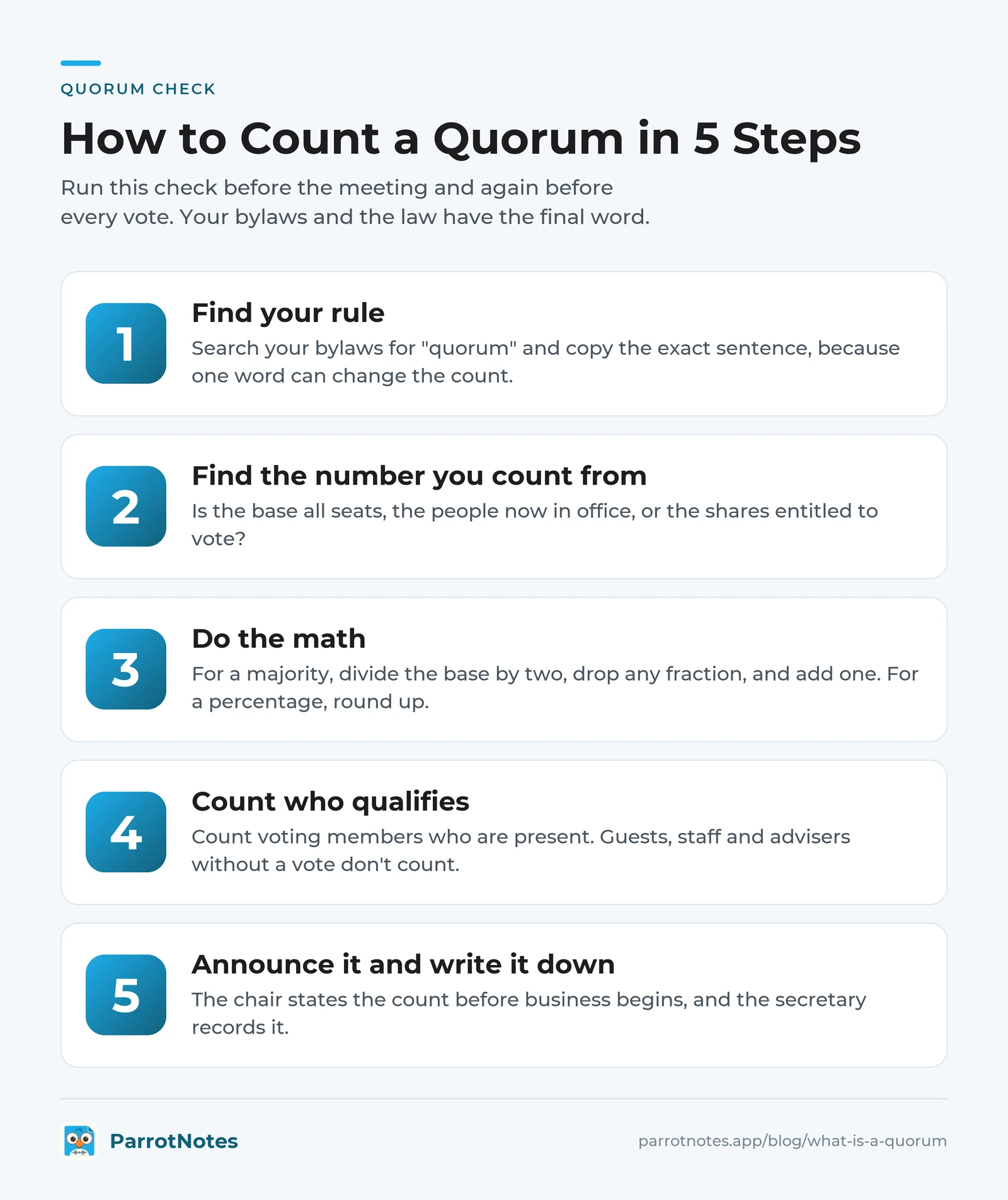
How to count a quorum in 5 steps
Run this check before the meeting and again before every vote.
1. Find your rule
Search your bylaws for "quorum" and copy the exact sentence, because one word can change the count. If they say nothing, check your charter, the statute for your type of organization, then your parliamentary authority.
2. Find the number you count from
Is the base all seats, the people now in office, or the shares entitled to vote? New York's law spells out one answer: the entire board means the number of directors there would be with no vacancies. Other rules differ, as the next section shows.
3. Do the math
For a majority, divide the base by two, drop any fraction, and add one. Half isn't a majority, so a six-seat board needs four people, not three. For a percentage, round up, because 25% of 130 members is 32.5 and 32 people falls short.
| Seats or members | Majority quorum |
|---|---|
| 5 | 3 |
| 6 | 4 |
| 7 | 4 |
| 9 | 5 |
| 12 | 7 |
| 25 | 13 |
| 100 | 51 |
4. Count who qualifies
Count voting members who are present, then adjust for proxies, remote attendees and ex-officio members using the "who counts" table below. Guests, staff and advisers without a vote don't count.
5. Announce it and write it down
The chair states the count before business begins, and the secretary records it. It takes 10 seconds, and it answers the first question anyone asks about a disputed vote.
The same board, four different quorums
Take Tom, who chairs a club board with nine seats. Two seats are vacant, so seven people are serving. Here's how his count changes with the bylaw's wording:
| Bylaw wording | Base | People needed |
|---|---|---|
| "A majority of the entire board" | 9 seats | 5 |
| "A majority of the directors then in office" | 7 people | 4 |
| "Five directors" | Fixed number | 5 |
| "One-third of the total number of directors" | 9 seats | 3 |
Four people came to Tom's last meeting. Under the second and fourth wordings, he had a quorum. Under the first and third, he didn't, and nothing they decided would bind the club.
If your wording is unclear, don't bet on the lower number. Get the higher number into the room, then ask a lawyer to settle the wording and fix the bylaw at your next chance.
A quorum isn't the votes you need
A quorum decides whether you can vote. A separate rule decides whether a motion passes, and together they can put a big decision in very few hands.
Here's the smallest group that can pass an ordinary motion if only a bare quorum turns up, everyone votes, and the motion needs a majority:
| Seats | Quorum | Yes votes to pass | Share of all seats |
|---|---|---|---|
| 5 | 3 | 2 | 40% |
| 7 | 4 | 3 | 43% |
| 9 | 5 | 3 | 33% |
| 15 | 8 | 5 | 33% |
| 25 | 13 | 7 | 28% |
| 100 | 51 | 26 | 26% |
Abstentions can shrink that further, depending on your rule. Under Robert's Rules, a majority vote usually means a majority of the votes cast, so abstentions have no effect. Delaware's board default is different: it takes the majority of the directors present.
Say five of nine directors attend, and the vote is two yes, one no, and two abstentions. Under the Robert's Rules default, the motion carries. Under a "majority of those present" rule, it fails, because it needed three.
Who counts toward a quorum?
A quorum counts presence, not votes, so a member who attends and abstains is still in the room. The harder cases depend on your rules:
| Person | Do they count? |
|---|---|
| Voting member in the room | Yes |
| Member who abstains | Yes, they're present |
| Guest, staff or non-voting adviser | No |
| Remote attendee | Only if allowed. Robert's Rules needs bylaw authorization for board meetings by phone or video, while Delaware treats such directors as present unless the charter or bylaws restrict it |
| Proxy holder | Only if the law or bylaws allow proxies, per Robert's Rules |
| Ex-officio member | Usually yes. Robert's Rules makes two exceptions, including a president who is ex-officio on all committees |
| Recused director | Often yes, but check your rules and how many people can vote on that item |
One more trap: signatures collected one by one don't replace a meeting. The official Robert's Rules FAQ says approval gathered from board members separately isn't valid board approval, even if every member agrees.
What happens if you lose a quorum or never reach one
Losing it mid-meeting
A common myth says that once you have a quorum, you keep it until the meeting ends. Under Robert's Rules, a quorum is only presumed to continue until the chair or a member points out that it's gone. After that, no substantive business can happen.
Votes taken earlier generally stand. They can become invalid if there's clear and convincing proof that no quorum was present when they were taken. Some state laws go the other way and let a meeting continue after people leave, so check yours.
Sample wording for the chair:
"Director Lee has left, which leaves four of nine directors present. We no longer have a quorum, so we can't take any more votes tonight. I'll entertain a motion to adjourn."
Never reaching it
Without a quorum, a group can do only four things: adjourn, set a time for a continued meeting, take a recess, or try to get more members there. You can talk through an issue informally, but you can't decide it. If you call a new meeting instead of continuing this one, send a fresh meeting notice as your bylaws require.
Anything else done in the group's name is null and void, and a unanimous vote can't waive the rule.
That's what Dana's board faced. If the roof couldn't wait, the four directors could act at their own risk, then ask a properly attended meeting to ratify the decision by majority vote.
Ratifying is a repair, not a plan. The people who acted carry the risk if the vote fails, and your bylaws and the law may limit it.
How to record a quorum in your minutes
Keep it short, and put the numbers in. These lines cover the three situations:
Quorum present:
Quorum: 6 of 9 directors present. Quorum (5) present.

Quorum lost:
At 8:05 p.m. Director Lee left, leaving 4 of 9 directors present.
The chair noted the loss of a quorum. No further business was transacted.
The meeting adjourned at 8:07 p.m.

No quorum:
Present: 3 of 9 directors. Quorum (5) not present.
No business was transacted. The meeting adjourned at 7:20 p.m.
Those lines drop straight into our board meeting minutes template. If your group follows the book, our Robert's Rules of Order minutes template notes that a quorum line is an extra you can choose to add, and it's worth choosing. Put a quorum check at the top of your meeting agenda too, ahead of any consent agenda vote.
Late arrivals and early departures are the details that vanish from memory first. Download ParrotNotes and, once members agree to recording, you get a transcript and a summary to check against your notes: the chair's count, who said they had to leave, and the wording of each motion. Follow local recording law, and if anyone objects, don't record.
How to set a quorum your group can meet
If you can change your bylaws, pick a number you'll reach on a bad night. Robert's Rules For Dummies gives the balance well: not so low that a handful of people can make major decisions, and not so high that meetings can't reach it.
Take Maya's parent club, with 240 members and a bylaw requiring a majority. That's 121 people. If a typical meeting draws 30, the club can never validly decide anything.
Look at your last 12 meetings, set the number under your usual turnout, and check that the law allows it. A fixed number or a percentage both work, and a percentage adjusts as membership changes.
For a yearly meeting, our guide to annual general meeting minutes covers how to record a quorum with proxies.
What is a quorum? The short version
Here's what to keep in mind the next time someone asks:
- A quorum is who must be present. The vote needed to pass is a separate rule.
- Law and governing documents come first. Robert's Rules is the fallback.
- Check what you count from, especially when seats are vacant.
- Recount before each vote, because people leave.
- Without a quorum, you can adjourn, recess, set a continued meeting or find more members.
Before your next meeting, copy your bylaw's quorum sentence to the top of the agenda and work out the number. Then try ParrotNotes free if you'd like a recording to back up your minutes.
Frequently Asked Questions
What is a quorum in simple terms?
A quorum is the minimum number of voting members who must be present before a meeting can make valid decisions. Your bylaws or the law usually set the number. If they don't, Robert's Rules sets it at a majority of the members.
Is a quorum 50% or 51%?
Neither, as a general rule. A majority quorum is more than half, so divide the number by two, drop any fraction, and add one. That's 4 of 7, 5 of 8 and 51 of 100. Many bylaws set a different number or percentage.
Can a meeting go ahead without a quorum?
People can gather and talk, but they can't take binding action. Under Robert's Rules, a group without a quorum can only adjourn, set a time for a continued meeting, recess, or take steps to get a quorum.
What happens if people leave and you lose a quorum?
Under Robert's Rules, once the loss is pointed out, no more substantive business can happen. Earlier votes generally stand unless there's clear and convincing proof that no quorum was present when they were taken. Some state laws let a meeting continue, so check yours.
Do vacant seats count toward a quorum?
It depends on your wording. A rule based on all seats counts them in the base, and New York's "entire board" is one example. A rule based on directors in office doesn't. Read your bylaws, and ask a lawyer if the wording is unclear.
Do abstentions count toward a quorum?
A member who attends and abstains is still present, so they count toward the quorum. The abstention matters for the vote instead. Under Robert's Rules it usually has no effect, but if a rule requires a majority of those present, it works like a no.
Do proxies count toward a quorum?
Only where the law or your bylaws allow proxies. Robert's Rules doesn't permit them otherwise. Delaware's stockholder default counts shares represented by proxy, which is one example of a law that does.
Related Posts

Best Talk to Text App for iPhone and Android
The best talk to text app for your phone: Apple Dictation and Siri on iPhone, Gboard and Gemini on Android, with free plans compared and a voice phrase sheet.

How to Use Speech to Text on iPhone
Turn on speech to text on iPhone in 3 steps, dictate in any app, switch languages, turn it off, and record when the mic stops. Checked on iOS 27, Nov 2026.

How to Record Calls on Samsung
Samsung call recording, step by step: record or auto record calls, find the files, get Galaxy AI transcripts, or turn it all off. Checked November 2026.