
Board Meeting Minutes Template and Sample

Sarah Johnson
Writes about field sales, meeting notes and voice-first workflows at ParrotNotes. Every article is reviewed by the ParrotNotes product team before it goes live.

Table of Contents
- 1.What makes board meeting minutes different
- 2.Board meeting minutes template: copy and fill
- 3.Board meeting minutes sample: a nonprofit board's regular meeting
- 4.What to leave out of board meeting minutes
- 5.Executive session: how to minute what you can't write down
- 6.Approving, signing, filing, and keeping board minutes
- 7.Let a recording fill in your board meeting minutes template
- 8.Copy the board meeting minutes template before your next meeting
Picture Nadia, three months into her first term as secretary of a community food pantry's board. A foundation weighing a $60,000 grant asks for the minutes showing the board approved the executive director's contract. That vote happened in February, before her time. The February minutes say "ED contract discussed and agreed."
No motion. No count. No note of who left the room when a spouse's firm came up. The grant officer is polite, but she wants the record, not a memory of it.
A good board meeting minutes template stops that from happening, because board minutes are read by people who weren't in the room: auditors, funders, lawyers, the IRS, and directors who join five years from now. Nobody wants a transcript. They want a clean record of quorum, motions, votes, and who was responsible for what.
This guide gives you the template in plain text, a note on each block explaining the board-specific choices, and a complete filled-in sample of a fictional nonprofit board's regular meeting. After that comes the list of what to leave out, how to handle an executive session, and what happens to the minutes after the meeting. At the end, there's a way to catch the exact wording of every motion without taking your eyes off the room; if you'd rather start there, download ParrotNotes free and come back for the template.
What makes board meeting minutes different
Board minutes follow the same first rule as any formal minutes. The official Robert's Rules of Order FAQ puts it in one line: "Minutes are a record of what was done at a meeting, not a record of what was said." If you minute staff meetings or committees too, our general meeting minutes template covers four formats and the approval routine that applies to all of them.
What sets a board apart is that its minutes carry legal weight. A board acts by voting, and the minutes are the proof that a quorum was present, that a motion was properly put, and that it carried.
In California, for example, Corporations Code section 6320 requires a nonprofit public benefit corporation to keep "minutes of the proceedings of its members, board and committees of the board." Most states have a similar rule, and your bylaws may add their own. This article isn't legal advice, so check both.
That weight is why a board meeting minutes format has parts a team meeting never needs:
- A call to order with the time, who presided, and a quorum statement
- Approval of the previous minutes, as read or as corrected
- A consent agenda, where routine items pass in one motion
- Motions in their final wording, with the outcome and the count
- Conflict-of-interest disclosures and who left the room
- An executive session entry that records that it happened without recording what was said
- Adjournment, a signature, and a filing routine
If your board runs from an order of business, the minutes follow the same sequence. The formal board agenda in our meeting agenda template guide gives the secretary the headings before the meeting starts.
Board meeting minutes template: copy and fill
Paste this into Word, Google Docs, or your notes app, and change the labels to match your bylaws. Everything in square brackets gets replaced; everything else is the wording most boards use.
[NAME OF ORGANIZATION]
BOARD OF DIRECTORS
Minutes of the [regular / special / annual] meeting

Date and place: [date], [address or "by video conference"]
Called to order: [time] by [name], [Chair / President], presiding
Secretary: [name] (or "[name], acting as secretary")

Directors present: [names]                          ([number])
Directors absent: [names]
Also present: [staff and guests, with role]
Quorum: [number] of [total] directors present. Quorum ([number]) present.

1. APPROVAL OF THE AGENDA
   The agenda was adopted [as circulated / with the following change: ...].

2. APPROVAL OF PRIOR MINUTES
   The minutes of the [date] meeting were approved [as circulated /
   as corrected: ...].

3. CONSENT AGENDA
   Motion by [name], seconded by [name], to approve the consent agenda
   consisting of: [committee minutes; routine reports; ...].
   [Item] was removed at the request of [name] and taken under item [n].
   Carried [unanimously / by a vote of X to Y].

4. REPORTS
   Treasurer's report: [key figures]. [Received and filed / see motion].
   Executive Director's report: [two or three lines]. Received.
   [Committee] report: [one or two lines]. Received.

5. UNFINISHED BUSINESS
   [Item]
   Motion by [name], seconded by [name], that [exact wording].
   [Amended to read: ...]
   [Carried / Lost] by a vote of [X] to [Y], [Z] abstaining.

6. NEW BUSINESS
   [Item]
   [Name] disclosed a conflict of interest ([reason]) and left the
   room at [time]. [Name] did not take part in the discussion or vote.
   Motion by [name], seconded by [name], that [exact wording].
   Carried, [X] to [Y]. [Name] returned at [time].

7. EXECUTIVE SESSION
   Motion by [name], seconded by [name], to enter executive session
   at [time] to discuss [general topic: personnel / legal / real estate].
   Carried. [Who left the room.]
   The board returned to open session at [time].
   [Any action taken on return, as a motion, or "No action was taken."]

8. ANNOUNCEMENTS AND NEXT MEETING
   Next regular meeting: [date, time, place].

9. ADJOURNMENT
   There being no further business, the meeting was adjourned at [time].

Action items
   [Action] | [Owner] | [Due date]

_______________________            _______________________
[Name], Secretary                  Approved: [date of approval]
Attachments: [treasurer's report; committee minutes; ...]
That's the whole board of directors meeting minutes template. The notes below explain why each block is written the way it is, which is most of how to take board meeting minutes well.
Call to order and quorum
Write the time, who presided, and the count. "Quorum: 6 of 9 directors present. Quorum (5) present." looks fussy, but it answers the first question a lawyer or auditor asks about any board vote: could the board act at all?
If a director arrives late or leaves early, note the time, because the quorum can change mid-meeting.
Approval of the agenda and prior minutes
In a formal meeting the chair's agenda is a proposal until the board adopts it, so the adoption goes in the record. The previous minutes are approved "as circulated" or "as corrected," and the correction goes into the text of the earlier minutes, not into today's.
Consent agenda
A consent agenda bundles the routine items (committee minutes, the standard reports, a bank signatory update) into one motion. Minute it as one motion, list what it contained, and note anything a director pulled out for separate discussion. The pulled item gets its own entry with its own motion.
Reports
Two lines and "received." The treasurer's report is the exception: record the headline figures (cash, the month's income and expenses, anything against budget), because those numbers are what a funder or auditor reads the minutes for. Attach the full report rather than copying it in.
Motions and votes: mover, seconder, wording, count
Every motion gets its final wording, as adopted or as lost. Robert's Rules' Official Interpretation 2006-7 says "all main motions which are moved during the course of a meeting (excepting only those which are withdrawn by the maker) should be recorded in the minutes." That includes the ones that failed.
Whether to name the seconder is a bylaws decision. The Charities Review Council's guide to taking nonprofit board minutes says "the names of the directors who move and second motions do not need to be recorded," but does say to "include the names of any directors who dissent or abstain." Many boards record both mover and seconder anyway because their bylaws ask for it. Pick one rule and apply it to every motion.
Record the count whenever there is one. "Carried" is fine for a unanimous voice vote; "Carried, 5 to 3, one abstaining" is what you write when it wasn't.
Conflicts of interest and recusal
When a director discloses a conflict, the minutes show four things: that the disclosure happened, its nature in a few words, that the director left the room, and that they took no part in the discussion or the vote. Write the times they left and returned. This is the entry Nadia's funder was looking for.
Executive session
Minute the motion to enter it, the time, the general topic, who left, the time the board returned, and any action taken in open session afterwards. The content stays out. There's a full section on this below.
Adjournment, signature, and attachments
"There being no further business" is the traditional line, and the time matters. The secretary signs: the 1876 edition of Robert's Rules of Order, now in the public domain, says the minutes "should be signed by the person who acted as clerk for that meeting," and some boards have the chair sign too. Listing the attachments tells a future reader where the treasurer's numbers came from.
Want the wording of every motion waiting in a transcript when you sit down to write? You can try ParrotNotes free: record the meeting with the board's agreement and fill in this template from the text afterwards. The section near the end shows how.
Board meeting minutes sample: a nonprofit board's regular meeting
Here's the template filled in for the Riverbend Community Food Pantry, a fictional nonprofit with a nine-member board. The people, numbers, and decisions are invented to show the format doing its job. The same sample works as a board meeting minutes example for a company or an association; change the report names and the rest stands.
RIVERBEND COMMUNITY FOOD PANTRY
BOARD OF DIRECTORS
Minutes of the regular meeting

Date and place: Tuesday, October 13, 2026, Pantry offices, 214 Mill Street
Called to order: 6:32 PM by Board Chair Denise Okafor, presiding
Secretary: Nadia Haddad

Directors present: D. Okafor (chair), N. Haddad (secretary), R. Castillo
  (treasurer), P. Lindqvist, J. Mbeki, S. Tran, A. Rowe                 (7)
Directors absent: L. Fenwick, M. Osei
Also present: Grace Whitfield (executive director); Tom Alvarez
  (Riverbend Credit Union, guest, for item 6a only)
Quorum: 7 of 9 directors present. Quorum (5) present.

1. APPROVAL OF THE AGENDA
   The agenda was adopted as circulated on October 6.

2. APPROVAL OF PRIOR MINUTES
   The minutes of the September 8 meeting were approved as corrected:
   under item 5, the van insurance renewal date reads November 30,
   not November 3.

3. CONSENT AGENDA
   Motion by S. Tran, seconded by J. Mbeki, to approve the consent
   agenda consisting of: finance committee minutes of September 29;
   programs committee minutes of September 22; the Q3 volunteer
   hours report. The bank signatory update was removed at the
   request of R. Castillo and taken under item 6b. Carried
   unanimously.

4. REPORTS
   Treasurer's report (R. Castillo): Cash at September 30, $148,200.
   September income $41,650; expenses $37,900. Food purchasing is
   $6,100 over budget year to date; grants are $9,000 ahead.
   Received and filed.
   Executive Director's report (G. Whitfield): 1,940 households
   served in September, up 12% on September 2025. Two part-time
   drivers hired. Received.
   Programs committee (P. Lindqvist): The mobile pantry pilot in the
   Eastside starts November 4. Received.

5. UNFINISHED BUSINESS
   5a. Refrigerated van replacement (carried over from September)
   Motion by R. Castillo, seconded by A. Rowe, that the board
   authorize the purchase of a used refrigerated van at a cost not
   to exceed $38,000, funded from the capital reserve. Amended by
   consent to add "following two written quotes." Carried as
   amended, 6 to 1.

6. NEW BUSINESS
   6a. Line of credit
   Tom Alvarez presented the credit union's terms. Mr. Alvarez left
   the room at 7:05 PM.
   Motion by J. Mbeki, seconded by P. Lindqvist, that the board
   authorize the Chair and Treasurer to open a $50,000 line of credit
   with Riverbend Credit Union on the terms presented. Carried, 5 to
   2. S. Tran and A. Rowe voted no.

   6b. Bank signatory update
   Motion by R. Castillo, seconded by S. Tran, that G. Whitfield be
   added as an authorized signatory on the operating account, with
   two signatures required above $5,000. Carried unanimously.

   6c. Winter warehouse lease
   P. Lindqvist disclosed a conflict of interest: the proposed
   landlord is her brother-in-law's company. She left the room at
   7:18 PM and took no part in the discussion or vote.
   Motion by A. Rowe, seconded by J. Mbeki, that the board approve a
   four-month lease of the Dock Street warehouse at $2,400 a month,
   from November 1. Carried, 5 to 1. P. Lindqvist returned at 7:27 PM.

7. EXECUTIVE SESSION
   Motion by D. Okafor, seconded by S. Tran, to enter executive
   session at 7:30 PM to discuss a personnel matter. Carried.
   G. Whitfield left the room.
   The board returned to open session at 7:52 PM. No action was
   taken.

8. ANNOUNCEMENTS AND NEXT MEETING
   The annual meeting will be held on Tuesday, November 10, 2026,
   at 6:30 PM at the Pantry offices.

9. ADJOURNMENT
   There being no further business, the meeting was adjourned at
   7:56 PM.

Action items
   Obtain two written quotes for the van   | G. Whitfield | Oct 27
   Sign line-of-credit documents           | D. Okafor, R. Castillo | Oct 30
   Update bank signatory forms             | R. Castillo  | Oct 23
   Circulate draft minutes                 | N. Haddad    | Oct 16

Nadia Haddad, Secretary                    Approved: November 10, 2026
Attachments: Treasurer's report (September); ED report; credit union
term sheet; Dock Street lease summary
Read it once as the grant officer would. Every vote has a count, the recusal shows when Priya Lindqvist left and came back, and the executive session is on the record without a word of its content. Nothing in it tells you what anyone argued, and nothing needs to.
Two habits from the chair make a sample like this possible in real life: restate every motion in its final form before the vote, and announce the result with the count. Those two sentences are what the secretary writes down.
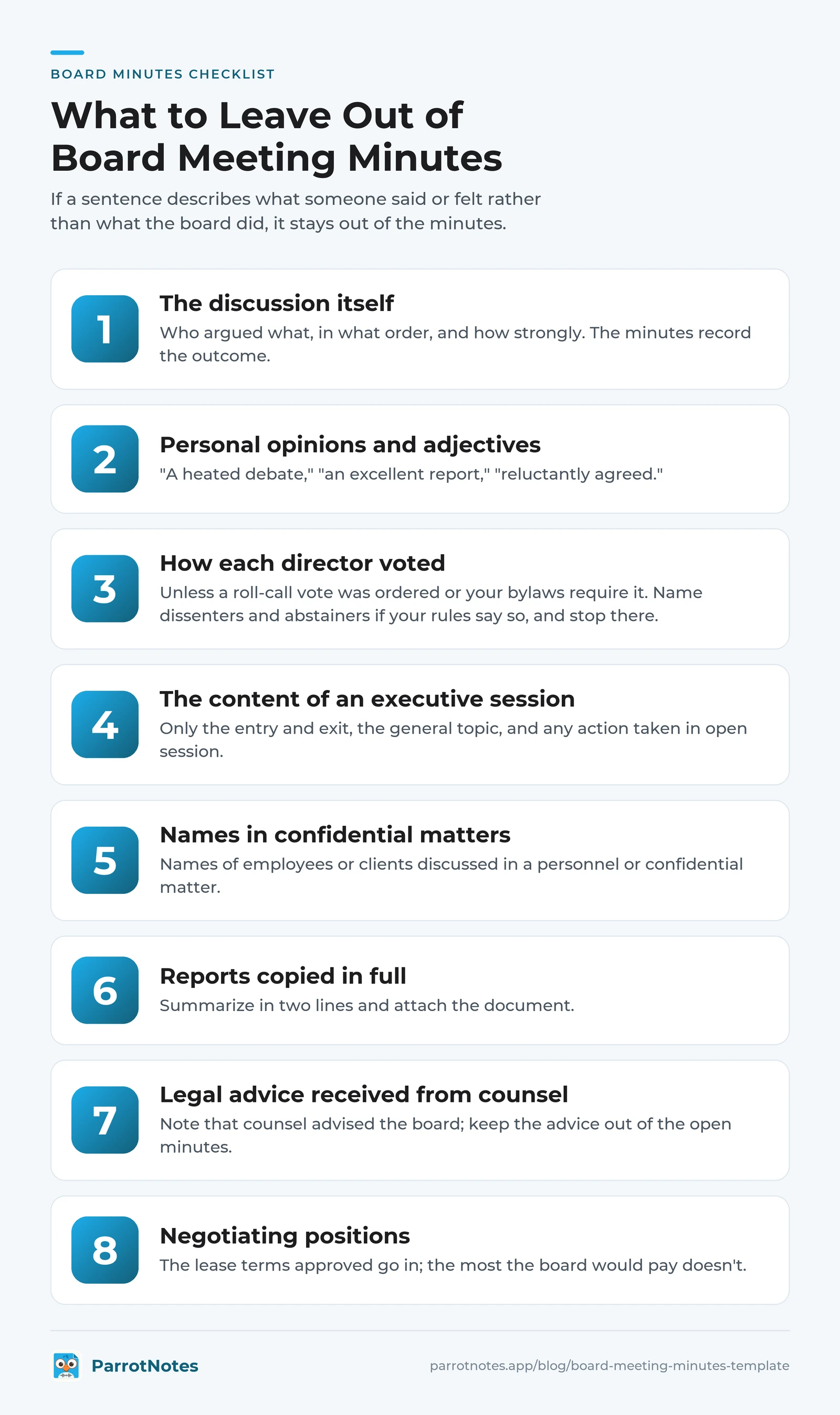
What to leave out of board meeting minutes
The template tells you what goes in. This list is the other half, and it's the part that keeps the organization safe.
- The discussion itself. Who argued what, in what order, and how strongly. The minutes record the outcome.
- Direct quotes from directors, unless a director asks that a specific statement be recorded and the chair agrees.
- Personal opinions and adjectives. "A heated debate," "an excellent report," "reluctantly agreed."
- How each director voted, unless a roll-call vote was ordered or your bylaws require it. Name dissenters and abstainers if your rules say so, and stop there.
- The content of an executive session. Only the entry and exit, the general topic, and any action taken in open session.
- Names of employees or clients discussed in a personnel or confidential matter.
- Motions that were withdrawn by the mover before a vote. Motions that failed do go in.
- Reports copied in full. Summarize in two lines and attach the document.
- Legal advice received from counsel. Note that counsel advised the board; keep the advice out of the open minutes.
- Negotiating positions, such as the most the board would pay for the warehouse. The lease terms approved go in; the ceiling doesn't.
- Time spent on each item. It reads as a judgment on the chair, and it proves nothing.
- Anything you'd be uncomfortable reading aloud to a funder, a judge, or a reporter, because any of them may one day be entitled to.
A useful test: if a sentence describes what someone said or felt rather than what the board did, it belongs in your own notes, not the minutes. Our meeting notes template covers that separate, private document.
Executive session: how to minute what you can't write down
An executive session is the part of the meeting the board closes to staff, guests, and sometimes some of its own members, usually for a personnel matter, litigation, or a negotiation. The minutes have to prove it happened properly without leaking why.
In the open minutes, record five things: the motion to enter the session and who moved and seconded it, the time, the general topic in a phrase ("a personnel matter," "pending litigation"), who left the room, and the time the board returned. Then record any action the board takes on returning to open session as a normal motion with a count, or write "No action was taken."
The Charities Review Council's guide takes the same line: "Record the topic(s) of discussion in the meeting minutes. The specific details of an executive session may be confidential, and might not be recorded in the official meeting minutes. Notes may be taken and kept separate."
If the board does decide something inside the session, most boards keep a short, separate set of executive session minutes, marked confidential, stored apart from the open minutes, and approved in a later executive session rather than in open meeting. Check your bylaws and parliamentary authority for how your board does it, and ask counsel if there's a dispute in the air.
Approving, signing, filing, and keeping board minutes
The minutes become the record only once the board approves them, so treat the draft as a draft. Circulate it marked DRAFT within a few days, take corrections at the next meeting, and note the approval date beside the signature.
Timing matters more for boards than for other meetings. For US nonprofits that file Form 990, the IRS instructions for Part VI, line 8 ask whether the organization "contemporaneously documented" every meeting of its governing body and its committees with authority to act. The instructions define contemporaneous as "by the later of (1) the next meeting of the governing body or committee (such as approving the minutes of the prior meeting), or (2) 60 days after the date of the meeting or written action." A board that approves minutes at the next meeting is inside that window; a board that lets drafts pile up is not.
How long do you keep them? The IRS's compliance guide for 501(c)(3) public charities lists board minutes among the records that "should be kept permanently," alongside the articles of incorporation and bylaws. State statutes, funder agreements, and your own bylaws may add rules, and for-profit boards have their own regime. Rules vary by state and by type of organization, and none of this is legal advice, so confirm your retention period with counsel.
The filing routine is simple once it's a habit. One folder per body, one file per meeting, named so they sort themselves: 2026-10-13-riverbend-board-minutes-APPROVED.pdf. Keep the signed, approved version as the record with its attachments, and keep executive session minutes in a separate, restricted folder. When the grant officer writes in two years, the answer should take one search.
Let a recording fill in your board meeting minutes template
The hard moment in board minutes is always the same: catching the exact wording of a motion and its amendment while counting hands, as the chair moves to the next item. A recording takes the capture job off your hands, and the template becomes something you fill in from a transcript the next morning.
Start with the board, not the app. Recording a board meeting needs the board's agreement and has to fit your bylaws, and some boards decide not to record at all. Ask the chair to put it to the board once, minute the decision, and repeat the reminder at the top of each meeting.
Recording laws vary by state and country, so this isn't legal advice: ask, and if anyone objects, don't. Stop the recording before an executive session, every time.
With that settled, set a phone running ParrotNotes in the middle of the table. Recording continues with the screen off, so the phone lies face down beside the sign-in sheet. Afterwards you get a transcript, an AI summary, and a list of action items, and each one maps onto the board meeting minutes template:
- Motions: search the transcript for "move" and "second" and copy the final wording, including the amendment by consent
- Counts: the chair's announcement is in the transcript, so the number in the minutes matches what was said aloud
- Recusals and times: "Priya has left the room" is timestamped, so the entry and return times are exact
- Action items: start from the extracted list, then confirm each owner and date against what the board decided
- Reports: the summary gives you the two-line entry and the treasurer's headline figures
Picture Marcus, an executive assistant who minutes the board of a 120-person engineering firm. His board agreed to recording in January and put it in its standing rules. On meeting day the phone records for 84 minutes, stops for a 20-minute executive session, and records the last ten minutes again. On Tuesday morning he pastes the template, fills in the seven motions from the transcript, and has the draft with the chair before lunch instead of on Friday.
The free plan includes 100 minutes of recording a month, up to 30 minutes per recording, with an AI summary on every recording and AI insights on five recordings a month. That fits a short committee meeting. A board meeting runs longer, so ParrotNotes Pro records up to 3 hours at a time, with 3,000 minutes a month, for $19.99 a month or $14.99 a month billed annually. Pro also adds speaker identification, which helps when you need the mover's name, AI chat ("What was the final wording of the van motion?"), export to docx and PDF for the approved copy, and transcription in 99+ languages with translation.
The boundary is the one the template enforces: the recording is a tool for writing the minutes, and the approved minutes are the record. Board business is sensitive, so read how we protect your data before the first meeting, and follow the board's decision on what happens to the audio once the minutes are approved.
Copy the board meeting minutes template before your next meeting
Board minutes are read by people who weren't there, years later, looking for proof of what the board did and that it was entitled to do it. The template gives them that, and the leave-out list keeps everything else where it belongs.
Here's the short version:
- Open with the call to order and a quorum count, and close with the time of adjournment and a signature
- Minute the consent agenda as one motion, and every other motion in its final wording with the count
- Record disclosures and recusals with the times a director left and returned
- Note that an executive session happened, and nothing about what was said in it
- Circulate the draft within days, approve at the next meeting, file the signed copy, and keep it
Think back to Nadia's February minutes. With this format, the funder's question is answered by item 6c: the motion, the count, and the times Priya left and came back.
Your next board meeting already has a date. Paste the board meeting minutes template into your notes app now. Then, if the board agrees to recording, download ParrotNotes free so the exact wording of every motion is waiting in the transcript when you sit down to write the minutes.
Frequently Asked Questions
What should a board meeting minutes template include?
A board meeting minutes template should include the organization and kind of meeting, the date and place, the time called to order and who presided, directors present and absent with a quorum statement, approval of the agenda and prior minutes, the consent agenda as one motion, reports received, every motion in its final wording with the outcome and count, disclosures and recusals with times, an executive session entry, the time of adjournment, action items, and the secretary's signature with the approval date.
Do board minutes need to record who seconded a motion?
Only if your bylaws or your lawyer say so. The Charities Review Council's guide says the names of directors who move and second motions "do not need to be recorded," while the names of directors who dissent or abstain should be. Many boards record both anyway. Choose one rule and apply it to every motion in every meeting.
How do you write executive session in board minutes?
In the open minutes, record the motion to enter executive session, the time, the general topic in a phrase such as "a personnel matter," who left the room, the time the board returned, and any action taken afterwards as a normal motion, or "No action was taken." Keep the content out. If the board decided something inside the session, most boards keep a separate confidential set of minutes approved in a later executive session.
How soon after the meeting should board minutes be written?
Draft them within days and approve them at the next meeting. For US nonprofits filing Form 990, the IRS instructions define contemporaneous documentation as by the later of the next board meeting or 60 days after the meeting. Whatever your rules, the sooner the draft is written, the more accurate it is, which is one more reason to capture the motions in a transcript.
Can we record a board meeting to help write the minutes?
Yes, if the board agrees, your bylaws allow it, and it is lawful where you are. Put the question to the board once and minute the decision, remind everyone at the top of each meeting, stop the recording before any executive session, and decide in advance what happens to the audio after the minutes are approved. The recording is a tool; the approved minutes remain the record.
Related Posts

Sales QBR: Agenda and Template for Sales Teams
Run a sales QBR that ends in a forecast you believe. Copy a timed 90-minute agenda, a rep's one-page prep template, and a filled-in example, all copy-ready.

How to Build a Sales Playbook From Your Team's Real Calls
Build a sales playbook from your team's real customer meetings: the sections it needs, a six-step method, a template, and one play built from three debriefs.

SaaS Sales: How It Works and How Reps Track Every Conversation
What is SaaS sales? Learn the subscription model, PLG vs sales-led, SDR/AE/CSM roles and the demo-to-renewal cycle, plus a deal log to track every call.