
Journalism Portfolio: What to Include and Examples

Sarah Johnson
Writes about field sales, meeting notes and voice-first workflows at ParrotNotes. Every article is reviewed by the ParrotNotes product team before it goes live.

Table of Contents
- 1.What a journalism portfolio is, and who reads it
- 2.What to include in a journalism portfolio
- 3.How to choose your clips: a four-question scorecard
- 4.Journalism portfolio examples: five ways to build one
- 5.Protect your clips from paywalls and dead links
- 6.Building a journalism portfolio with no published clips
- 7.Journalism portfolio checklist: 10 points before you send the link
- 8.Your journalism portfolio is never finished
Priya applied for a city hall reporting job on a Monday. On Wednesday the hiring editor emailed back: two of her three links went to a paywall, and the third, her best investigation, now returned a "page not found" because the site had been redesigned. She had the story. She just couldn't show it. (Priya is a composite, not a real reporter.)
A journalism portfolio is the first thing an editor checks after your name, and it fails in quiet ways: too many clips, the wrong clips, dead links, no bio, no way to reach you. You probably already know you need one. This guide shows what to put in it, how to choose your clips, five ways to host it with prices checked on each vendor's site on October 26, 2026, and a 10-point checklist to run before you send the link.
If your best material is still sitting in interview recordings, ParrotNotes turns them into searchable transcripts, so finding the quote that makes a clip strong takes minutes, not an afternoon.
What a journalism portfolio is, and who reads it
A journalism portfolio is a curated collection of your published work, plus enough about you that an editor can decide whether to commission or hire you. It's usually a web page, sometimes a PDF of clips attached to an application.
Write it for two readers. Commissioning editors reading a freelance pitch want proof you can deliver this exact kind of story. Hiring editors want range, consistency and a beat they can picture you on. If it works for them, it works for sources and PR people too.
What to include in a journalism portfolio
A strong portfolio has seven parts. Most of the ones that fail are missing two or three of them.
- Your clips. Headline, outlet, date and a one-line note on what you did, linked to the live page with a saved copy (more on that below).
- A short bio. Nicholas Holmes, founder of the portfolio site Clippings.me, told IJNet that about 200 words is enough: "No fluff, no buzzwords. Just plain-spoken facts about you."
- A beat line. One sentence at the top: "I cover housing and local government in Ohio." It tells a skimming editor where you fit.
- Contact details. A professional email address on every page, plus a secure channel for sources if you offer one.
- Multimedia, if you make it. Audio, video, photos, data graphics and podcasts you made or reported.
- Proof beyond bylines. Awards, fellowships, stories that changed a policy, books and republications.
- A resume link. One page, linked rather than pasted in.
Put your strongest, most relevant clip first. Group the rest by beat or format, not by date, so an editor looking for your data work finds it fast.
How to choose your clips: a four-question scorecard
Most reporters have more clips than a portfolio can carry. Holmes warned IJNet that "a page with hundreds of clippings can't do every one justice" and suggested 10 to 20 for a public portfolio.
How many depends on who's reading:
| Where it's going | How many clips |
|---|---|
| A freelance pitch | 2 or 3, all close to the story you're pitching (the count Mediabistro suggests when the editor doesn't name one) |
| A job or internship application | Whatever the posting asks for; if it doesn't say, about 5 to 8 |
| Your public portfolio page | 10 to 20 |
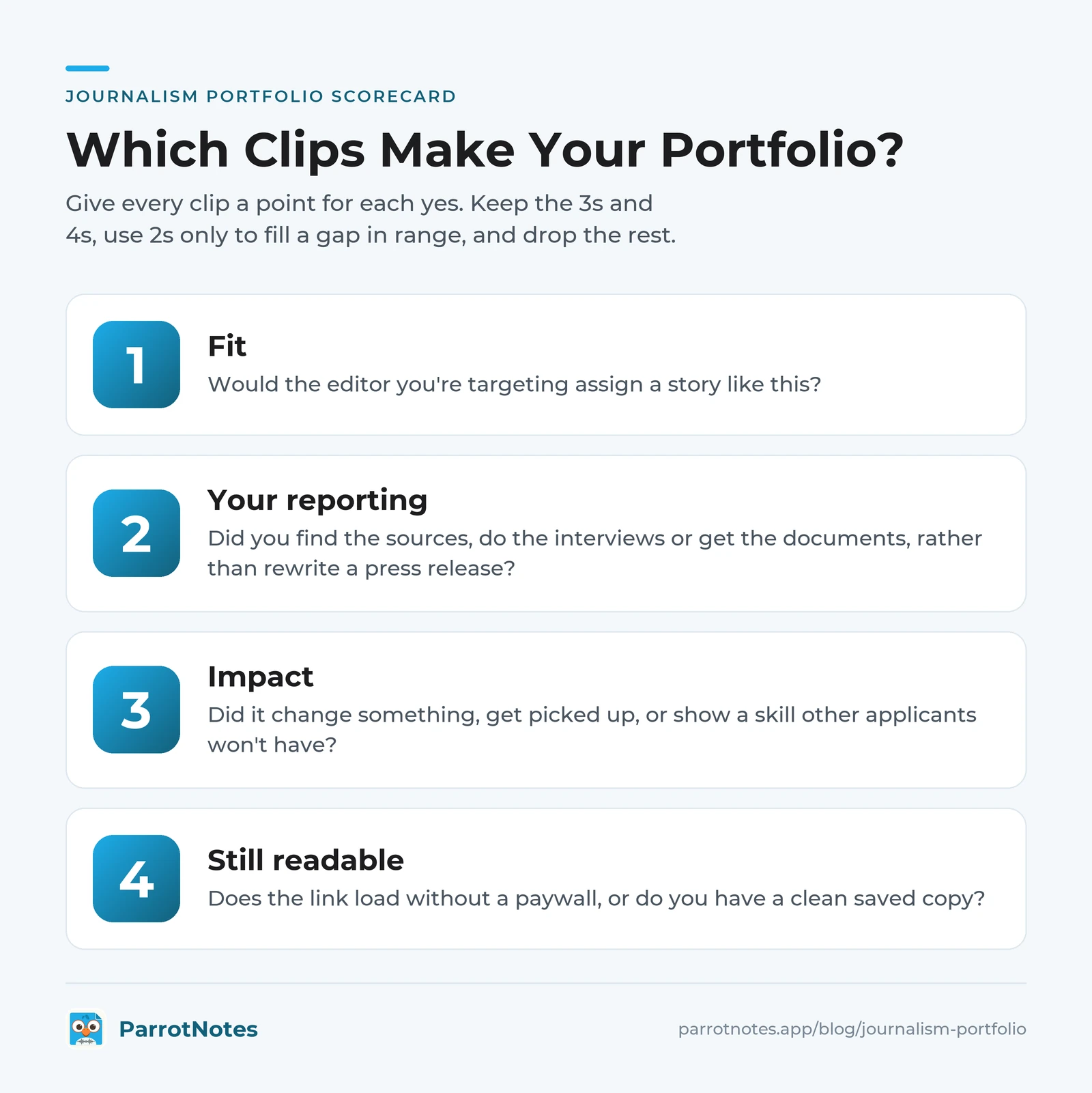
To decide which ones make it, give every clip a point for each "yes":
- Fit: Would the editor you're targeting assign a story like this?
- Your reporting: Did you find the sources, do the interviews or get the documents, rather than rewrite a press release?
- Impact: Did it change something, get picked up, or show a skill other applicants won't have (data, video, a hard interview)?
- Still readable: Does the link load without a paywall, or do you have a clean saved copy?
Keep the 3s and 4s. Use 2s only to fill a gap in range. Drop the rest, however proud you are of them.
A worked example. Marcus has 30 clips from three years at a regional daily and wants to move into health reporting. (Marcus is a composite.) His 12 weather and traffic briefs score 0 or 1, so they go. Of eight council stories scoring 2, he keeps the two about hospital funding.
Six of his ten features score 3 or 4, led by a hospital staffing story built on public records. He adds four more for range: a profile, a data piece, an obituary and a breaking story. That's 12 clips, with the staffing story first, all saying "I can cover health."
Writing new samples instead? Our guides on how to write a news story and feature writing examples cover the two formats editors ask for most.
Journalism portfolio examples: five ways to build one
Most journalism portfolio examples fall into five types. Here they are with free tiers and prices checked on each vendor's own site on October 26, 2026.
| Platform | What it is | Free option | Paid plans |
|---|---|---|---|
| Muck Rack | A journalist profile that indexes your digital bylines automatically, with a Portfolio section for your best work | Creating or claiming a profile is free | No paid plan for journalists; verified full-time journalists get advanced features |
| Authory | A portfolio and archive that can import your past and future articles automatically | Free plan, up to 10 content items | Lite $9/month billed yearly (50 items); Standard $15/month billed yearly with unlimited items, a custom domain and automatic import; 14-day trial, no card |
| Journo Portfolio | A template-based portfolio site builder for writers | Build for free, but the site isn't published until you upgrade | Plus $7/month billed yearly; Pro $10/month with a custom domain; Unlimited $14/month |
| Contently | A portfolio that doubles as an application to Contently's freelance network for brand clients | No fee listed; Contently's team reviews your work to match you with clients | None listed |
| A personal website | Your own domain on any site builder | Wix has a free plan on a wixsite.com address | A custom domain needs a paid plan; prices vary by builder |
Staff reporters with many digital bylines should claim a Muck Rack profile first: it's free and fills itself as your stories run. Freelancers writing for many outlets save the update after every story with an auto-importing archive like Authory, whose backups also help when outlets delete old work. Students need little more than a free profile and a simple personal site.
Many reporters use two: a Muck Rack profile for discoverability and a journalism portfolio website they control. For the rest of a freelancer's setup, from invoicing to backups, see our lean kit of freelance journalist tools.
Protect your clips from paywalls and dead links
Links rot faster than most reporters expect. A Pew Research Center study published in May 2024 found that 38% of webpages that existed in 2013 were no longer accessible, and 23% of news webpages contained at least one broken link.
Outlets close, get bought, redesign and put archives behind paywalls. Protect each clip in three ways:
- Save a PDF the day it runs. Print the page to PDF with the headline, byline, date and outlet visible.
- Archive the live page. The Wayback Machine has a free Save Page Now feature that keeps a public copy you can link to later.
- Link the copy when the original fails. If a clip goes behind a paywall, link your PDF or the archived copy and say so: "Originally published in The Ledger, March 2025; archived copy."
Do this as you publish. Rebuilding a three-year archive the week of an application is how good clips get lost.
Building a journalism portfolio with no published clips
Everyone starts with zero. Editors don't expect a first portfolio full of national bylines. As Dana Nickel wrote for the Foreign Press, "samples should not be exclusively from big-name publications."
Places to get your first clips:
- Student media: the campus paper, radio station or magazine.
- Local outlets: community papers, hyperlocal sites and newsletters often take pitches from new writers.
- Your own reporting: a newsletter or blog where you report, not just comment, held to the journalism code of ethics you'd follow for an editor.
- Q&A interviews: an edited interview with a local business owner or official is one of the easiest real clips to produce.
Jordan, a second-year student, had no clips in September. (Jordan is a composite.) She interviewed four small-business owners about a road closure on their street, published two Q&As and a short news story on her own newsletter, then pitched the strongest one to a community paper, which ran it in November. Three clips, one with an outlet's name on it, in two months.
Interviews are where most first clips come from, and the work is in the transcript. Recording on your phone lets you keep eye contact and get exact quotes; our guide on how to conduct an interview covers the questions, and how to quote an interview covers checking every quote against the audio. Your next clip starts with the interview. Download ParrotNotes free, record in person with permission, and search the transcript for the line you need.
Journalism portfolio checklist: 10 points before you send the link
Run this before every application or pitch:
- The beat line is at the top and matches the job or pitch.
- The strongest relevant clip comes first.
- The clip count suits the reader (2 or 3 for a pitch, what the posting asks for a job, 10 to 20 on the public page).
- Every clip shows headline, outlet, date and what you did.
- Every link loads in a private browser window, without a paywall.
- Every clip has a saved PDF or archived copy.
- The bio is about 200 words, in plain language, and current.
- Your email address is on every page.
- The page works on a phone. Editors open links from email on the go.
- Nothing is out of date: old job titles, a beat you've left, a broken photo.
If you freelance, set your rates before the first commission comes in; our free freelance rate calculator helps you work out a day rate.
Your journalism portfolio is never finished
A journalism portfolio does one job: it gets an editor to say yes. Keep it short, current and pointed at the work you want next. Score your clips, protect each one the day it runs, and start with what you have, because student, local and self-published reporting all count.
Review it every three months, and update it the day a new clip runs. When your next story starts with an interview, ParrotNotes records it on the phone in your pocket and gives you a transcript you can search before you write.
Frequently Asked Questions
What should be in a journalism portfolio?
Your best clips with headline, outlet and date, a bio of about 200 words, a one-line beat description, contact details, any multimedia, awards or impact, and a resume link. Put the strongest, most relevant clip first.
How many clips should a journalism portfolio have?
Send 2 or 3 closely matched clips with a freelance pitch, follow the posting's number for a job, and keep 10 to 20 on a public portfolio page.
What is the best website for a journalism portfolio?
There's no single best one. A free Muck Rack profile helps editors find you, Authory imports and backs up articles automatically, and a personal site gives you full control. Many journalists use a Muck Rack profile plus one site they control.
How do I make a journalism portfolio with no experience?
Write for student media, pitch community papers and newsletters, and publish your own reported work, such as Q&A interviews with local people. Editors want real reporting, not only big-name outlets.
Related Posts

Zoom AI Companion Meeting Summary: How It Works and Its Limits
Zoom AI Companion meeting summary, checked on Zoom's own pages in Oct 2026: plans, setup, who receives it, 33 languages and limits. Try ParrotNotes free.

Value Engineering: How Suppliers Win Specs Without Cutting Value
Value engineering explained: the SAVE job plan, function analysis, and how suppliers answer a VE swap, with a worked example and a proposal template. Try free.

Samsung Voice Recorder: Transcribe, Share and Organize Recordings
How to use the Samsung voice memo app: record, transcribe with Transcript assist, share and organize recordings, with menu paths checked on Samsung's pages.