Verbatim vs Clean Verbatim Transcription: Which to Use

Sarah Johnson
Writes about field sales, meeting notes and voice-first workflows at ParrotNotes. Every article is reviewed by the ParrotNotes product team before it goes live.
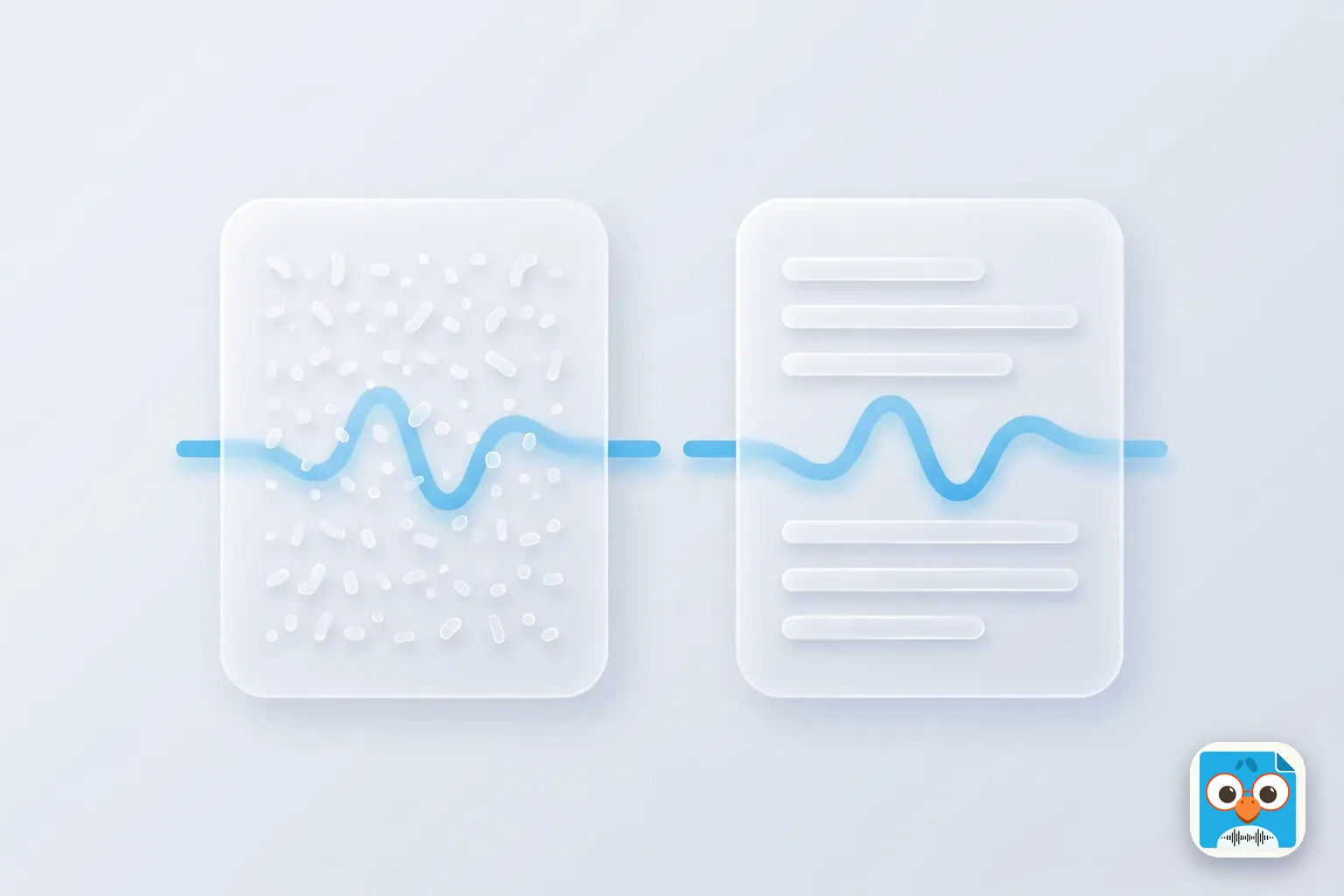
Table of Contents
- 1.What is verbatim transcription?
- 2.The four transcription styles, from strict to edited
- 3.Verbatim transcription style sheet: 12 speech features
- 4.Which to use: verbatim vs clean verbatim by job
- 5.Verbatim transcription for journalists: quotes, checks and the audio
- 6.How to get either style from one AI transcript
- 7.Pick the style for the job, not the look
Priya ordered clean transcripts of 24 interviews for her PhD study on how teachers talk about burnout. They came back tidy and easy to read. Then her supervisor asked where the hesitations were. Her method looked at how people paused before naming a problem, and every pause had been edited out. (Priya is a composite, not a real researcher.)
She didn't have bad transcripts. She had the wrong style.
Most people treat transcript style as a box to tick at checkout. It isn't. Verbatim transcription keeps every sound a speaker makes; clean verbatim keeps every meaningful word and drops the rest. Pick the wrong one and you either pay for detail you'll delete, or lose detail you need.
This guide gives you a straight answer: the four styles side by side, a style sheet for 12 speech features, a decision table for nine common jobs, and a workflow for getting either style from one recording.
If you're about to record the interview, get ParrotNotes free: record on your phone, get the transcript, then edit it into the style you need.
What is verbatim transcription?
Verbatim transcription is a written record of speech exactly as it was spoken: every word, filler, repetition, false start and audible sound, with nothing corrected or removed. It's also called full verbatim, strict verbatim or true verbatim.
Clean verbatim, also called intelligent verbatim, keeps every word that carries meaning but removes fillers ("um", "uh", "you know"), stutters and false starts. It doesn't reword, correct or summarize what the speaker said.
Researchers draw a similar line. In a 2005 paper in Social Forces, Oliver, Serovich and Mason describe naturalized transcription, where "every utterance is transcribed in as much detail as possible", and denaturalized transcription, where stutters, pauses and nonverbals are removed. Their denaturalized style goes further than clean verbatim, though: grammar is corrected too.
The four transcription styles, from strict to edited
The further down this table you go, the easier the text is to read and the further it moves from the audio.
| Style | Also called | What it keeps | Who uses it |
|---|---|---|---|
| Jefferson-style notation | Detailed, conversation-analysis transcript | Every sound plus timed pauses, overlaps, pitch and stress in special symbols | Linguists and conversation analysts |
| Verbatim | Full, strict, true verbatim; naturalized | Every word and audible sound, as spoken | Legal, investigations, discourse research |
| Clean verbatim | Intelligent verbatim | Every meaningful word in the speaker's own phrasing | Journalism, podcasts, most qualitative research, business |
| Edited | Non-verbatim; denaturalized | The meaning, with grammar fixed and sentences tightened | Published Q&As, articles, summaries |
The line that matters most is between clean verbatim and edited. Clean verbatim removes noise; it never changes words. Fix a speaker's grammar or swap "gonna" for "going to" and you've made an edited transcript: fine for an article, but not a record you can quote from.
Here's one short line in each of the three common styles (composite example):
- Verbatim: "So we, um, we didn't, we didn't get the, uh, the funding until March. [laughs] Which was late."
- Clean verbatim: "So we didn't get the funding until March. [laughs] Which was late."
- Edited: "We didn't receive the funding until March, which was late."
For a full interview laid out in each style, with header block and timestamps, see our interview transcription example.
Verbatim transcription style sheet: 12 speech features
"Remove fillers" sounds simple until you hit a stammered answer, a sworn word or two people talking at once. Copy this table into your brief or send it to whoever transcribes for you.
| Speech feature | Verbatim | Clean verbatim |
|---|---|---|
| Fillers (um, uh, er, hmm) | Keep every one | Remove |
| Verbal tics ("you know", "like", "I mean") used as filler | Keep | Remove; keep when they carry meaning ("I mean the March budget") |
| Repeated words and stutters ("we, we, we") | Keep each repetition | Keep one |
| False starts ("We were, the team was") | Keep, with a dash or comma | Remove the abandoned start |
| Grammar errors and nonstandard grammar | Keep | Keep. Never correct |
| Slang and contractions ("gonna", "y'all") | Keep as spoken | Keep as spoken |
| Profanity | Keep | Keep (redact only if the client asks, and mark it) |
| Laughter, sighs, coughs | Tag every one: [laughs], [sighs], [coughs] | Tag only when it changes meaning |
| Long pauses | Tag, often with length: [pause 4 sec] | Remove, unless the pause is the point |
| Crosstalk and interruptions | Show both speakers and where they overlap | Give each speaker a clean line; tag [crosstalk] if words are lost |
| Unclear audio | [inaudible 00:12:41] with a timestamp | Same: never guess |
| Background sounds (phone, door, siren) | Tag when audible | Tag only when someone reacts to it |
Two rules hold in both columns: never correct what someone said, and never fill a gap you couldn't hear.
Which to use: verbatim vs clean verbatim by job
Start from what the transcript will be used for, not from what looks tidy.
| Job | Style | Why |
|---|---|---|
| Court, deposition or other legal record | Verbatim | Federal law says court sessions "shall be recorded verbatim" (28 U.S.C. § 753(b)); exact words can be challenged |
| HR or investigation interview | Verbatim | Hesitations, corrections and who interrupted whom may matter later |
| Conversation or discourse analysis | Verbatim, or Jefferson-style | How something was said is the data |
| Thematic qualitative research | Clean verbatim | The words are the data; fillers slow coding |
| News quotes | Clean verbatim, checked against the audio | Quotes must be the speaker's words, not a tidied version |
| Podcast or video transcript | Clean verbatim | Readers want the conversation, not every "um" (see podcast transcription) |
| Oral history archive | Verbatim | Future researchers can't re-interview the speaker; voice and dialect are part of the record |
| User or market research interviews | Clean verbatim | Teams scan for needs and quotes; verbatim only for tone studies |
| Meeting minutes | Neither: summary from a clean transcript | Minutes record decisions, not dialogue |
When verbatim transcription is the only safe choice
Use verbatim when someone may later argue about exactly what was said, or when the way it was said is what you're studying. The same goes for any interview you can never repeat, such as an oral history.
Verbatim also costs more when you pay for it. Rev, for example, lists human transcription at $1.99 per minute and sells verbatim as a separate add-on "to capture every word, filler, and nonverbal" (Rev pricing, checked October 1, 2026). Every tag takes a transcriber extra time.
When clean verbatim is the better choice
For almost everything else, clean verbatim is the right default. It's faster to read, easier to search and still faithful to the speaker.
The test is simple: will anyone need to know how this was said, or only what was said? If only what, choose clean verbatim.
Verbatim transcription for journalists: quotes, checks and the audio
Reporters work in the clean verbatim column, with one habit borrowed from verbatim: go back to the audio for every quote you print.
Daniel, a freelance reporter, interviewed a city planner for 40 minutes about a delayed bridge. His clean transcript read: "We knew in January the budget wouldn't hold." When he played back the clip at 00:18:22, the planner had said, "We knew, uh, by January, I'd say, that the budget wouldn't hold." (Daniel is a composite, not a real reporter.)
The clean version had lost "by" and "I'd say". Neither is a filler, and both soften the claim. Daniel used the full line.
A clean transcript is your map; the recording is the source. Check every line you plan to quote against the audio. Our guide on how to quote an interview covers when you can trim with an ellipsis and when you should paraphrase instead.
Note the style at the top of the transcript ("Clean verbatim, quotes checked against audio on [date]"), and keep the audio: if a source disputes a quote, the recording settles it.
Want the transcript ready before you're back at your desk? Try ParrotNotes free on your next interview, then search the transcript for the line you need.
How to get either style from one AI transcript
You don't need to choose a style before you record.
- Record clearly. Put the phone close to the speaker in a quiet room. Our guide on how to record an interview covers placement and consent.
- Get the AI transcript. Record in ParrotNotes, or upload an existing file to the free audio to text tool. On Pro, speaker identification labels who said what, and you can transcribe in 99+ languages.
- Treat it as a first draft in either style. No AI transcript is a certified record. Read it against the audio for the passages that matter before you rely on them.
- Edit toward your column of the style sheet. For verbatim, listen through and add every filler, repetition and tag the job needs. For clean verbatim, cut fillers and false starts, tag meaningful laughs and pauses, and leave every other word alone.
- Check quotes, then export. Copy the transcript or export it as text or markdown; Pro adds DOCX and PDF export. Add the style line at the top so the next reader knows what they have.
For Priya, this order would have meant one AI draft, then a verbatim pass on the passages her method analyzed. For the full process, see how to transcribe an interview.
Pick the style for the job, not the look
Verbatim and clean verbatim aren't better and worse versions of one thing. They answer different questions.
- Verbatim when how something was said matters: legal records, investigations, discourse research, oral history
- Clean verbatim for almost everything else: journalism, podcasts, thematic research, user interviews
- Edited only for publishing, never as a record you quote from
- Use the style sheet so everyone treats fillers, crosstalk and pauses the same way
- Check every quote against the audio, whichever style you chose
Record your next interview on the phone you already carry. Download ParrotNotes free and get a searchable transcript you can shape into verbatim or clean verbatim.
Frequently Asked Questions
What is the difference between verbatim and clean verbatim transcription?
Verbatim transcription records every word and sound as spoken, including fillers, stutters, false starts and laughter. Clean verbatim removes fillers, stutters and false starts but keeps every meaningful word in the speaker's own phrasing. Neither one corrects grammar or rewords what was said.
Is intelligent verbatim the same as clean verbatim?
Yes, they're two names for the same style. Check a provider's sample before you order, because where clean ends and edited begins differs from one company to the next.
Which transcription style is best for qualitative research?
It depends on the method. For thematic analysis, clean verbatim is usually enough because the words are the data. For conversation or discourse analysis, use verbatim or a detailed notation, because pauses and overlaps are part of what you study.
Should journalists use verbatim transcription?
Most reporters work from clean verbatim and check every printed quote against the audio. Full verbatim is worth it for contested or legal stories.
Does clean verbatim change what the speaker said?
It shouldn't. Clean verbatim only removes fillers, repeated words and abandoned starts. If grammar is fixed or sentences are reworded, the transcript is edited, and you shouldn't quote from it without checking the recording.
Related Posts
Skip-Level Meeting Questions and How to Record the Answers
40 skip-level meeting questions by purpose, a 30-minute agenda, questions for employees, and how to record the answers without breaking trust. Copy them.
Sales Call Report Template (and a Faster Way to Fill It In)
Copy a nine-field sales call report template for in-person visits, see it filled in, and learn a 3-minute spoken debrief that fills it before your next stop.
Sales Activity Tracking Without Micromanaging
Sales activity tracking that coaches instead of polices: a three-question test, a one-page weekly sheet, and a 15-minute review your reps will keep up.