
Sales Pitch Examples for In-Person Meetings

Sarah Johnson
Writes about field sales, meeting notes and voice-first workflows at ParrotNotes. Every article is reviewed by the ParrotNotes product team before it goes live.

Table of Contents
- 1.What a sales pitch has to do when you're in the room
- 2.The in-person sales pitch structure: six beats
- 3.8 sales pitch examples for in-person meetings
- 4.How to write a sales pitch for your own meetings
- 5.Capture the buyer's reaction: the 90-second post-pitch debrief
- 6.Where the pitches go next
- 7.Keep the reaction, not just the pitch
The pitch took 80 seconds. Theo had practised it in the van, and it landed: the operations manager nodded twice, leaned back, and said, "The board's nice, but my drivers will think it's a spy camera."
That sentence is the most valuable thing Theo will hear all day. It's the objection, the tone of the account, and the first line of his next visit. By the time he's parked outside the next depot, it will have become "some pushback on driver privacy" in the CRM, and by Friday it will be gone.
Most sales pitch examples online are emails, cold calls, and Shark Tank openers. They stop when the pitch ends, and they're written for a screen. This guide is for the pitch you give standing at a counter, sitting in a dispatch office, or holding a cup on a trade-show stand. You'll get eight original examples sorted by the moment in a field rep's day, each with its structure labelled, then filled in, then a note on when it works and how to capture what the buyer says back.
The reaction is the output. The last section gives you a 90-second debrief script to keep it, and if you'd rather speak that debrief in the car than type it at night, you can try ParrotNotes free before your next visit.
What a sales pitch has to do when you're in the room
A sales pitch in person has one job the email version doesn't: it has to stop. In a room, the buyer's face tells you when you've said enough, and the pitch that works is the one that hands the floor back before that point.
The data on this comes from phone and video calls, and it's stricter than most reps expect. Gong analysed 326,000 sales calls of at least ten minutes and found the winning ratio was 43% talking to 57% listening. The average across all calls was 60% talking. Talking for more than 65% of the call led to lower conversion and win rates, and sellers who won deals asked 15 to 16 questions, while sellers who lost asked about 20.
In a room the temptation to talk is stronger, because silence feels longer and you brought a demo. So treat every example below as a paragraph, not a presentation: 30 to 90 seconds, then questions.
The in-person sales pitch structure: six beats
Every example in this guide is built from the same six beats. Learn them once and you can write a sales pitch for any room.
- See. Open with something only you could say: what you noticed on the way in, or what they said last time.
- Say. Name the problem in one sentence, in their words if you have them.
- Offer. What you do about that problem, one sentence, no feature list.
- Prove. One number, one example, or the product itself. Say where the number came from, or leave it out.
- Ask. One question that hands the floor back.
- Agree. A next step with a date attached, even if the next step is "I'll come back in March."
Beat 5 is where the meeting begins. Gong's discovery call research, from 519,291 sales conversations, found that asking around 11 to 14 questions in total and going deep on three to four customer problems had the highest likelihood of moving a deal to the next step.
The pitch earns the right to ask those questions. It doesn't replace them. Our BANT qualification guide covers which ones to ask first.
8 sales pitch examples for in-person meetings
Every sales pitch script below is invented for illustration. Theo, Amara, and the people they meet don't exist, and the numbers inside the scripts are chosen to show each structure working, not to prove anything about real results.
Theo Lindgren sells fleet telematics, a tracker in each van and a live board in dispatch, to regional courier and service companies. His pitches happen in depots. Amara Okoye sells commercial coffee machines and service plans to cafés, hotels, and offices. Hers happen at counters, in breakfast rooms, and at trade shows.
1. The walk-in pitch (30 seconds at the counter)
Structure
1. Who I am, in one breath
2. What I noticed on the way in
3. What I do for places like this, one sentence
4. The ask: five minutes with the owner now, or a morning to come back
Filled in (Amara at a café)
"Morning, I'm Amara Okoye from Halden Coffee Systems. I noticed the queue was out of the door at ten past eight and you're pulling every shot on a two-group. We look after espresso machines and service plans for about 40 cafés around here, mostly so the machine never goes down on a Saturday. Is the owner in, or is there a better morning to catch them for five minutes?"
When it works. Before the rush or after it, never during. It lives or dies on line 2: "I noticed the queue" is worth ten company descriptions. If you didn't notice anything, don't walk in yet.
Capture the reaction. One spoken line in the van: who you spoke to, the owner's name, the morning they said, and the machine on the counter. The walk-in is the pitch reps most often forget to record, because it felt like nothing happened.
2. The first-meeting pitch (90 seconds at the top of a booked meeting)
Structure
1. Thank them and name the time they gave you
2. Why I asked for this meeting, using what they said on the call that booked it
3. What we do, one sentence, in their terms
4. One number from a similar customer, framed as an example, with its source
5. The question that hands the floor back
Filled in (Theo at a courier depot)
"Thanks for the half hour, Sunil. When we spoke on the phone you said your drivers do 14 to 16 drops an hour and dispatch finds out about a late run when the customer calls. What we do is put a tracker in each van and a live board in dispatch, so the late run shows up before the phone rings. A courier about your size, 38 vans, cut failed first-time deliveries by about a fifth in their first quarter; that's their number from their own system, and I'd rather you judged it against yours. Before I show you anything: what does a late run cost you today, in redeliveries or in calls?"
When it works. When a phone call booked it and you wrote down what they said, because line 2 is their words coming back. It fails when the rep skips line 2 and opens the laptop. Line 4 needs a number from a customer you can name if asked; if you don't have one, use the product instead.
Capture the reaction. Their answer to the last question, in their words, and the cost figure they gave you. That figure is the business case for the rest of the deal.
3. The walk-through pitch (after seeing the site)
Structure
1. Three things I saw, in the order I saw them
2. The one that matters most, in their words if they flagged it
3. What changes if that one is fixed
4. The ask: a next step tied to what I saw
Filled in (Theo, back in the office after walking the yard)
"Three things from the yard. Your drivers are loading from paper run sheets, two vans were idling the whole 20 minutes we were out there, and the three o'clock wave was still being sorted at twenty past. The one you flagged was the three o'clock wave. If dispatch can see which vans are back and empty, that wave goes out when the vans are ready instead of when the sheet is printed. Can I take the run sheets from one route for next Tuesday's wave and show you what the board would have shown?"
When it works. Only after a walk-through, and only if you speak in what you saw. It's the strongest in-person sales pitch there is, because no email can do it, and the one that dies fastest in memory: by the second depot, the order you saw things in is gone.
Capture the reaction. The three observations, which one they said mattered, and their exact words about it, before you start the engine.
4. The trade-show pitch (standing, 45 seconds)
Structure
1. A question about them before anything about you
2. What we do, tied to their answer
3. One thing to see, hold, or taste on the stand
4. The ask: a day to visit
Filled in (Amara at a hospitality show)
"How many machines are you running across the hotel?"
Visitor: "Four, and the breakfast one is the one that breaks."
"That's what this stand is for: these are the machines we put in breakfast rooms, because they're built for 200 covers before nine. Try a shot from that one, and while it pours, tell me who looks after the breakfast machine now. If it's worth a look, I'll come to the hotel. Is a weekday morning or afternoon easier?"
When it works. When line 1 is a question. This is the nearest thing here to an elevator pitch example, and the rule is the same: the visitor has heard "we're the leading provider of" 30 times since lunch. It fails when there's nothing to hold or taste, or when the rep collects a badge scan instead of a day.
Capture the reaction. You'll give this pitch 40 times in a day. Speak a 20-second note after each: name, hotel, number of machines, the breakfast problem, the day they said. On Monday, 40 badge scans are a list. Forty notes are a route.
5. The second-visit pitch (their words from last time)
Structure
1. Their words from the last visit, quoted back
2. What I did about it since
3. The offer, adjusted to what they told me
4. One question about what has changed since
5. The ask
Filled in (Amara, back at the café with the owner)
"Last time you said, 'I can't have another Saturday like the one in March.' I went away and checked: on the plan I'm proposing, a Saturday breakdown gets a technician within four hours and a loan machine comes with them. I've priced it for the two-group and the grinder you run, not the three-group I mentioned first. Has anything changed since we spoke, another breakdown or a change of staff? If it still fits, I'd like to book the install for a Monday when you're closed until eleven."
When it works. Only if you wrote down the quote. "Last time you said" is the most persuasive opener in field sales and the easiest to fake badly: "you mentioned some issues" tells the buyer you forgot.
Capture the reaction. New quotes, what changed, the install date. The second visit produces the notes the third visit opens with.
6. The sample or demo pitch (the product in the room)
Structure
1. What they'll see in the next five minutes, one sentence
2. Hand it over: they drive
3. Narrate only what they touch
4. Stop before they've finished looking
5. The question: what would you want this to show you?
Filled in (Theo, with a tablet in the dispatch office)
"This is the dispatch board with one of our demo vans on it. You take the tablet. Tap any van: that's where it is, how long it's been stopped, and the drops it has left. I'll keep quiet unless you ask. That dot going amber is a stop over 15 minutes. What would you want this to show you at three o'clock on a Friday?"
When it works. When the buyer holds the product: a tablet in their hands, a shot from the machine on the stand. It fails when the rep demos the roadmap or narrates features the buyer hasn't touched.
Capture the reaction. What they tapped first, what they asked, and their answer to line 5. That answer is the requirement, and it's rarely the feature you'd have led with.
7. The two-stakeholder pitch (owner and operator in the room)
Structure
1. Name the two jobs in the room and what each one cares about
2. One sentence for the operator's problem
3. One sentence for the owner's number
4. Proof that speaks to both
5. One question to each, by name
6. The ask: a decision step with a date
Filled in (Theo, with the owner and the operations manager)
"Sunil, you want to know about a late run before the customer does. Marianne, you want to know what it costs and when it pays back. The board answers Sunil's problem on day one. On the number: 38 vans at our per-van rate works out at about the cost of one redelivery per van per month, and you'll have your own redelivery figure, so I'd rather use yours. Sunil, which route would you trial it on? Marianne, who else needs to see the number before you'd sign a 12-month term? If the trial route runs for two weeks from the 6th, can we sit down on the 20th with the results?"
When it works. When you know both jobs before you walk in and speak to each by name. It fails when the pitch is aimed at the room, because two people never want the same sentence. If there are more than two, or you're not sure who signs, build the stakeholder map first and pitch to it.
Capture the reaction. Two reactions, kept separately, and the name Marianne gives when you ask "who else." That name is the next meeting.
8. The renewal pitch (an existing account)
Structure
1. What happened this year, in their numbers
2. What I'd change next year
3. The renewal, with the one thing that's different
4. The question: what would you change?
5. The ask, with the date the current plan ends
Filled in (Amara, with an office manager)
"This year we did three call-outs at Northgate, all on the fourth-floor machine, and the longest you were without coffee was one morning. Next year I'd move that machine to a six-monthly service instead of annual, and that's the one change in the renewal; the price is otherwise the same. What would you change, if anything? Your plan ends on the 30th, so can we agree it by the 20th so nothing lapses?"
When it works. When you have the year's numbers to hand. "How's everything been?" invites the buyer to remember the bad morning. Opening with the three call-outs shows you already know about it.
Capture the reaction. Their answer to "what would you change." It's the one line in the meeting you couldn't have predicted, and it's next year's pitch.
How to write a sales pitch for your own meetings
Four rules turn the eight sales pitch examples above into your own scripts.
- Open with something only you could say. What you saw on the way in, or what they said last time. A sales pitch that could be emailed to any account is an email, so send it as one and save the visit.
- Use one number and say where it came from. A customer you can name, a figure from their own system, or the product in their hands. A made-up number ends the account when it's checked.
- Hand the floor back inside 90 seconds. Then ask the 11 to 14 questions Gong's data points to, across the whole meeting, and go deep on three or four problems rather than skimming eight.
- Ask with a date. "Can I come back?" is not an ask. "Tuesday the 6th at 9:30, with the run sheets" is.
If a phone call booked the meeting, the cold call script and the pitch in the room share their line 2: what they said on the call is what you open with at the depot.
Capture the buyer's reaction: the 90-second post-pitch debrief
Here's the part no other list of sales pitch examples covers. The pitch is the input. The reaction is the output, and it's lost between stops.
The numbers on why are blunt. SPOTIO's State of Field Sales 2026, from a survey of 452 sales professionals, found B2B field reps spend 33% of their time on active selling and lose roughly 25% of the week to administrative tasks and data entry, about 10 hours in a 40-hour week. Salesforce's 2026 State of Sales figures, from 4,000+ sales professionals, put it at 60% of reps' time on non-selling tasks, and name "manually entering customer notes into the CRM" among them.
So the CRM note gets written at night, from memory, and the sentence that mattered becomes "some pushback." The fix is to speak the debrief in the car, in the same six prompts every time, before the next stop.
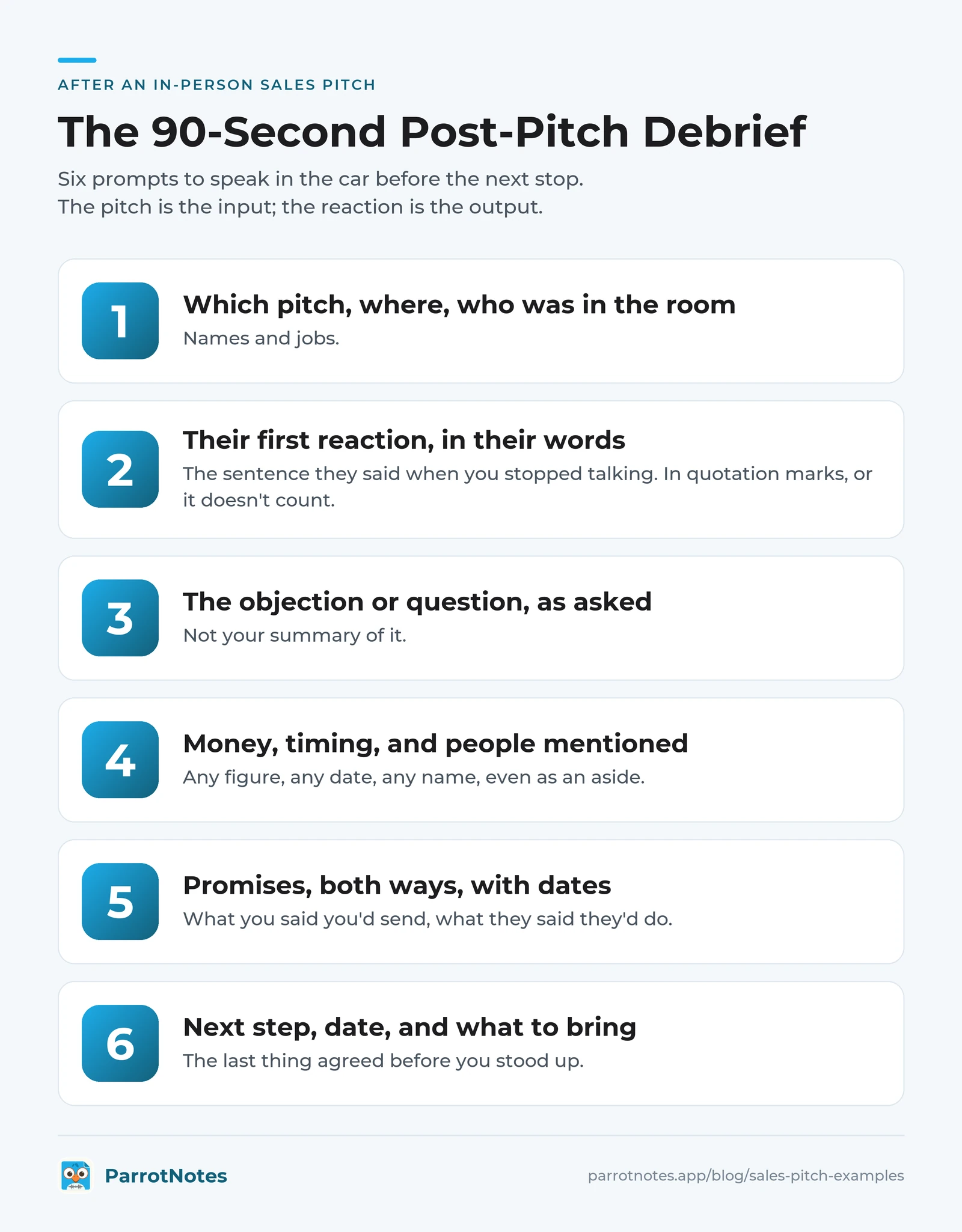
The six prompts
- Which pitch, where, and who was in the room. Names and jobs. "Redpath Couriers, dispatch office, first-meeting pitch, Sunil Mehta, operations manager."
- Their first reaction, in their words. The sentence they said when you stopped talking. In quotation marks, or it doesn't count.
- The objection or question, exactly as asked. Not your summary of it. "My drivers will think it's a spy camera" is a different objection from "privacy concerns."
- Money, timing, and other people mentioned. Any figure, any date, any name, even as an aside.
- Promises, both ways, with dates. What you said you'd send, what they said they'd do.
- Next step, date, and what to bring. The last thing agreed before you stood up.
Ninety seconds covers all six. Prompts 2 and 3 decay first and matter most, so say them before you've closed the car door.
Speak it, then let the phone do the typing
Sit in the car, open ParrotNotes, press record, and talk through the six prompts in order. Only you are speaking, so there's nobody to ask for permission. When you stop, you get a transcript, an AI summary, and the action items pulled out with dates, so prompt 5 is already a list with owners.
ParrotNotes can draft the follow-up email from the debrief, so the promises reach the buyer in writing before your next stop. On Pro, the sales frameworks sort what you said into BANT, MEDDIC, or SPIN fields, and AI chat answers "what did Carmen say about Saturdays?" in the car park before the second visit, which is how example 5 gets its opening line. Recording works even where the depot has no signal; transcription and AI run once you're back in coverage.
If you recorded the meeting itself, with everyone's permission, the transcript gives you the reaction in the buyer's exact words rather than your memory of them. Ask before you press record, every time.
In the United States, federal law permits recording a conversation you're part of (18 U.S.C. § 2511(2)(d)), but some states and countries require everyone's consent, and this isn't legal advice. A debrief spoken alone in the car needs none of that. Where recordings touch customer conversations, you can read how we protect your data first.
Want to try it on tomorrow's route? Download ParrotNotes free. The free plan gives you 100 minutes of recording a month, up to 30 minutes per recording, with an AI summary on every recording and AI insights on five recordings a month. Pro is $19.99 a month, or $14.99 a month billed annually, with 3,000 minutes a month, recordings up to 3 hours, the sales frameworks, and AI chat across every debrief you've ever spoken.
Worked example: pitch, reaction, debrief, email
Here's Theo's Thursday, invented to show the routine end to end.
He gives the first-meeting pitch (example 2) at Redpath Couriers. Sunil's reaction is the sentence from the top of this article: "The board's nice, but my drivers will think it's a spy camera." Sunil also says a late run "probably costs us $40 a time in redeliveries, maybe 30 a week," and that the owner, Marianne, "signs anything over a thousand a month."
In the van, Theo speaks the debrief:
1. Redpath Couriers, dispatch office, first-meeting pitch, Sunil Mehta, ops manager, Thursday 10:15. 2. First reaction: "The board's nice, but my drivers will think it's a spy camera." 3. Objection: driver privacy, in those words. He asked whether drivers can see what dispatch sees. 4. Money: "$40 a time, maybe 30 a week" for late runs. Timing: wants something before the December peak. People: Marianne Redpath, owner, "signs anything over a thousand a month." 5. Promises: I'll send the driver-facing view and two references from couriers by Monday. Sunil will pull last month's redelivery count. 6. Next step: Tuesday the 6th at 9:30, with Marianne in the room, run sheets from the three o'clock wave.
The transcript goes into the CRM as it is, the summary becomes the call report, and the action items are two, with dates. The follow-up email, drafted from the debrief and tidied in two minutes, opens with Sunil's own objection: "You said your drivers will think it's a spy camera, so the first thing I've attached is what the driver sees." The five lines that email needs are in our guide to the follow-up email after a sales call.
On Tuesday the 6th, Theo gives the two-stakeholder pitch (example 7), and its line 2 is Sunil's objection, answered. That's the loop: the reaction from one pitch writes the next one.
Where the pitches go next
A month of debriefs is a record of what buyers say when they hear your pitch: objections in their words, the questions they ask on a demo, the numbers they quote for the cost of the problem. That's the raw material for a sales playbook built from real calls, with the objection section written from prompt 3 across the whole team.
Keep the reaction, not just the pitch
The sales pitch examples above are a set of openings. Learn the six beats, take the structure that fits the moment, and fill it with what you saw and what they said. Then stop talking and keep what comes back.
The short version:
- An in-person sales pitch is a paragraph: see, say, offer, prove, ask, agree, inside 90 seconds
- Eight moments, eight structures: walk-in, first meeting, walk-through, trade show, second visit, demo, two stakeholders, renewal
- The reaction in the buyer's own words is worth more than the pitch
- Speak the six-prompt debrief in the car before the next stop, and let the transcript be the CRM note, the call report, and the email draft
Think back to Sunil's spy-camera line. Kept in his words, it became the first line of Theo's email and the second beat of his next pitch. Download ParrotNotes free, pick the example that matches your next meeting, and speak the debrief before you leave the car park.
Frequently Asked Questions
What is a good sales pitch example for an in-person meeting?
A good in-person sales pitch opens with something only you could say (what you noticed on the way in, or what the buyer said last time), names the problem in one sentence, offers what you do about it, gives one sourced number or puts the product in the buyer's hands, and hands the floor back with a question inside 90 seconds. The walk-through pitch is the strongest example, because no email can do it.
How long should a sales pitch be in person?
Thirty seconds at a counter or trade-show stand, and 90 seconds at the top of a booked meeting. Gong's analysis of 326,000 sales calls found the winning talk-to-listen ratio was 43% talking to 57% listening, and that talking for more than 65% of the call lowered win rates. The pitch is a paragraph; the meeting is the questions that follow it.
How do you start a sales pitch in person?
Start with what you saw or what they said, never with your company. "I noticed the queue was out of the door at ten past eight" or "Last time you said, 'I can't have another Saturday like March'" earns the next sentence. "We're a leading provider of" loses it. At a trade show, start with a question about them.
What should I write down after a sales pitch?
Six things, spoken in the car within 90 seconds: which pitch and who was in the room, the buyer's first reaction in their exact words, the objection or question exactly as asked, any money, timing, or names mentioned, promises both ways with dates, and the next step with a date and what to bring. The exact words matter most and fade first.
How is an in-person sales pitch different from a cold call script?
A cold call script has to earn 30 seconds from someone who didn't expect the call, so it leads with the reason for calling and asks for a meeting. An in-person pitch already has the meeting, so it leads with what you've seen or heard, steers by the buyer's reaction in the room, and ends with a next step and a date. What the buyer said on the call is what the pitch in the room opens with.
Related Posts
What Is B2B Sales? A Plain Guide for New Reps
What is B2B sales? A plain-English guide for new reps: B2B vs B2C, the seven-stage cycle, who does what, a first-30-days checklist and a jargon decoder.
Solar Sales: How Closers Keep Track of Every Household
What solar sales is, how closers work, and an eight-field household record for every in-home consultation, plus the follow-up and referral rhythm. Copy it.
Outside Sales Rep: The Role, the Tools and a Typical Day
What an outside sales rep does, earns (BLS 2025) and carries, a typical day hour by hour, and how reps capture notes between visits. Copy the territory plan.