
Sales Closing Techniques That Work Across a Table

Sarah Johnson
Writes about field sales, meeting notes and voice-first workflows at ParrotNotes. Every article is reviewed by the ParrotNotes product team before it goes live.
Table of Contents
Marco had been at the food plant for fifty minutes, and it had gone well. The maintenance lead showed him the machine that jammed twice a shift, and everyone nodded at the right moments. Then Marco closed his notebook and asked, "So, should we move forward?"
The plant manager smiled. "Let us think about it."
Most sales closing techniques are written for a phone call or a video screen. Across a table, with two or three buyers watching you, pressure lines sound worse and vague ones get vaguer. Below are seven ethical closes that hold up in the room. They clarify the next decision instead of pressuring the buyer. Each comes with the line to say and when not to use it, plus a closing card you can copy.
If you'd rather capture the buyer's exact words than scribble them, try ParrotNotes free on your next visit (with everyone's permission to record).
What a close is in a B2B sale
In a large sale, the close is rarely a signature. It's a commitment that moves the deal forward: a site survey, a technical review, a trial with a start date. Huthwaite, the firm behind SPIN Selling, calls this stage obtaining commitment: securing "next steps that advance the sales process."
That's why the classic closes misfire in B2B. In SPIN Selling, built on research into more than 35,000 sales calls, Neil Rackham shows why techniques like closing work in small sales but fail in larger ones. (Our SPIN Selling guide covers the questions that come first.)
Sandler makes the same point from the other side: pain, budget, and the decision process should be clear before you present. So before any close, check three things in your notes:
- The problem, in the buyer's words. Not "efficiency issues" but "the line jams twice a shift."
- Who decides, and how. Names, roles, and anyone not in the room.
- The next decision they can make today. Not the purchase. The next step.
If one is blank, no closing technique will save the meeting. Go back to discovery questions, not a harder close.
Seven sales closing techniques for in-person meetings
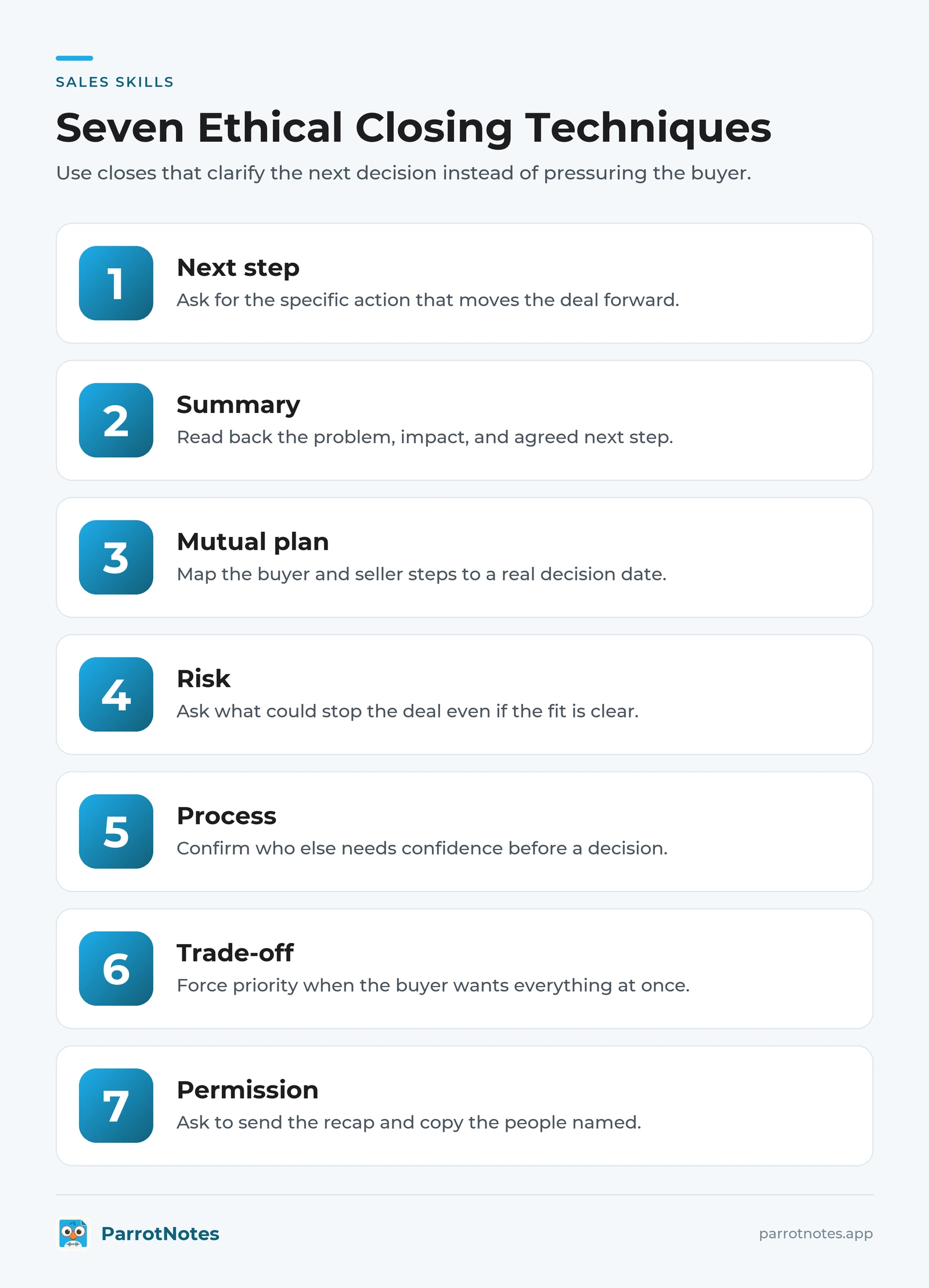
1. The next-step close
What it is: you ask for the specific action that moves the deal forward, with a name and a date.
Across the table: "Does it make sense to book the technical review with Priya and your maintenance lead next Tuesday?"
Don't use it when the buyer hasn't agreed there's a problem yet. A meeting booked out of politeness gets cancelled.
2. The summary close
What it is: you read back the problem, the impact, and the agreed next step, then ask if you missed anything.
Across the table: "Here's what I heard. The line jams twice a shift, each jam costs about 20 minutes, and you want it fixed before the holiday peak. Did I get that right?"
Don't use it when you're summarizing from memory. A wrong number read back to a buyer costs more trust than no summary at all.
3. The mutual-plan close
What it is: you map the buyer's and seller's steps back from a real decision date, together.
Across the table: "If the new line has to run by March, can we work back from that and list what has to happen, and who does it?"
Don't use it when there's no date the buyer cares about. A plan with an invented deadline is a pressure close in a spreadsheet. See our mutual action plan template.
4. The risk close
What it is: you ask what could stop the deal even if the fit is clear.
Across the table: "Suppose everyone here likes this. What could still stop it?"
Don't use it when you haven't earned the trust to hear the answer. Early in a first meeting, it sounds like doubt.
Matthew Dixon and Ted McKenna's study of 2.5 million recorded sales conversations found that 40% to 60% of deals are lost to buyers who intend to buy but never act. The risk close surfaces that fear while you can still answer it.
5. The decision-process close
What it is: you confirm who else needs to feel confident before a decision.
Across the table: "Who else needs to be comfortable with this before it can move, and what will they ask you?"
Don't use it when you asked it last visit and nothing changed; ask what's new instead. For long deals, a stakeholder map keeps the answers in one place.
6. The trade-off close
What it is: you force a priority when the buyer wants everything at once, and you offer your recommendation.
Across the table: "If we fix one thing first, I'd start with the jams on line two, because that's the lost output. Does that match your priority?"
Don't use it when the buyer has one clear goal. Offering choices there just slows them down.
7. The permission close
What it is: you ask to send the recap and copy the people named in the meeting.
Across the table: "Would it help if I sent a recap with those three next steps today and copied your maintenance lead?"
Don't use it when someone asked to keep the conversation private. Ask who should get the recap instead.
Sales closing techniques to retire at a customer's table
Some classic closes do real harm in person:
- The assumptive paperwork close. Sliding the order form across the table before anyone has said yes.
- Now-or-never. "This price is only good today." In a committee sale nobody can say yes today, so you've handed them a reason to say no.
- The hard close. "What will it take to get you to sign today?"
Challenger's research on indecision points the other way. Their JOLT method (judge the level of indecision, offer your recommendation, limit the exploration, take risk off the table) rests on a finding about high performers: with an undecided buyer, "FOMO was not as important as FOMU," the fear of messing up. Extra urgency makes a nervous buyer freeze.
If a close turns up a real concern, stop closing and handle it. Our objection handling guide covers that part.
The in-person closing card
Copy this into your notes app. It turns the seven sales closing techniques above into one page. If the middle column is empty, the close isn't ready.
| Close | Say it like this | Have in your notes first | It worked if |
|---|---|---|---|
| Next step | "Does it make sense to book X with Y on Tuesday?" | The right person for the next step | A name and a date |
| Summary | "Here's what I heard... did I get that right?" | Problem, impact, and deadline in their words | They correct or add a detail |
| Mutual plan | "Can we work back from March?" | A date the buyer chose | A list of steps with owners |
| Risk | "What could still stop it?" | Signs of real interest | A specific worry you can answer |
| Decision process | "Who else needs to be comfortable?" | The names already given | New names or questions |
| Trade-off | "If we fix one thing first..." | Two or more competing needs | They pick one |
| Permission | "Can I send a recap and copy X?" | The three next steps, agreed | They name who to copy |
A worked visit: from "let us think about it" to a date
This visit is invented to show the card in use.
Two weeks later, Marco goes back. This time he checks his notes before he walks in: jams twice a shift, about 20 minutes each, fix wanted before the holiday peak, maintenance lead signs off.
At the end, he reads back the summary. The plant manager corrects one detail: it's line two, not line one. Marco asks the risk question.
The answer is that the last vendor's install overran by a week. So he offers a phased install over two weekends, then the next-step close: a technical review with the maintenance lead, Thursday at 10.
He sends the recap from the car park, copying the maintenance lead, using one of our follow-up email templates.
With ParrotNotes, Marco could record the meeting with permission and leave with a transcript, a summary, action items, and a draft recap. The free plan includes 100 minutes a month; Pro adds sales frameworks like BANT, MEDDIC, and SPIN.
Conclusion
The best sales closing techniques don't trap anyone. They make the next decision obvious. Check your notes for the problem, the decision process, and the next step, pick the close that fits the moment, and get the commitment in writing the same day.
Copy the closing card, and download ParrotNotes free so the buyer's exact words are in your notes before you ask for anything.
Frequently Asked Questions
What is the best sales closing technique?
For B2B deals, the next-step close usually does the most work. It asks for a specific action, with a named person and a date, that moves the deal forward, which fits how large deals are bought: in several steps, by several people. Pair it with a summary close so the buyer hears their problem read back first.
Are assumptive closes bad?
Not always. In a simple, low-cost sale where the buyer has clearly decided, assuming the order saves time. In a B2B meeting with a committee, it usually backfires: sliding paperwork across the table before anyone has agreed looks like pressure, and professional buyers pull back. Use a summary or next-step close instead.
How do you know when to close a sale?
Close when your notes show three things: the problem in the buyer's own words, who decides and how, and a next step the buyer can agree to today. Buying signals help too, like questions about timing or installation. If one of the three is missing, go back to discovery first.
What should you do if the buyer says "let me think about it"?
Treat it as a sign that something is unclear, not as a no. Ask what they'd want to think through, then use the risk close: "What could stop this, even if you like it?" The answer is often a specific worry you can deal with. Agree a dated next step, even a small one, before you leave.
How many times should you ask for the close?
Ask for a commitment at the end of every meeting, sized to the stage. A first visit might close on a site survey, a second on a technical review, a third on a trial. Each small yes builds the path to the order. Asking for the full order again, with nothing new to offer, reads as pressure.
Related Posts
Windshield Time: Turn Drive Time Into Done Admin
Windshield time eats a field rep's day. Audit one week, keep the drive for driving, and try a two-minute parked debrief to clear your admin between stops.
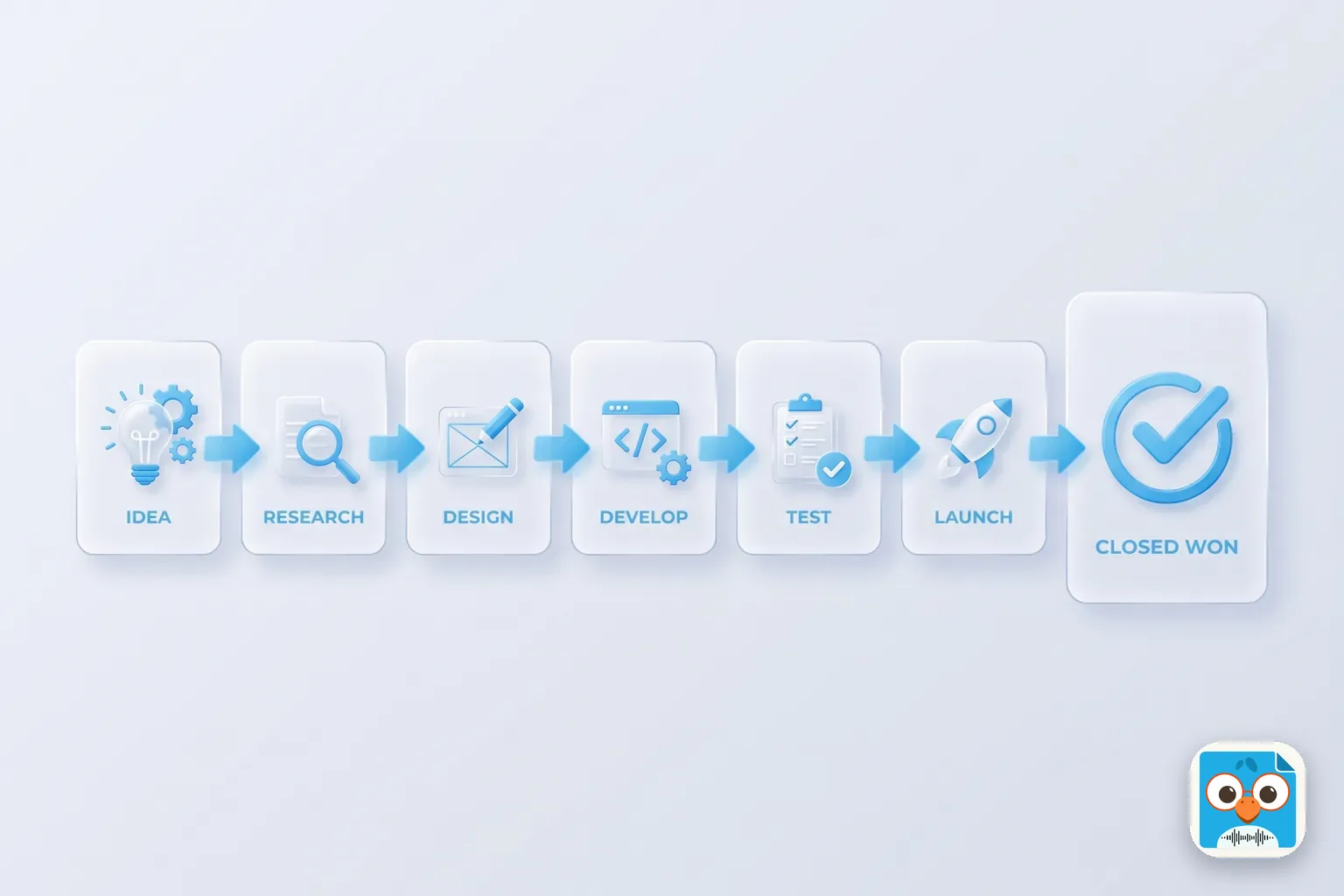
What Is a Sales Pipeline? Stages, Examples and Mistakes
What is a sales pipeline? Learn the seven stages with exit criteria, follow one field deal from prospect to close, and avoid the mistakes that inflate it.
The Challenger Sale: Summary and How to Apply It in the Field
The Challenger Sale in plain English: the five seller profiles, teach, tailor, and take control, plus a six-step pitch and call sheet for your next visit.