
What Is a Pull Quote? Examples and How to Pick One

Sarah Johnson
Writes about field sales, meeting notes and voice-first workflows at ParrotNotes. Every article is reviewed by the ParrotNotes product team before it goes live.
Table of Contents
- 1.What is a pull quote?
- 2.Pull quote vs block quote
- 3.Where pull quotes go and how they look
- 4.Pull quote examples
- 5.How to pick a pull quote: the six-question test
- 6.Worked example: six lines, one pull quote
- 7.Pull quote mistakes editors flag
- 8.Find the best line in your interview
- 9.Pick the line that earns the space
Maya has a 2,400-word profile, a layout with one empty slot on page two and 20 minutes before the page closes. Her designer wants "something big and punchy" for that slot. She scrolls the draft and picks the first quote that sounds dramatic. It's the last line of the story. (Maya is a composite, not a real editor.)
That's a classic way for a pull quote to go wrong. You already know the big type in the middle of a magazine page is there to stop the reader. The hard part is picking the line that earns the space.
Below: what it is, how it differs from a block quote, where it goes and what editors say makes a good one. Then a six-question test, and a worked example that runs six lines through it.
Most pull quotes start life in an interview. If you record yours, try ParrotNotes free: it records on your phone and gives you a searchable transcript, so the best line is a search away.
What is a pull quote?
A pull quote is a short line lifted from an article and set again in larger or different type on the same page, so it catches the eye of someone skimming. Wikipedia defines it as "a key phrase, quotation, or excerpt that has been 'pulled' from an article and used as a page layout graphic element." You'll also hear it called a pull-out quote, a lift-out quote or a pullquote.
It usually repeats words the reader will meet in the body. It can be a quote from a source, or a sharp sentence from the writer's own text.
A pull quote has two jobs:
- Stop the page-flipper. On a page of grey text, the big line is often the first thing a reader sees. It's a second headline.
- Break up the page. It gives the eye a rest in a long feature, the same way a photo does.
The magazine pull quote is the classic form, and long newspaper features use them too. You'll also see them in newsletters, annual reports, brochures and long web articles.
Pull quote vs block quote
People mix these up because both are quotes set apart from the text. They do different jobs.
| Pull quote | Block quote | Epigraph | |
|---|---|---|---|
| What it is | A line repeated from the article as a design element | A long quotation set off as part of the text | A short quotation that opens a piece or chapter |
| Repeats the body? | Yes, the reader meets it again | No, it appears once | No, it usually comes from another work |
| Purpose | Catch the eye, break up the page | Quote a long passage so it's readable | Set the tone |
| Size | Larger or bolder than the body | Same size or smaller, indented | Small, often italic |
| Where | Near the text it repeats, set in or beside a column | In the flow of the text | Before the first paragraph |
A callout is a looser cousin. It can hold a fact, a statistic or a tip instead of a quote.
If you came here from a WordPress screen: WordPress has a Pullquote block for this design element. Its documentation says "Pullquotes are like blockquotes but designed to draw attention," and you can add one by typing /pullquote in an empty paragraph (as of November 2026). The rest of this guide is about the editorial choice: which words go in it.
Where pull quotes go and how they look
Placement
The design rule, cited on Wikipedia from Nigel French's InDesign Type (2010), is that a pull quote "should appear before the text it cites and, generally, fairly close to it." The reader sees the big line first, then finds it in the story a little later.
The reverse is worse. David Herder, an editor at Pioneer Utility Resources, put it this way in his team's published advice: "you should never place a pull quote in a place where they would have already encountered the quote."
How many
Fewer than you think. The Microsoft Style Guide says simply: "Use pull quotes sparingly." Mike Teegarden, another Pioneer editor, suggests you "limit pull quotes to one every couple of pages." On the web, one or two per long article is plenty.
Length and attribution
Microsoft's guide says pull quotes should be short, "from a few words to a few lines," and that a quote from a person needs their name, title and organization. The exception is a profile, where the whole piece is about the person quoted.
On the web and in newsletters
Online, a pull quote is usually a styled block between paragraphs. Two things change:
- Screen readers read it twice. The line exists in the body and in the pull quote, so it's heard twice. One fix is to hide the repeated copy from assistive technology. Ask your developer how your site handles it.
- Email clients strip styling. In a newsletter, keep the pull quote readable as plain text: quotation marks and an attribution line, not only big type.
Pull quote examples
The examples below are invented samples written for this article. The people, places and quotes are fictional, and none of them is taken from a real publication.
Profile of a ferry captain (the source's own words):
Sample: "The river doesn't care how many years you've done this." Dana Whitlock, captain, Harbor Point ferry
News feature on a school bus driver shortage (a sharp line from the writer's text):
Sample: 41 drivers. Routes meant for 60.
Q&A in a trade newsletter (an original opinion, attributed):
Sample: "Most reps don't lose deals on price. They lose them in the follow-up." Tom Reyes, regional sales manager
Long-read about a family bakery closing (a short quote that hints without spoiling):
Sample: "We kept the lights on for the regulars. Then the regulars moved."
Each is short, makes sense with no context and pulls the reader into the story. None is the story's last line.
For full story openings with the lede, nut graf and first quote in place, see our feature writing examples.
How to pick a pull quote: the six-question test
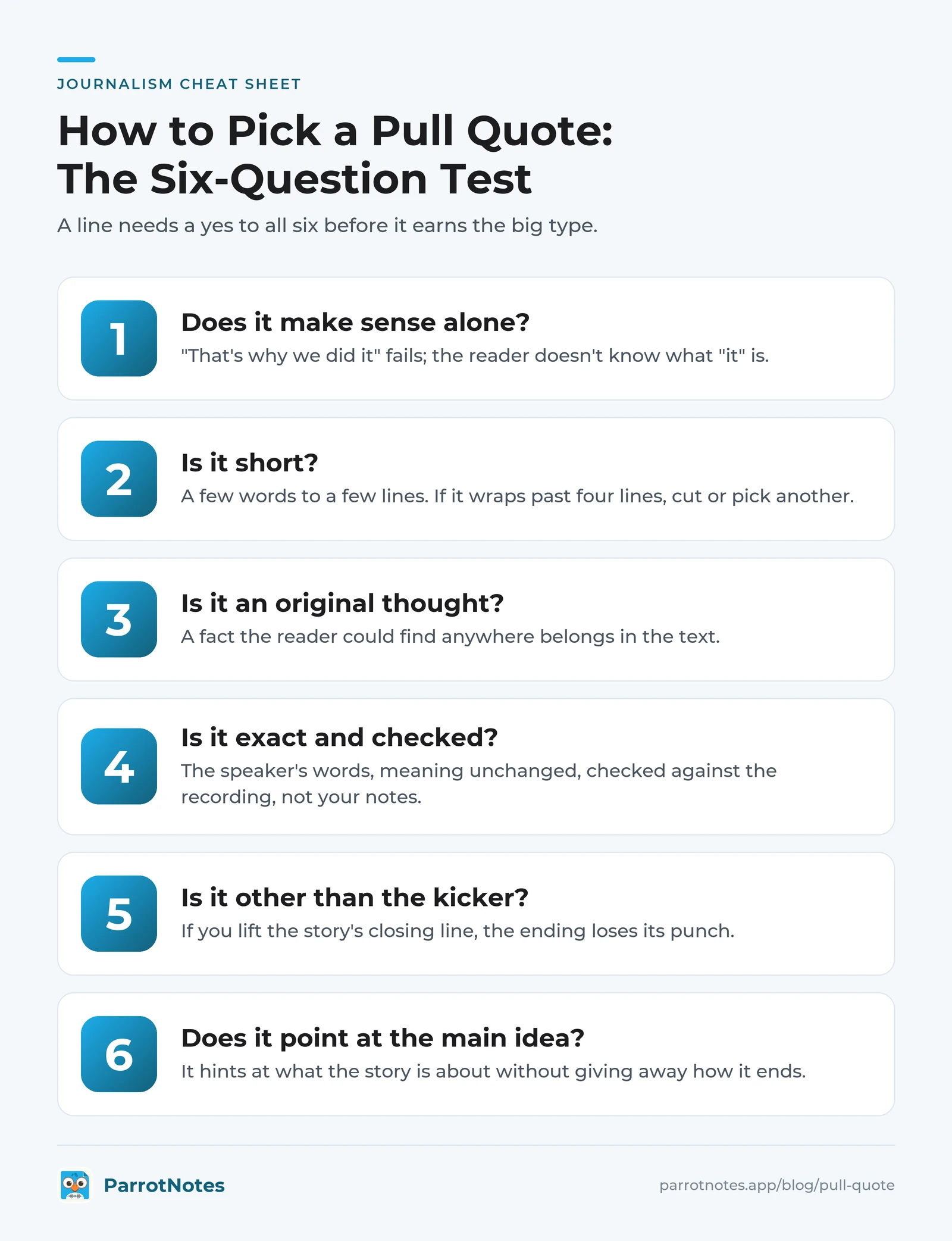
The editors quoted above agree on more than they disagree. Put their rules together and you get six questions. A line needs a yes to all six.
- Does it make sense alone? Noble Sprayberry at Pioneer: "A pull quote should make complete sense by itself." "That's why we did it" fails; the reader doesn't know what "it" is.
- Is it short? A few words to a few lines (Microsoft). If it wraps past four lines in your column, cut or pick another.
- Is it an original thought? Jennifer Paton at Pioneer: "Strong pull quotes capture an original thought." A fact the reader could find anywhere belongs in the text.
- Is it exact and checked? It's the speaker's words, with the meaning unchanged and nothing stitched together from two answers. Check it against the recording, not your notes. Our guide on how to quote an interview covers that check.
- Is it something other than the kicker? Lisa Savage at Pioneer warns against redundancy. If you lift the story's closing line, the ending loses its punch.
- Does it point at the story's main idea? The best pull quote echoes the nut graf: it hints at what the story is about without giving away how it ends.
Some house styles let a pull quote trim or paraphrase the text it repeats; Wikipedia notes they "need not be a verbatim copy." If it sits in quotation marks with a name under it, though, keep the speaker's exact words. Anything else is a misquote in 40-point type.
Worked example: six lines, one pull quote
Here's the test in action. The story is an illustration: a feature on a small-town library that dropped late fees. The librarian, "Ruth Alvarez," is fictional, and so are her answers.
Sam, the editor (also fictional), has the transcript of a 45-minute interview. He shortlists six lines.
| # | Candidate line | Alone? | Short? | Original? | Exact? | Not kicker? | Main idea? |
|---|---|---|---|---|---|---|---|
| 1 | "We dropped fines on March 1." | Yes | Yes | No, it's a fact | Yes | Yes | Partly |
| 2 | "That's when it clicked for us." | No | Yes | No | Yes | Yes | No |
| 3 | "A $2 fine kept a kid away for a whole summer." | Yes | Yes | Yes | Checked | Yes | Yes |
| 4 | "We got back 400 books in the first month, which honestly surprised the board, and some of the staff, and me too if I'm honest about it." | Yes | No | Partly | Yes | Yes | Yes |
| 5 | "Libraries are for everyone." | Yes | Yes | No, it's a slogan | Yes | Yes | Weak |
| 6 | "Come back. We kept your card." | Yes | Yes | Yes | Yes | No, it's the last line | Yes |
Line 3 wins. It stands alone, it's 11 words, it's a thought only this source would put that way, and it points at the story's real subject: fines keep people away. Before it ran, Sam played the audio around it to confirm "a whole summer," not "the whole summer."
Line 6 is the strongest line in the interview, which is exactly why it stays at the end. Line 4 has the best number, but it belongs in the body, where the 400 books can do their work.
Pull quote mistakes editors flag
- Filling space. Pam Blair at Pioneer: "Don't use a quote just because you need to fill space." A good photo, run bigger, is often better.
- Lifting the kicker. The ending is the reader's reward. Don't print it in 40-point type on page one.
- Changing the words. Tidying a quote in display type is still changing it.
- Leaving out who said it. See our guide to attribution in journalism.
- Too many. Three on a 1,200-word story read as padding.
Before the page closes, check:
- The line makes sense with no context
- It's a few words to a few lines
- It matches the transcript word for word (or is clearly the writer's own sentence)
- It isn't the story's last line
- It sits before and near the text it repeats
- The speaker's name and role are under it
Find the best line in your interview
The best line is often buried in minute 34 of an interview. The hard part is finding it again, and making sure it's word for word.
Take Lena, a freelancer writing a profile of a beekeeper (a composite, not a real person). She remembers a great line about "bees not reading the calendar," but not when she said it. She searches her transcript for "calendar," finds it at minute 22, and plays the audio to confirm the exact words before sending it to her editor.
ParrotNotes helps with that part (plans as of November 2026):
- Record on your phone: in-person interviews on the iPhone or Android phone you already carry
- Transcript and summary: on every recording, with full-text search across all your transcripts
- Ask your recording: type "What did she say about the calendar?" and get the answer with its context
- Speaker identification (Pro): see who said what in a group interview
Always get consent before you record. Our guide on how to transcribe an interview covers cleanup. Already have an audio file? The free audio to text tool turns it into a transcript.
The Free plan gives you 100 minutes of recording a month, with recordings up to 30 minutes. Pro is $19.99 a month, or $14.99 a month billed annually, with 3,000 minutes and recordings up to three hours. Download ParrotNotes free and record your next interview with it.
Pick the line that earns the space
A pull quote is a second headline, set in the middle of the page. To choose well:
- Know the job: catch the skimmer and break up the page, not fill a hole
- Keep it apart from a block quote: a pull quote repeats the text, a block quote is the text
- Run the six questions: alone, short, original, exact, not the kicker, on the main idea
- Place it first: before and near the text it repeats, with the speaker named
Open your last feature and find its pull quote, or the line that should have been one. Then run it through the test. Download ParrotNotes free before your next interview, so the line you want is a search away.
Frequently Asked Questions
What is a pull quote?
A pull quote is a short line lifted from an article and repeated in larger or different type on the same page. It catches the eye of someone skimming and breaks up long text.
What is the difference between a pull quote and a block quote?
A pull quote repeats a line from the article as a design element and is set larger. A block quote is a long quotation set off as part of the text, appears only once and is usually the same size or smaller.
Where should a pull quote go?
Before the text it repeats and fairly close to it, so the reader sees the big line first and finds it in the story soon after. Never after the reader has already read the line.
Does a pull quote have to be word for word?
If it's in quotation marks and attributed to a person, yes: use their exact words and don't change the meaning. Some house styles allow a trimmed or paraphrased line when it comes from the writer's own text.
How many pull quotes should an article have?
Few. Editors suggest about one every couple of pages in print, and a single pull quote is often enough for a web article.
Related Posts
Best Talk to Text App for iPhone and Android
The best talk to text app for your phone: Apple Dictation and Siri on iPhone, Gboard and Gemini on Android, with free plans compared and a voice phrase sheet.
How to Use Speech to Text on iPhone
Turn on speech to text on iPhone in 3 steps, dictate in any app, switch languages, turn it off, and record when the mic stops. Checked on iOS 27, Nov 2026.
How to Record Calls on Samsung
Samsung call recording, step by step: record or auto record calls, find the files, get Galaxy AI transcripts, or turn it all off. Checked November 2026.