
MRO Sales: How Reps Win Maintenance, Repair and Operations Accounts

Sarah Johnson
Writes about field sales, meeting notes and voice-first workflows at ParrotNotes. Every article is reviewed by the ParrotNotes product team before it goes live.
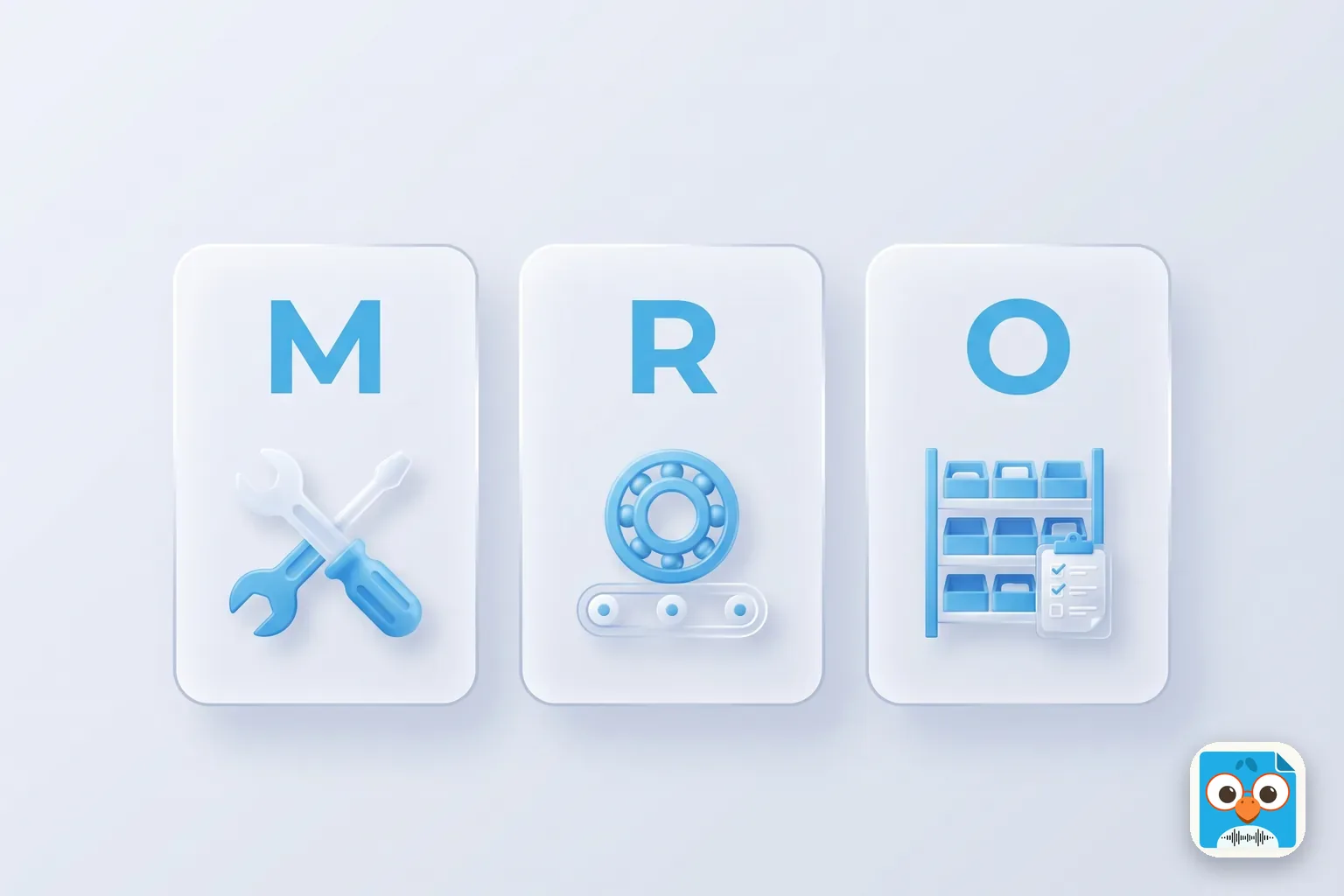
Table of Contents
Marcus lost the bearings and belts business at a corrugated box plant by $0.11 a unit. He'd quoted from the catalog, matched the incumbent's list, and shaved a little more to be safe. What he never did was walk to the storeroom, where the maintenance supervisor kept a whiteboard of every line stop that month. Three of the nine stops were "part not in crib." At that plant, a stopped corrugator cost more per hour than Marcus's whole annual margin on the account. (Marcus is a composite, not a real person.)
That's the trap in MRO sales. The catalog makes it look like a price business, and buyers will happily let you believe that. The reps who win maintenance, repair and operations accounts sell something else: fewer line stops, fewer purchase orders, and a storeroom that has the part before anyone has to ask.
This guide is for the rep who calls on plants, not the strategy deck. It covers what MRO sales is, why these accounts are won on the plant floor, the three buyers you need and what each one listens for, a plant-walk account map you can fill in on the way out, a stockout cost worksheet built from the customer's own numbers, and a 90-day managed-inventory pilot that turns a catalog account into a partnership.
What is MRO sales?
MRO sales is the selling of maintenance, repair and operations supplies to plants and facilities: the parts and consumables that keep equipment running but never end up in the finished product. Bearings, motors, belts, fasteners, hydraulic fittings, cutting tools, lubricants, electrical components, safety gear, janitorial and welding supplies all count. The seller is usually a distributor rep, a manufacturer's rep carrying several lines, or a direct rep for a maker of one of those categories.
MRO is a strange category to sell because the buyer rarely wants the product for its own sake. A maintenance manager doesn't want a 6205 bearing. They want the conveyor back up by second shift. That gap between what you ship and what they're buying is where every good MRO rep lives.
A plant's MRO spend is also large and oddly managed. Boston Consulting Group puts it at 0.5% to 4.5% of revenue depending on the industry, and found that at one steel maker 20% of MRO spending was scattered across more than 1,600 suppliers. At another company, a long tail of 1,300-plus vendors accounted for 20% of spend but 45% of purchase orders. Every one of those small, unplanned orders is a plant someone could consolidate, and the rep who sees it first usually gets it.
Want the maintenance manager's exact words on hand when you write that quote? Try ParrotNotes free on your next plant walk.
Why MRO accounts are won on the plant floor
Grainger's 2024 annual report describes a "large and fragmented MRO industry" in which it competes with manufacturers selling direct, other wholesale distributors, retailers and internet-based businesses. Fragmented is the useful word. No single supplier owns a plant's MRO spend, which means every plant has gaps a rep can fill.
BCG's research explains why those gaps exist. Nonproprietary MRO buying is often decentralized: plants in the same company use different suppliers for the same part, and nobody bundles purchases across sites. Long-tail buying is mostly unplanned, triggered by a stockout or an urgent repair rather than a forecast. And many companies buy 40% to 70% of spare parts straight from the equipment OEM, often at a premium, because nobody has checked whether a standard part would do.
None of that shows up in a catalog or an RFQ. It shows up in the crib, on the maintenance whiteboard, and in the stack of emergency POs on the purchasing agent's desk. If you've read our guide to industrial sales, you know the plant visit is the job. In MRO it's the whole job: no walk, no quote.
The three buyers and what each one listens for
MRO decisions rarely sit with one person. Three roles shape them, and the rep who talks to one is competing against the rep who talks to all three.
| Buyer | What they own | What they listen for | What loses them |
|---|---|---|---|
| Maintenance manager or supervisor | Uptime, the crib, the work-order backlog | "Part on the shelf before the breakdown", same-day delivery, a rep who knows the equipment | Being treated as a purchasing agent; a price pitch |
| Plant or operations manager | Throughput, labor, shift schedule | Hours of production recovered, fewer line stops, fewer people hunting for parts | Technical detail with no production number attached |
| Purchasing or procurement | Vendor count, PO volume, contract compliance, spend reports | Consolidation, fewer invoices, usage reports, a contract they can defend | Side deals with maintenance that bypass the system |
Start with maintenance. They feel the pain, they'll show you the crib, and they'll confirm or correct your numbers. Bring the plant manager in once you can express the problem in hours of production. Go to procurement last, with a consolidation story and a usage report, not a discount. Our post on selling to procurement covers that meeting in detail.
Priya sells cutting tools and abrasives for a regional distributor. For two years she had a friendly maintenance contact at a metal fabricator and a flat $4,000 a month in orders. The step change came when she asked him which line's tooling spend "nobody wanted to talk about." He pointed at a laser cell that burned through consumables at twice the rate of the others. She took that one number to the plant manager, not as a complaint but as a trial: her inserts on that cell for 60 days, scrap and tool changes logged. The cell's tool spend dropped, the plant manager asked what else she carried, and purchasing wrote a blanket order that tripled the account. (Priya is a composite, not a real person.)
The plant-walk account map
The best MRO reps fill in the same nine fields on every first visit, and update them on every visit after. Walk the plant with the maintenance lead (budget 45 to 90 minutes), then capture these before you leave the parking lot.
MRO PLANT-WALK ACCOUNT MAP
1. Plant / site:                      Shifts per day:
2. Production lines and the critical equipment on each:
3. Crib / storeroom locations, who runs them, how parts are issued:
4. Last three unplanned stops: what failed, how long, what it cost (their words):
5. Parts that are "always out" or ordered by overnight freight:
6. Incumbent suppliers by category (and which ones they'd change):
7. OEM-only parts that could be standard:
8. Who signs: maintenance / plant manager / purchasing (names, how each wants to be reached):
9. One thing they said that tells you what they actually want:
Field 4 is the one most reps skip and the one that writes your proposal. A stoppage story told by the person who lived it, with the number they put on it, is worth more than any brochure. Field 9 is the sentence you'll open your follow-up email with.
The map also protects you from the classic MRO failure: a supervisor who trusts you leaves, and the account resets to zero because everything lived in your head. For the per-visit version, our sales call report template does the job.
The stockout cost worksheet
"We sell total cost of ownership" is the line everyone uses and almost nobody shows. Here's the arithmetic, done with the customer's own numbers so they can't argue with the inputs.
STOCKOUT COST WORKSHEET (one line, one year)
A. Unplanned stops caused by a missing part, last 12 months:  ____
B. Average hours lost per stop (from maintenance):              ____
C. Cost of one lost production hour (from plant manager):     $____
D. Downtime cost = A x B x C                                  $____
E. Emergency orders per year (overnight freight, will-call):   ____
F. Cost per emergency order (freight + expediting + PO time): $____
G. Emergency cost = E x F                                     $____
H. Total exposure = D + G                                     $____
I. Annual price gap between you and the incumbent             $____
Decision: if H is many times I, sell availability. If not, compete on price or walk.
A worked example. Tom sells industrial supplies to a plastics compounder with two extrusion lines. The maintenance supervisor counted four stops last year where the line waited for a part: two on a drive coupling, one on a gearbox seal, one on a heater band. Average wait, five hours. The plant manager's figure for a lost hour on that line was $1,800. That's 4 x 5 x $1,800, or $36,000 in downtime. Purchasing added eleven overnight orders at roughly $140 each in freight and expediting, another $1,540. Total exposure: about $37,500. The price gap between Tom's blanket pricing and the incumbent's on the same basket was $2,100 a year. He stopped talking about price. (Tom is a composite, not a real person.)
Two honest notes. First, the worksheet sometimes goes against you: a plant with one stop a year and a well-run crib is a price account, and pretending otherwise burns your credibility. Second, never fill in C or F yourself. Ask, write down the answer and the name of the person who gave it, and quote them back in the proposal.
Ready to capture those numbers without stopping the walk? Download ParrotNotes free and record the conversation, or dictate the worksheet in the car.
From catalog orders to a managed-inventory pilot
Once maintenance owns the exposure number, the natural next step is managed inventory: bins or a vending unit you keep stocked, with min/max levels set from usage. Grainger's KeepStock program, to pick the largest example, covers vendor-managed inventory, customer-managed inventory and on-site vending. You don't need that scale to run the same play at one crib.
Three rules keep a pilot winnable:
- One crib, one line, 90 days. Not the whole plant. Pick the line from field 4 of your map, the one with the stop history.
- One metric, agreed before you start. Usually "unplanned stops caused by a missing part" or "emergency orders on this line." Have maintenance log it; it's their number, not yours.
- A quarterly review on the calendar before the bins arrive. The review is where you expand, with data, or stop with a thank-you.
Here is the one-page proposal that goes with it. Send it after the walk and the worksheet, never before.
MANAGED-INVENTORY PILOT: [Plant], [Line]
Problem (their words):  "[Field 9 of the account map]"
Exposure last 12 months: $[H from the worksheet], per [names who gave B, C, F]
Scope: [N] SKUs in [crib], min/max set from last 12 months of usage
Service: weekly count and replenishment by [rep], same-day call for emergencies
Metric: unplanned stops from missing parts on [line], logged by maintenance
Baseline: [A] stops / [E] emergency orders last 12 months
Target: [number] over 90 days
Commercial: pilot pricing per attached; no contract until the 90-day review
Review: [date], with [maintenance], [plant manager], [purchasing]
Procurement likes this page because it has a baseline, a metric and an exit. Maintenance likes it because the service is specific. The plant manager likes it because it's one line, not a plant-wide change. If the metric moves, expansion is a conversation about which line is next, and the account stops being a catalog comparison. That is how MRO sales compounds: a blanket order beats a hundred quotes.
Keep the account alive between visits
MRO accounts are rarely lost in a meeting. They erode: a competitor's rep catches a stockout you didn't hear about, a new maintenance manager arrives with their own vendor, purchasing runs a consolidation and you weren't on the list. Three habits prevent most of it.
Run a reorder rhythm. For a book of a few hundred plants, the same discipline as a wholesale sales rep applies: know each account's order cadence and call when it slips, not after the quarter closes.
Watch for buying signals. A new production line, an expansion, an equipment upgrade or a hiring surge all raise maintenance demand. Those are the weeks to be in the plant with your map open.
Dictate the visit before you drive off. The map, the worksheet inputs, who said what. Reps who leave it for Friday lose the numbers, and the numbers are the proposal.
That last habit is where ParrotNotes fits. Open it on your phone in the parking lot and talk through the nine fields; it records in the background with no bot and no extra device, then gives you a transcript, a summary and the action items. If the maintenance lead is happy to be recorded during the walk itself (ask first; rules vary by state, see our guide to one-party consent states), the phone can stay in your pocket while you talk. Afterwards, ask the transcript "What did they say the last line stop cost?" and the worksheet input comes back in their words. The follow-up email draft opens with field 9.
The Free plan includes 100 minutes of recording a month and 5 AI-powered recordings. Pro ($19.99 a month, or $14.99 a month billed annually) adds 3,000 minutes and AI search across every plant visit, so when purchasing asks in month seven what the baseline was, you have it. Get ParrotNotes free and fill in your first account map on a real plant.
Sell the stop, not the part
MRO sales is won in the crib and on the maintenance whiteboard, not in the catalog. Walk the plant before you quote. Talk to all three buyers and give each one their own number: uptime for maintenance, production hours for the plant manager, vendor count for purchasing. Build the exposure from the customer's own figures, and be honest when it says you're in a price fight. Then turn the worst line into a 90-day pilot with one metric and a review date.
Pick the plant with the most emergency orders in your territory. Book the walk, fill in the map, and run the worksheet with the people who own the numbers. Capture it before you leave the lot. Download ParrotNotes free and make that visit the one the proposal is built on.
Frequently Asked Questions
What does MRO mean in sales?
MRO stands for maintenance, repair and operations. MRO sales is selling the supplies that keep a plant or facility running without becoming part of the product: bearings, belts, fasteners, tools, lubricants, electrical parts, safety and janitorial items. Distributors, manufacturers' reps and direct reps all sell it.
Who buys MRO supplies at a plant?
Usually three people. The maintenance manager or supervisor decides what the crib needs and feels every stockout. The plant or operations manager cares about production hours lost. Purchasing controls vendor count, purchase orders and contracts. Winning the account means giving each of them their own number.
How is MRO sales different from other industrial sales?
Orders are small, frequent and often unplanned, and the buyer wants availability more than the product itself. Capital equipment sales turn on one big decision; MRO turns on hundreds of reorders and whether the part is on the shelf. Managed inventory and consolidation, not unit price, are the levers.
What is vendor managed inventory in MRO?
The supplier keeps a plant's bins or vending unit stocked to agreed minimum and maximum levels, counts and replenishes on a schedule, and invoices on usage. It cuts emergency orders and purchase orders for the plant and raises switching costs for the supplier. Start with one crib and one line for 90 days.
How do MRO reps compete with online catalogs and marketplaces?
By selling what a website can't deliver: a walk through the plant, a crib set up from real usage, same-day emergency response, technical help choosing a standard part over an OEM one, and a usage report purchasing can defend. On pure commodity items with no stockout history, expect to compete on price.
Related Posts

User Research Interview: Questions and a Note-Taking System
Run a user research interview that holds up: 30 questions by stage, the ones to avoid, a one-page note sheet and a 10-minute debrief. Try ParrotNotes free.

Trial Close Questions: When to Ask and What to Listen For
Trial close questions for five moments in a sales meeting, a green-amber-red guide to the answers and a note template for the follow-up. Try ParrotNotes free.
Nursing Professional Development: A Plan You'll Actually Keep
Nursing professional development without the binder: a six-step plan, a one-page template, ANCC renewal categories and a monthly review. Try ParrotNotes free.