
Equipment Rental Sales: Winning Contractors and Keeping the Fleet Out

Sarah Johnson
Writes about field sales, meeting notes and voice-first workflows at ParrotNotes. Every article is reviewed by the ParrotNotes product team before it goes live.
Table of Contents
- 1.What is equipment rental sales?
- 2.The two numbers behind every equipment rental sales week
- 3.Win contractors by the phase of the job
- 4.The jobsite walk
- 5.The off-rent call: turn returns into swaps
- 6.Rent vs buy: the conversation contractors expect
- 7.A week in an equipment rental sales territory
- 8.Capture the jobsite before you drive off
- 9.Keep the fleet out
It's 7:10 on Monday and Marco is looking at his branch's utilization report. Eleven of the 19-foot scissor lifts are sitting in the yard. Two of the four 60-foot booms are out. His manager has circled the scissors in red. (Marco is a composite, not a real rep.)
He knows where the scissors should be. A tilt-up warehouse two exits away just got its roof on, and the interior trades start next month. The question is whether he gets there before the national chain's rep does.
That's equipment rental sales in one morning. You're not selling a machine once. You're selling time on your fleet, over and over, to contractors who can call three other branches by lunch.
This guide is for the outside rep at a rental branch. It covers the two numbers that shape your week, selling by job phase, a jobsite walk card, the off-rent call, rent vs buy with a worked example, and a five-day plan.
Most of that depends on remembering what you saw on site. If you'd rather talk a jobsite walk through in the truck than type it on your phone, try ParrotNotes free.
What is equipment rental sales?
Equipment rental sales is the job of getting contractors, industrial plants and municipalities to rent machines and tools from your branch instead of owning them or renting from a competitor. The rep finds projects, visits jobsites, quotes rates and keeps the fleet on rent. Success is measured in rental revenue and in how much of the fleet is out working.
It's a big and growing market. The American Rental Association forecasts US construction, industrial and general tool rental revenue of $83.5 billion in 2026, up 3.4%, according to Rental Equipment Register's report on the forecast. ARA's Tom Doyle said the growth "indicates the preference for renting over ownership."
The buyer is rarely one person. On a typical job you deal with the superintendent who orders equipment, the project manager who approves the rate, the owner of a smaller sub who decides everything, and an office person who handles purchase orders and invoices. Each wants something different from you.
The two numbers behind every equipment rental sales week
Your branch manager will talk about utilization constantly. It's worth knowing exactly what the two main numbers mean, because they tell you what to sell.
Time utilization is the share of available days a unit spends on rent. A boom lift that was out 20 of 25 available days ran at 80% time utilization. Companies count the days differently, so compare like with like.
Dollar utilization compares rental revenue to what the fleet cost. Herc Holdings, the parent of Herc Rentals, follows American Rental Association guidelines. It divides rental revenue (excluding re-rent, delivery, pick-up and other ancillary revenue) by the fleet's average original equipment cost, according to its first-quarter 2025 results. Herc reported 37.6% for that quarter.
What they mean for you:
- Low time utilization in a category: units are sitting. That's this week's push. Find the jobs that need them.
- High time, low dollar utilization: the units are out, but at rates too low to pay for themselves. Stop discounting that category.
- Both high: you may be short. Tell your manager before you promise a contractor a unit you can't deliver.
That last one matters more than it sounds. A missed delivery on a Monday pour costs you the account faster than any price war.
Win contractors by the phase of the job
Contractors don't rent equipment at random. They rent what the next phase of the job needs. If you know where a project is in its schedule, you know what to offer and when to call.
| Job phase | What's usually on site | What to offer next | When to call |
|---|---|---|---|
| Site work | Excavators, dozers, compact track loaders, rollers | Trench shoring, pumps, light towers | When the permit is posted or the site is cleared |
| Foundations | Trench boxes, pumps, small excavators, compactors | Telehandlers, generators | As footings are poured |
| Structure | Telehandlers, boom lifts, welders | Scissor lifts, heaters | When steel or tilt-up panels go up |
| Enclosure and MEP | Scissor lifts, booms, temporary power, heaters | More scissors, dehumidifiers, material lifts | Once the roof is on |
| Finishes | Scissor lifts, floor equipment, dehumidifiers | Floor scrapers, polishers, small tools | When drywall starts |
| Closeout | Sweepers, scrubbers, skid steers for landscaping | Final cleanup and landscaping equipment | Two to four weeks before handover |
Use it as a map, not a script. Every job runs its own sequence, and the best schedule source you have is the superintendent. Ask what's starting in the next two weeks and who's bringing it in. The general contractor's weekly OAC meeting sets that schedule; our construction meeting minutes template shows what gets recorded there.
Tanya, a composite rep at a regional independent, keeps a list of every active job in her territory with its phase and next trade. When a job moves from structure to enclosure, she calls the drywall and mechanical subs that week, before they've picked a rental company for the interior work. Most of her new accounts come from subs she met on a GC's site.
The jobsite walk
A jobsite visit is where equipment rental sales is won. You see what's on site, whose tags are on it, and what's coming next. Always check in at the trailer, follow the site's PPE and safety rules, and stay out of active work zones.
Look for four things on the walk:
- Whose equipment is here. Count competitor units by type. Those are your next swaps.
- What's sitting. A boom parked for a week is a unit the contractor is paying for and not using. Point it out, and you've earned trust.
- What phase is next. Match it to the table above.
- Who decides. The super may order, but someone else may approve rates.
Then write it down before you leave the lot. Use this eight-field card:
Jobsite walk debrief card
- Job name, address and general contractor
- Phase today and next phase, with start date
- Our units on site (type and number)
- Competitor units on site (type, number, whose)
- Idle units seen, and who's paying for them
- Contacts met: name, role, who orders, who approves rates
- What they asked for or complained about, in their words
- Next step: what you'll send or do, and by when
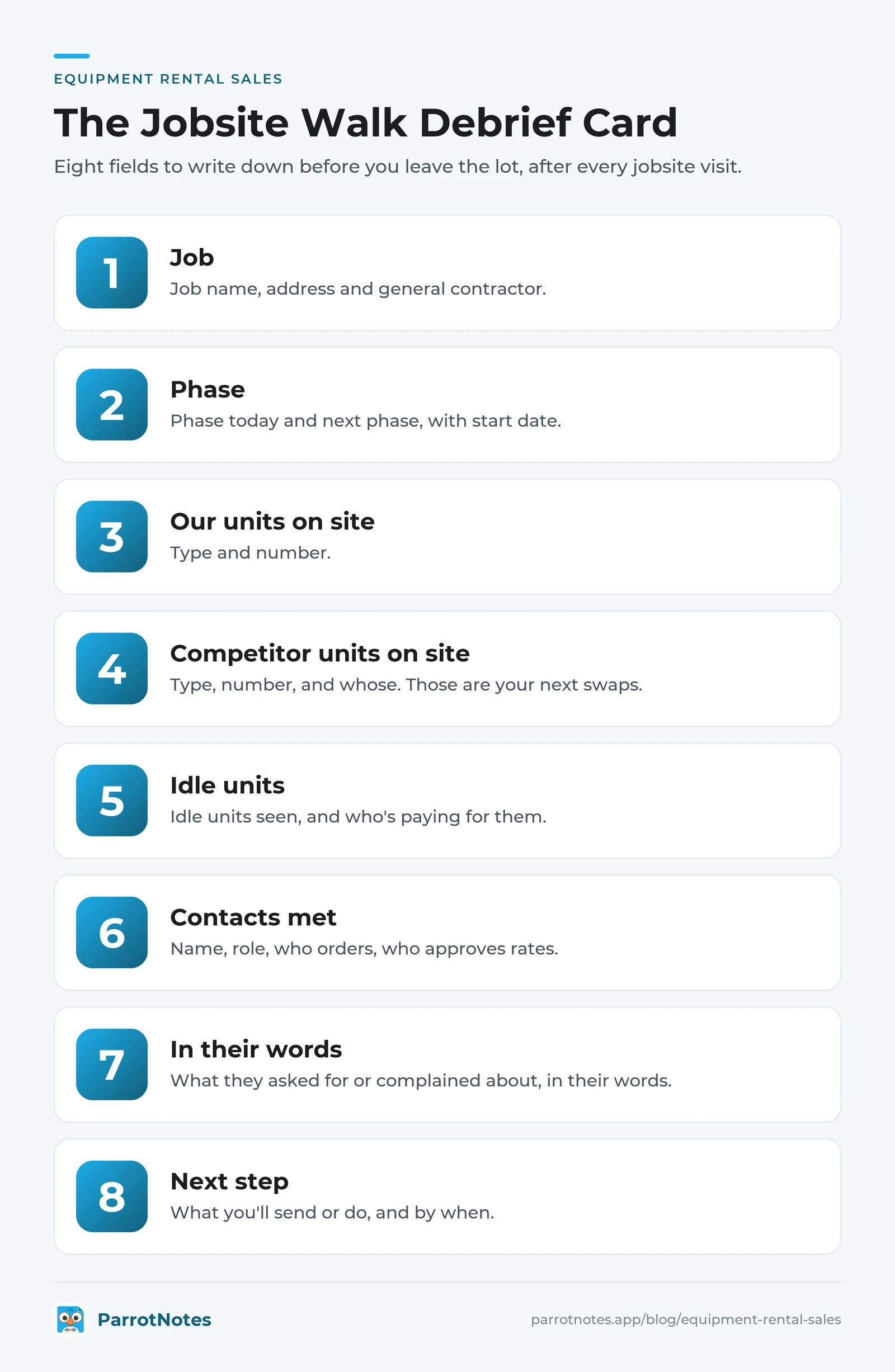
The card works as your sales call report for the visit. For the daily record the contractor keeps, see the construction daily report guide.
The off-rent call: turn returns into swaps
When a contractor calls a unit off rent, most reps let dispatch handle it. That's a missed sale.
An off-rent call tells you the job has moved on. Before the unit comes back, ask three questions:
- What's replacing it? If the excavator is done, telehandlers are often next.
- Do you have another job that needs it? A unit that goes from one site to another never sits in your yard.
- Was there anything wrong with it? A problem you hear about is one you can fix. One you don't hear about loses the account.
Dev, a composite rep at a national branch, made a habit of calling every off-rent customer within the hour. A paving contractor returning two rollers mentioned a second job starting in nine days. Dev held the rollers for him at the yard, and they went back out the following week instead of sitting until the next order.
Rent vs buy: the conversation contractors expect
Sooner or later a good customer says, "I've rented this machine all year. Should I just buy one?" Answer it honestly, with their numbers. You'll keep the account either way.
The question is simple: how many months a year does the contractor actually need the machine? Owning has a fixed yearly cost. Renting costs nothing in the months the machine isn't needed.
Worked example (illustrative numbers only). A contractor is weighing an $80,000 compact track loader. Use your branch's rates and the contractor's own figures in a real conversation.
| Yearly cost of owning | Amount |
|---|---|
| Depreciation (sold for $44,000 after 3 years) | $12,000 |
| Financing (6% on $80,000) | $4,800 |
| Insurance | $1,600 |
| Maintenance and repairs | $4,000 |
| Storage, hauling and admin | $2,400 |
| Total per year | $24,800 |
Say your four-week rate is $3,100. The break-even is $24,800 ÷ $3,100 = 8 four-week periods a year.
- Needs it 5 periods a year: renting costs $15,500. Owning costs $24,800. Renting saves $9,300.
- Needs it 10 periods a year: renting costs $31,000. Owning saves $6,200.
If the contractor is clearly past break-even, say so and introduce your branch's used-equipment team or rent-to-own option, if you have one. Bigger purchases with a capital approval behind them run on a different clock; our guide to capital equipment sales covers that kind of deal.
Run the same math for a machine they already own and barely use, and you may win a rental customer. Either way, you've done the math with them, not at them.
A week in an equipment rental sales territory
Here's a five-day plan that keeps you in front of customers and keeps the fleet out:
- Monday: read the utilization report. Pick two categories that are sitting. List the jobs on your phase map that need them. Make your calls before the supers get busy.
- Tuesday and Wednesday: jobsite visits, clustered by area. Aim for the jobs about to change phase. Fill in the debrief card after each one.
- Thursday: follow up on every quote from the week. A quote follow-up email the day after the quote beats a call a week later. Visit one new prospect you spotted on a site.
- Friday: call every customer who went off rent this week. Update the CRM and your job list. Plan next week's route.
For more on tiering accounts and planning visit frequency, see our sales territory management playbook. If you're new to the field side of the job, the outside sales rep guide walks through a typical day.
Capture the jobsite before you drive off
The debrief card only works if you fill it in. By the fourth site of the day, the competitor's tag numbers and the super's exact words are already fading.
So talk it through before you pull out. Sit in the truck, open your phone and record two minutes on the eight fields. Never take notes or dictate while you're driving.
That's what ParrotNotes is for. You get a transcript and an AI summary of every recording. AI-powered recordings add action items and key points, so "send the super a quote for two 19-foot scissors by Thursday" becomes a task, not a memory. Pro also drafts the follow-up email for you.
Search your recordings later for a job name or a contractor's name, and the whole history comes back: what was on site in March, what they said about rates, which units they returned.
Keep the fleet out
Equipment rental sales comes down to being on the right site before the next phase starts.
- Read the utilization report first. Low time utilization tells you what to push this week.
- Sell by job phase. Know what's next on each job and call before the contractor picks a supplier.
- Walk the site and write it down. Use the eight-field card after every visit.
- Treat every off-rent call as a sales call. Turn returns into swaps.
- Do the rent-vs-buy math honestly. You'll keep the account either way.
Start with your next jobsite walk. Download ParrotNotes free: you get 100 minutes of recording a month and an AI summary on every recording, enough to debrief every site you visit this week.
Frequently Asked Questions
What does an equipment rental sales rep do?
An equipment rental sales rep finds construction and industrial projects, visits jobsites, quotes rental rates and keeps contractors renting from their branch. They work an assigned territory, call on general contractors, subcontractors, plants and municipalities, and are usually measured on rental revenue and how much of the branch's fleet is on rent.
What is time utilization in equipment rental?
Time utilization is the share of available days a rental unit spends on rent. A machine out 20 of 25 available days has 80% time utilization. Branches track it by category so reps know which equipment is sitting in the yard and needs to be sold that week.
What is dollar utilization?
Dollar utilization compares rental revenue to the fleet's original equipment cost. Herc Holdings, the parent of Herc Rentals, following American Rental Association guidelines, divides rental revenue (excluding re-rent, delivery, pick-up and other ancillary revenue) by the average original equipment cost of the fleet. High time utilization with low dollar utilization usually means rates are too low.
How do you find new customers in equipment rental sales?
Look for active jobs: posted permits, cleared sites, new steel. Visit the general contractor's site, learn the schedule, and meet the subcontractors who start next. Call them before their phase begins. Off-rent calls and competitor units on site are also good leads.
When should a contractor buy equipment instead of renting?
When they need the machine more months a year than the break-even point. Add up the yearly cost of owning (depreciation, financing, insurance, maintenance, storage and hauling) and divide it by your monthly or four-week rate. If they'd rent it for more periods than that, buying is usually cheaper.
Is equipment rental sales a good job?
It suits reps who like being outdoors and on jobsites, and who enjoy a short sales cycle with frequent orders. Job postings typically ask for prior sales experience, often in construction or heavy equipment, and include territory planning and CRM reporting. Pay structures vary by company.
Related Posts

Zoom AI Companion Meeting Summary: How It Works and Its Limits
Zoom AI Companion meeting summary, checked on Zoom's own pages in Oct 2026: plans, setup, who receives it, 33 languages and limits. Try ParrotNotes free.

Value Engineering: How Suppliers Win Specs Without Cutting Value
Value engineering explained: the SAVE job plan, function analysis, and how suppliers answer a VE swap, with a worked example and a proposal template. Try free.

Samsung Voice Recorder: Transcribe, Share and Organize Recordings
How to use the Samsung voice memo app: record, transcribe with Transcript assist, share and organize recordings, with menu paths checked on Samsung's pages.