
Life Insurance Needs Analysis: How Agents Run One With a Client

Sarah Johnson
Writes about field sales, meeting notes and voice-first workflows at ParrotNotes. Every article is reviewed by the ParrotNotes product team before it goes live.

Table of Contents
Priya had done the math before she rang the doorbell. Ten times Dan's salary: $800,000. She said it in the first ten minutes, and Dan's face closed.
"That's a lot of insurance for a guy who drives a 2014 Civic," he said. The meeting never recovered. (Priya and Dan are composites, not real people.)
The number wasn't wrong. It just wasn't theirs. Dan had no idea where it came from, so he had no reason to trust it.
A life insurance needs analysis fixes that. Instead of quoting a rule of thumb, you build the number with the client, line by line, from their mortgage, their kids' ages, and what they want covered. You already know clients buy what they understand. Below: the four common sizing methods, one household run through all four, and a fact-finder in meeting order.
It's written for agents. The numbers are illustrations, not advice for any real client.
If you'd rather listen than scribble while the client talks through their debts, ParrotNotes records the meeting (with the client's permission) and gives you a transcript and summary afterward.
What a life insurance needs analysis is
A life insurance needs analysis estimates how much coverage a client needs, and for how long, by comparing what the family would have to pay for after a death with the resources already in place. The gap between the two is the coverage amount you recommend. It's a narrower cousin of the customer needs analysis that B2B reps run after discovery: one household, and the output is a dollar figure.
The National Association of Insurance Commissioners tells consumers to consider "the number of people who are dependent upon you financially," whether there will be "substantial debts and taxes owed," and whether savings or other investments could cover expenses instead (NAIC: Tips for Buying Life Insurance). A needs analysis puts numbers on each of those questions.
Many clients don't know where to start. In the 2026 Insurance Barometer Study from LIMRA and Life Happens, 29% of American adults said they need life insurance and another 9% said they need more, and "I'm not sure how much I need or what type to buy" was a top reason younger adults gave for not owning it (LIMRA 2026 Insurance Barometer presentation).
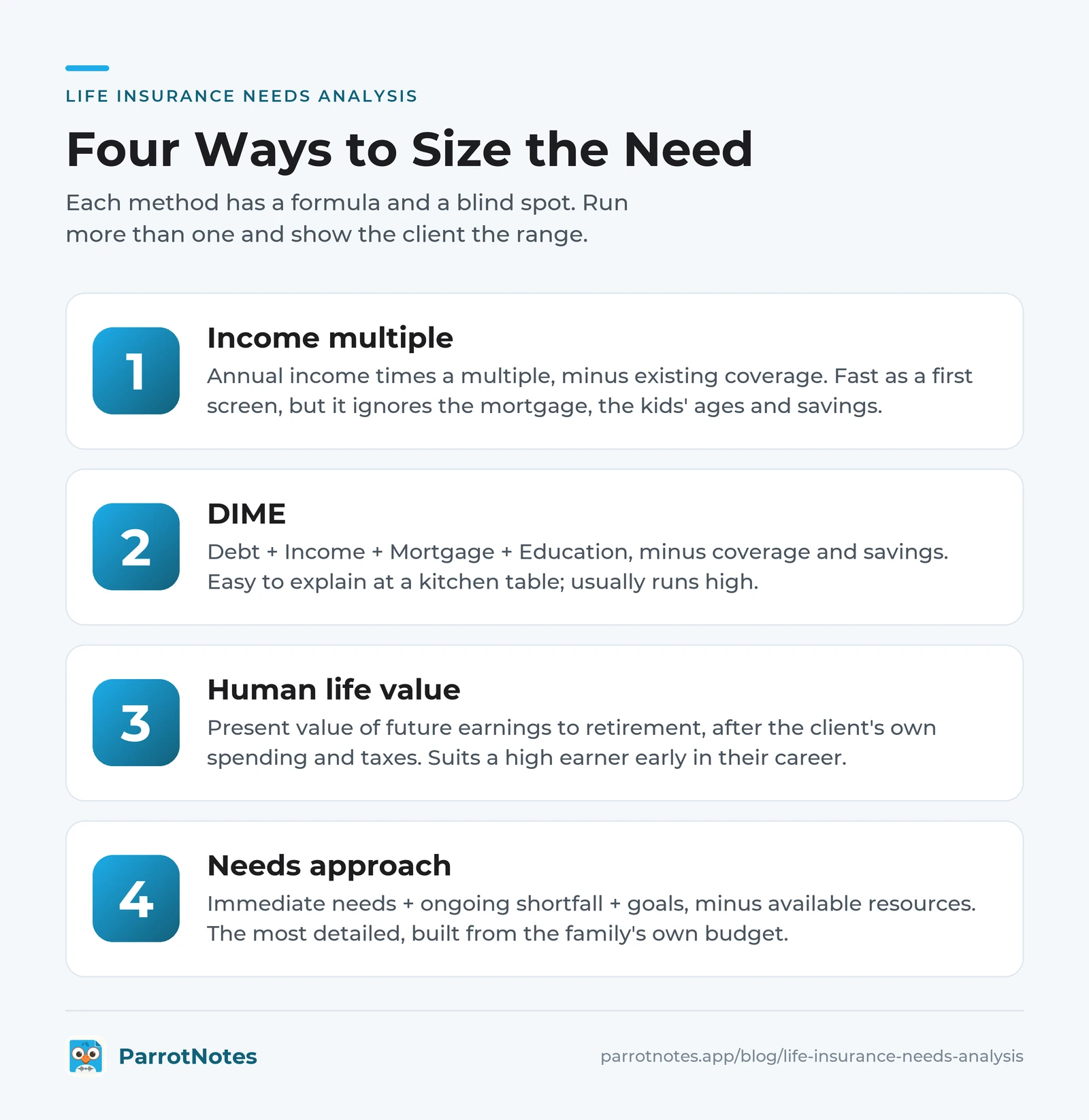
Four ways to size the need
Most agents use one or more of these. Each has a formula and a blind spot.
1. Income multiple
Formula: annual income × a multiple (the multiple varies widely by source; 10 is a common example), minus existing coverage.
It's fast and useful as a first screen. It ignores the mortgage, the kids' ages, and the savings, so two clients with the same salary get the same answer even when their lives look nothing alike.
2. The DIME method
Formula: Debt (non-mortgage debts plus final expenses) + Income (annual income × years the family needs it) + Mortgage (balance left) + Education (the client's goal for the kids), minus existing coverage and savings.
DIME is easy to explain at a kitchen table because the client can see every piece. Its blind spot: it adds up future income at face value, with no investment return and no credit for a surviving partner's paycheck, so it usually runs high.
3. Human life value
Formula: the present value of the client's future earnings to retirement, after subtracting what they'd spend on themselves and taxes.
It values the client's working life in today's dollars, which suits a high earner early in their career. It ignores goals, assets, and actual spending, and it undervalues a partner whose unpaid work at home would cost money to replace.
4. The needs approach (capital needs analysis)
Formula: immediate needs (final expenses, debts, mortgage payoff, an emergency fund) + ongoing needs (the family's yearly shortfall, brought to today's dollars) + goals (education), minus available resources (existing coverage, savings, and other income).
This is the most detailed of the four and the one built from the client's own budget. It takes longer, and it depends on a number many clients haven't worked out: what the household would spend each year without them.
One household, four answers
Here's one illustrative household run through all four methods. The figures are invented for the example, not a recommendation.
The Reyes household: Dan, 38, earns $80,000. Lena, 36, earns $40,000 and would keep working. Their children are 6 and 3.
They owe $260,000 on the mortgage and $18,000 on a car loan and cards. Dan has group life through work at $80,000 and the couple has $30,000 in savings. They want $50,000 per child toward college, and they estimate $15,000 for final expenses.
| Method | How it's built for the Reyes family | Total need | After coverage and savings |
|---|---|---|---|
| Income multiple (10×) | $80,000 × 10 | $800,000 | $720,000 (minus the $80,000 group policy) |
| DIME | $33,000 debt and final expenses + $1,200,000 income (15 years until the youngest turns 18) + $260,000 mortgage + $100,000 education | $1,593,000 | about $1,483,000 |
| Human life value | $56,000 a year (Dan's pay less 30% for his own spending and taxes) for 27 years to age 65, discounted at 4% | about $914,000 | not reduced (this method values earnings, not gaps) |
| Needs approach | $313,000 immediate (final expenses, debts, mortgage, $20,000 emergency fund) + $222,000 for a $20,000 yearly shortfall over 15 years at 4% + $100,000 education | about $635,000 | about $525,000 |
Same family, answers from $525,000 to $1.48 million. That spread isn't a flaw. It's the conversation.
What drives each number:
- DIME is highest because it replaces all of Dan's income for 15 years and gives no credit for Lena's $40,000 or for investment growth on the payout.
- The needs approach is lowest because it counts Lena's income, assumes the mortgage is paid off (so the family's yearly costs drop to an assumed $60,000), and discounts the shortfall. It also leaves out Social Security survivor benefits; a surviving spouse caring for a child under 16 and unmarried children under 18 may qualify (SSA: Who can get survivor benefits), which would lower the gap further. Ask the client to check their own estimate rather than guessing one.
- Human life value sits in the middle and changes the most with the discount rate and the consumption percentage. Move the 30% to 20% and it rises by more than $100,000.
- The income multiple lands near the middle by luck, not by design.
Change one assumption, such as Lena stopping work to care for the kids, and the needs approach jumps closer to DIME. That's why you build it with the client instead of for them.
Running a life insurance needs analysis at the table
The math is the easy part. Meetings go wrong on missing numbers, a client who feels interrogated, or a total with no story behind it. For the openers and closes around this part of the meeting, see our life insurance sales script.
Before the meeting
When you confirm the appointment, ask the client to bring four things: a recent mortgage statement, a list of other debts with balances, their workplace benefits summary (for group life amounts), and a rough monthly budget if they have one. Real numbers beat guesses you'll have to redo.
Our insurance sales tips cover the rest of the appointment prep.
The fact-finder in meeting order
Work through it in this order. It starts with people, because that's what the client cares about, and saves the budget for last, once they see why it matters.
| Order | Ask about | Feeds which method |
|---|---|---|
| 1 | Who depends on the income, and the ages of the children | Years of income (DIME, needs approach) |
| 2 | Each partner's income, and whether the survivor would keep working | Income multiple, HLV, needs approach |
| 3 | Mortgage balance and years left | DIME, needs approach |
| 4 | Other debts: car, cards, student or business loans | DIME, needs approach |
| 5 | Goals beyond debts: college, care for a parent, time off for the survivor | DIME, needs approach |
| 6 | Coverage in place: group and individual, with amounts | Subtracted in every method |
| 7 | Savings the family would use first | Subtracted in DIME and needs approach |
| 8 | What the household spends in a year without the mortgage | Needs approach |
| 9 | Budget for the premium: comfortable and stretch | Which option you present |
Write the numbers down as the client says them ("about $260,000, 24 years left"). You'll want their words when you play it back.
Playing back the range
Don't present one number first. Present the range and let the client choose what to cover. A three-line playback works:
- "If we cover only the mortgage, the debts, and final expenses, that's $293,000, or about $183,000 beyond the $110,000 in coverage and savings you already have."
- "If we also cover the yearly gap for Lena and the kids until the youngest is 18, plus college, it's about $525,000."
- "If you'd want to replace your full income for those years, regardless of Lena's pay, it's closer to $1.48 million."
Then ask, "Which of those feels like what you'd want in place?" Whichever line they pick, it's now their number, not yours.
That's what happened when a composite couple, Marcus and Jo, saw their range. They'd expected to be sold the biggest policy. Instead they chose the middle line and asked to revisit the income piece once their car loan was paid off. The agent booked that review 12 months out before leaving.
What to keep out of your notes, and recording with consent
A needs analysis collects money details. Keep it to what the sales process needs.
- Health details stay out. Medical history, medications, and anything from underwriting questions belong in the carrier's application, not in your fact-finder or a voice note.
- No account or Social Security numbers. Write balances, not account numbers.
- Ask before you record. A voice note to yourself after the meeting needs no one's permission. Recording the conversation with the client needs their agreement first, every time. State laws differ, so check the one-party and two-party consent states and your agency's policy.
- Your carrier and state set the rules. Use your carrier's approved illustrations and forms, and sell only what you're licensed and appointed for. Your state insurance department, listed in the NAIC directory, is the authority. This isn't legal or financial advice.
With the client's agreement, recording lets you watch them, not your clipboard, while they talk about who depends on them. Try ParrotNotes free at your next needs meeting and compare the notes with your usual ones.
After the meeting
Do these the same day, while the numbers are fresh.
- Finish the analysis. Fill any gaps from your notes, run the method you'll present, and keep the assumptions (years, discount rate, survivor income) on the page so you can show your work.
- File the record. Put the fact-finder and the client's chosen priority in your agency management system. Our guide to insurance agent client notes shows a five-block note that fits.
- Request illustrations from the carrier for the amount and term the client picked.
- Send a recap. Summarize what they told you, the range, and the line they chose, with the next meeting date. Our follow-up email after a sales call templates adapt well.
- Set the review date. A needs analysis is a snapshot. A new child, a refinance, or a raise changes it.
Conclusion
A life insurance needs analysis turns a number the client has to trust into one they helped build. Use the income multiple as a screen, DIME when you need something easy to explain, human life value for young high earners, and the needs approach when you have the family's budget. Then present the range and let the client pick what to cover.
At your next appointment, run the fact-finder in order, play back three lines instead of one number, and book the review before you leave. The client who chooses their own coverage is the one who keeps it.
Want the client's exact numbers without looking down at a notepad? Download ParrotNotes and record your next needs meeting, with permission.
Frequently Asked Questions
What is a life insurance needs analysis?
It's a structured way to estimate how much life insurance a client needs and for how long. You add up what the family would have to pay for after a death, such as debts, the mortgage, ongoing living costs, and goals like college, then subtract existing coverage, savings, and other income. The gap is the coverage to consider.
What is the DIME method in life insurance?
DIME adds four amounts: Debt (non-mortgage debts and final expenses), Income (yearly income times the years the family needs it), Mortgage (the balance left), and Education (the client's goal for the children). Existing coverage and savings are then subtracted. It's easy to explain but usually runs high because it ignores a survivor's income and investment growth.
What is the difference between human life value and the needs approach?
Human life value estimates what the client's future earnings are worth to the family in today's dollars, after their own spending and taxes. The needs approach starts from the family's actual costs and goals and subtracts the resources already in place. Human life value measures economic worth; the needs approach measures the gap.
What information do you need for a life insurance needs analysis?
Ages of dependents, each partner's income, the mortgage balance, other debts, goals such as college, coverage already in place, savings, yearly household spending, and a budget for the premium. Ask the client to bring a mortgage statement and their workplace benefits summary to the meeting.
How often should a client's life insurance needs analysis be updated?
Review it when the client's life changes, such as a new child, a home purchase or refinance, a large raise, or a paid-off debt, and set a regular review date at the end of each meeting. An annual policy review is a natural time to revisit it.
Related Posts

Warm Calling vs Cold Calling: What Changes and When Each Works
Warm calling vs cold calling: what changes on the call, a five-question warmth test, six warm-call openers, and when a cold call is still the right move.

TurboScribe Review: Free Plan, Limits and Alternatives
TurboScribe review from its own pages, checked November 2026: free plan limits, the $10 Unlimited plan, safety, fine print, alternatives. Try ParrotNotes free.

How to Transcribe Audio in Word: Upload or Record
How to transcribe audio in Word: upload or record, which accounts and devices have Transcribe, the 300-minute limit, fixes for a missing button, and an example.