
Charge Nurse Duties: The Role and How to Stay on Top of It

Sarah Johnson
Writes about field sales, meeting notes and voice-first workflows at ParrotNotes. Every article is reviewed by the ParrotNotes product team before it goes live.
Table of Contents
- 1.What a charge nurse is, and why the role varies so much
- 2.The core charge nurse duties, in six groups
- 3.Charge nurse vs nurse manager: where the line sits
- 4.Charge nurse duties by shift phase
- 5.How to stay on top of charge nurse duties: a personal charge sheet
- 6.Why the charge nurse role feels hard at first
- 7.Take charge with a list you can trust
At 03:40 on her first night in charge, Lena finally sat down. The census was steady, the float nurse had found the supply room, and the broken pump was tagged for biomed. Then a new graduate walked past with her coat on. Lena had promised to cover her break at 01:00 and never did.
Nobody was hurt. But the new nurse went home thinking nobody had her back, and Lena drove home replaying it.
That's what charge nurse duties feel like in the first month: not one hard task, but forty small promises made in hallways, each one easy to drop. (Lena is invented. The dropped break isn't unusual.)
If you're about to take charge, or just started, you know the job is bigger than the job posting. This guide explains the role as the American Nurses Association and the national delegation guidelines describe it, groups the duties into six areas, and maps them onto a real shift.
Then it gives you one thing the career guides don't: a personal charge sheet for the non-clinical follow-ups, with a firm line around patient information. If you'd rather say your list out loud in the parking lot than write it on a paper towel, try ParrotNotes free before your next shift in charge.
What a charge nurse is, and why the role varies so much
A charge nurse is a registered nurse who leads a unit for one shift. The nurse manager owns the unit around the clock; the charge nurse owns the next 8 or 12 hours of it.
The American Nurses Association lists the core charge nurse duties in its piece on charge nurse vs nurse manager: "ensuring staff adheres to workplace protocols and procedures," "assisting nurses in their charge with patient-related questions," "overseeing the smooth transition from one shift to another," and "acting as a liaison between nurses and doctors." The same page says an RN typically needs "three to five years of clinical experience" before taking charge.
What that list hides is how much the job varies. On some units the charge nurse carries a full patient assignment on top of running the shift. On others the role is assignment-free.
The American Association of Critical-Care Nurses (AACN) published one hospital's story of moving to assignment-free charge nurses. It names the problem plainly: the role comes with "competing demands," including "overseeing daily operations, supporting less experienced nurses, ensuring clinical protocols and smooth patient flow, while also sometimes managing their own patient assignments." After the change, the unit reported that staff were regularly taking lunch breaks and overtime fell as nurses left on time.
So before you judge yourself against any list, ask your manager one question: "Do I carry patients when I'm in charge, and what happens when the unit gets busy?" The answer shapes everything below.
The core charge nurse duties, in six groups
Most charge nurse responsibilities fall into six groups. Your job description will use different words, but the work is the same.
1. Staffing and assignments
You match nurses and assistive staff to the work, based on acuity, skill mix and experience. You handle call-outs, request a float nurse or send one, and adjust assignments when the shift changes shape. Breaks belong here too. A charge nurse who plans break coverage at the start of the shift has fewer 03:40 moments.
2. Flow and throughput
You keep admissions, transfers and discharges moving, in step with the house supervisor or bed management. This is the most interruption-heavy part of the job: the phone rings, and the plan you made at 19:00 changes.
3. Staff support, mentoring and conflict
You're the first person a newer nurse asks. You coach in the moment, back people up when a shift goes sideways, and step into conflicts before they spread. An AACN post on charge nurses puts the stakes simply: "A great charge nurse can make your shift run smoothly, while a not-so-great one can make work much more difficult."
4. Delegation and escalation
Delegation is a legal concept in nursing, not just a management habit. The National Council of State Boards of Nursing's National Guidelines for Nursing Delegation set out five rights: the right task, the right circumstance, the right person, the right directions and communication, and the right supervision and evaluation.
The line that matters most for a charge nurse: "The licensed nurse cannot delegate any activity that requires clinical reasoning, nursing judgment, or critical decision making." Your state's nurse practice act and your facility's policy decide the details, so know both.
Escalation sits next to delegation. You decide what you can solve on the unit and what goes up the chain to the house supervisor, the manager or the provider.
5. Communication and shift transitions
You're the liaison between nurses, providers, other departments and leadership, and you oversee the handover from one shift to the next. Patient report itself follows your facility's approved process and systems. Your job is to make sure it happens, on time, for everyone.
6. Unit operations
Supplies, equipment, safety checks and policy compliance: the stocked cart, the pump that goes to biomed, the fridge log, the code cart check. None of it is glamorous, and all of it becomes your problem at 02:00 if nobody owned it at 19:00.
Charge nurse vs nurse manager: where the line sits
The ANA draws the difference in scope and setting. Charge nurses oversee operations "for the duration of their shift," while a nurse manager may oversee "all activities at one or more locations and for all shifts within a 24-hour cycle." Nurse managers "often work in an office environment versus a clinical setting," and are "more clinically removed, focusing on setting overall standards of care."
| Charge nurse | Nurse manager | |
|---|---|---|
| Time horizon | This shift | The unit, every shift, all year |
| Where | On the floor | Mostly an office |
| People work | Assignments, coaching in the moment, breaks | Hiring, schedules, reviews, development |
| Money | Supplies used tonight | The unit budget |
| Typical route in | RN with clinical experience, chosen for the role | Often a graduate degree (MSN or MBA), per ANA |
In practice, you're the manager's eyes on every shift. A Tuesday staffing gap or a pump that keeps failing only gets fixed if it reaches the manager. If you're the manager reading this, the nurse manager one-on-one guide shows how to give your charge nurses a monthly slot for exactly that.
Charge nurse duties by shift phase
Lists are easy to read and hard to use at 02:00. Here's the same work mapped onto a 12-hour shift; move the times to fit yours.
| Phase | Charge nurse duties | What you can keep in your own notes |
|---|---|---|
| Before the shift (commute, locker room) | Check who's on, who's floating, known call-outs; think through break coverage | Staffing gaps, your plan for breaks, questions for the off-going charge nurse |
| Start of shift (first 30 to 60 minutes) | Take handover from the previous charge nurse through the facility's process; make assignments; run the huddle | Staff-only actions from the huddle, with an owner each |
| During the shift | Flow and throughput, coaching, delegation, escalation, conflict, supplies and equipment | Promises to staff, equipment tags, supply requests, items for the manager |
| End of shift | Hand over to the next charge nurse through the approved process; make sure every nurse's report happens | Open operational items to pass on, unfinished promises |
| After the shift (drive home) | Report anything that needs leadership; reflect | A short reflection in general terms, one pattern for the manager |
The middle column is the job. The right-hand column is what slips. Everything in it is about staff, equipment and the unit, never about a patient.
How to stay on top of charge nurse duties: a personal charge sheet
Most charge nurses already keep a personal list on a paper towel or the back of a hand. The problem is that clinical and operational items land on the same scrap, and the scrap lands in a scrubs pocket.
Split them. Patient information stays in your facility's EHR and approved systems, full stop. That includes your facility's report sheet, which follows its own rules. Your personal charge sheet holds only what's left: people, promises, equipment and the unit.
The charge sheet template
Copy this into whatever you use, paper or app:
| Section | What goes here | Example entry |
|---|---|---|
| Staffing | Call-outs, floats, who's orienting, break plan | "Float from 4 West, needs supply room tour" |
| Promises to staff | What you said you'd do, and when | "Cover Jo's break at 01:00" |
| Equipment and supplies | Tags, biomed calls, restock requests | "Second pump tagged, biomed ticket before 07:00" |
| For the manager | Patterns, not cases | "Third Tuesday this month short one tech" |
| For the next charge nurse | Open operational items | "Linen delivery late, called at 05:30" |
| For me | Your own learning and one reflection | "Ask the educator about the new pump in-service" |
| Never here | Names, room or bed numbers, diagnoses, record numbers, any detail about a patient | Stays in the EHR |
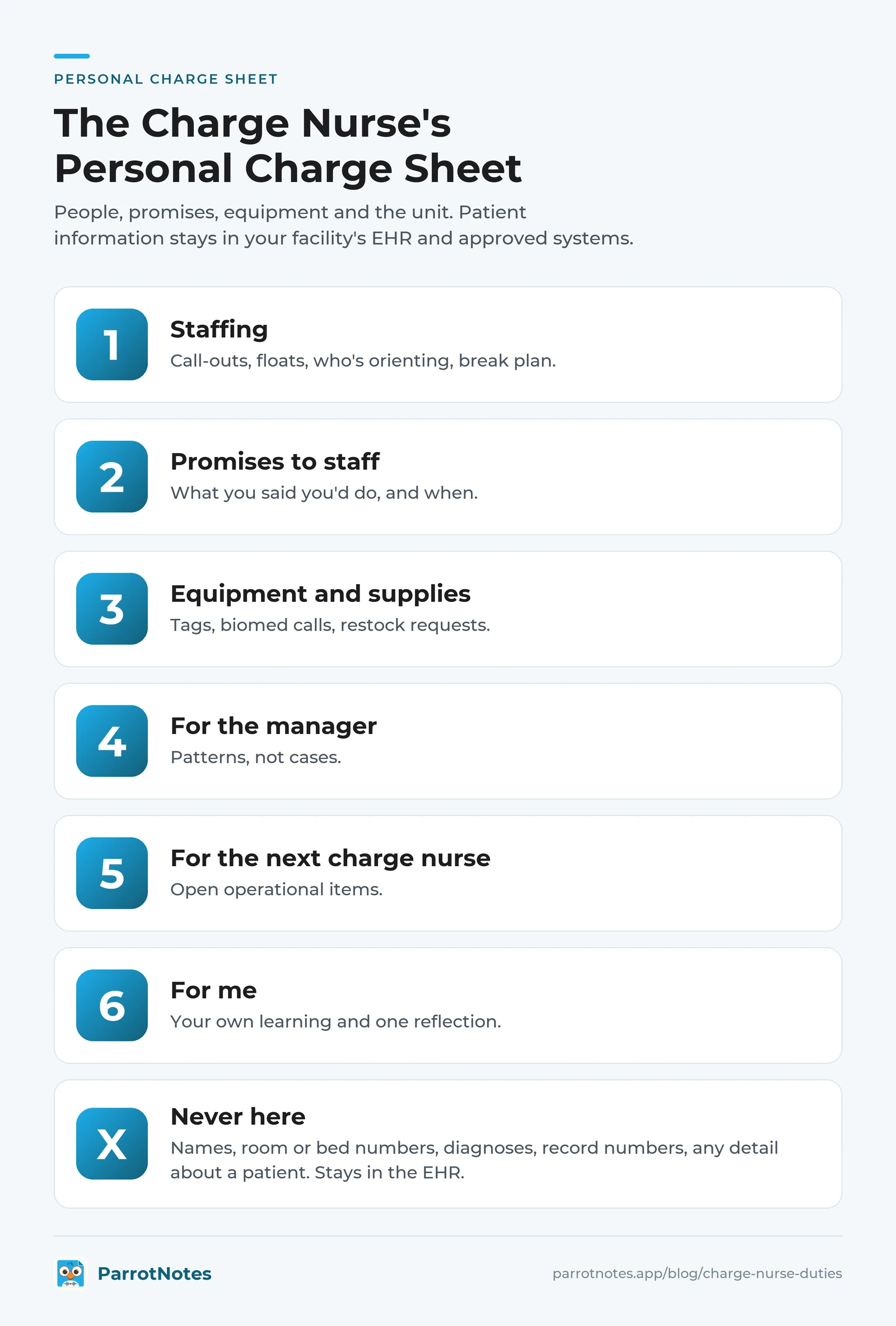
A filled-in charge sheet (fictional)
Omar has been a charge nurse on a medical unit for six months. Omar is invented; the habit is the point.
Before his shift, he sits in the car for two minutes and talks through his sheet into ParrotNotes: "Staffing: one call-out on nights, float requested. Break plan: I cover the two new grads first. Equipment: check whether biomed returned the bladder scanner. For the manager: the Tuesday tech gap again."
After the huddle he adds 60 seconds of staff-only actions, each with an owner: "Kim restocks the supply room before midnight. Raj orients the float." At 07:30 he reads the summary and the list of action items, ticks off what's done, and forwards the manager line to himself for the monthly one-on-one.
Nothing in Omar's sheet is about a patient. The rule is simple: if it's about a patient, it lives in the EHR.
ParrotNotes turns each spoken sheet into a transcript, a summary and action items, on the phone you already carry. The free plan includes 100 minutes of recording a month, up to 30 minutes per recording, and a summary on every recording. Want your own list out of your head and into your pocket? Download ParrotNotes free and try it on your next shift prep.
A note on huddles: record one only if it's staff-only (announcements, staffing, supplies), your facility's policy allows it and the team agrees. If patients come up, don't record; dictate a staff-only recap afterwards. Huddle templates and time management across a busy shift are topics of their own; this guide sticks to the role.
Why the charge nurse role feels hard at first
If the first month feels like drowning, you're in good company. A 2023 study in Nursing Management on a charge nurse leadership development program says it directly: "CNs often feel unprepared to effectively assume these essential leadership roles." The same authors found that their hospital had "no standardized competencies" for the role before the program.
Most nurses are chosen for charge because they're clinically strong. The job then asks for other skills. A 2023 scoping review protocol in BMJ Open on charge nurse skills groups them into five categories: leadership, interpersonal communication, clinical-administrative caring, problem solving, and knowledge of the healthcare environment.
Here's how to build those skills without waiting for a course:
- Shadow before you lead. Ask for two or three shifts alongside an experienced charge nurse, and write down what they do in the first hour.
- Ask your manager the scope questions. Do you carry patients? Who's your escalation contact at night? What can you approve on your own?
- Learn delegation from the source. Read the NCSBN five rights once, then your state board's rules.
- Ask your educator for charge training. The nurse educator guide shows how in-services can be recorded, with approval, so staff can revisit them.
- Reflect after the shift, in general terms. One pattern, one thing to do differently.
That last habit compounds. Grace, a night charge nurse on a surgical unit (also invented), records two minutes on the drive home after each charge shift: what went well, what didn't, what she'd change. No cases, only patterns.
After six weeks, she searched her notes for "break" and found the same problem eight times: breaks collapsed whenever an admission came in after 02:00. She took that pattern, not a single story, to her manager. The unit now names a break buddy at the huddle.
Take charge with a list you can trust
Charge nurse duties come down to six groups: staffing, flow, staff support, delegation and escalation, communication and handovers, and unit operations. Mapped onto a shift, they're manageable. Left in your head, they turn into Lena's 03:40.
Three things to do before your next shift in charge:
- Ask the scope questions. Patients or not, who you escalate to, what you can approve.
- Start a personal charge sheet. Nothing about patients, ever.
- Reflect in patterns. Two minutes after the shift, in general terms.
If your own rotation is hard to keep straight, the free shift schedule generator puts it on your phone's calendar. For the staff meetings charge nurses often help run, the staff meeting agenda template and the meeting minutes template keep the follow-through visible, and the apps for nurses guide covers the rest of the kit.
Ready to keep your charge sheet by voice? Try ParrotNotes free: record your shift prep in the parking lot, and read your action items on your first break.
Frequently Asked Questions
What are the main charge nurse duties?
The main charge nurse duties are staffing and assignments, keeping patient flow moving, supporting and coaching staff, delegating and escalating safely, overseeing shift transitions, and keeping the unit running (supplies, equipment and policy). The ANA also names acting as a liaison between nurses and doctors and answering nurses' patient-related questions. Exact duties vary by facility and unit.
How many years of experience do you need to be a charge nurse?
The American Nurses Association says an RN typically needs three to five years of clinical experience before becoming a charge nurse. There's no single national rule, though. Each hospital sets its own requirements, and some units choose charge nurses earlier based on leadership, reliability and how well they know the unit. Ask your manager what your unit expects.
Does a charge nurse take patients?
It depends on the unit. On many units the charge nurse carries a patient assignment on top of running the shift, especially when staffing is tight. Other units use assignment-free charge nurses, and AACN has published one hospital's experience of that model, including staff taking regular breaks and less overtime. Ask your manager which model your unit uses.
What's the difference between a charge nurse and a nurse manager?
A charge nurse leads the unit for one shift, on the floor, and usually stays close to patient care. A nurse manager is responsible for the unit across all shifts: hiring, schedules, budget, standards of care and staff development, mostly from an office. Nurse managers often hold a graduate degree such as an MSN or MBA.
Can a charge nurse keep notes in ParrotNotes?
Yes, for notes with no patient in them: your shift prep, break plan, staff-only huddle actions, equipment follow-ups, items for your manager, training notes and your own reflection. Patient information stays in your facility's EHR and approved systems, and patient report follows your facility's process.
Related Posts

How to Translate Audio to English From a Recorded Conversation
Translate audio to English the right way: pick a route for your recording, keep names and numbers intact, then check the English with our six-point sheet.

RFQ vs RFP: The Difference and How to Respond to Each
RFQ vs RFP from the supplier's side: what each asks for, how to tell which one you've got, and how the response differs. Includes a triage test and example.

Meeting Cadence: How Often Your Team Should Actually Meet
Set a meeting cadence that fits your team: a map from daily to quarterly, a five-question calendar audit to cut meetings, and notes that let you meet less.