
Nurse Leadership Styles: Which One Fits Your Unit

Sarah Johnson
Writes about field sales, meeting notes and voice-first workflows at ParrotNotes. Every article is reviewed by the ParrotNotes product team before it goes live.

Table of Contents
- 1.What nurse leadership styles are, and why the style matters
- 2.Eight nurse leadership styles, explained
- 3.Which style fits your unit: a decision table for eight moments
- 4.Find your default style: a 10-question self-check
- 5.Practicing a new style without patient data
- 6.The best nurse leadership style is the one the moment needs
On Monday, Grace runs the day shift like a coach. She asks the team how to split the day's work and spends her spare minutes with the new graduate.
On Thursday, two nurses call in sick, the float pool is empty and the board fills by 08:00. Grace stops asking. She gives short, clear instructions, names who covers which break and checks back every hour. (Grace is a composite, not a real person.)
Was Grace a democratic leader or an autocratic one? Both, and that's the point.
Most articles on nurse leadership styles ask "which one is yours?" as if a style were a personality type. A more useful view: a style is a tool, and good leaders switch tools when the unit changes.
Below: eight nurse leadership styles and what the evidence says about each, a decision table for eight unit moments, and a 10-question self-check to find your default.
If you lead huddles or staff meetings, try ParrotNotes free to capture the staff-side decisions and follow-ups in your own words, never patient details.
What nurse leadership styles are, and why the style matters
A leadership style is the typical way a leader makes decisions, gives direction and treats the people doing the work. Skills are what you do (run a huddle, delegate, give feedback); style is the how behind them. If you want the skills side, our guide to nurse leadership skills shows seven of them on a real unit.
Style matters because nurses feel it every shift. A 2021 systematic review by Specchia and colleagues looked at 12 studies on leadership style and nurse job satisfaction.
Transformational leadership was positively linked with satisfaction in all nine studies that measured it. Authentic, resonant and servant leadership were also positively linked, each in one study. Laissez-faire and passive-avoidant leadership were negatively linked wherever they were measured. Transactional leadership was mixed. The studies were cross-sectional, so they show association, not cause.
Two of nursing's best-known frameworks name a style outright. The ANCC Magnet Model lists Transformational Leadership as the first of its five components. The AACN's Healthy Work Environment standards make Authentic Leadership the sixth standard, saying leaders "must fully embrace the imperative of a healthy work environment, authentically live it" and "engage others in its achievement."
Eight nurse leadership styles, explained
1. Transformational leadership
The transformational leader builds a shared vision and helps people grow toward it. The idea comes from James MacGregor Burns (1978) and was developed by Bernard Bass, who described four parts: idealized influence (being a role model), inspirational motivation, intellectual stimulation (inviting new ideas) and individualized consideration (knowing each person).
On a unit, it sounds like "Here's where we want to be by spring, and here's how you could help get us there." It is the style with the strongest evidence in nursing. Its risk is all vision, no follow-through.
2. Transactional leadership
Transactional leaders run on clear expectations, rewards and corrections: meet the standard, get the agreed result. It keeps checklists, audits and schedules consistent. The review found it mixed for satisfaction: useful for structure, thin as a whole approach.
3. Servant leadership
Robert Greenleaf's 1970 essay The Servant as Leader put it plainly: "The servant-leader is servant first." The servant leader asks what the team needs to do its best work and removes obstacles.
A charge nurse covering a break so a colleague can actually eat is servant leadership in action. The risk is a leader who serves everyone and never makes the hard call.
4. Democratic (participative) leadership
The democratic leader brings the team into decisions. Kurt Lewin's 1939 studies with Ronald Lippitt and Ralph White are the classic comparison of democratic, autocratic and laissez-faire climates. In nursing, it's the backbone of shared governance, where unit councils shape practice. It builds buy-in, but it's slow, and it fails when a decision has to be made in five minutes.
5. Autocratic (directive) leadership
The autocratic leader decides and directs. As a default it drains a team, but in a crisis it gives one clear voice and no debate. Use it briefly and say why. "I'm going to be directive for the next hour, and we'll debrief after" keeps trust intact.
6. Laissez-faire leadership
Laissez-faire leaders step back and let the team run itself. With a highly experienced, self-directed team on a quiet shift, a light touch can work. As a habit, the evidence is clear: it's the style most consistently linked with lower nurse satisfaction. Absence isn't autonomy.
7. Situational leadership
Paul Hersey and Ken Blanchard's situational model says the right style depends on the person's readiness for the task. It moves through four modes: telling, selling, participating and delegating. A new graduate on day three needs telling; a nurse with ten years on the unit needs delegating.
8. Authentic leadership
Authentic leaders are self-aware, honest and consistent, so the team knows where it stands. It's the leadership standard AACN chose for healthy work environments. On a unit it sounds like "I got that schedule wrong, and here's how I'm fixing it."
Nurse leadership styles compared
| Style | Core idea | What the evidence says | Best for |
|---|---|---|---|
| Transformational | Shared vision, growth | Positive in all 9 studies assessed (Specchia 2021) | Change, culture, development |
| Transactional | Clear rules and rewards | Mixed | Standards, audits, schedules |
| Servant | Team needs first | Positive (one study) | Tired or stretched teams |
| Democratic | Decide together | Not studied in that review | Councils, practice changes |
| Autocratic | Leader decides | Not studied in that review | Short crises |
| Laissez-faire | Hands off | Negative wherever assessed | Rarely, only expert teams |
| Situational | Match the person's readiness | Not studied in that review | Mixed-experience units |
| Authentic | Honest, self-aware | Positive (one study); AACN standard | Building trust |
Which style fits your unit: a decision table for eight moments
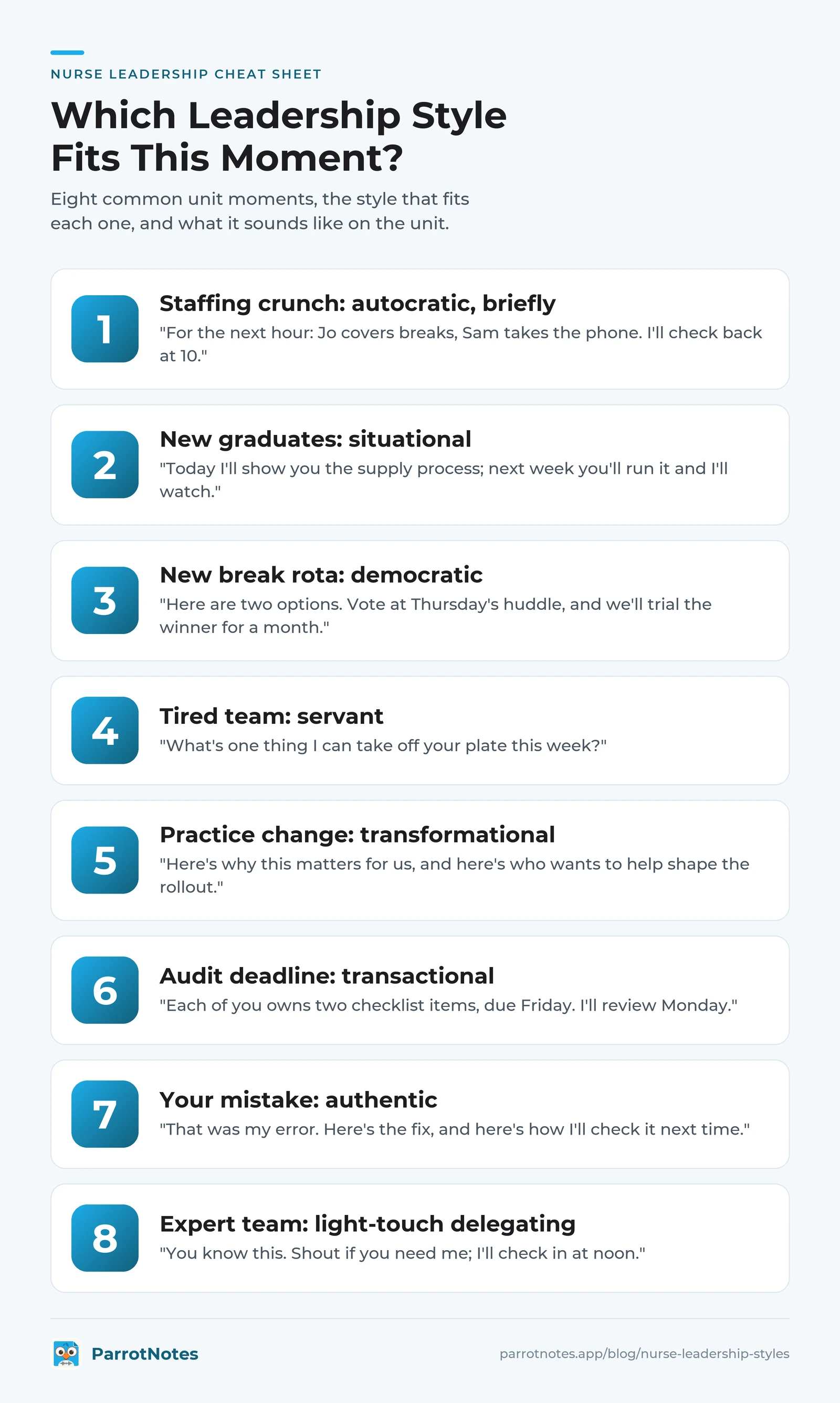
Use this table when the unit changes and you're not sure how to lead it. Every example is about staff and operations, never a patient.
| Unit moment | Style that fits | What it sounds like | How it backfires |
|---|---|---|---|
| Two call-outs, no float, board full | Autocratic, briefly | "For the next hour: Jo covers breaks, Sam takes the phone. I'll check back at 10." | Staying directive after the crunch passes |
| A new-graduate cohort starts | Situational (telling, then selling) | "Today I'll show you the supply process; next week you'll run it and I'll watch." | Delegating before they're ready |
| Choosing a new break rota | Democratic | "Here are two options. Vote at Thursday's huddle, and we'll trial the winner for a month." | Polling on things you can't actually change |
| Team is tired after a hard month | Servant | "What's one thing I can take off your plate this week?" | Promising fixes you can't deliver |
| A practice change from the council | Transformational | "Here's why this matters for us, and here's who wants to help shape the rollout." | A big speech with no plan |
| Audit or compliance deadline | Transactional | "Each of you owns two checklist items, due Friday. I'll review Monday." | Using it for everything after |
| You made a scheduling mistake | Authentic | "That was my error. Here's the fix, and here's how I'll check it next time." | Over-apologizing, no fix |
| Experienced team, quiet shift | Light-touch delegating (not laissez-faire) | "You know this. Shout if you need me; I'll check in at noon." | Disappearing for the shift |
Notice that even the hands-off row ends with a check-in. That's the line between delegating and laissez-faire.
Take Malik, a new nurse manager whose unit council wanted to change the self-scheduling rules. He was a natural autocrat and drafted the new rules himself. The council rejected them in one meeting.
He tried again with the democratic row: two options, a vote, a one-month trial. The second version passed and stuck. (Malik is a composite, not a real person.) If you're new to managing, our nurse manager guide covers the one-on-ones where much of this style work happens.
Want to see which style you actually used this week? Download ParrotNotes and talk a two-minute recap after a huddle or staff meeting. The transcript shows your real words, not the ones you remember.
Find your default style: a 10-question self-check
This is a reflection tool written for this article, not a validated instrument (researchers use Bass and Avolio's Multifactor Leadership Questionnaire). Answer yes or no, about the last month only.
- When a decision affected the whole team, did I usually make it alone? (autocratic)
- Did I ask the team to choose between options at least once? (democratic)
- Did I explain the "why" behind a change, not just the "what"? (transformational)
- Did I set clear expectations and check them against a standard? (transactional)
- Did I take a task off someone's plate so they could do their best work? (servant)
- Did I lead a new nurse differently from an experienced one? (situational)
- Did I admit a mistake to the team? (authentic)
- Were there shifts where I wasn't really leading at all? (laissez-faire warning)
- Did I switch style at least once when the unit changed? (range)
- After a crunch, did I tell the team why I'd been directive? (repair)
How to read it: your yes answers on 1 to 7 show your defaults. A yes on 8 is the one to fix first, given the evidence. A no on 9 or 10 means your range is the thing to practice. Pick one style you rarely use and try it at one moment from the decision table this month.
Practicing a new style without patient data
Three habits help a new style stick:
- Plan one moment. Before a huddle, choose the row you'll practice. Our nursing huddle template gives you a ten-minute structure to try it in.
- Reflect after the shift. Two minutes on what you said and how the team responded. A nursing reflective journal gives you a simple script.
- Review monthly. Re-take the self-check and compare.
Ana, a charge nurse, noticed from her reflections that she went quiet on busy weekends. Her fix: a check-in at 10:00 and 14:00 every weekend shift. A month later, her answer to question 8 was no. (Ana is a composite, not a real person.)
Talk your reflection on the drive home, or record a nursing staff meeting with the room's agreement and your organization's permission, and you get a transcript and an AI summary.
Keep it to your team and your own leadership. ParrotNotes makes no HIPAA claim, so patient details never go in.
The Free plan includes 100 minutes a month with a summary on every recording; Pro is $19.99/month ($14.99/month billed annually) and adds 3,000 minutes and AI search across your notes. It runs on iOS, Android and macOS.
The best nurse leadership style is the one the moment needs
The evidence favors transformational, authentic and servant leadership as defaults, and it warns against laissez-faire. But the leaders nurses trust most switch styles on purpose:
- Directive for an hour in a crunch, then explain why
- Democratic for decisions the team will live with
- Situational with new graduates
- Present, even when the team runs itself
Pick one row from the decision table and practice it on your next shift. Ready to keep a record of how you lead? Get ParrotNotes free and capture your two-minute reflection after the next huddle.
Frequently Asked Questions
What are the main nurse leadership styles?
Transformational, transactional, servant, democratic, autocratic, laissez-faire, situational and authentic. Most leaders have a default but switch with the situation.
What is the best leadership style in nursing?
Transformational leadership has the strongest evidence. A 2021 systematic review found it positively linked with nurse job satisfaction in all nine studies that measured it, and the Magnet Model names it as a core component. In practice, the best leaders adapt their style to the moment.
What is transformational leadership in nursing?
It means building a shared vision and helping each nurse grow toward it. Bass described four parts: role modeling, inspiring motivation, inviting new ideas and attention to each person's development.
Is autocratic leadership ever good in nursing?
Yes, briefly. In a sudden staffing crisis, one clear voice helps the team move. Then explain why you took charge and debrief.
How do I find my nursing leadership style?
Use a short self-check like the one above. For research or formal development, the validated tool is the Multifactor Leadership Questionnaire.
Related Posts

What Is a Submittal in Construction? A Guide for Product Reps
What is a submittal in construction? The types, the review process and stamps, plus a worked product-rep package and a pre-send checklist. Try ParrotNotes free.

Transcription Guidelines: Rules for Accurate, Consistent Transcripts
Transcription guidelines from Rev, GoTranscript and two universities compared rule by rule, plus a one-page house style you can copy. Try ParrotNotes free.

Tactical Empathy in Sales: Chris Voss Techniques for Real Calls
Tactical empathy for sales calls: Chris Voss's mirrors, labels and calibrated questions, a buyer-line phrasebook and a worked call. Try ParrotNotes free.