
Meeting Minutes Template: Formats and Examples

Sarah Johnson
Writes about field sales, meeting notes and voice-first workflows at ParrotNotes. Every article is reviewed by the ParrotNotes product team before it goes live.

Table of Contents
- 1.What meeting minutes are (and what they aren't)
- 2.Which meeting minutes template fits your meeting?
- 3.Meeting minutes template 1: standard business meeting minutes
- 4.Template 2: formal meeting minutes (Robert's Rules format)
- 5.Template 3: committee or working-group minutes
- 6.Template 4: simple minutes for a recurring team or project meeting
- 7.What meeting minutes must contain, and what to leave out
- 8.How to take meeting minutes in five steps
- 9.Approval, corrections, signing, and storage
- 10.Let a recording fill in your meeting minutes template
- 11.Copy a meeting minutes template and minute your next meeting
Picture Teresa, the office manager at a 90-person packaging distributor. She's also secretary of the site's health and safety committee, which meets on the first Wednesday of the month. Six weeks after the March meeting, an insurer's auditor asks what the committee decided about ladder inspections. Teresa opens the minutes. Under item 4 they say "Ladders discussed."
She remembers there was a vote. She doesn't remember whether it was for monthly or quarterly inspections, or who was meant to set them up.
A good meeting minutes template stops that from happening, because it asks for the right things in the right order. You didn't take the secretary job to be a court reporter, and nobody expects a transcript. What they expect is the official record: who was there, what was moved, what was decided, and who's doing what next.
This guide gives you four meeting minutes formats, one for each kind of meeting you're likely to minute, each with a filled-in example you can copy. After the templates you'll find what minutes must contain and what to leave out, a five-step routine for taking them, and how approval, signing, and storage work. At the end there's a way to let a recording do the capturing while you keep order in the room.
What meeting minutes are (and what they aren't)
What should meeting minutes include? Meeting minutes should include the name of the body and the kind of meeting, the date and place, who attended and who chaired, whether the previous minutes were approved, every motion with its outcome and vote, the decisions and action items with owners and dates, and the time the meeting adjourned. They don't include the discussion.
That last line surprises people, so here it is from the source. The official Robert's Rules of Order FAQ puts it plainly: "Not only is it not necessary to summarize matters discussed at a meeting in the minutes of that meeting, it is improper to do so. Minutes are a record of what was done at a meeting, not a record of what was said."
That single rule solves most minute-taking problems. You aren't chasing every remark. You're waiting for the moment something is done: a motion is made, a vote is taken, a decision is stated, or a task is assigned. Then you write that down, in full.
It also settles the difference between minutes and notes. Minutes are the official record of a body that makes decisions, approved by the group and kept. Meeting notes are an informal working record for the people in the room.
If your meeting doesn't vote and nobody will inspect the record later, a meeting notes template is the lighter tool. Either way, the record has a job to do. Atlassian's Workplace Woes survey of 5,000 knowledge workers found that "54% of workers frequently leave meetings without a clear idea of next steps or who owns which task." Minutes that name owners and dates are the cure.
Want the motions and action items captured while you keep order? You can try ParrotNotes free: record the meeting with everyone's agreement, then fill in the template from the transcript and the AI summary.
Which meeting minutes template fits your meeting?
Match the format to how formal the body is, not to how important the topic feels.
| Your meeting | Use this format | What makes it different |
|---|---|---|
| Management, leadership, or department meeting that keeps a record | 1. Standard business minutes | Decisions and action items, no motions |
| Association, society, council, or any body that follows Robert's Rules or bylaws | 2. Formal minutes | Motions with mover, vote counts, adjournment, signature |
| Committee, working group, or task force reporting to a larger body | 3. Committee minutes | Numbered items against the agenda, recommendations to the parent body |
| Recurring team or project meeting that needs a light official record | 4. Simple minutes | One page, carried-forward actions |
Boards of directors, homeowners' associations, and nonprofit boards use format 2 with extras: a quorum statement, executive session entries, conflict-of-interest disclosures, and retention periods set by law. Each deserves its own guide. Until then, format 2 plus your bylaws will carry you through.
Every template below is plain text. Paste it into Word, Google Docs, or your notes app, and change the labels to match your rules.
Meeting minutes template 1: standard business meeting minutes
Use this when a management or department meeting makes decisions the company wants on file, and nobody moves motions. It's the most common meeting minutes format in an office, and the minutes of meeting template most people are looking for.
MINUTES
Meeting:
Date, time, and place:
Chair:
Minute-taker:
Present:
Absent:
Guests:

1. Previous minutes
   Approved as circulated / approved with the following corrections:

2. Matters arising (actions from the last meeting and their status)
   Action | Owner | Status

3. [Agenda item]
   Decision:
   Action | Owner | Due

4. [Agenda item]
   Decision:
   Action | Owner | Due

5. Any other business

6. Next meeting (date, time, place)

Meeting closed at:
Minutes prepared by:            Date:
Approved on:                    Signed (chair):
Here's the template filled in for a monthly leadership meeting at a 60-person logistics firm. Marta, the executive assistant, takes the minutes.
| Section | Marta's minutes |
|---|---|
| Meeting | Leadership team monthly meeting, Tuesday, October 6, 9:00 to 10:15 AM, boardroom |
| Chair and minute-taker | Chair: Daniel Reyes (managing director). Minutes: Marta Kowalski |
| Present and absent | Present: D. Reyes, A. Osei, L. Fontaine, R. Iyer. Absent: S. Park |
| 1. Previous minutes | Minutes of September 1 approved with one correction: the depot lease renewal date is March 31, not March 1 |
| 2. Matters arising | Fleet insurance renewal (A. Osei): complete. Racking survey (L. Fontaine): report due in November |
| 3. Q4 hiring plan | Decision: two warehouse operative roles and one dispatcher role will be advertised in October. Action: R. Iyer to post the roles by October 16 |
| 4. Depot lease renewal | Decision: the company will open negotiations with the landlord for a five-year term. Action: D. Reyes to write to the landlord by October 20; L. Fontaine to obtain two comparable rents by October 30 |
| 5. Any other business | S. Park's request to move the December meeting to December 8 was noted. Deferred until S. Park returns |
| 6. Next meeting | Tuesday, November 3, 9:00 AM, boardroom |
| Closed | 10:15 AM. Prepared by M. Kowalski, October 6. Approved November 3, signed D. Reyes |
Notice what isn't there. No "Daniel felt strongly that," and no summary of the twenty-minute debate about the lease. Each item ends in a decision, an action, or a deferral, and every action has one name and one date.
Template 2: formal meeting minutes (Robert's Rules format)
Use this for any body that follows Robert's Rules of Order or has bylaws: an association, a professional society chapter, a cooperative, a council, or a club. Boards use it too, with the extras mentioned above.
The backbone is old and stable. The 1876 edition of Robert's Rules of Order, now in the public domain, lists the essentials of the opening paragraph. They are the kind of meeting (regular, special, or adjourned), the name of the assembly, the date and place, whether the regular chair and secretary were present, and whether the previous minutes were approved. It tells the secretary to record "what is 'done' by the assembly, not what is said by the members." Every main motion goes in, adopted or rejected, and so does the number of votes on each side when a vote is counted.
[NAME OF ORGANIZATION]
Minutes of the [regular / special / annual] meeting

Called to order: [time] on [date] at [place], [name] presiding,
[name] acting as secretary.
Members present: [number, or names if your bylaws require them]
Quorum: present / not present
Minutes: The minutes of the [date] meeting were [approved as read /
approved as corrected].

REPORTS
Treasurer's report: [received and filed / key figures]
[Committee] report: [received; any motion arising is recorded below]

UNFINISHED BUSINESS
Motion: Moved by [name] that [exact wording of the motion].
[Adopted / Lost] [by voice vote / by a vote of X to Y / by ballot X to Y].

NEW BUSINESS
Motion: Moved by [name] that [exact wording].
[Amended to read: ...] [Adopted / Lost] [vote].
Motion: Moved by [name] that [exact wording]. Postponed to the [date] meeting.

ANNOUNCEMENTS
[Brief]

Adjourned: [time]

_____________________________
[Name], Secretary
Approved: [date]
Here's the formal meeting minutes template filled in for a fictional regional chapter of a professional association.
NORTH VALLEY CHAPTER, ASSOCIATION OF FACILITIES PROFESSIONALS
Minutes of the regular meeting

Called to order: 6:32 PM on Thursday, October 8, at the Grange Hall,
Chapter President Lena Ortiz presiding, Secretary Tom Abara present.
Members present: 23. Quorum (15) present.
Minutes: The minutes of the September 10 meeting were approved as
corrected: the treasurer's closing balance reads $14,210, not $14,120.

REPORTS
Treasurer's report: Opening balance $14,210; income $1,850 (dues);
expenses $620 (venue, speaker gift); closing balance $15,440. Filed.
Programs committee (chair: Priya Nair): The spring conference venue
search is down to two sites. Report received.

UNFINISHED BUSINESS
Motion: Moved by Priya Nair that the chapter hold its spring
conference on Friday, April 17, at the Riverside Conference Center,
at a cost not to exceed $6,500. Adopted by a vote of 19 to 4.

NEW BUSINESS
Motion: Moved by Hector Ruiz that chapter dues be raised from $85 to
$95 a year from January 1. Amended by consent to "from $85 to $90 a
year." Adopted as amended, 14 to 9.
Motion: Moved by Dana Whitfield that the chapter form a mentoring
program. Referred to the membership committee, to report at the
November meeting.

ANNOUNCEMENTS
The holiday social will be held on December 10. Details to follow.

Adjourned: 7:48 PM

Tom Abara, Secretary
Approved: November 12
Three habits keep formal minutes clean. Write the motion in its final wording, as adopted or as lost, not as first spoken. Record the outcome, and the count whenever there is one. Many bodies record the mover's name and leave out the seconder's; follow your own rules on that, and be consistent.
If your chair runs the meeting from an order of business, the minutes fall out of it in the same sequence. The formal agenda in our meeting agenda template guide gives the secretary the headings above.
Template 3: committee or working-group minutes
Committees report to a parent body, so their minutes have a second reader: the board or management team that receives them. This meeting minutes template numbers the items to match the agenda, and separates what the committee decided from what it recommends upward.
[COMMITTEE NAME] MINUTES
Date, time, place:
Chair:                  Secretary:
Present:
Absent:
In attendance (non-members):

1. Minutes of the last meeting: approved / approved as corrected
2. Action log review
   # | Action | Owner | Due | Status

3. [Agenda item 3]
   Outcome: decided / recommended to [parent body] / deferred
   Detail:
   Action | Owner | Due

4. [Agenda item 4]
   Outcome:
   Detail:
   Action | Owner | Due

Recommendations to [parent body] (copied from the items above):
-

Next meeting:
Closed at:
Here's Teresa's March meeting, minuted the way it should have been.
| Item | Health and safety committee minutes, Wednesday, March 4 |
|---|---|
| Present | Teresa Lindqvist (secretary), Sam Okafor (chair, operations), Jo Baptiste, Kemal Aydin, Ruth Adler. Absent: Ben Hollis |
| 1. Minutes | Minutes of February 4 approved |
| 2. Action log | #14 Fire door survey (K. Aydin): complete. #15 First-aid kit restock (R. Adler): complete |
| 3. Forklift refresher training | Outcome: decided. All 11 forklift operators will complete refresher training by May 29. Action: K. Aydin to book the trainer by March 20 |
| 4. Ladder inspections | Outcome: decided, 4 votes to 1. Portable ladders will be inspected monthly, not quarterly, by the warehouse team leaders, using the tagging system. Action: J. Baptiste to issue inspection tags and a register by March 27 |
| 5. Warehouse temperature complaints | Outcome: recommended to the leadership team: a heating survey of bays 3 and 4 before October. Action: T. Lindqvist to include this in the report to leadership by March 11 |
| Recommendations | Heating survey of bays 3 and 4 (item 5) |
| Next meeting | Wednesday, April 1, 2:00 PM, training room. Closed 3:05 PM |
Now the auditor's question has a one-line answer, with the vote, the frequency, the owner, and the date.
Template 4: simple minutes for a recurring team or project meeting
Some meetings need an official record without any ceremony: a project steering meeting, a weekly operations meeting, or a tenants' liaison group. Keep it to one page and carry open actions forward until they're closed.
[MEETING NAME] MINUTES: [date]
Present:                        Absent:
Chair:                          Minutes:

Previous minutes: approved / corrections:

Open actions carried forward
# | Action | Owner | Due | Status

Items
1. [Topic]: Decision. Action (owner, due).
2. [Topic]: Decision. Action (owner, due).

New actions (also added to the log above)
# | Action | Owner | Due

Next meeting:
Here's the block used for a project steering meeting.
WAREHOUSE MANAGEMENT SYSTEM PROJECT: STEERING MINUTES, October 9
Present: A. Osei (chair), R. Iyer, L. Fontaine, vendor PM G. Lau
Absent: none. Minutes: M. Kowalski

Previous minutes: approved.

Open actions carried forward
#7 Data migration test plan | G. Lau | Oct 2 | Done
#8 Barcode scanner order | L. Fontaine | Oct 16 | In progress

Items
1. Go-live date: Decision: go-live moves from November 2 to November 16,
   because the scanner delivery slipped. Action: A. Osei to inform
   department heads by October 12.
2. Training: Decision: two half-day sessions per shift, week of
   November 9. Action: R. Iyer to publish the roster by October 23.

New actions
#9 Inform department heads of the new date | A. Osei | Oct 12
#10 Publish training roster | R. Iyer | Oct 23

Next meeting: Friday, October 23, 11:00 AM
If the group never votes, nobody signs anything, and the minutes only ever go to the people who were there, you've drifted into notes territory. That's fine, and the six formats in our meeting notes template guide will serve you better than this one.
Minuting a meeting this week? Download ParrotNotes free, put your phone on the table with everyone's agreement, and check the exact wording of each decision against the transcript before you circulate the draft.
What meeting minutes must contain, and what to leave out
Robert's Rules' one-line test, done not said, gives you this table. It applies to any meeting minutes template above; check your bylaws for anything they add.
| Put it in | Leave it out |
|---|---|
| Kind of meeting, name of the body, date, time, and place | Summaries of the discussion |
| Who chaired and who took the minutes, or their substitutes | Who argued for or against |
| Attendance, and whether a quorum was present | The secretary's opinions or adjectives ("a lively debate") |
| Whether the previous minutes were approved, and as read or as corrected | Personal remarks, apologies for lateness, jokes |
| Every main motion in its final wording, with the mover and the outcome | The name of the seconder, unless your rules require it |
| Vote counts when the vote was counted, by ballot, or by roll call | Motions that were withdrawn |
| Decisions and action items, each with one owner and a due date | Reports in full (record that the report was received, and file it) |
| Reports received, and any motion arising from them | Anything from an informal session that the body agreed was off the record |
| Time of adjournment, secretary's signature, date approved | Predictions, intentions, or "it was felt that" |
A wording bank for the entries that stall you
Minute-takers rarely get stuck on the decisions. They get stuck on the phrasing of the routine entries. Copy these.
- Motion: "Moved by [name] that [exact wording]."
- Outcome: "Adopted." / "Lost." / "Adopted by a vote of 12 to 3." / "Adopted as amended."
- Put off: "Postponed to the [date] meeting." / "Referred to the [name] committee, to report on [date]."
- No motion: "No action taken."
- Previous minutes: "Approved as read." / "Approved as corrected."
- Abstention or recusal: "[Name] abstained." / "[Name] declared an interest and left the room for this item."
- Reports: "The treasurer's report was received and filed."
- Decision without a motion: "Decision: [full sentence]." / "Action: [name] to [task] by [date]."
How to take meeting minutes in five steps
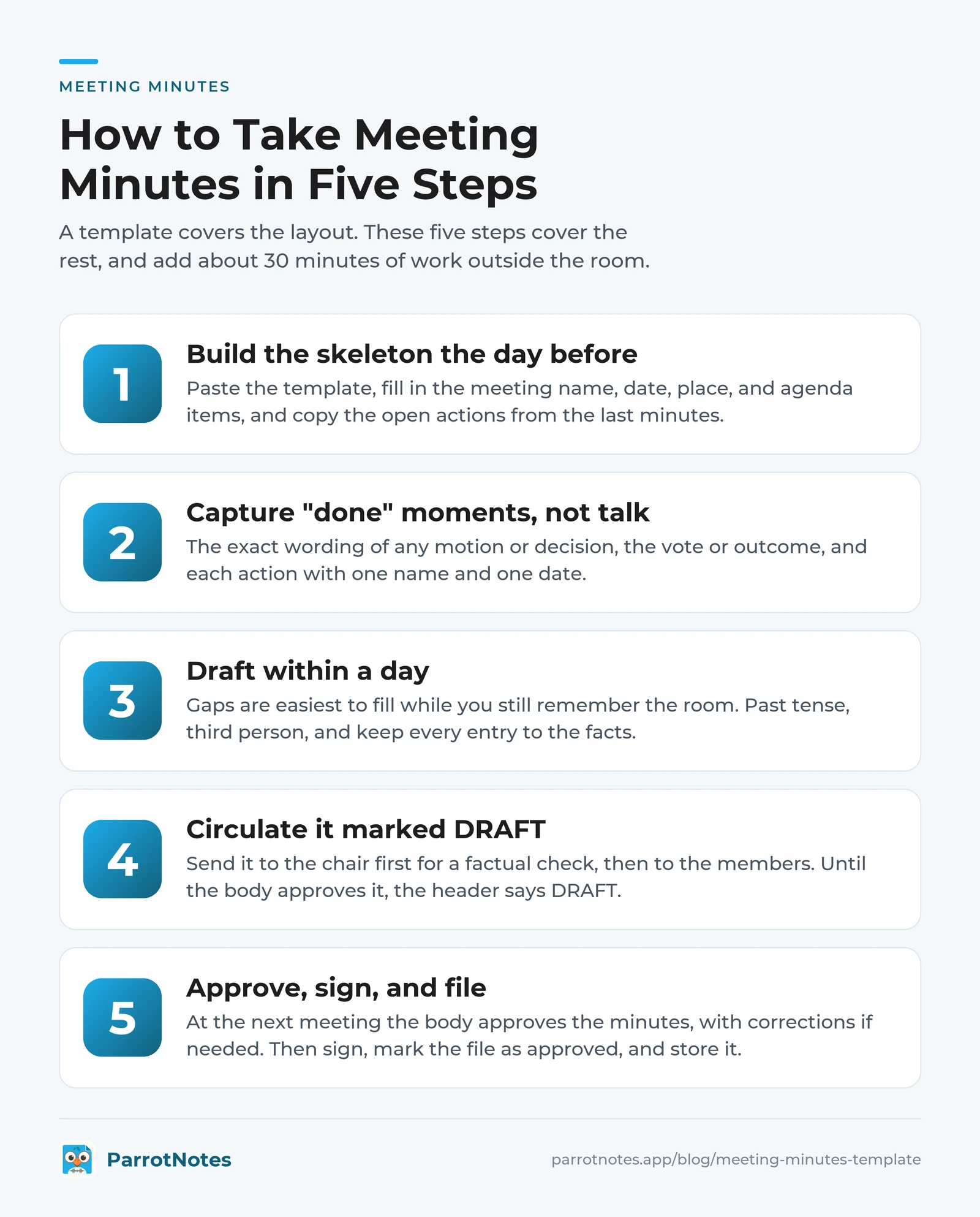
A template covers the layout. These five steps cover the rest, and for an ordinary meeting they add about 30 minutes of work outside the room.
- Build the skeleton the day before. Paste the template, fill in the meeting name, date, place, and agenda items, and copy the open actions from the last minutes. Half the document exists before anyone arrives.
- Capture "done" moments, not talk. Write three things when they happen: the exact wording of any motion or decision, the vote or outcome, and each action with one name and one date. When a topic ends without any of those, ask the chair: "What am I minuting for this item?"
- Draft within a day. Gaps are easiest to fill while you still remember the room. Type it into the template, in past tense and third person, and keep every entry to the facts.
- Circulate it marked DRAFT. Send it to the chair first for a factual check, then to the members. Until the body approves it, the header says DRAFT.
- Approve, sign, and file. At the next meeting the body approves the minutes, with corrections if needed. Then sign, mark the file as approved, and store it. The next section covers how.
Marta's habit is worth copying. She reads the decisions and actions back in the last five minutes of the meeting, straight from her skeleton. Anyone who disagrees says so there, instead of in a reply-all a week later.
Approval, corrections, signing, and storage
Minutes become the official record only when the body approves them. Until then, they're the secretary's draft.
Approval happens at the next meeting, or by a review process your bylaws allow. The chair asks for corrections. If there are none, the minutes are approved as read or as circulated. If a member offers a correction and nobody objects, it's made.
Corrections are recorded in a particular way. The Robert's Rules FAQ explains that corrections made at the time of approval go into the text of the minutes being approved. The minutes of the meeting where that happened say only that the earlier minutes were approved "as corrected." If an error turns up after approval, the body corrects it with a motion to Amend Something Previously Adopted, and the original file gets a note pointing to the correcting meeting rather than a silent edit. Tom Abara's balance correction, above, follows that pattern.
Signing makes the approved version identifiable. The 1876 Robert's Rules says "the minutes should be signed by the person who acted as clerk for that meeting: in some societies the chairman must also sign them." Sign the approved version, not the draft, and add the approval date.
Retention depends on what kind of body you are, so read your bylaws and ask whoever handles compliance. Some minutes have a legal floor. In the UK, for example, the Companies Act 2006, section 248 requires every company to record minutes of its directors' meetings and to keep them "for at least ten years from the date of the meeting." Rules vary by country and type of organization, and this article isn't legal advice.
With no legal floor, keep every approved set for as long as its decisions still matter. For most organizations, that means keeping them all.
Storage is simpler than people make it. One folder per body, one file per meeting, named so they sort themselves: 2026-10-08-north-valley-chapter-minutes-APPROVED.pdf. Keep the draft and the approved version as separate files. If a member asks in two years what was decided about dues, the answer should take one search, not an afternoon.
Let a recording fill in your meeting minutes template
Every meeting minutes template has the same weak point: someone has to catch the exact wording of a motion while also counting the vote, and often while chairing. A recording takes the capture job off your hands, and the template becomes something you fill in from a transcript afterwards.
Start with consent. Tell the meeting you're recording to help with the minutes, and get agreement. Recording rules vary by state and country. In California, for example, Penal Code section 632 makes it an offense to record a confidential communication without the consent of all parties, and some bylaws say whether recordings may be kept.
This isn't legal advice: ask permission every time, and check your own rules. Pause the recorder for anything the body takes into a closed session.
Then set a phone running ParrotNotes in the middle of the table. Recording continues with the screen off, so the phone can lie face down. Afterwards you get a transcript, an AI summary, and a list of action items, and each one maps onto the minutes:
- Motions and decisions: search the transcript for "moved" and "decision," and copy the final wording, including any amendment
- Votes: the chair's announcement of the result is in the transcript, so the count in the minutes matches what was said aloud
- Action items: start from the extracted list, then confirm each owner and date
- Reports: the summary gives you the two-line entry for "received and filed"
Two habits from the chair make this work far better. Restate every motion in its final form before the vote, and announce the result with the count. That puts the record-ready wording straight into the recording.
Picture Teresa's April meeting. Her phone sits by the sign-in sheet, recording with the committee's agreement. When item 4 comes up in the action log, Sam restates it: "Monthly ladder inspections, tags and register issued March 27, done." Back at her desk, Teresa searches the transcript for "ladder," confirms the wording, and has the draft minutes with Sam within the hour.
The free plan includes 100 minutes of recording a month, up to 30 minutes per recording, with an AI summary on every recording. That fits a short weekly team meeting. For a 75-minute committee or a two-hour chapter meeting, ParrotNotes Pro records up to 3 hours at a time, with 3,000 minutes a month. Pro costs $19.99 a month, or $14.99 a month billed annually.
Pro also adds speaker identification, which helps when you need the mover's name, plus AI chat ("What did we decide about dues?"), export to docx and PDF for the approved copy, and transcription in 99+ languages with translation.
One boundary to keep. The recording is a tool for writing the minutes; the approved minutes remain the record. Once they're approved, follow your own rules on whether to keep or delete the audio. If your meetings cover sensitive matters, read how we protect your data before you start.
Copy a meeting minutes template and minute your next meeting
The right meeting minutes template asks for what was done, in the order the meeting did it. Here's the short version:
- Pick the format by the body: standard business, formal Robert's Rules, committee, or simple recurring
- Record the essentials: kind of meeting, body, date and place, chair and secretary, attendance, and previous minutes
- Write every motion in its final wording with its outcome and count, and every action with one owner and one date
- Leave the discussion out
- Circulate as a draft, approve at the next meeting, sign, and file one named copy per meeting
Think back to Teresa's two-word entry. With the committee format, the auditor's question is answered in one line, with the vote and the owner beside it.
Your next meeting already has a date. Paste the template that fits into your notes app now. Then download ParrotNotes free, so the exact wording of every motion is waiting in the transcript when you sit down to write the minutes.
Frequently Asked Questions
What should a meeting minutes template include?
A meeting minutes template should include the kind of meeting and the name of the body, the date and place, who chaired and who took the minutes, attendance and quorum, whether the previous minutes were approved, every motion in its final wording with its outcome and vote count, action items with owners and due dates, and the time of adjournment. Leave out the discussion.
Do meeting minutes record who said what?
No. The official Robert's Rules of Order FAQ says minutes are "a record of what was done at a meeting, not a record of what was said," and calls summarizing the discussion improper. Record motions, decisions, votes, and actions. If your organization wants a summary of the debate, keep it as a separate document.
Who approves meeting minutes, and when?
The body that held the meeting approves its own minutes, usually at the start of the next meeting. The chair asks for corrections; if there are none, the minutes are approved as read. Corrections go into the text, and the new minutes state that the earlier minutes were approved "as corrected." Until approval, circulate them marked DRAFT.
Can I record a meeting to write the minutes?
Yes, with the meeting's agreement and within the law where you are. Some places, such as California under Penal Code 632, require the consent of all parties to record a confidential conversation, and some bylaws set their own rules. Ask every time, pause for closed sessions, and treat the recording as a tool. The approved minutes stay the record.
Related Posts

Voice Notes on iPhone: Everything You Can Do With Them
Voice notes on iPhone can do more than record. Learn to capture, tidy, transcribe, sync, and share them, and which iPhone voice tool fits each job. Try it free.

Sandler Pain Funnel Questions (With a Note-Taking Template)
The 8 Sandler pain funnel questions as Sandler publishes them, what to write down at each one, a note-taking template and a worked call. Copy it free.

Sales Meeting Agenda: Templates for Weekly Team Meetings
Running a weekly sales meeting that produces nothing? Copy four sales meeting agenda templates for field teams, plus a rep prep card and a record-ready run.