
Float Nurse: What the Float Pool Is Like, Pay and How to Prepare

Sarah Johnson
Writes about field sales, meeting notes and voice-first workflows at ParrotNotes. Every article is reviewed by the ParrotNotes product team before it goes live.

Table of Contents
- 1.What is a float nurse?
- 2.What float pool nursing is like
- 3.Float nurse pay: what named sources say
- 4.How to prepare before you float
- 5.The first 15 minutes: a float nurse checklist
- 6.When an assignment is beyond you: three lanes
- 7.Keep a personal unit sheet, with no patient data
- 8.Is float nursing right for you?
It's 6:52 a.m. and Priya has just learned she's on telemetry today, not the med-surg unit she worked last week. Her badge won't open the med room. She can't find the supply closet, and the charge nurse didn't know a float was coming. (Priya is a composite, not a real person.)
That's the job in one picture. A float nurse goes where the hospital is short, so being new is part of the work, shift after shift. Some nurses love that. Some don't.
Most guides list pros and cons and stop. This one adds pay figures with a name and a date on each, two real offers compared line by line, a checklist for your first 15 minutes on a unit, and a rule for when an assignment is beyond you.
None of it touches patient information. If you'd like to keep your own unit notes by voice once you're off the floor, ParrotNotes turns a spoken note into a searchable one. More on the safe way to do that below.
What is a float nurse?
A float nurse is a registered nurse who covers short-staffed units instead of working one home unit. The duties match any RN's on that unit, as far as your validated competency goes. What changes is the setting, sometimes every shift.
People use the term for three different setups, and they're not the same job:
| Setup | Who it is | How it works | Published example |
|---|---|---|---|
| Hospital float pool | RN hired into the pool, with no home unit | Sent where the need is that shift | WakeMed lists self-scheduled pool roles, some limited to certain areas |
| System float pool | RN covering several hospitals in one health system | Assignments can run per diem or for several weeks | Houston Methodist has staff pick their shifts per six-week period and at least three locations |
| Floated staff nurse | RN with a home unit, moved for a shift | Usually low census at home, or a gap elsewhere | University of Michigan nursing's process matches each nurse to a similar unit, medicine to medicine or ICU to ICU |
Ask which one you're being offered, how many units and sites it covers, and how much say you get.
What float pool nursing is like
The recent evidence is small but direct. A 2025 study in the Journal of Nursing Management interviewed 27 nurses from five Dutch hospitals: 10 working in a float pool inside one hospital, and 17 ICU nurses expecting to float between hospitals. It's qualitative, so read it as themes rather than rates.
What float pool nurses valued:
- Learning, the benefit mentioned most
- Schedule flexibility, which appealed to nurses with caregiving duties
- Variety in wards and treatments
What they found hard:
- A heavy workload at first, easing with experience
- Feeling like an outsider, and hesitating to keep asking questions
- Units that didn't know a floater was coming
- Different protocols and terminology from ward to ward
- A fear of losing skills from not staying in one field
The unit feels it too. In a 2023 study of floating to ICUs, floating nurses worried about unfamiliar patient types and equipment locations, while the ICU nurses reported "cognitive overload" from orienting floaters on top of their own work. So every question you can answer yourself helps a busy team.
Float nurse pay: what named sources say
Float pool nurse salary numbers disagree because they measure different things. All were checked on November 2, 2026:
| Source | Figure | Date on the page |
|---|---|---|
| Salary.com, float RN | Median $88,052; middle half $77,108 to $101,945 | October 1, 2026 |
| Incredible Health, float pool | $84,768 a year, about $40.75 an hour | None stated |
| PayScale, float pool | $34.76 an hour base; 10th to 90th percentile $26.97 to $48.44 | Last updated October 2, 2024 |
| BLS, all RNs (no float line) | Median $97,550; $100,220 in hospitals | May 2025 |
| WakeMed, one employer's posted rates | $47.25 to $63.25 an hour, plus shift differentials | Checked November 2026 |
None of these national estimates shows a clear float premium over the BLS figure for hospital RNs. Premiums live in a specific employer's rate card. University of Michigan's process, for example, lists an $8 an hour bonus for designated floats, in a document last reviewed in August 2017, so treat that as an example, not a current rate.
A worked example: two posted offers
Marcus has family health cover through his spouse and wants fewer weekends. (Marcus is a composite too.) He's looking at two med-surg float roles from the same WakeMed page, as listed in November 2026:
| Supplemental pool (option 3) | Full-time pool (option 5) | |
|---|---|---|
| Base rate | $60.25 an hour | $52.00 an hour |
| Minimum hours | 48 every two weeks | 72 per pay period |
| Base pay at the minimum | $2,892 | $3,744 |
| Benefits | Not eligible | Eligible |
| Weekends and holidays | Not required | Required |
The base pay line assumes a two-week pay period and leaves out differentials. The higher rate earns less at the minimum, because the hours are lower: at $60.25, you'd need about 62 hours every two weeks to match $3,744. For Marcus, who doesn't need the benefits, the supplemental role can still win. For a nurse who needs the insurance, that $8.25 an hour isn't a raise at all.
Before you compare any two offers, ask:
- Is the rate base pay, or does it already include differentials?
- What happens to your hours when a unit cancels you for low census?
- Which units can you be sent to, and is there a rate tier by unit?
- How much paid orientation do you get on each unit?
Check overtime too. The Department of Labor's Fact Sheet 54 says shift differentials count in the regular rate, so overtime is worked out on that higher figure. Run your own shifts through our free overtime calculator, and put a rotation on your calendar with the shift schedule generator.
How to prepare before you float
Know your floor. Some employers set one for you: WakeMed asks for a current North Carolina RN license, CPR and two recent years of hospital experience in the skills area. If you're newly licensed, our new grad nurse tips are a better start.
Make a competency list. Write down which unit types you've been validated for, on what date, and what you'd need before taking the next one. Ask your pool manager to confirm it, so it's settled before anyone's rushing you at 7 a.m.
Protect your sleep. If your float schedule moves you between days and nights, our night shift nurse tips give you a timed plan for sleep, meals and caffeine.
Reread the orientation basics. Our nursing orientation checklist covers your first weeks on one unit, and much of it shortens to a single shift.
The first 15 minutes: a float nurse checklist
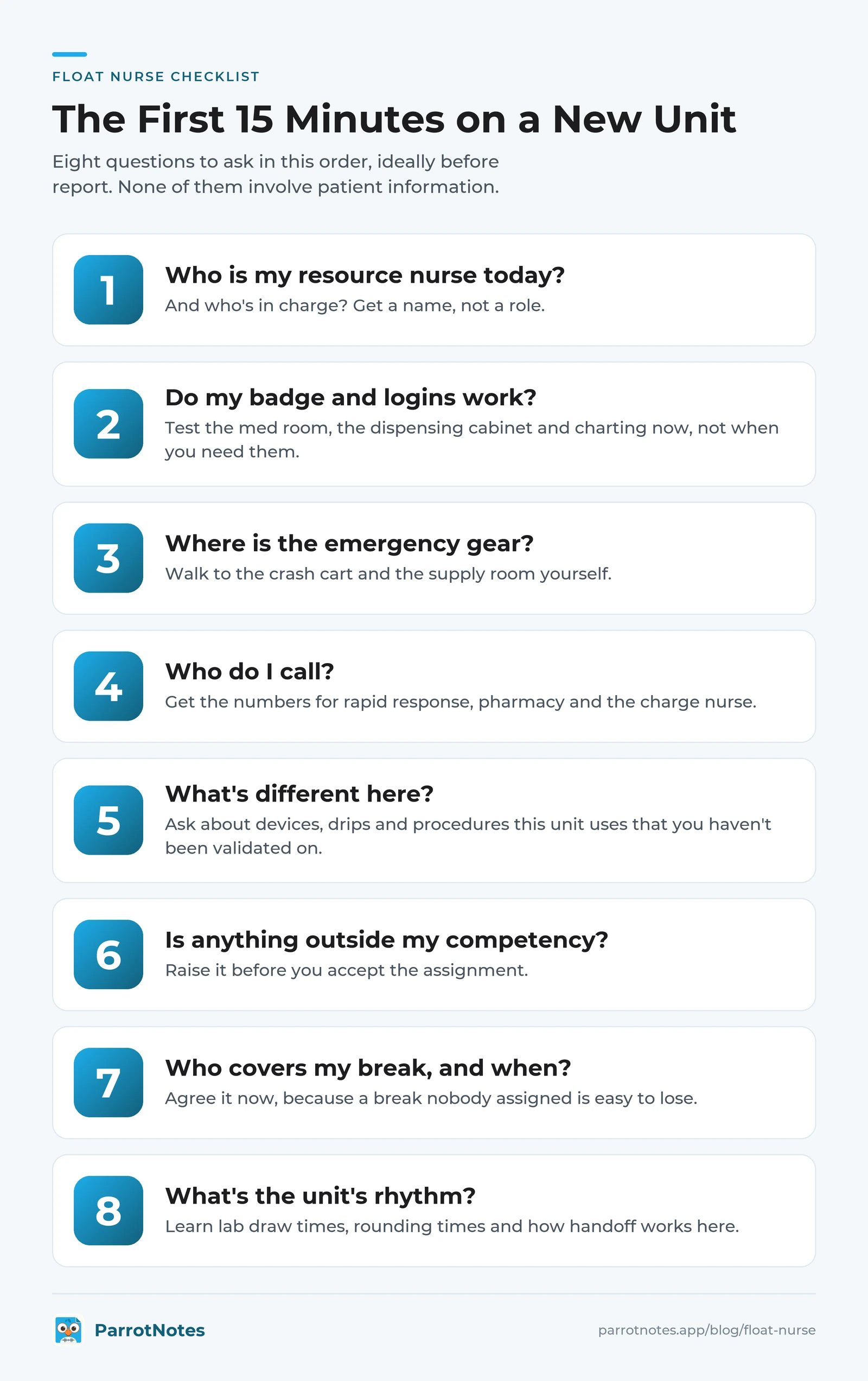
Joan Borgatti's FLOAT plan in American Nurse Journal (2010) still holds up: find a resource person, lower your stress, orient yourself, ask questions, take five minutes to review your assignment. This checklist turns that into eight specific questions. Ask them in this order, ideally before report:
- Who is my resource nurse today, and who's in charge? Get a name, not a role.
- Do my badge and logins work? Test the med room, the dispensing cabinet and charting now, not when you need them.
- Where is the emergency gear? Walk to the crash cart and the supply room yourself.
- Who do I call? Get the numbers for rapid response, pharmacy and the charge nurse.
- What's different here? Ask about devices, drips and procedures this unit uses that you haven't been validated on.
- Is anything on my assignment outside my competency? Raise it before you accept, using the scripts below.
- Who covers my break, and when? Agree it now, because a break nobody assigned is easy to lose.
- What's the unit's rhythm? Learn lab draw times, rounding times and how handoff works here.
Then take your five minutes and plan the shift. The checkpoints in our nurse time management guide work on any unit. Anything about a patient stays in your facility's approved systems, not on your phone.
When an assignment is beyond you: three lanes
The clearest published answer we found comes from a licensing board. The California Board of Registered Nursing's statement on floating, dated 1998 and still on its site, says it's the RN's responsibility to decide whether they're clinically competent for the care required. If they aren't, they shouldn't accept the assignment, but they may accept a limited assignment that uses their existing competence. It also warns that accepting such an assignment can put your license at risk, and that managers must assign patient care only to clinically competent RNs.
That gives you three lanes:
| Lane | When it applies | What to say |
|---|---|---|
| Accept | Same patient population and skills you've been validated for | "I'm good with this. Who's my resource nurse if I get stuck?" |
| Accept with limits | Most of the work is familiar, but one skill or device isn't | "I can take these duties. I haven't been validated on this device, so I need someone who has to take that part. Who should that be?" |
| Escalate before accepting | The core care is outside your competency | "I'm not competent to safely take this assignment, and I'd like to tell you before I accept it. What can I safely do to help the unit today? Please bring in the supervisor if we need to." |
Back to Priya. She raises one drip she hasn't been validated on. The charge nurse moves that patient to a telemetry nurse and gives Priya a lighter assignment in exchange. It takes 40 seconds, and it works because she asked before accepting.
Where this applies. California's statement covers California RNs, and rules vary by state. Facility policy and union contracts matter too: Michigan's process gives floating nurses the right to refuse a particular assignment based on competency, and says floats won't be put in charge (see our guide to charge nurse duties for what that role carries). Check your own state board and policy before you need them. This is general information, not legal advice.
Keep a personal unit sheet, with no patient data
Every unit teaches you something, and most of it fades by the next visit. Keep one short sheet per unit, for yourself:
| Goes on the sheet | Never goes on the sheet |
|---|---|
| Where the supply room and crash cart are | Patient names, rooms, diagnoses or any identifying detail |
| Who was helpful, and who runs the unit | Anything you heard in report or a huddle |
| Lab, rounding and break routines | Door codes, passwords or logins |
| What you were validated on, and what to look up next | Anything you wouldn't want a colleague to read |
You can do this by voice. After the shift, off the unit, say 60 seconds into ParrotNotes: where things are, how the break worked, what you'd do differently. You get a transcript, a summary and tags, so you can search "4 West" before your next shift there.
The limits are firm. Never record on the unit, and never record report, huddles, or anything involving a patient. ParrotNotes makes no HIPAA claim and isn't a place for patient information. These are your own orientation notes, about the building and the routine. Check your employer's policy too.
Six weeks later, Priya's sent back to telemetry. She reads her sheet in the parking lot, walks in knowing where the supply room is, and already knows who to ask. Nobody has to orient her from scratch.
Is float nursing right for you?
A float nurse role tends to suit you if you want variety and schedule control, and can stand being new again and again. It's a poorer fit if you need one team around you or you're still building core skills.
- Find out which float setup you're being offered
- Compare the offer in dollars at the minimum hours, with benefits in view
- Settle your competency list before the shift, not during it
- Use the eight questions, and raise any gap before you accept
Your second shift on a unit gets easier if your notes are waiting, and ParrotNotes is free to try for exactly that.
Frequently Asked Questions
What does float nurse mean?
A float nurse is a registered nurse who moves to whichever unit is short-staffed instead of working one home unit. Some are hired into a float pool with no home unit, some cover several hospitals in a health system, and some are staff nurses moved for a single shift.
How much do float pool nurses make?
Estimates vary by source and method. Salary.com listed a median of $88,052 for float RNs as of October 1, 2026, and Incredible Health shows $84,768 a year. Actual posted rates can differ a lot: WakeMed listed $47.25 to $63.25 an hour plus differentials in November 2026, depending on commitment and unit.
Can a float nurse refuse an assignment?
It depends on your state and employer. The California Board of Registered Nursing says an RN who isn't clinically competent for the care shouldn't accept the assignment, and may accept a limited one. Check your own state board, facility policy and any union contract, and raise the problem before you accept the patients.
Can a new grad be a float nurse?
Sometimes, but many roles expect experience first. WakeMed, for example, asks for two recent years of hospital experience in the skills area. If you're considering it as a new grad, ask how much orientation you'd get on each unit and which units you'd be limited to.
Is float pool nursing harder than working on one unit?
It's harder in specific ways. Nurses in a 2025 Dutch study described a heavy workload at first, feeling like an outsider and differing protocols, though many said it eased with experience, and float pool nurses in that study were generally satisfied with their jobs.
Related Posts

What Is a Byline? Meaning, Examples and Who Gets One
The meaning of byline explained with examples: byline vs dateline, who gets one under AP and NPR rules, plus a freelancer credit email to copy. Learn more.
SDR vs BDR: What Each Role Does and Why Companies Mix Them Up
SDR vs BDR compared: what each role does, the pay employers state and why titles get mixed up, from 154 live job ads. Try ParrotNotes free for hand-off notes.

Sales Email Subject Lines: Examples by Situation and What to Avoid
Sales email subject lines for every situation: 40 short examples, what to avoid, and a five-question check. Build yours from your meeting notes. Try it free.