
What Is B2B Sales? A Plain Guide for New Reps

Sarah Johnson
Writes about field sales, meeting notes and voice-first workflows at ParrotNotes. Every article is reviewed by the ParrotNotes product team before it goes live.
Table of Contents
- 1.What is B2B sales?
- 2.B2B sales vs B2C sales: what changes when the customer is a company
- 3.The B2B sales cycle, stage by stage
- 4.Who does what on a B2B sales team
- 5.Where a B2B rep's day goes
- 6.Your first 30 days in B2B sales: a week-by-week checklist
- 7.The B2B jargon decoder: 20 terms and what to write down
- 8.One first deal, stage by stage
- 9.Keep every conversation on the record
Picture Maya on day two of onboarding at a commercial cleaning supplies distributor. By 10 AM she has heard "B2B," "ICP," "pipeline," "MQL," and "the buying committee" from three different people, and nobody has stopped to explain any of them. She writes the words in the margin and plans to look them up tonight.
Here's the lookup, starting with the plain answer to what is B2B sales. B2B sales means business-to-business sales: one company selling products or services to another company, rather than to an individual shopper. The buyer is an organization, the money is the organization's, and the purchase has to earn its keep in that organization's work.
If you're new, you know Maya's morning: everyone assumes you know the words. This is the guide we'd hand a new rep: how B2B differs from selling to consumers, the sales cycle stage by stage from the rep's seat, who does what on the team, and two things you can use this week, a first-30-days checklist and a jargon decoder.
One theme runs through all of it. B2B deals take weeks or months and involve a lot of people, so the rep who wins is usually the one who wrote down what was said. If you'd rather say your notes in the car than type them at 9 PM, try ParrotNotes free before your first ride-along.
What is B2B sales?
B2B sales is the process of selling a product or service to a business, government agency, or other organization, which then uses it to run, improve, or grow its own operation. The buyer is rarely one person: several people weigh in, the purchase goes through approval, and the deal takes longer than a consumer purchase because more is at stake for the buyer.
B2B sales meaning in one sentence
The B2B sales meaning in one line: the customer is a company, not a person, so you're selling to a group with a budget and a job to do.
Three quick tests tell you whether a sale is B2B:
- Who buys? An organization: a company, a school district, a hospital group, a city.
- Whose money? The organization's, so someone has to approve spending it.
- What for? To do the organization's work better, cheaper, faster, or safer. Nobody buys 400 cases of floor cleaner for fun.
The U.S. Bureau of Labor Statistics describes the classic B2B seller, the wholesale and manufacturing sales representative, as someone who sells "goods for wholesalers or manufacturers to businesses, government agencies, and other organizations." There were 1,571,400 of those jobs in the United States in 2025, before you count software, services, or any other B2B category.
Examples of B2B sales
B2B covers a lot of ground. Find your own job on this map.
| Kind of B2B sale | What's sold | Who buys | Example |
|---|---|---|---|
| Supplies and consumables | Cleaning products, packaging, parts | Purchasing, operations, facilities | A distributor sells 400 cases of floor cleaner a quarter to a gym chain |
| Wholesale and distribution | Products for resale | Retail buyers, store owners | A food broker places a snack line in 60 convenience stores |
| Manufacturing and industrial | Components, machinery, MRO supplies | Plant managers, engineers, purchasing | An industrial rep gets a gearbox specified at a food plant |
| Software (SaaS) | Subscriptions to cloud software | Department heads, IT, finance | A SaaS sales rep closes 50 seats on an annual plan |
| Services | Consulting, staffing, logistics, insurance | Owners, HR, operations, finance | A staffing agency signs a warehouse for 20 seasonal workers |
| Capital equipment | Machines, vehicles, systems | Owners, plant managers, finance | A fleet dealer sells six vans to a plumbing company |
Deal values run from a few hundred dollars to millions. What stays constant is the buyer: an organization that needs the purchase to pay off.
B2B sales vs B2C sales: what changes when the customer is a company
B2C (business-to-consumer) sales is selling to a person for their own use: a phone, a gym membership, a car. You've bought plenty of things as a consumer, so the fastest way to understand B2B is to see what changes when the customer becomes a company.
| B2C sales | B2B sales | |
|---|---|---|
| Who decides | One person, sometimes a household | A group: users, managers, finance, procurement |
| How many people | One or two | Forrester's 2026 research: 13 internal stakeholders and nine external influencers in a typical decision |
| Why they buy | Want, taste, convenience, price | Return on the money: does it save time, cost, or risk? |
| How long it takes | Minutes to days | Weeks to months, longer for large purchases |
| Deal size | Small, one-off | Larger, often repeating: blanket orders, subscriptions, renewals |
| Relationship | Ends at the checkout | Continues: reorders, renewals, expansion, referrals |
| What the rep has to remember | Little | Everything anyone said, for months |
The "how many people" row surprises new reps most. In its 2026 State of Business Buying release, Forrester reports that "the typical buying decision now includes 13 internal stakeholders and nine external influencers," and that procurement professionals are decision-makers in 53% of business buying cycles. You won't meet all 13. Each one you do meet will say something that matters later.
The "how long" row is stretching too. Salesforce's State of Sales statistics report that 57% of sales professionals now say the sales cycle is getting longer. A conversation in your first month can decide a question that's asked in your fourth.
So the B2B rep's job has two halves. Half is selling: finding the right companies, understanding their problem, showing how you solve it. The other half is keeping track: who said what, who still has to say yes, and what you promised along the way.
The B2B sales cycle, stage by stage
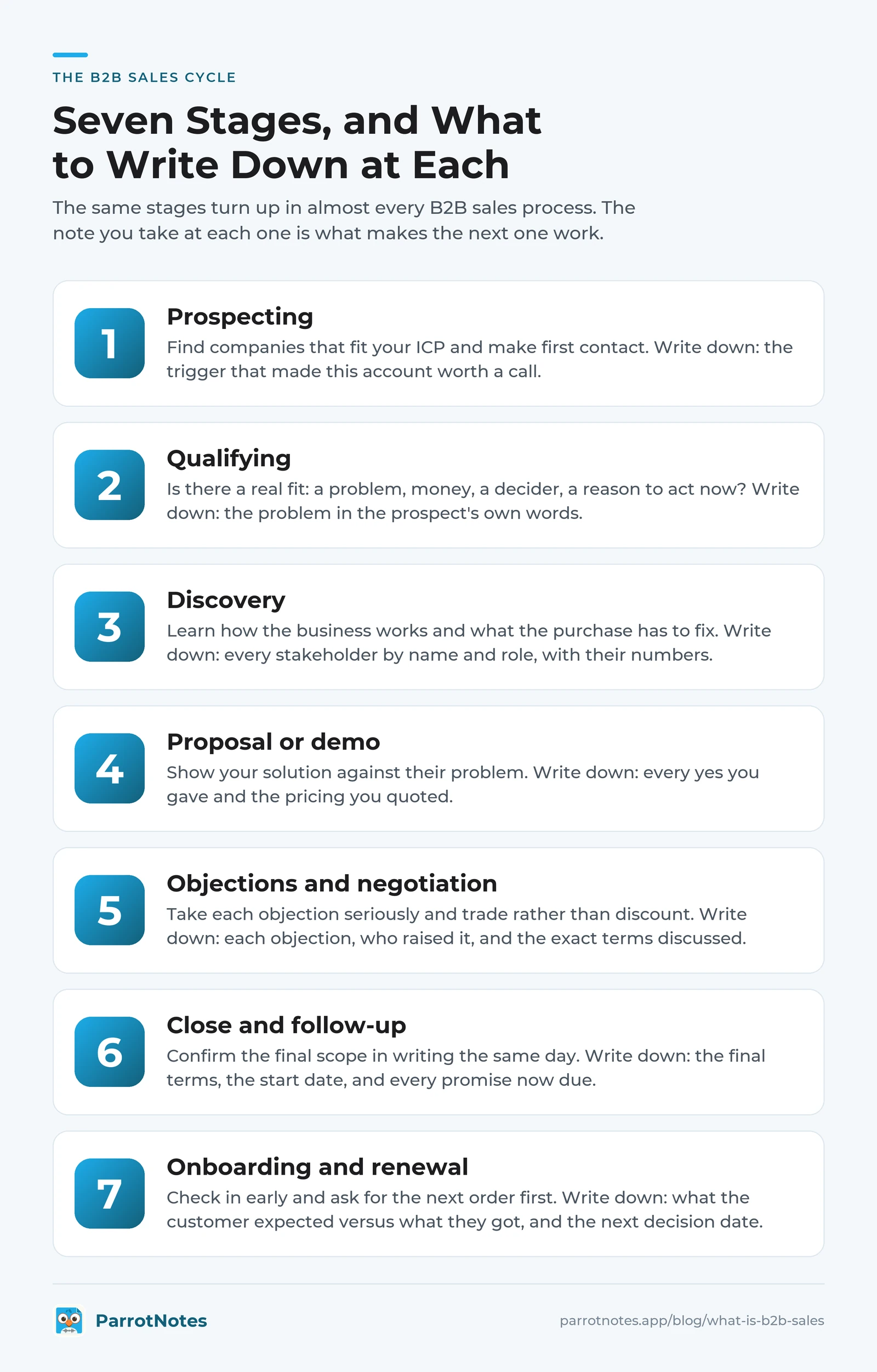
Every company draws its own B2B sales process, with five to ten steps in the CRM. Underneath, the same seven stages turn up almost everywhere. For each one, here's what happens, what a new rep does, and what to write down so the next stage works.
1. Prospecting
What happens: you find companies that fit your ideal customer profile (ICP) and reach out by call, email, LinkedIn, referral, or a walk-in visit. What you do: build a list from your territory, research each account for five minutes, make first contact. What to write down: the trigger that made this account worth a call (a new site, hiring, a competitor's contract ending) and the name of the first person who answered.
2. Qualifying
What happens: a first conversation to find out whether there's a real fit: a problem you solve, money to solve it, someone who can decide, and a reason to act now. Most teams use a framework here; the BANT qualification guide covers the most common one. What you do: ask more than you tell, then decide whether to keep going. What to write down: the problem in the prospect's own words, who else is involved, and any date they mentioned.
3. Discovery
What happens: a deeper meeting, often in person, where you learn how the business works and what the purchase has to fix. In a bigger account this is where you meet the rest of the buying group; the enterprise sales guide shows how to track a committee across months of meetings. What you do: listen, ask "why," and map who cares about what. What to write down: every stakeholder by name and role, the numbers they use (units a month, cost per unit, downtime hours), and what "success" means to each person.
4. Proposal or demo
What happens: you show your solution against their problem: a demo, a sample, a site trial, or a written proposal with pricing. Forrester's 2026 release notes that more than 60% of business buyers now use a trial. What you do: present, answer questions, and confirm what the proposal has to include. What to write down: every "does it do X?" you answered with a yes, the pricing you quoted, and what the prospect said they'd need to see to move forward.
5. Objections and negotiation
What happens: the buyer pushes back on price, timing, risk, or a competitor's offer, and procurement may join. What you do: take each objection seriously, trade rather than discount, and keep the decision-makers in the loop. What to write down: each objection, who raised it, what you offered in return, and the exact terms discussed. A concession you can't remember is a concession you'll make twice.
6. Close and follow-up
What happens: a signed order, contract, or purchase order, then the handover to whoever delivers. What you do: confirm the final scope in writing the same day, in a follow-up email that lists what was agreed. What to write down: the final terms, the start date, and every promise made in stages 4 and 5, because all of them are now due.
7. Onboarding and renewal
What happens: the customer starts using what they bought. In B2B the sale is rarely over: there are reorders, renewals, and the chance to sell more. What you do: check in early, fix problems fast, and ask for the next order before a competitor does. What to write down: what the customer expected versus what they got, and the date the next decision comes up.
One habit connects all seven stages. Picture Dev, a second-year rep for a packaging supplier. In stage 5 he agreed to hold last year's price on a 12-pallet order if the customer signed by month end. He didn't write it down.
The order arrived at the new price. The buyer remembered the promise, Dev didn't, and the account went quiet for a year. Dev is invented; the mistake isn't.
Who does what on a B2B sales team
A B2B deal passes through several hands, and each handover is a place where what the customer said can get lost. Here's the cast from the new rep's side.
| Role | What they own | What they hand you | What you hand them |
|---|---|---|---|
| SDR or BDR (sales development rep) | Stages 1 and 2 | A booked meeting, with why the prospect took it | The outcome, and feedback on lead quality |
| Account executive (AE) | Stages 3 to 6, discovery through close | In many field teams, this is you | The signed deal and the record of what was promised |
| Field or outside sales rep | The same stages, in person, across a territory | Often also you; see inside sales vs outside sales for how the day differs | Visit reports and CRM updates |
| Sales engineer or specialist | Technical questions, demos, specs | Answers you can quote to the customer | The exact question asked, with the customer's numbers |
| Account manager or customer success | Stage 7: onboarding, renewal, expansion | Signals that the customer is ready to buy more | Everything the customer expects, in writing |
| Sales manager | Pipeline, forecast, coaching, your ramp | Deal reviews, ride-alongs, feedback | An honest pipeline and a record of every meeting |
Titles vary. A small distributor may have one person doing all six rows; a software company may split them across three teams. What doesn't vary is the customer, who remembers every conversation as one conversation with "your company." Your notes keep it that way from your side too.
Where a B2B rep's day goes
New reps assume the day will be mostly selling. The data says otherwise. Salesforce's 2026 State of Sales survey of 4,050 sales professionals found that the average seller spends 40% of their time selling; its statistics page puts it the other way round, with reps spending 60% of their time on non-selling tasks. The same announcement reports that 46% rarely get feedback on their sales conversations.
For a field rep, much of that 60% happens in the car. The BLS notes that some wholesale and manufacturing reps "have large territories and travel considerably." Four to eight meetings a day, each full of names, numbers, and promises, with a CRM and a stack of other B2B sales tools that expect an update on every one.
The usual result is a notebook nobody can read on Friday and a CRM filled in from memory on Saturday. The fix is a habit before it's a tool: debrief every meeting before you start the car. Two minutes, the same order every time: who you met, what they said, what you promised, what happens next.
That's where ParrotNotes fits. Stay parked, hit record, and talk through the meeting while it's fresh. Recording keeps going with the screen locked, so the phone sits in the cup holder.
When you stop, you get a transcript, an AI summary, and action items with owners, and it can draft the follow-up email from what you said. Recording works with no signal; transcription and AI run once you're back in coverage. After a phone or video call, the same spoken debrief does the job.
If a customer agrees, you can also record the meeting itself and get the discovery answers in their exact words. Ask before you press record, every time, and skip it if anyone hesitates.
In the United States, federal law permits recording a conversation you're part of (18 U.S.C. § 2511(2)(d)), but some states and countries require everyone's consent. This isn't legal advice; check your company's policy and the local rule. A debrief you dictate alone in the car needs none of that.
Want to try it on your first week of visits? Download ParrotNotes free. The free plan gives you 100 minutes of recording a month, up to 30 minutes per recording, with an AI summary on every recording and AI insights on five recordings a month. Pro is $19.99 a month, or $14.99 a month billed annually, with 3,000 minutes a month, recordings up to 3 hours, and built-in sales frameworks (BANT, MEDDIC, SPIN) that pull qualification answers out of a recording for you. Customer names and numbers stay private: see how we protect your data.
Your first 30 days in B2B sales: a week-by-week checklist
Nobody hands you this list, so here it is. It's built for a field rep with a territory, but the order works for any B2B seat.
Week 1: learn the map
- Read the sales playbook, then ask which parts came from real customer calls and which are theory. If your team doesn't have one, our guide to building a sales playbook from real calls shows what a good one contains.
- Write your ideal customer profile in one sentence: the size, industry, and situation of the companies you're meant to win.
- List your territory's top 25 accounts with one line each: what they buy now, from whom, and the last contact.
- Learn the product well enough to answer the five questions customers ask most.
- Set up your debrief habit: the same four prompts after every meeting, spoken or typed, before you drive.
Week 2: watch it done
- Ride along on at least four customer meetings. Debrief each one yourself, then compare your notes with the senior rep's.
- Sit in on a pipeline review and note what your manager asks about each deal. Those questions are your future note template.
- Shadow one full cycle if you can: first call, discovery, proposal, close.
- Ask an account manager what customers complain about after the sale. It's your best objection prep.
Week 3: run your own meetings
- Book and run at least three first meetings from your top-25 list.
- Use a qualification framework in every one, and put the four answers in the CRM the same day.
- Send a follow-up email within two hours of each meeting, listing what was agreed and what happens next.
- Get an experienced rep to review your notes from one meeting. Fix what they'd have captured that you didn't.
Week 4: build the pipeline
- Have every open opportunity in the CRM with a stage, a dated next step, and the names of everyone involved.
- Review your first month's debriefs and pull out the three customer questions you couldn't answer. Get the answers.
- Book your next 15 meetings.
- Tell your manager where you're stuck, with the meeting record to show it. Feedback is easier to get when you can show the conversation.
By day 30 you won't have closed much, and that's normal in B2B. What you should have is a pipeline you can explain, a note for every meeting, and a debrief habit that runs without thinking.
The B2B jargon decoder: 20 terms and what to write down
Every term below will come up in your first month. The third column is what glossaries leave out: what to capture the moment you hear it.
| Term | Plain meaning | What to write down when you hear it |
|---|---|---|
| B2B / B2C | Selling to businesses / selling to consumers | Which one this account is, if your company does both |
| ICP (ideal customer profile) | The kind of company you're built to win | Whether this account fits, and why not if it doesn't |
| Territory | The accounts or geography you own | Every account in it, with a last-contact date |
| Prospect | A company you're pursuing that hasn't bought yet | How they came to your attention |
| Lead / MQL / SQL | A contact showing interest; marketing-qualified; sales-qualified | What they did to become a lead, and who qualified them |
| Pipeline | All your open deals, by stage | Each deal's stage and next step, with a date |
| Opportunity | A qualified deal with a real chance of closing | The problem, the people, the money, the timing |
| Stakeholder | Anyone with a say in the decision | Name, role, what they care about, and their stance |
| Decision-maker | The person who can say yes | Their name, and whether you've met them |
| Champion | Someone inside the account who wants you to win | What they need from you to sell it internally |
| Buying committee | The group that decides together | Who's on it, and who's missing from your meetings |
| Procurement | The team that manages purchasing, terms, and vendors | Their process, their forms, and their timeline |
| Discovery | The meeting where you learn the problem in depth | The problem in the customer's words, with numbers |
| Objection | A reason not to buy | The exact words, who said it, and what you answered |
| Proposal / quote / RFQ | Your written offer; a buyer's request for a quote | Every price and term you put in writing, with the date |
| Close | The moment the deal is signed | Final scope, start date, and every promise now due |
| Quota | The sales number you're measured on | Your number, the period, and where you stand |
| Forecast | Your manager's estimate of what will close and when | Which deals you've committed to, and why |
| Renewal / upsell | Buying again / buying more | The date the next decision comes up |
| Call report / visit report | Your written record of a customer meeting | Everything above, within minutes of the meeting |
Keep this page open in your first pipeline review. When a word you don't know comes up, the third column tells you what your manager is about to ask for.
One first deal, stage by stage
Here's the checklist and the decoder on a real-shaped deal. Maya, her employer, and the customer are invented, and the numbers illustrate rather than prove anything.
Stage 1, prospecting (week 2). On a ride-along, Maya spots a new branch of a regional gym chain, Northgate Fitness, going up in her territory. Debrief line: "Northgate, new branch on Route 9, opening in two months, buys from a national supplier."
Stage 2, qualifying (week 3). A first call with the facilities manager, Tom. Problem in his words: "Our supplier takes ten days to deliver and we've run out of disinfectant twice." Into the CRM that afternoon: spend about $3,000 a month across four sites, Tom recommends but the operations director, Lena, signs, and the trigger is the new branch.
Stage 3, discovery (week 4). A site visit with Tom and the branch manager. Maya captures the stakeholders (Tom, Lena, a manager per site, procurement at head office), the numbers (four sites, 60 cases a month, 48-hour delivery), and what success means to each person. Lena wants one invoice a month, not four.
Stage 4, proposal (week 5). A quote for all four sites with 48-hour delivery and one monthly invoice. Maya's notes list the two yeses she gave: a free dispenser install at the new branch, and a trial month there first.
Stage 5, negotiation (week 7). Procurement asks for net-60 terms and a 5% cut. Maya's manager agrees to net-45 in exchange for a 12-month agreement. Every term goes in the record, with who agreed it.
Stage 6, close (week 9). A signed 12-month agreement. Maya's same-day follow-up email lists the terms, the trial dates, the dispenser install, and Lena's single invoice, read straight from the record.
Stage 7, onboarding (week 12 onward). One late delivery in the trial month, which Maya hears about because she checked in on day 10. The other three sites switch in month four. The renewal date is already in the record.
At day 30, Maya had closed nothing. What she had was Northgate at stage 3, a pipeline she could explain, and a record of every conversation. That's a good first month in B2B sales.
Keep every conversation on the record
B2B sales is selling to organizations: more people, more money, more time, and a relationship that keeps going after the signature. The selling part you'll learn from your team. The keeping-track part is yours from day one.
The short version:
- B2B sales means the customer is a company, so you're selling to a group with a budget and a job to do
- Compared with B2C, expect more decision-makers, longer cycles, and a relationship that continues after the close
- The seven stages run from prospecting to renewal, and each one has something you must write down
- Use the first 30 days to learn the map, watch it done, run your own meetings, and build a pipeline you can explain
- Debrief every meeting before you start the car
Think back to Maya on day two, writing "ICP" in the margin. Thirty days later she can explain every deal in her pipeline, because she has a record of every meeting. Download ParrotNotes free, set up the four-prompt debrief, and start your record before your first meeting, not after your first lost deal.
Frequently Asked Questions
What is B2B sales in simple terms?
B2B sales is one business selling products or services to another business, government agency, or organization, rather than to an individual consumer. The buyer is usually a group spending the organization's money, so the sale involves more people, more approval steps, and a longer timeline than a consumer purchase, and the relationship often continues through reorders or renewals.
What is the difference between B2B and B2C sales?
B2C sells to a person for their own use; B2B sells to an organization for its work. That changes who decides (a group instead of one person), why they buy (return on the money rather than preference), how long it takes (weeks or months instead of minutes), and what follows the sale (renewals and reorders instead of a one-off purchase).
How long is a B2B sales cycle?
It depends on the product and the buyer. A repeat supplies order can close in days; a software or equipment purchase with a committee and procurement can take months. Salesforce's 2026 State of Sales research reports that 57% of sales professionals say the cycle is getting longer, so plan for deals to outlast your memory of any single meeting.
What does a B2B sales rep do all day?
Prospecting, first calls, discovery meetings, proposals, negotiations, and follow-ups, plus the admin around them: CRM updates, call reports, and internal meetings. Salesforce's 2026 survey found the average seller spends 40% of their time selling. For a field rep, much of the rest happens in the car between visits, which is where a two-minute spoken debrief after each meeting pays off.
Is B2B sales a good career for a beginner?
It can be. The BLS reports a 2025 median pay of $76,460 a year for wholesale and manufacturing sales representatives and about 123,400 openings a year through 2035, mostly to replace people who leave. Pay usually mixes salary with commission, so the first months are lean while the pipeline builds. People who like learning how businesses work, and who keep good records, tend to do well.
Related Posts
Solar Sales: How Closers Keep Track of Every Household
What solar sales is, how closers work, and an eight-field household record for every in-home consultation, plus the follow-up and referral rhythm. Copy it.
Sales Pitch Examples for In-Person Meetings
Eight sales pitch examples written for meetings in the room: structure, filled-in script, when each works, and a 90-second debrief to capture the reaction.
Outside Sales Rep: The Role, the Tools and a Typical Day
What an outside sales rep does, earns (BLS 2025) and carries, a typical day hour by hour, and how reps capture notes between visits. Copy the territory plan.