
SaaS Sales: How It Works and How Reps Track Every Conversation

Sarah Johnson
Writes about field sales, meeting notes and voice-first workflows at ParrotNotes. Every article is reviewed by the ParrotNotes product team before it goes live.
Table of Contents
- 1.What is SaaS sales?
- 2.How SaaS sales works: models, roles and the cycle
- 3.Why a SaaS deal is so hard to keep track of
- 4.The SaaS deal log: one entry per conversation
- 5.Worked example: a 60-day trial-to-close, conversation by conversation
- 6.How reps capture each conversation: calls, demos and in-person moments
- 7.Keep the whole subscription on the record
Eleven months after the deal closed, the renewal call opens with a question the rep can't answer: "During the trial, your team said the reporting module would be included at our tier. Where is it?"
The rep who ran the trial has moved to another team. The CRM says "Trial: positive. Next step: pricing." The reporting remark, if it was ever made, lives in a demo nobody wrote up. And now the renewal, worth more than the original deal, hangs on it.
That's the part of SaaS sales the beginner guides skip. Selling software by subscription means the account never closes. It gets demoed, trialled, negotiated, onboarded, renewed and expanded, and every one of those steps is a conversation somebody has to remember.
This guide covers how SaaS sales works: the subscription model, product-led versus sales-led, who does what, the cycle from demo to renewal, and the metrics reps hear about every Monday. Then it gets to the part that keeps deals alive: a per-conversation deal log built for a SaaS cycle, and a worked 60-day example so you can see it hold up.
What is SaaS sales?
SaaS sales is the selling of cloud-hosted software that customers pay for by subscription, usually monthly or annually, instead of buying a licence once. The customer's revenue arrives over time, so the sale isn't finished at the signature: the rep, or a colleague, has to keep the customer using the product through onboarding, renewal and expansion. That ongoing relationship is what makes a SaaS sales process different from selling a one-time product.
The word reps use for the money is ARR, annual recurring revenue: the subscription value of every active customer, added up and expressed per year. A single deal is measured by its ACV, annual contract value. A $2,000-a-month contract is $24,000 ACV and adds $24,000 to ARR for as long as the customer stays.
SaaS sales vs selling a one-time product
| One-time product sale | SaaS sale | |
|---|---|---|
| Revenue | Arrives at signature | Arrives monthly or annually, for as long as the customer stays |
| When the rep's job ends | At the close | It doesn't; the account hands over to renewal and expansion |
| Biggest risk | Losing the deal | Winning it, then losing the customer at renewal |
| Number of conversations | A handful | Dozens: demo, trial, procurement, onboarding, check-ins, renewal |
| What a promise costs | One delivery | Every renewal that follows |
The last row is why this article exists. In a subscription business, a remark in a demo can still be costing you money three years later.
How SaaS sales works: models, roles and the cycle
Most explanations of the SaaS sales model describe it from the company's side. Here it is from the rep's side, because that's who has to keep track of it.
Product-led, sales-led and the hybrid most reps live in
Two motions dominate. In ProductLed's definition, product-led growth "uses the product itself (often via free trial or freemium) as the primary driver of acquisition, activation, retention, and expansion." Sales-led growth, the same page says, "relies heavily on the efforts of a sales team to drive customer acquisition, retention, and revenue growth." ProductLed's own benchmark survey found that almost 60% of the companies surveyed had already implemented a product-led motion.
In practice most SaaS reps work a hybrid. A prospect signs up for a free plan, uses it for a few weeks, hits a limit, and a rep steps in to run a demo for the wider team. That rep is doing sales-led work on a product-led lead. The conversation count doesn't drop; it starts earlier.
| Motion | Who starts the deal | Where the rep enters | Typical ACV |
|---|---|---|---|
| Product-led (self-serve) | The user, by signing up | Only when usage signals a bigger account | Low |
| Product-led with sales assist | The user, then a rep | At a usage trigger: seat limit, team invite, admin request | Low to mid |
| Sales-led (transactional) | Marketing or an SDR | From first call, through demo and trial | Mid |
| Sales-led (enterprise) | An SDR or the AE | From first call, through security review, procurement and legal | High |
Who does what: SDR, AE, SE, CSM
A SaaS deal passes through several hands. Each handover is a place where what the customer said can get lost.
- SDR (sales development rep) finds and qualifies leads, books the first meeting, and hands the deal to an AE. What the prospect said in that first call is the deal's first record.
- AE (account executive) runs discovery, the demo, the trial, pricing and the close. Owns the deal until signature.
- SE (solutions engineer) joins for technical demos, proof-of-concept setups and security questionnaires. Often the person who makes the promises the AE later has to keep.
- CSM (customer success manager) takes the account after signature: onboarding, adoption, the renewal, and the first sign of expansion. Inherits everything the AE wrote down, and nothing the AE didn't.
- Account manager in some teams owns renewal and expansion instead of the CSM.
Four people, at least two handovers, and one customer who remembers all of it as a single conversation with "your company."
The SaaS sales cycle from demo to renewal
Most guides describe a SaaS sales cycle that ends at the close. The rep's cycle doesn't.
| Stage | What happens | The conversation that matters |
|---|---|---|
| 1. Discovery | Qualify the problem, the people and the budget | The prospect describes the pain in their own words |
| 2. Demo | Show the product against that pain | Feature questions, and any "does it do X?" answered with a yes |
| 3. Trial or proof of concept | The prospect uses it for a few weeks | Success criteria agreed; usage problems reported |
| 4. Security, legal and procurement | Questionnaires, terms, redlines | Commitments on data, uptime, support and price |
| 5. Close | Signature and payment | The final scope, tier and any exceptions |
| 6. Onboarding and adoption | Setup, training, first value | What the customer expected versus what they got |
| 7. Renewal | Opens well before the term ends, with the notice period in mind | Every promise from stages 2 to 6 comes back |
| 8. Expansion | More seats, a higher tier, another team | Usage signals and the internal champion's next goal |
Salesforce's State of Sales statistics report that 57% of sales professionals now say the sales cycle is getting longer. The same page reports that sellers use an average of eight tools to close deals, which is eight places for a note to sit unread.
How long is a SaaS sales cycle? It depends on the ACV and the motion: a self-serve upgrade can take a day, and an enterprise deal with a security review takes months. The honest answer for any rep is "longer than you'll remember accurately without writing it down."
The metrics reps hear about
You'll hear these in every pipeline review. Here's what they mean and what a rep's notes have to do with them.
- ARR and MRR: annual and monthly recurring revenue. Your quota is usually expressed in new ARR.
- ACV: the annual value of one contract.
- Churn: customers or revenue lost in a period. Every churned customer had a reason, and it was usually said out loud before the renewal.
- Gross revenue retention (GRR): revenue kept from existing customers, ignoring upsells. In SaaS Capital's 2025 retention benchmarks, a survey of more than 1,000 private B2B SaaS companies, the median gross retention was 91%.
- Net revenue retention (NRR): the same figure including upsells, cross-sells and price increases. SaaS Capital's median was 101%, and multi-year contracts ran higher at 103% NRR and 94% GRR. NRR above 100% means the existing base is growing without a single new logo, which is why expansion conversations get so much attention.
- Pipeline coverage: open pipeline divided by quota; your manager has a multiple in mind, and will ask why yours is under it.
- Win rate and cycle length: what share of qualified deals close, and how long they take.
Notice how many of these are decided after the close. Churn, GRR, NRR and expansion all depend on what the customer was told during the sale. The rep who closes on a promise nobody recorded is spending next year's retention number today.
If you'd rather have every conversation written up before you reach the next meeting, you can try ParrotNotes free now; the rest of this article shows exactly where it fits.
Why a SaaS deal is so hard to keep track of
Do the arithmetic on one mid-market SaaS deal. A discovery call, two demos, a 30-day trial with weekly check-ins, a security questionnaire, two procurement calls, a pricing negotiation, a kickoff, three onboarding sessions, quarterly check-ins and a renewal call. That's around 20 conversations before the first renewal, across an SDR, an AE, an SE and a CSM.
Forrester's 2026 State of Business Buying reports that "the typical buying decision now includes 13 internal stakeholders and nine external influencers." Not all of them join your calls, but any of them can ask what was said on one.
Then there's the time. Salesforce's statistics page above reports that reps spend 60% of their time on non-selling tasks. Writing up calls is one of them, and it's the first to slip on a busy day, which is exactly when the important call happened.
The result is a familiar pattern. The demo remark isn't written down. The trial check-in is summarised as "going well," and procurement is "in legal."
Onboarding belongs to someone else. At renewal, the customer's memory of the whole thing is the only complete record in the room.
Picture Dana, an AE selling a scheduling platform. In March she tells a prospect's operations lead, on a demo, that the reporting module "comes with your tier." It's nearly true: it's an add-on at that tier, included at the next one up. The deal closes in May at the lower tier.
In February, the CSM gets the renewal call from the story at the top of this article, and the only written record is "Trial: positive." Dana didn't lie. She never wrote down what she said. That story is invented, but the shape of it is not.
The SaaS deal log: one entry per conversation
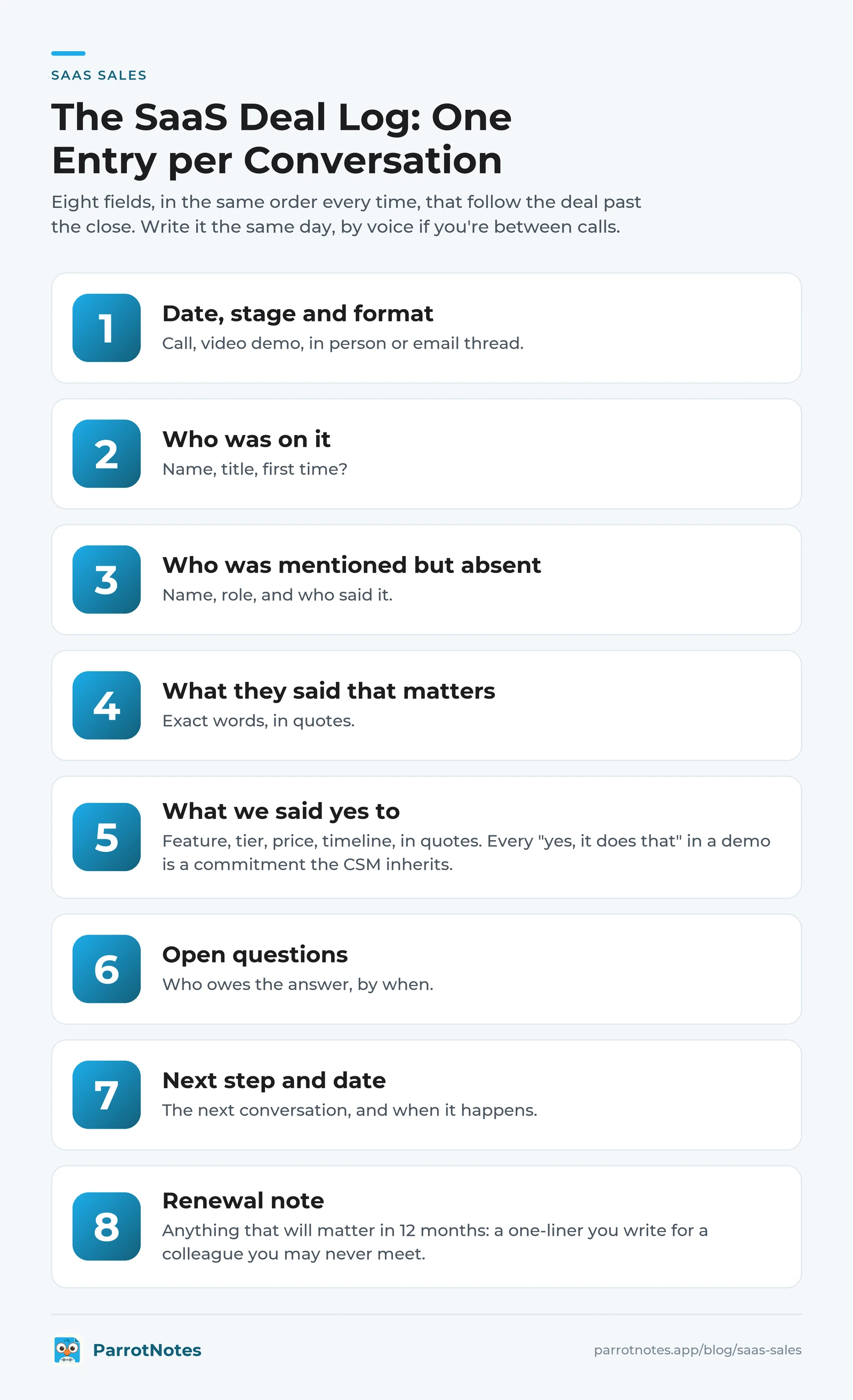
The fix is a log with one entry per conversation, in the same order every time, that follows the deal past the close. Keep it in a note on your phone, a page in the CRM, or the notes field on the opportunity, wherever the CSM will actually read it.
The eight fields
1. Date, stage and format (call, video demo, in person, email thread):
2. Who was on it (name, title, first time?):
3. Who was mentioned but absent (name, role, who said it):
4. What they said that matters (exact words, in quotes):
5. What we said yes to (feature, tier, price, timeline, in quotes):
6. Open questions (who owes the answer, by when):
7. Next step and date:
8. Renewal note (anything that will matter in 12 months):
Field 5 is the one SaaS reps need most and other templates miss. Every "yes, it does that" in a demo is a commitment the CSM inherits. Write it as a quote, with the tier it applies to.
Field 8 is a one-liner you write for a colleague you may never meet. "Ops lead expects reporting; confirm add-on at renewal." It takes ten seconds and it's the answer to the question in the opening scene.
What to capture at each stage
The eight fields stay the same. What goes in them changes by stage.
| Stage | Field 4 should hold | Field 5 should hold | Field 8 should hold |
|---|---|---|---|
| Discovery | The pain in their words, the trigger, who feels it | Nothing yet; resist the urge | Why they're buying: the reason they'll renew or leave |
| Demo | Every "does it do X?" | Every "yes", with tier | Features they cared about most |
| Trial | Success criteria, blockers, who actually logged in | Setup help, extended dates, extra seats | Who the real users are |
| Security and procurement | Requirements, redlines, the deadline they're working to | Data, uptime, support and price commitments | Contract term, auto-renew date, notice period |
| Close | Final scope and exceptions | Anything outside the standard contract | Exactly what tier they bought |
| Onboarding | Expectation versus what they got | Training and setup promised | Early adoption signals |
| Renewal and expansion | Their view of value so far, budget changes | Pricing, added seats, upgrades | The next expansion trigger |
One entry a conversation, and the renewal call stops being a surprise.
Our guide to enterprise sales has a companion template, a per-meeting stakeholder log, for deals with a buying committee that stretches over months. For a large SaaS deal, use both: the deal log for the conversations, the stakeholder log for the people. And if the committee is big enough to need a map of its own, the stakeholder mapping template covers who plays which role.
Worked example: a 60-day trial-to-close, conversation by conversation
The deal below is invented for illustration. The rep, the buyer and the company don't exist, and the details are chosen to show the log doing its job, not to prove anything about real deals.
Priya Raman is an AE at Ledgerline, a fictional invoicing platform for logistics firms. The prospect is Harbor & Finch Logistics, 80 staff, currently on spreadsheets. The deal is worth $18,000 ACV on the Team tier.
| # | Day | Stage | Who | What mattered |
|---|---|---|---|---|
| 1 | Day 1 | Discovery (video call) | Tom Okafor, finance manager | "We lose two days a month reconciling driver invoices." Mentions "Lena in ops will need to see it" |
| 2 | Day 4 | Demo (video call) | Tom + Lena Marsh, ops lead | Lena: "Can drivers submit from their phones?" Priya: "Yes, on Team and above." Lena: "And the fleet cost report?" Priya: "That's on Business tier" |
| 3 | Day 8 | Trial kickoff (video call) | Tom, Lena, two dispatchers | Success criteria: 50 driver invoices submitted by phone in 3 weeks; reconciliation under half a day |
| 4 | Day 15 | Trial check-in (call) | Lena | 22 invoices in; drivers "like it"; one dispatcher hasn't logged in |
| 5 | Day 22 | Trial check-in (call) | Tom | 61 invoices; reconciliation took 3 hours. Tom: "Sam, our CFO, wants a security questionnaire before anything is signed" |
| 6 | Day 29 | Security review (email thread + call) | Sam Reyes, CFO; Priya + SE | 40-question form; data residency and export commitments given in writing |
| 7 | Day 36 | Pricing (video call) | Tom + Sam | Sam: "We'll sign for a year if the fleet report is included." Priya: "It's Business tier; I can quote both." Sam wants to think |
| 8 | Day 41 | Procurement (call) | Tom | Team tier chosen at $18,000; fleet report not included; Tom: "Lena knows, she's fine for now" |
| 9 | Day 45 | Close (e-signature, confirming call) | Tom + Sam | Signed, annual, auto-renews Day 410, 30 days' notice |
| 10 | Day 52 | Onboarding kickoff (video call) | Lena + dispatchers, CSM Jordan | Priya hands over: log shared; Jordan reads entries 2 and 7 aloud |
| 11 | Day 60 | Two-week check-in (call) | Jordan + Lena | Lena: "When we outgrow this, the fleet report is the reason we'd upgrade" |
Look at what the log makes visible. The fleet cost report was asked about on Day 4 and answered honestly: it's on the higher tier. It came back on Day 36 as the CFO's condition, was consciously left out on Day 41, and by Day 60 it's the first expansion signal, written into field 8 for a renewal conversation ten months away.
Here's how two of the entries read in full.
Entry 2, Day 4, demo
Date, stage, format: Day 4, demo, video call
Who was on it: Tom Okafor (finance mgr); Lena Marsh (ops lead, first time)
Mentioned but absent: none new
What they said: Lena: "Can drivers submit from their phones?" and
  "Do we get the fleet cost report?"
What we said yes to: Priya: "Phone submission, yes, on Team and above."
  "Fleet cost report is Business tier, not Team."
Open questions: Does Lena want a Business-tier trial? (Priya to ask Tom, Day 8)
Next step: Trial kickoff, Day 8
Renewal note: Lena cares about the fleet report; expect it at expansion.
Entry 8, Day 41, procurement
Date, stage, format: Day 41, procurement, phone call
Who was on it: Tom Okafor
Mentioned but absent: Sam Reyes (CFO) approved Team tier; Lena "is fine for now"
What they said: Tom: "Team tier at $18,000, annual. Fleet report can wait."
What we said yes to: Priya: "Team tier, annual, phone submission included,
  no fleet report. Export commitment from Day 29 stands."
Open questions: none
Next step: Contract to Sam by Day 43; signature target Day 45
Renewal note: Fleet report explicitly excluded, Lena aware. Raise Business
  tier at the 6-month check-in, not at renewal.
When Jordan the CSM takes over on Day 52, the handover is two entries, not a phone call with a rep who's already on the next deal. And when the renewal comes round on Day 380, nobody has to ask what was promised about reporting. It's in field 5, in quotes, with a tier next to it.
How reps capture each conversation: calls, demos and in-person moments
A log only works if it gets written the same day. In SaaS sales the conversations come in two kinds, and each needs its own routine.
The spoken debrief after every call or demo
Most SaaS conversations happen on video or phone. Rather than typing an entry while the next call loads, talk it through.
The minute the call ends, open ParrotNotes, press record, and speak the eight fields in order: date and stage, who was on it, who got mentioned, what they said that matters, what you said yes to, what's open, the next step, and the renewal note. Two to three minutes of talking. ParrotNotes transcribes it and gives you a summary, the action items with owners, and a draft follow-up email, so the entry and the recap are done before the next demo starts.
ParrotNotes records through your phone's microphone or your Mac, so the debrief is your own account, spoken straight after the call while Lena's exact words are still in your head. No bot in the meeting, nothing for the customer to approve, and a workflow that works just as well for a customer who'd rather not be recorded.
The follow-up email templates in our earlier guide include a five-line version that maps neatly onto fields 5, 6 and 7: what we agreed, what's open, what happens next.
Recording in-person conversations with consent
SaaS selling isn't all screens. There's the user conference, the on-site executive briefing, the customer visit for a kickoff, the field marketing dinner. These are the conversations that get lost most often, because they happen away from the desk and nobody sends a calendar invite.
Picture Marcus, a rep at his company's user conference. In the hallway after a session, a customer's head of operations tells him three things: they're adding a second warehouse in Q2, their current integration is "held together with tape," and their IT lead is the person to convince. Marcus asks if he can record the conversation on his phone so he doesn't misremember it, and she says yes.
Fifteen minutes later he has a transcript. By the flight home the deal log has an entry with her exact words and the IT lead's name in field 3. Marcus is invented; the hallway conversation is the kind every conference produces.
Two rules for these moments. First, ask before you record, every time, and don't record if anyone would rather you didn't; recording laws vary by state and country, and this isn't legal advice. Second, if you can't record, dictate the debrief the moment you're alone, the same way you would after a call. Our security page covers how recordings and transcripts are protected.
Where ParrotNotes fits
ParrotNotes turns the debrief into the log entry and the in-person conversation into a searchable record.
- After a call or demo: record the spoken debrief. You get a transcript, an AI summary, extracted action items, and a draft follow-up email.
- In person, with consent: record the conversation itself. Recording carries on with the screen locked, so the phone stays in your pocket. Speaker identification on Pro labels who said what.
- Later, at renewal: search across every debrief for "fleet report" and get Day 4, Day 36, Day 41 and Day 60 back. On Pro, ask AI chat "what did we promise about reporting?" and get the sentence with its date.
- On a framework: Pro includes sales frameworks (MEDDIC, SPIN, BANT), so a discovery debrief can be organised by qualification letter. See our MEDDPICC guide for what each one means on a real deal.
- At a conference abroad: Pro's multilingual transcription covers 99+ languages with translation, so a conversation in Spanish can become an English log entry.
Want to try it on this week's demo? Download ParrotNotes free. The free plan gives you 100 minutes of recording a month, up to 30 minutes per recording, an AI summary on every recording and AI insights on five recordings a month. Pro is $19.99 a month, or $14.99 a month billed annually, with 3,000 minutes a month, recordings up to 3 hours, and every AI feature on every recording.
Keep the whole subscription on the record
SaaS sales is a long relationship sold one conversation at a time, and the deals that go wrong usually go wrong at renewal, over something said in a demo a year earlier that nobody wrote down. The model is simple. The discipline is the log.
The short version:
- SaaS sales means subscription revenue, so the account never closes; it renews or churns
- The cycle runs discovery, demo, trial, procurement, close, onboarding, renewal, expansion, across an SDR, AE, SE and CSM
- Churn, GRR and NRR are decided by what the customer was told during the sale
- Keep one log entry per conversation, quote what they said and what you said yes to, and write a renewal note every time
- Speak the debrief straight after each call or demo; record in-person conversations only with consent
Think back to the renewal call at the top. With a log, the answer is Priya's Day 4 sentence, read back with the tier next to it. Download ParrotNotes free, record the debrief after your next demo, and start the log on the deal that's closest to renewal.
Frequently Asked Questions
What is SaaS sales in simple terms?
SaaS sales is selling cloud-hosted software that customers pay for by subscription rather than buying once. Because revenue arrives over the life of the subscription, the sale continues after signature: the rep or a customer success manager has to keep the customer onboarded, renewed and expanding. Deals run through discovery, a demo, a trial, procurement, close, onboarding and renewal.
What does a SaaS sales rep actually do all day?
An SDR books qualified first meetings, and an AE runs discovery calls, demos, trials, pricing and the close, usually on video. A solutions engineer handles technical demos and security questionnaires. A CSM runs onboarding, check-ins and renewals. Between calls, every one of them writes up what was said, or should, because the next person in the chain depends on it.
What is the difference between product-led and sales-led SaaS sales?
In product-led growth, the product is the main driver of acquisition, with users signing up for a free trial or free plan and upgrading themselves. In sales-led growth, a sales team drives acquisition through outreach, demos and negotiation. Most SaaS reps work a hybrid, stepping in when a self-serve account shows signs of becoming a bigger one.
How long is the SaaS sales cycle?
It ranges from a day for a self-serve upgrade to many months for an enterprise deal with security review, legal and procurement. Salesforce's State of Sales statistics report that 57% of sales professionals say cycles are getting longer. Whatever your cycle, plan for more conversations than you can remember without a written log.
How do SaaS reps keep track of every conversation on a deal?
Keep one log entry per conversation with the same eight fields: date and stage, who was on it, who was mentioned, what they said, what you said yes to, open questions, next step, and a renewal note. Write it the same day, by voice if you're between calls, and share the whole log with the CSM at handover so the renewal is answered from the record.
Related Posts
Sales QBR: Agenda and Template for Sales Teams
Run a sales QBR that ends in a forecast you believe. Copy a timed 90-minute agenda, a rep's one-page prep template, and a filled-in example, all copy-ready.
How to Build a Sales Playbook From Your Team's Real Calls
Build a sales playbook from your team's real customer meetings: the sections it needs, a six-step method, a template, and one play built from three debriefs.
Otter.ai Alternatives for In-Person Meetings (7 Options Compared)
Looking for an Otter.ai alternative that works in a room, not on Zoom? Seven options scored on bots, minute caps and phone apps, prices checked Sept 2026.