
Solar Sales: How Closers Keep Track of Every Household

Sarah Johnson
Writes about field sales, meeting notes and voice-first workflows at ParrotNotes. Every article is reviewed by the ParrotNotes product team before it goes live.
Table of Contents
- 1.What is solar sales?
- 2.Why solar sales is a memory problem
- 3.The household record: eight fields for every solar sales consultation
- 4.Follow-ups and referrals: the rhythm after the sit
- 5.Two weeks in one neighbourhood: a worked example
- 6.Solar sales mistakes the record prevents
- 7.Keep every household on the record
Picture Devon at 7:15 on a Thursday evening, at the third kitchen table of the day. The Okonkwos' electric bill sits between the coffee mugs. Mrs. Okonkwo wants to know whether the panels survive hail, her husband is on a work call, and the neighbour who passed on their name has a chimney that shades the roof after 3 PM.
By 8:40 Devon has built a design, heard "we need to talk it over," and booked a second sit for Saturday with both of them. By Saturday, the hail question has gone.
That is solar sales as it's lived: not a pitch, but a run of households, each with its own bill, roof, two decision-makers, financing worries and neighbours, and a decision made over days in a home you visit twice.
If you searched the term to find out what the job is, the first section covers it from primary sources: what gets sold, how the work splits between setters and closers, and what the census says about the industry. If you already run sits, the rest is yours: the questions every homeowner will ask, an eight-field household record you can copy, the follow-up and referral rhythm, and a worked two weeks in one neighbourhood.
Want the record first? Skip to the eight fields below. And if you'd rather dictate it in the driveway than type it at midnight, you can try ParrotNotes free before your next sit.
What is solar sales?
Solar sales is the selling of solar energy systems, and usually the financing that pays for them, to the people who will own or use them. In residential solar sales the customer is a household: one or two homeowners, one roof, one electric bill, and a decision made at the kitchen table over one or two visits. The sale bundles equipment, installation, permits and a payment method into one contract.
The industry is large enough to have its own census. The Interstate Renewable Energy Council reports that "the U.S. solar industry employed 280,119 workers in 2024, roughly level with the industry's 2023 employment," with 178,713 of those jobs in installation and project development, "nearly two-thirds of all solar jobs," according to its National Solar Jobs Census 2024. Sales roles sit inside those installation and project development firms, and a further 34,625 jobs are in wholesale trade and distribution.
Residential and commercial
Residential solar sales is the kitchen-table version, and it's what most people mean by the term. Commercial solar sales sells to businesses, schools and nonprofits with a roof or a car park, and it runs like any other B2B deal: a committee, a longer cycle and a procurement process. If that's your side of the business, our guide to enterprise sales covers how to keep track of every stakeholder meeting. This article stays in the home.
Setters, closers, and how a sit gets set
Most residential solar teams split the work in two. A setter (or canvasser) finds the homeowner, at the door, by phone, or from a web lead, qualifies the basics and books an appointment: the sit. A closer runs the sit: the in-home consultation, the design, the numbers, the paperwork. Some reps do both, and in smaller companies the closer also chases the site survey and the install.
Door-to-door is still the most common way a sit gets set, followed by referrals from installed customers and inbound leads. Whichever way the appointment arrives, the closer walks into a home knowing three or four facts from the setter and leaves knowing forty.
What a solar sales job looks like
The job is mostly evenings and weekends, because that's when both homeowners are in. A closer might run two or three sits a night, with a site survey or an install check-in during the day and follow-up calls in between. The kit is a tablet for the design, a phone, a folder of contracts and cancellation forms, and whatever else survives the carry test in our guide to sales tools for field reps.
Pay is usually commission-heavy: a base plus commission, or commission only, calculated per watt sold or per closed deal, with the structure set by the company and the financing product. No public statistical source tracks solar sales pay separately from other sales jobs, so treat any specific number you read online as one company's claim. Before you accept a solar sales job, ask how commission is calculated, when it's paid (at signing, at install, or at the utility's permission to operate), and what happens to it if the customer cancels.
Why solar sales is a memory problem
A B2B rep juggles many meetings about one deal. A solar closer juggles many deals with one meeting each, and every one of them is a household with its own numbers.
Think about what you learn in one sit. The bill: the utility, the monthly average, the kilowatt-hours, the rate plan. The roof: age, pitch, orientation, shade from that chimney, whether the electrical panel needs an upgrade.
Then the people: who decides, who was in the room, what each of them worries about, and the detail that will win or lose the second sit. The money: cash, loan, lease or power purchase agreement, what you quoted, what they said they can afford a month. And the neighbours who asked what you were doing there.
Multiply by six households a week and the details blur into one composite family with a vague roof.
The questions every homeowner will ask
Homeowners have good guides now. The Federal Trade Commission's Solar Power for Your Home page and the Department of Energy's Homeowner's Guide to Going Solar both tell them what to ask. A closer should know those questions cold, and the record should show the answer that was given at each table.
| What the homeowner will ask (FTC and DOE) | What you need on the record |
|---|---|
| "Are you likely to save money on your bills?" | Their actual bill and kWh, the utility's fixed charges, the offset you designed for, the number you said |
| "How will things work with your utility company?" | The utility's net metering or export rate, and whether you explained it |
| "How long do you plan to stay in your home?" | Their answer, and what you said about transferring a lease or loan |
| "Do you have to get homeowners' association (HOA) approval?" | HOA yes or no, who applies, and the timeline |
| Is the roof suitable? (DOE: best on "south-facing roofs with a slope between 15 and 40 degrees"; shade and roof age matter) | Orientation, pitch, shade sources, roof age and material, and whether the site survey needs to check anything |
| "What will I pay up front?" "What annual percentage rate will I pay?" "Will the payments change during the financing term?" "Is there a balloon payment?" | Every financing number you quoted, with the product it belongs to |
| "Will a lien be placed on my home or system?" | Your answer, as given |
| "Do I have a right to cancel this financing? What's the deadline?" | The cancellation forms handed over, and the date the right expires |
Three consumer-protection facts a closer has to have straight
These three come up at almost every table, and getting them wrong costs deals and reputations.
The right to cancel. Under the FTC's Cooling-Off Rule, for most sales made at a customer's home, "your right to cancel for a full refund lasts until midnight of the third business day after the sale." The seller must give the buyer "two copies of a cancellation form" and "a copy of your contract or receipt," dated, with the seller's name and address, explaining the right to cancel. Hand them over, say so out loud, and write down that you did. States add their own rules on top.
Dealer fees and the loan amount. The Consumer Financial Protection Bureau's August 2024 issue spotlight on solar financing found that lender fees folded into solar loans "can increase the loan principal by 30 percent or more above the cash price," and that marketing often shows a "net cost" after an assumed tax credit while the real loan amount sits in small print. Show the loan amount, and write down that the homeowner saw it.
The tax credit is not a rebate. The same CFPB report notes that the federal credit depends on the homeowner's own tax liability, and that many loans assume a large prepayment, typically around 30 percent, by about month 19 to keep the payment from rising. Say "if you qualify," say what happens to the payment if they don't prepay, and record that you said it.
The FTC's advice to homeowners is blunt: "Never deal with a power or home repair company that pressures you for a quick decision, tells you to sign a contract without time to review, or asks you to pay in cash." A closer who leaves a paper trail of straight answers is the one who gets the referral.
The household record: eight fields for every solar sales consultation
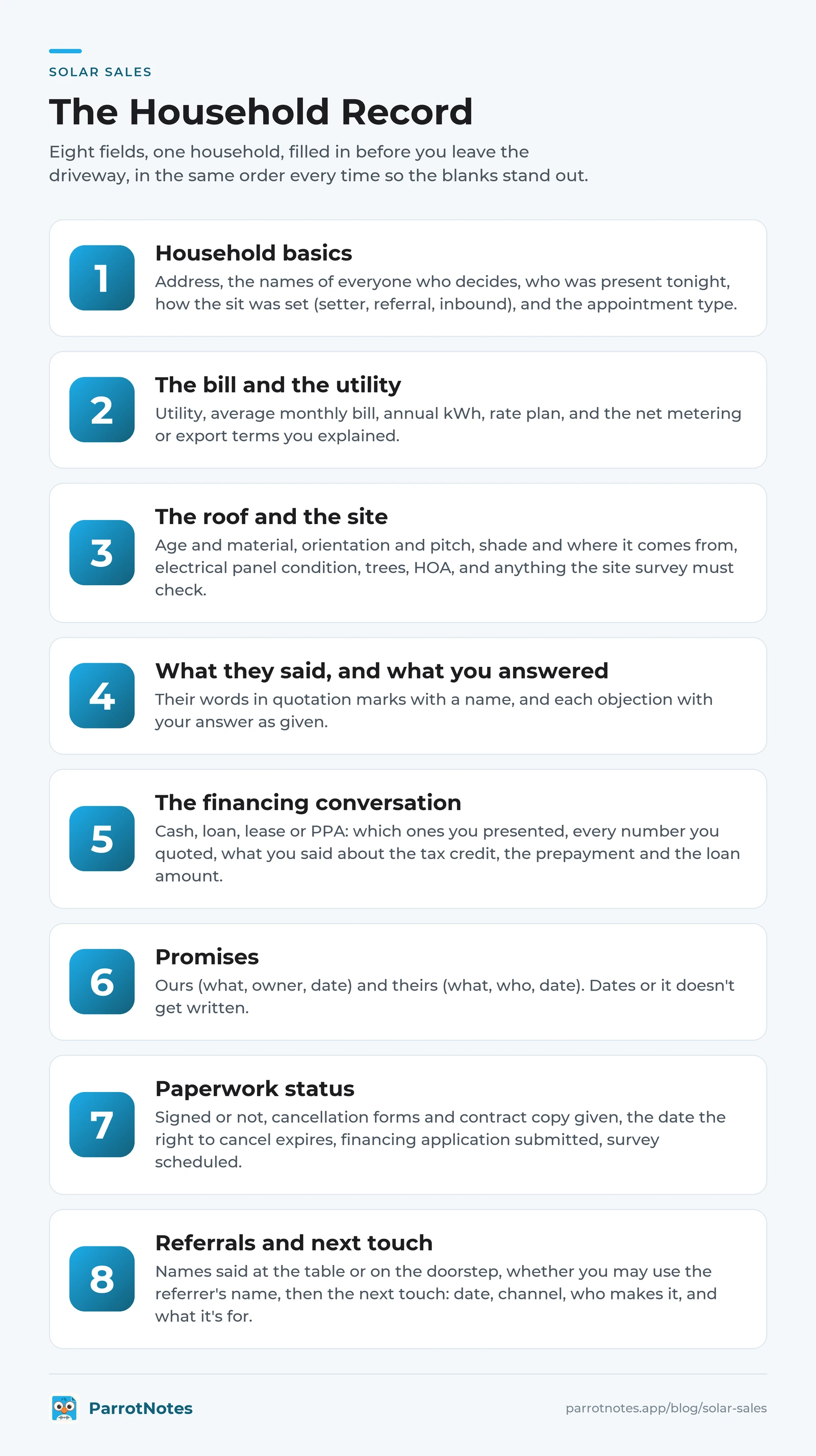
This is the record. Eight fields, one household, filled in before you leave the driveway, in the same order every time so the blanks stand out. Copy it into your notes app or the visit-note field in your CRM.
- Household basics. Address, the names of everyone who decides, who was present tonight, how the sit was set (setter, referral, inbound), and the appointment type (first sit, second sit, survey, install check-in).
- The bill and the utility. Utility, average monthly bill, annual kWh, rate plan, and the net metering or export terms you explained.
- The roof and the site. Age and material, orientation and pitch, shade and where it comes from, electrical panel condition, trees, HOA, and anything the site survey must check.
- What they said, and what you answered. Their words in quotation marks with a name ("I don't want a payment that goes up"), and each objection with your answer as given: the hail question, the "moving in five years" question, the neighbour's bad experience.
- The financing conversation. Cash, loan, lease or PPA: which ones you presented, every number you quoted, what you said about the tax credit, the prepayment and the loan amount, and what they said they could afford.
- Promises. Ours (what, owner, date): the revised proposal, the HOA letter, the survey slot. Theirs (what, who, date): the twelve months of bills, the spouse at the second sit.
- Paperwork status. Signed or not, cancellation forms and contract copy given, the date the right to cancel expires, financing application submitted, survey scheduled.
- Referrals and next touch. Names said at the table or on the doorstep, which neighbour asked what you were doing, and whether you may use the referrer's name. Then the next touch: date, channel, who makes it, and what it's for.
Three rules make it work. Field 4 uses quotation marks and a name: "I don't want a payment that goes up" is a fact you can design around, and "they seemed interested" is not. Field 6 gets dates or it doesn't get written. Field 7 is filled in the same night, because the three-business-day clock is already running.
Dictate it in the driveway
The record takes ten minutes to type and three to say. Typing waits for midnight, and by midnight the hail question has become "some stuff about weather." So say it.
Stay parked, open ParrotNotes, hit record, and talk through the eight fields in order. Recording keeps going with the screen locked, so the phone sits in the cup holder while you talk. When you stop, you get a transcript, an AI summary and a list of action items, so field 6 is already pulled out with owners and dates. Recording works without a signal; transcription and AI run once you're back in coverage.
Recorded the sit itself, with the homeowners' permission? Then the transcript holds field 5 in their exact words, which matters when the second sit starts with "that's not what you said last time." Ask before you press record, every time, and skip it if anyone hesitates.
In the United States, federal law permits recording a conversation you're part of (18 U.S.C. § 2511(2)(d)), but some states require everyone's consent, and laws vary by country. This isn't legal advice. A debrief you dictate alone in the driveway needs none of it.
ParrotNotes can also draft the follow-up email from the recording, so the promises in field 6 reach the household in writing the same night. Bills and financing details are personal, so it's worth reading how we protect your data before you carry a neighbourhood's worth of them on your phone.
Want to try it on tomorrow's sits? Download ParrotNotes free. The free plan gives you 100 minutes of recording a month, up to 30 minutes per recording, with an AI summary on every recording and AI insights on five recordings a month.
Pro is $19.99 a month, or $14.99 a month billed annually, with 3,000 minutes a month, recordings up to 3 hours, and AI chat for asking "what did Mrs. Okonkwo say about hail?" on Saturday morning.
Follow-ups and referrals: the rhythm after the sit
A solar sale is won between visits. The rhythm below turns the record into the next touch. It assumes a signed deal at the first or second sit; an unsigned household stays on the same rhythm until it says no.
The same night. A short recap email or text: what you designed, the numbers you quoted, what each side promised, and the second-sit date. It should read as a summary of fields 5 and 6, nothing new. Our follow-up email after a sales call templates include a five-line version that takes two minutes to send.
Within 48 hours. One call. If they said "we need to talk it over," ask what they talked about. If a spouse missed the first sit, this call is where you confirm they'll be at the second. Read field 4 before you dial, so you're answering the objection they raised, not the one you expect.
Before the site survey. Confirm the date, say who's coming, and check field 3 for anything the surveyor must look at: the panel, the chimney shade, the section of roof they're worried about.
On install day and at permission to operate. A message on each. The homeowner is about to become your best or worst reference, and both moments are when they're talking to neighbours.
Thirty days after. The referral ask, done properly: "Who on the street has asked you about the panels?" Names go into field 8 of the original record, and each one gets called with the referrer's permission. Our cold call script guide has a referral opener and a 60-second post-call debrief for exactly that call.
Referrals are the compounding part of solar sales. One installed household on a street is a reason to knock on every door around it, and a record that says which neighbour asked is a warm lead you'd otherwise forget.
Two weeks in one neighbourhood: a worked example
The two weeks below are invented to show the record doing its job. Devon, the families, the street and the numbers don't exist, and nothing here is evidence of how real territories perform.
Devon Ashworth is a closer working Larkspur Meadows, a subdivision of about 300 homes with one installed customer at the start of the fortnight. Six households, nine sits, two site surveys.
| Day | Household | Sit | Present | What mattered |
|---|---|---|---|---|
| Mon | Patel | First sit (setter) | Both | Bill $210/month; want cash purchase; roof is 19 years old |
| Tue | Okonkwo | First sit (referral from the Lindqvists) | Mrs. Okonkwo only | Hail question; chimney shade after 3 PM; "no payment that goes up" |
| Wed | Brennan | First sit (setter) | Both | Moving in five years; HOA approval needed |
| Thu | Sato | First sit (inbound) | Both | Lease preferred; EV arriving in spring |
| Sat | Okonkwo | Second sit | Both | Signed a loan; cancellation forms given; neighbours at 14 and 18 asked |
| Mon | Brennan | Second sit | Both | Declined for now; roof replacement first |
| Tue | Delgado (from Okonkwo, no. 14) | First sit (referral) | Both | Bill $340/month; two ACs; wants same installer as neighbours |
| Thu | Patel | Survey day | Mr. Patel | Roof age flagged; installer wants a roofer's report |
| Sat | Reyes (from Okonkwo, no. 18) | First sit (referral) | Mrs. Reyes only | Second sit needed with Mr. Reyes; PPA questions |
Here's how the Okonkwo first-sit record reads.
Tuesday, the Okonkwos (first sit)
1. Basics. 22 Larkspur Way. Deciders: Adaeze and Chidi Okonkwo. Present: Adaeze. Set by referral from the Lindqvists at 26. First sit. 2. Bill. Meadow Valley Electric, $265/month average, about 14,800 kWh/year, standard residential rate. Explained net metering credits at the utility's export rate. 3. Roof. Asphalt shingle, about 8 years old, south-west facing, moderate pitch. Chimney shades the west section after 3 PM. Panel is 200 amp, looks fine. No HOA. 4. In their words, and my answers. "I don't want a payment that goes up" (Adaeze). "Chidi will ask what happens in hail" (Adaeze). Hail: answered with the panel's impact rating and the warranty terms, said I'd bring the spec sheet. Shade: said the design avoids the west section. 5. Financing. Presented loan and lease. Quoted a fixed loan payment and stated the loan amount, not the net after credit. Said the tax credit depends on their tax situation. Adaeze said "under $200 a month is fine." 6. Promises. Ours: Devon to bring the hail spec sheet and a design with no west-section panels, Saturday. Theirs: Adaeze to have Chidi at the Saturday sit and to pull the last 12 bills. 7. Paperwork. Not signed. Nothing given yet. 8. Referrals and next touch. Adaeze mentioned "the Delgados at 14 have two ACs and complain about their bill." No permission to use her name yet. Next: Saturday 10 AM, in person, both present, hail sheet and revised design.
Now watch Saturday. Devon reads Tuesday's record in the driveway, walks in with the spec sheet, and opens with the hail question before Chidi asks it. The design shows nothing on the west section, so the shade objection never comes up. The loan payment is under $200 and fixed, which was field 4.
They sign. Devon hands over two cancellation forms and a copy of the contract, says the date the right to cancel runs out, and writes that in field 7 before pulling away.
The referral chain follows from field 8. At signing, Devon asks who else on the street has asked about the panels, and Adaeze offers the Delgados at 14 and the Reyes family at 18, with permission to use her name. Both become first sits within a week. Two weeks, one street, two new households from one record.
Solar sales mistakes the record prevents
Picture the same fortnight with no records. It's invented too, but these are the mistakes every solar sales manager sees when a deal cancels in the three-day window.
- The second sit that restarts from zero. Devon can't remember what was quoted on Tuesday, quotes a different number on Saturday, and Chidi hears a moving target.
- The objection answered twice, badly. The hail question gets an improvised answer instead of a spec sheet, because nobody wrote down that it was coming.
- The forms nobody can prove were given. A cancellation arrives on day four, the homeowner says they never got the forms, and there's no field 7 to point to.
- The referral name that evaporated. "The Delgados at 14" was said once, on a doorstep, and never written down. The Delgados sign with whoever knocks next.
- The financing detail that turns into a complaint. The homeowner understood the net cost as the loan amount. A record saying "stated the loan amount, not the net after credit" is the difference between a misunderstanding and a dispute.
None of these is a selling mistake. They're record mistakes, and the record takes three minutes in the driveway.
Keep every household on the record
Solar sales is a job of kitchen tables, two visits and a decision made between them. The selling is done at the table, and it's won or lost on what you carry out of the driveway: the bill, the roof, the words they used, the number you quoted, and the date the forms were handed over.
The short version:
- Solar sales means selling a system and its financing to a household, usually across a first sit, a second sit and a site survey
- Every homeowner will ask the FTC and DOE questions, and your record should show the straight answer you gave
- Fill in the eight-field household record in the driveway, every sit, in the same order
- Run the follow-up rhythm off the record: same night, 48 hours, survey, install, 30 days
- Field 8 is where referrals live, and referrals are how a street becomes a territory
Think back to Devon at the Okonkwos' table on Thursday, with a hail question, a chimney and a spouse who wasn't there. With a record, Saturday opens with the answer. Download ParrotNotes free, copy the eight fields, and dictate your first household record before you pull out of the driveway.
Frequently Asked Questions
What is solar sales?
Solar sales is selling solar energy systems, usually with the financing that pays for them, to homeowners or businesses. Residential solar sales happens at the kitchen table over one or two in-home consultations covering the electric bill, the roof, a system design and a payment method (cash, loan, lease or power purchase agreement), followed by a site survey and installation.
What does a solar sales rep do?
A setter finds homeowners and books appointments; a closer runs the in-home consultation, designs the system, presents the numbers and financing, handles objections, signs the contract and hands over the required cancellation forms, then follows up through the site survey, installation and referral stage. Many reps do both jobs, mostly in evenings and weekends when both homeowners are in.
Is solar sales a good job?
It suits people who like evenings on the road, straight talk about money, and being paid on results. Pay is usually commission-heavy, calculated per watt or per deal, with terms that vary by company and financing product; no public statistical source tracks solar sales pay on its own, so ask how and when commission is paid and what happens on a cancellation before you accept a solar sales job.
What should a solar sales rep write down after an in-home consultation?
Eight things: the household and who was present, the bill and utility, the roof and site, what the homeowners said in their own words with each objection and your answer, the financing presented and every number quoted, promises on both sides with dates, paperwork status including the cancellation forms, and referral names with the next touch. Dictate it in the driveway before the next sit.
How do solar sales reps get referrals?
By asking at two moments, at signing and about 30 days after installation, with a specific question: "Who on the street has asked you about the panels?" Write every name in the household's record with whether you have permission to use the referrer's name, then call each one within a week. One installed home on a street is the warmest lead source in solar sales.
Related Posts

What Is B2B Sales? A Plain Guide for New Reps
What is B2B sales? A plain-English guide for new reps: B2B vs B2C, the seven-stage cycle, who does what, a first-30-days checklist and a jargon decoder.

Sales Pitch Examples for In-Person Meetings
Eight sales pitch examples written for meetings in the room: structure, filled-in script, when each works, and a 90-second debrief to capture the reaction.

Outside Sales Rep: The Role, the Tools and a Typical Day
What an outside sales rep does, earns (BLS 2025) and carries, a typical day hour by hour, and how reps capture notes between visits. Copy the territory plan.