
Vendor Managed Inventory (VMI): How It Works for Distributors

Sarah Johnson
Writes about field sales, meeting notes and voice-first workflows at ParrotNotes. Every article is reviewed by the ParrotNotes product team before it goes live.

Table of Contents
- 1.What is vendor managed inventory?
- 2.The two VMI programs a distributor can sit in
- 3.How vendor managed inventory works, step by step
- 4.VMI vs consignment vs customer-managed inventory
- 5.What the VMI numbers say, and what they don't
- 6.The VMI fit scorecard
- 7.The cost-to-serve check
- 8.How to pitch a vendor managed inventory program
- 9.Running the program: the rules sheet
- 10.Say yes to vendor managed inventory after the math
"Can't you just keep the bins full for us?" Dana had waited two years for a maintenance supervisor to say that. She said yes in the parking lot, before she'd worked out who would count the bins, who would own the stock, or what a weekly visit to a plant 50 minutes from her branch would cost. Eight months later it was her busiest account and one of her least profitable. (Dana is a composite, not a real person.)
That's the part most explanations of vendor managed inventory skip. They're written for the buyer, and they make it sound like a free upgrade. If you sell for a distributor or a manufacturer, you already know somebody pays for the labor.
This guide covers what VMI is, the two programs a distributor can sit in, and how one runs, plus a scorecard for picking accounts, a cost check, and a rules sheet for the customer meeting.
What is vendor managed inventory?
Vendor managed inventory (VMI) is an arrangement in which the supplier, not the buyer, watches the buyer's stock and decides when and how much to replenish, within limits both sides agreed in advance.
The buyer stops writing most purchase orders. The supplier gets usage or count data, and it builds the order. As TrueCommerce's VMI guide puts it, VMI "is about replenishment responsibility." It isn't automatically about who owns the stock, which is where a lot of confusion starts.
The same guide dates the Walmart and Procter & Gamble relationship, the usual example, to the late 1980s. In industrial distribution, it looks more like a rep with a scanner in a storeroom.
Want the supervisor's exact words on hand when you write the proposal? Try ParrotNotes free on your next plant walk.
The two VMI programs a distributor can sit in
A distributor can be on either end of a VMI deal, and the conversation changes completely. New to the channel? Start with what an industrial distributor does.
| Upstream: the manufacturer manages the distributor | Downstream: the distributor manages the customer | |
|---|---|---|
| Who decides the reorder | The manufacturer | The distributor |
| Where the stock sits | Distributor branches and warehouses | Plant cribs, bins, vending units |
| How the data arrives | System feed from the distributor's ERP | Scans, electronic bins, vending logs, a rep's count |
| Who you're selling to | Branch manager, purchasing lead | Maintenance, plant manager, purchasing |
| Published example | SKF VSM and Midwest Wheel | Fastenal's FMI, Grainger's KeepStock |
The downstream version is big business. Fastenal's 2025 10-K shows its Fastenal Managed Inventory programs (FASTStock, FASTBin, and FASTVend) at 44.7% of 2025 sales, up from 42.5% in 2024. Grainger's 2024 10-K says KeepStock includes vendor-managed inventory, customer-managed inventory, and onsite vending. You don't need that scale, but you do need to know which conversation you're in.
How vendor managed inventory works, step by step
Details vary, but a downstream program usually runs through seven steps.
- Agree the scope. Pick the SKUs and locations. Start small; our MRO sales guide makes the case for one crib, one line, and 90 days.
- Set min and max levels. Use the last 12 months of usage, not the customer's memory.
- Get the count. A rep scans bins, or electronic bins and vending units report on their own.
- Build the order. Anything at or below its minimum gets ordered up to its maximum.
- Deliver and put away. Stock goes into labeled bins, not onto a dock.
- Invoice as agreed. That's on delivery or on consumption, depending on the deal.
- Review and adjust. Remove slow movers, add missed parts, and reset the levels.
Step two is where programs drift.
An illustration: a bearing moves 10 a week, and you count weekly and deliver on the next visit. A part counted just above minimum isn't ordered until next week and arrives the week after, so the minimum must cover two weeks. That's 20 units plus 5 for safety stock: a minimum of 25. Add two more weeks of usage and the maximum is 45.
For a second opinion, the free EOQ calculator works out a reorder point and safety stock.
If the lead time varies as well as usage, the free safety stock calculator compares the common formulas side by side, including one that covers late deliveries.
VMI vs consignment vs customer-managed inventory
These terms get used as if they meant the same thing. They answer two different questions: who decides the reorder, and who owns the stock?
| Model | Who decides the reorder | Who owns the shelf stock | When the customer pays |
|---|---|---|---|
| VMI, customer-owned | Supplier | Customer, from delivery | On delivery |
| VMI, consigned | Supplier | Supplier, until it's used | On consumption |
| Consignment, customer-run | Customer | Supplier, until it's used | On consumption |
| Customer-managed inventory | Customer, using your bins or app | Customer | On delivery |
Expect buyers to ask for the second row, because it keeps stock off their books until they use it. It's also the row that costs you the most, as the math below shows.
What the VMI numbers say, and what they don't
The strongest evidence we found is an academic paper. Dong, Dresner, and Yao, writing in Production and Operations Management in 2014, isolated the effect of handing the reorder decision to the supplier. On average, it cut distributor inventory by about 7%, stockouts by 31%, and inventory variability by 9%.
The authors say inventory reductions may come first, with the stockout benefit more likely after the first year. So don't promise it in a 90-day pilot.
Vendor data is larger on paper, but read it as marketing. TrueCommerce's whitepaper covers 156 location relationships across 21 distributors and 10 suppliers, one to two years in. It reports a 24% average sales increase, 25% more inventory turns, and 31% fewer stockouts. Its SKF VSM case study reports a 14% sales increase and 50% better turns at Midwest Wheel's eight warehouses over eight months.
Here's the catch: all of those measure a supplier managing a distributor's stock. We didn't find an independent study of bins at a plant. So if you're pitching a plant, don't borrow the 31%. Use the customer's own stockout history. Our free inventory turnover calculator works out the customer's current turns from cost of goods sold and average inventory, so a pilot starts from their own baseline.
The VMI fit scorecard
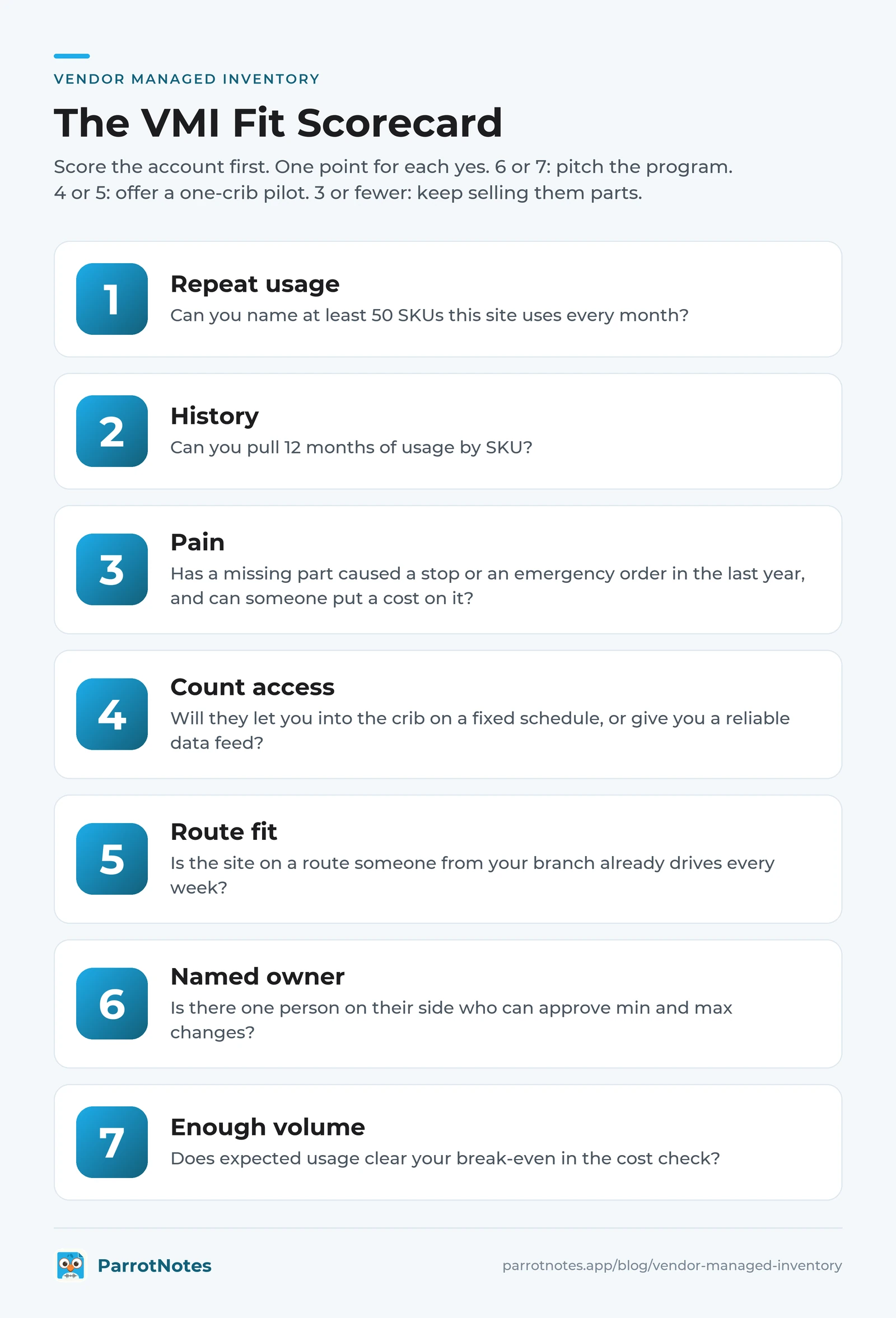
Before you offer a vendor managed inventory program, score the account. Give it one point for each yes.
- Repeat usage: Can you name at least 50 SKUs this site uses every month?
- History: Can you pull 12 months of usage by SKU?
- Pain: Has a missing part caused a stop or an emergency order in the last year, and can someone put a cost on it?
- Count access: Will they let you into the crib on a fixed schedule, or give you a reliable data feed?
- Route fit: Is the site on a route someone from your branch already drives every week?
- Named owner: Is there one person on their side who can approve min and max changes?
- Enough volume: Does expected usage clear your break-even in the cost check below?
Scoring: 6 or 7, pitch the program. 4 or 5, offer a one-crib pilot and fix the gaps first. 3 or fewer, keep selling them parts. The 50-SKU line and the bands are our starting points, so adjust them to your own book.
The cost-to-serve check
A vendor managed inventory program raises what an account earns and what it costs to keep. Run this before you agree to anything, with your finance team's figures.
VMI COST-TO-SERVE WORKSHEET (one account, one year)
A. Expected usage through the program:             $____
B. Gross margin % on that usage:                    ____%
C. Program gross profit = A x B                    $____
D. Visits x hours per visit x loaded labor rate    $____
E. Delivery trips x cost per trip                  $____
F. Bins, labels, scanners, software                $____
G. Slow-mover write-offs and returns               $____
H. Average stock you own on site x carrying rate   $____
I. Program profit = C - D - E - F - G - H          $____
J. Today's profit (gross profit - order handling)  $____
Decision: run the program only if I beats J.
Rosa runs it for a plastics plant, with illustrative figures. The account buys $70,000 a year at 26% margin, or $18,200, and small-order handling costs about $3,500, so J is $14,700. The plant wants consigned bins and would consolidate other suppliers, taking usage to $120,000 at 24% margin. (Rosa is a composite, not a real person.)
| Line | Consigned | Customer-owned |
|---|---|---|
| Program gross profit (C) | $28,800 | $28,800 |
| 52 visits x 2.5 hours x $38 (D) | -$4,940 | -$4,940 |
| 52 trips x $25 (E) | -$1,300 | -$1,300 |
| Bins and software (F) | -$1,500 | -$1,500 |
| Write-offs (G) | -$800 | -$800 |
| $30,000 on site x 20% (H) | -$6,000 | $0 |
| Program profit (I) | $14,260 | $20,260 |
| Against today's $14,700 | -$440 | +$5,560 |
Look at the left column: Rosa would add $50,000 in sales and earn slightly less. Consigned, the program needs about $122,000 in usage just to match today. Customer-owned, about $97,000.
So Rosa goes back with customer-owned stock and a buyback on slow movers at the end of the term. To test your own margins, try the free margin calculator.
How to pitch a vendor managed inventory program
Downstream, start with maintenance, bring in the plant manager, and go to purchasing last with a usage report. The MRO sales guide has the plant-walk map and a one-page pilot proposal, and selling to procurement covers that last meeting.
Upstream, the room is different. Theo, a manufacturer's rep, pitched VMI to a branch manager who said, "You'll fill my shelves to hit your quota." Theo stopped selling turns and offered a written maximum per SKU, a 90-day review, and returns on anything overstocked. The manager agreed to one product family.
If the branch's own reps need convincing too, use a joint call. (Theo is a composite, not a real person.)
Whichever way you're selling, expect some version of these three objections.
| What they say | What's underneath | What to offer |
|---|---|---|
| "You'll overstock us." | You control the order and profit from it | A written maximum per SKU, with a monthly usage report |
| "We'll be locked in." | Leaving looks hard | A named exit: return terms and a review date |
| "Your count won't match ours." | Past invoice disputes | One count method, scan logs they can see |
Be honest about that second row. Switching costs are one reason you want the program, and buyers know it. So show them the exit.
Running the program: the rules sheet
A vendor managed inventory dispute often starts with something nobody wrote down. Bring this sheet to the customer meeting and fill it in together.
VMI PROGRAM RULES SHEET
1. Scope:      SKUs, locations, who approves adds and removals
2. Levels:     who sets min/max, how often they're reset, who can override
3. Count:      method, day of week, who has access
4. Ownership:  when title passes (delivery or consumption)
5. Billing:    invoice trigger, PO type, price basis
6. Service:    fill-rate target, emergency response time
7. Exit:       notice period, what happens to stock on site, buyback terms
8. Review:     dates, attendees, the one metric that decides expansion
Lines 4, 5, and 7 have contract and accounting consequences. Treat this as a list of questions, not legal or accounting advice, and have your advisers review the final agreement. For line 8, our sales QBR template gives you an agenda.
The sheet only stays true if visits get captured. The supervisor asks you to drop a seal, a line goes down for a rebuild, purchasing wants a new PO number. If those comments never reach a system, a min level can stay wrong for months.
That's where ParrotNotes fits. Dictate the visit in the parking lot and get a transcript, a summary, and the action items, with no extra device. If the supervisor is happy to be recorded during the walk (ask first; see our guide to one-party consent states), the phone can stay in your pocket.
As of November 2026, the Free plan includes 100 minutes of recording a month and 5 AI-powered recordings. Pro is $19.99 a month, or $14.99 a month billed annually, with 3,000 minutes. Download ParrotNotes free and use it on your next bin count.
Say yes to vendor managed inventory after the math
Vendor managed inventory moves the reorder decision to the supplier; it doesn't settle who owns the stock. Work out which side you're on before you quote any results. Score the account, run the cost check, watch consigned stock, and write the rules down before the first bin goes up.
Pick the one account in your territory that's asked you to "just keep the bins full." Run the worksheet tonight, with real numbers, and take the answer to your next visit.
Frequently Asked Questions
What is vendor managed inventory in simple terms?
The supplier watches the customer's stock and decides when to send more, within minimum and maximum levels both sides agreed. The customer stops placing most routine orders. Who owns the stock is a separate decision, set in the agreement.
What is an example of vendor managed inventory?
A distributor rep visits a plant every week, scans the bins in the maintenance crib, and restocks anything at or below its minimum. Upstream, a supplier can review and replenish a distributor's warehouses, as SKF VSM reports doing for Midwest Wheel.
What is the difference between VMI and consignment?
VMI is about who decides the reorder. Consignment is about who owns the stock: the supplier keeps title until the customer uses it. A program can be both, one, or the other. The two together cost the supplier the most, because it does the work and carries the stock.
What are the disadvantages of vendor managed inventory?
For the supplier: labor, delivery cost, carrying cost on consigned stock, and slow movers. For the customer: less direct control, shared data, and a program that takes effort to leave. Written maximums, one count method, and a clear exit reduce most of these.
Does VMI reduce stockouts?
One peer-reviewed study of supplier-managed distributor stock found about 31% fewer stockouts on average, more likely after the first year. That measures upstream programs. For bins at a plant, baseline the customer's own stockouts and measure against that.
Is a vending machine the same as VMI?
Not by itself. Vending is a way to control and count stock. It becomes VMI when the supplier uses that data to decide on the replenishment. Grainger's KeepStock lists vendor-managed inventory, customer-managed inventory, and onsite vending as separate parts of one program.
Related Posts

Best Talk to Text App for iPhone and Android
The best talk to text app for your phone: Apple Dictation and Siri on iPhone, Gboard and Gemini on Android, with free plans compared and a voice phrase sheet.

How to Use Speech to Text on iPhone
Turn on speech to text on iPhone in 3 steps, dictate in any app, switch languages, turn it off, and record when the mic stops. Checked on iOS 27, Nov 2026.

How to Record Calls on Samsung
Samsung call recording, step by step: record or auto record calls, find the files, get Galaxy AI transcripts, or turn it all off. Checked November 2026.