
Nurse Self-Evaluation Examples for Your Annual Review

Sarah Johnson
Writes about field sales, meeting notes and voice-first workflows at ParrotNotes. Every article is reviewed by the ParrotNotes product team before it goes live.

Table of Contents
- 1.What a nurse self-evaluation is for
- 2.First rule: keep patients out of your self-evaluation
- 3.24 nurse self-evaluation examples by review category
- 4.How to write the growth area without hurting your review
- 5.A fill-in-the-blank nurse self-evaluation template
- 6.Keep a year-round log so next year's self-evaluation writes itself
- 7.Before you submit: a five-point check
- 8.Your next nurse self-evaluation starts this week
Dana's self-evaluation is due Friday. The form has six boxes, and the only things she can remember are from the last three weeks: a rough weekend, one missed huddle and a compliment from a family member she's not allowed to write about anyway. (Dana is a composite, not a real nurse.)
Eleven months of solid work, and almost none of it is on the page.
If that sounds familiar, you're not bad at self-evaluations. You're relying on memory, and memory favors last month. This guide gives you nurse self evaluation examples you can adapt tonight: 24 example lines across eight review categories, a fill-in template, and a simple way to collect evidence all year so next year's form takes 20 minutes.
Every example describes your own work: teamwork, learning, precepting, committees, reliability. None of them uses a patient detail, and the second section explains why yours shouldn't either.
If you want an easy way to build that evidence, ParrotNotes turns a 60-second voice note after your shift into a searchable, summarized log of your own wins and training.
What a nurse self-evaluation is for
A self-evaluation is your side of the annual review. Your manager writes theirs, you write yours, and the meeting works through where they match and where they don't.
It matters in nursing because your manager rarely sees you work. In 1982, Knox and MacKay noted in the Canadian Journal of Nursing Research that "the supervisor has infrequent opportunities to observe the nurse in action." Their argument still holds: "Particularly when it is combined with goal setting, self-appraisal has potential for stimulating improved work performance and professional growth."
Self-ratings and manager ratings also don't always line up. A 2024 study of 58 hospital nurses in Brazil found that nurses' self-assessments mostly agreed with their managers'. The biggest gaps were in attitudinal competencies, followed by teaching and preceptorship.
That's a practical lesson. Claims about attitude ("I'm a team player") and teaching ("I'm a good preceptor") are the ones most likely to be read differently. Back them with something specific: a date, a number, a role, a result.
First rule: keep patients out of your self-evaluation
Tip: your self-evaluation is about you, never about a patient. Leave out names, initials, room or bed numbers, ages, diagnoses, dates of a specific patient event, and any detail a coworker could use to guess who it was. A self-evaluation gets read, copied and filed by people outside your unit, so treat it like any other document that leaves the floor.
You lose nothing: the strength was your skill, judgment or teamwork, and that survives once the patient is removed.
Here's how a few common lines read before and after:
| If your draft says | Write this instead |
|---|---|
| "I caught Mr. R's change in condition in room 12 on March 3" | "I escalated concerns early and used the rapid response process when my assessment changed" |
| "I calmed down the angry family in bed 4" | "I de-escalated tense conversations and brought in my charge nurse when needed" |
| "I handled the code on nights in June" | "I completed my ACLS renewal and took a defined role in emergencies when assigned" |
| "My patient with [diagnosis] taught me..." | "Caring for more complex assignments taught me to plan my shift around reassessment times" |
| "[Coworker name] was slow, so I covered" | "I offered help to teammates when my assignment allowed" |
When in doubt, describe the pattern, not the person. Our guide to the nursing reflective journal uses the same rule for reflections.
24 nurse self-evaluation examples by review category
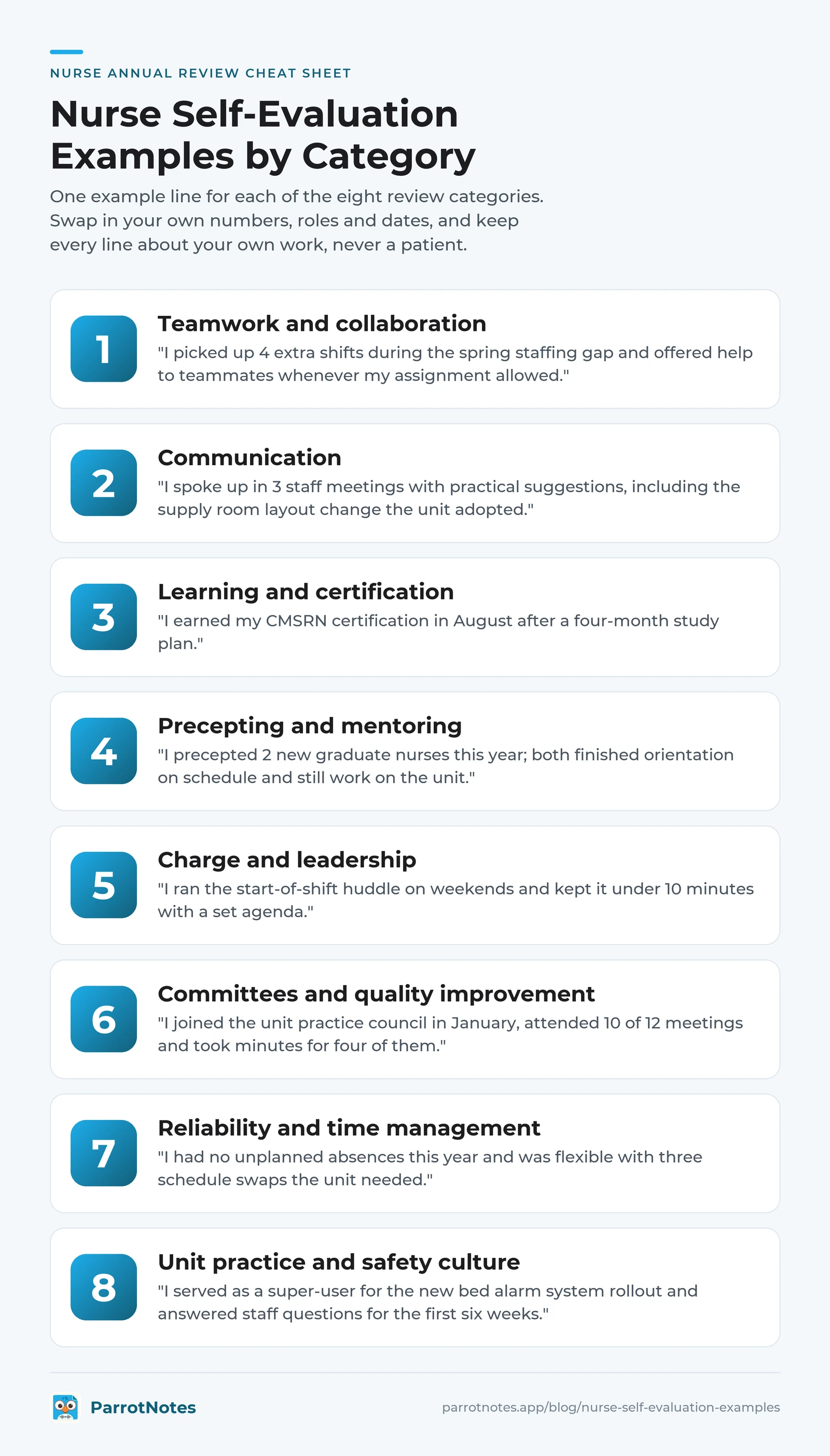
Most nursing review forms use some version of these eight categories. Each has two strengths and one growth area; swap in your own details where the brackets are.
1. Teamwork and collaboration
- "I picked up [4] extra shifts during the [spring] staffing gap and offered help to teammates whenever my assignment allowed."
- "I was the go-to person for [IV pump troubleshooting] on nights, and I showed [3] newer nurses how to sort out the common alarms."
- Growth: "I tend to take on others' tasks instead of asking for help myself. This year I'll ask the charge nurse earlier when my assignment gets heavy."
2. Communication
- "I gave clear, organized updates at huddles and asked [2] senior nurses for feedback on them, which helped me keep them short."
- "I spoke up in [3] staff meetings with practical suggestions, including the [supply room layout] change the unit adopted."
- Growth: "I avoid difficult conversations with coworkers. I'll use the 'ask, tell, ask' approach and practice one direct conversation per month."
3. Learning, certification and continuing education
- "I earned my [CMSRN] certification in [August] after a [four-month] study plan."
- "I completed [18] contact hours this year, including [two] courses on [sepsis recognition], and shared a one-page summary with the unit."
- Growth: "I left my annual competencies until the last week. Next year I'll finish each one within a month of it opening."
If CE hours are on your form, our list of free nursing CEUs shows where to find them and how to track them.
4. Precepting and mentoring
- "I precepted [2] new graduate nurses this year; both finished orientation on schedule and still work on the unit."
- "I set up a weekly 15-minute check-in with each orientee and kept short notes so feedback was specific, not general."
- Growth: "I sometimes step in too quickly when an orientee is slow. I'll practice waiting and asking a question first."
Self and manager ratings split most often here, so name the numbers. Our nurse preceptor guide has a week-by-week plan.
5. Charge and leadership
- "I took charge on [24] shifts and kept assignments fair by checking acuity and experience before I made them."
- "I ran the start-of-shift huddle on [weekends] and kept it under [10] minutes with a set agenda."
- Growth: "I'm comfortable leading on calm days but go quiet when the unit is short. I'll ask for one leadership course or shadowing day this year."
For the skills behind these lines, see nurse leadership skills.
6. Committees, shared governance and quality improvement
- "I joined the unit practice council in [January], attended [10] of [12] meetings and took minutes for [four] of them."
- "I helped run the [hand hygiene] audit for [three] months and presented the unit's results at a staff meeting."
- Growth: "I bring ideas to council but rarely own the follow-up. This year I'll lead one small project from idea to staff education."
Committee work is easy to forget by review time; see our guide to shared governance in nursing.
7. Reliability and time management
- "I had no unplanned absences this year and was flexible with [three] schedule swaps the unit needed."
- "I finished my documentation within the shift on almost every shift by charting in real time at set points."
- Growth: "My breaks slip on busy days, and I feel it by hour ten. I'll agree a break buddy at the start of each shift."
8. Unit practice and safety culture
- "I served as a super-user for the [new bed alarm system] rollout and answered staff questions for the first [six] weeks."
- "I reported [near misses] through the reporting system so the unit could learn from them, and I encouraged newer nurses to do the same."
- Growth: "I know the policy changes but don't always read the updates when they come out. I'll set aside 15 minutes each week to catch up."
Ready to stop rebuilding your year from memory? Download ParrotNotes free and start a private log of your own wins today.
How to write the growth area without hurting your review
The growth box makes most nurses freeze. Too vague ("I need to improve my time management") reads as a weakness with no plan.
A simple formula works: what you noticed + why it matters + what you'll do + by when.
Marcus, a composite med-surg nurse, first wrote: "I struggle with delegation." His manager asked what that looked like. His second draft read: "I keep tasks I could delegate to aides because I worry about asking. It costs me time late in the shift. By March I'll delegate at least two tasks each shift and check in with my aide at midshift."
The second version shows self-awareness, a plan and a date. That's what managers want to see.
Pick a real growth area, but not one that reads like a safety risk. Burnout belongs in a conversation with your manager, not a one-line confession; our article on nurse burnout covers how to raise it. For habits that ease the strain between shifts, see our guide to nurse self-care.
Turn your growth area into next year's goal with the guide to SMART goals for nurses.
A fill-in-the-blank nurse self-evaluation template
Copy this, fill in the brackets and trim to fit your form's boxes.
NURSE SELF-EVALUATION: [Year]
Role and unit type: [Staff RN, med-surg]   Review period: [dates]

1. My biggest contributions this year
   - [Strength, with a number or role]
   - [Strength, with a number or role]
   - [Strength, with a number or role]

2. Teamwork and communication
   - [Example of helping the team or improving communication]

3. Learning and certification
   - [Course, certification or contact hours, with dates]

4. Teaching, precepting or committee work
   - [Orientees precepted, councils joined, projects led]

5. Growth area
   - I noticed: [pattern]
   - It matters because: [effect on your work or team]
   - I will: [action] by [date]

6. Goals for next year (SMART)
   - [Goal 1]
   - [Goal 2]

7. Support I need from my manager
   - [Course, schedule, mentor or resource]

Check: no patient names, rooms, dates of patient events or diagnoses.
Box 7 is the one most nurses skip. Asking for a specific course or committee seat turns the review into a plan both sides own.
Keep a year-round log so next year's self-evaluation writes itself
Software engineer Julia Evans calls this a brag document: a running list of what you did, kept so you don't rely on memory at review time. Her advice translates well to nursing: write it regularly, and "you don't have to try to make your work sound better than it is."
Nurses rarely have time to type, though. A spoken note works better:
- After the shift, off the unit, alone. The car or the walk home. Never record on the floor or near patients.
- Speak for 60 seconds. What went well for you, what you learned, who you helped, any training or meeting you did.
- Keep patients out. Same rule as your form: describe the pattern, not the person.
- Tag it. One label, such as "Review", keeps the entries together.
- Review once a month. Pull the best line into your running draft. Our guide to nursing professional development has a 20-minute monthly review you can borrow.
Joy, a composite charge nurse, started doing this in January. By October she had about 40 short notes. Her self-evaluation took 25 minutes, and her manager asked to borrow her format for the unit.
In ParrotNotes, each recording gets a transcript and an AI summary, and keyword search finds "precepting" or "council" across the whole year. Recording works offline; the transcript arrives once you're connected. The Free plan includes 100 minutes a month, which covers a minute a day. Pro ($19.99/month, or $14.99/month billed annually) adds 3,000 minutes, AI chat and AI semantic search, so you can ask "what did I do on the practice council this year?" It runs on iOS, Android and macOS.
ParrotNotes makes no HIPAA claim, which is one more reason the log is about you and your team only. Try ParrotNotes free and record tonight's first 60-second note.
Before you submit: a five-point check
Read your draft once more and check:
- Numbers: does each strength have a number, role or date?
- Balance: are your examples spread across the year, not just the last month?
- Patients: are names, rooms, ages, diagnoses and event dates all gone?
- Growth area: does it include an action and a date?
- Ask: have you named the support you need?
The same evidence answers nurse interview questions if the review leads to an internal move.
Your next nurse self-evaluation starts this week
A strong self-evaluation is specific and fair to yourself:
- Use the eight categories as a checklist, and adapt the examples to your year
- Back attitude and precepting claims with numbers, because those are read differently most often
- Write the growth area as noticed, why, action, date
- Keep every line about your own work, never a patient
- Collect evidence all year instead of reconstructing it in one night
Fill in the template for this review. Then start a 60-second log for the next one with ParrotNotes, free to download.
Frequently Asked Questions
What should a nurse write in a self-evaluation?
Write specific examples of your own work under each category on the form: teamwork, communication, learning, precepting, leadership, committee work, reliability and unit practice. Add a number, role or date to each, one honest growth area with a plan, and your goals for next year.
What are examples of strengths for a nurse self-evaluation?
Examples include precepting new graduates who finished orientation on time, earning a certification, completing contact hours, taking charge on a set number of shifts, joining a practice council, and serving as a super-user for new equipment.
How do I write about areas for improvement as a nurse?
Use a four-part line: what you noticed, why it matters, what you'll do, and by when. For example: "I keep tasks I could delegate. By March I'll delegate two tasks each shift and check in with my aide at midshift."
Can I mention patients in my nursing self-evaluation?
Keep patient details out. Describe your skill or judgment instead of the case, and leave out names, rooms, ages, diagnoses and dates of patient events. The strength is still clear without them.
How long should a nurse self-evaluation be?
Follow your form's boxes. Two to four specific sentences per category is usually enough; one strong example with a number beats a paragraph of adjectives.
Related Posts

Sales Ramp Time: How Long New Reps Take and How to Shorten It
Sales ramp time: how long new reps take to reach full productivity. Get 2026 benchmarks, the formula, a worked example and a six-month plan to shorten it.

Rev Transcription Review: Accuracy, Pricing and Turnaround
Rev transcription review from Rev's own pages, checked Oct 27, 2026: plans, per-minute prices, add-ons, accuracy and turnaround. Try ParrotNotes free.
Product Spec Sheet: Format, Example and What Buyers Look For
Copy a product spec sheet format, see a filled-in example, and learn what engineers, purchasing and quality check first. Free template and checklist inside.