
Nursing Professional Development: A Plan You'll Actually Keep

Sarah Johnson
Writes about field sales, meeting notes and voice-first workflows at ParrotNotes. Every article is reviewed by the ParrotNotes product team before it goes live.
Table of Contents
- 1.What nursing professional development means
- 2.Why most nursing professional development plans die
- 3.Step 1: a 15-minute self-assessment
- 4.Step 2: one goal per year, written SMART
- 5.Step 3: the one-page nursing professional development plan
- 6.Step 4: build the plan around the hours you already owe
- 7.Step 5: capture what you learn before it fades
- 8.Step 6: the 20-minute monthly review
- 9.Keep the plan, not the binder
Priya bought the binder in January. Tabs for certification, conferences, a leadership course, a journal club. She filled in the first page during a quiet night shift, put it in her locker, and picked up two extra shifts in February. In October the binder has one page in it. (Priya is a composite, not a real nurse.)
If that sounds familiar, the problem isn't your discipline. Most nursing professional development advice is written for a career, not for a week with three 12-hour shifts in it.
This guide is the other kind. It gives you a six-step nursing professional development plan that fits on one page, a table that turns the ANCC renewal categories into "which one can I finish from my unit", a way to keep what you learn at in-services before it fades, and a 20-minute monthly review that keeps the plan alive. No patient information is ever part of it.
Want somewhere to put the first note? Try ParrotNotes free and dictate your self-assessment on the drive home.
What nursing professional development means
Nursing professional development is the planned, ongoing learning a nurse does to stay competent and grow into new roles: continuing education, certification, degrees, precepting, committee work, presenting and reflection, organized around written goals and reviewed regularly.
The phrase has a second meaning too. In the United States it also names a specialty: the educators and practice-development nurses who run orientation, in-services and competency programs. The Association for Nursing Professional Development states its mission as "to advance quality health care by defining and promoting nursing professional development practice" on its About page. If you're a nurse educator, our nurse educator guide covers that side of the work.
This article is about the first meaning: your own development as a nurse. It isn't optional, either. The ANA's Scope and Standards of Practice puts it in Standard 13, which an open SUNY Delhi textbook chapter quotes as "The registered nurse seeks knowledge and competence that reflects current nursing practice and promotes futuristic thinking." The same chapter calls professional development "an essential task for every nurse."
Why most nursing professional development plans die
Plans fail for four reasons. None of them is laziness.
- They're built for a desk job. A plan that asks for an hour every Tuesday evening assumes you have Tuesday evenings.
- The goals are vague. "Grow as a leader" can't be done by Friday, so it never starts.
- Nothing captures what you learn. You sit through an in-service, something clicks, and it's gone by the second med pass.
- Nobody checks. Your manager asks once a year at review time. By then you've forgotten you had a plan.
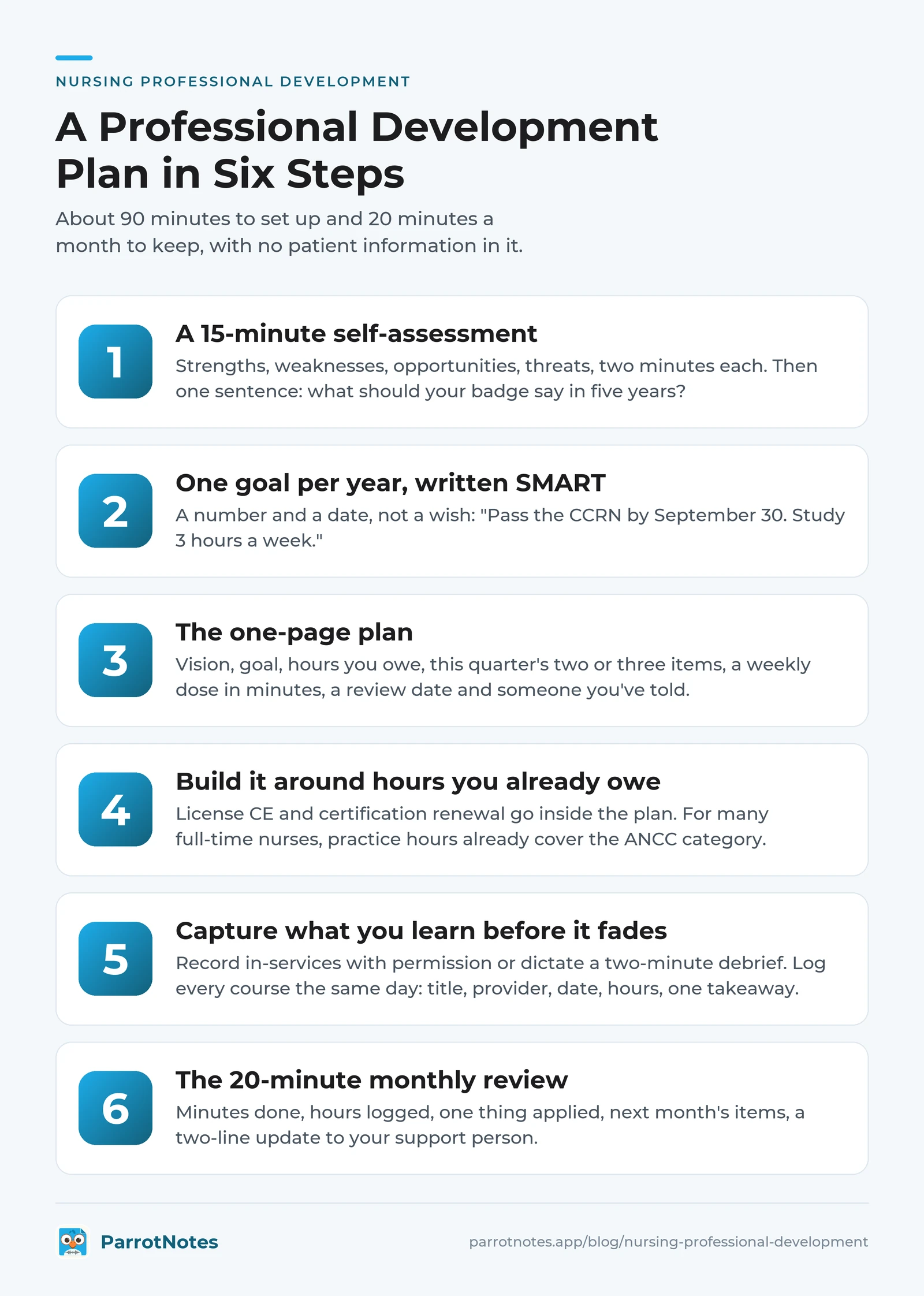
The six steps below fix each one. Together they take about 90 minutes to set up and 20 minutes a month to keep.
Step 1: a 15-minute self-assessment
The ANPD's own guide to building a plan, written by Jo-Ann R. Robinson and Denise Menonna Quinn, starts with self-assessment and suggests two tools: reflective journaling and a professional SWOT analysis (strengths, weaknesses, opportunities, threats). The authors note that "reflective journaling is an approach to self-assessment" in their NPD In Motion article.
You don't need a worksheet. Answer these out loud or on paper, two minutes each:
- Strengths: What do coworkers ask me to help with? What did my last evaluation praise?
- Weaknesses: Which situation on my unit still makes me nervous? What skill do I avoid?
- Opportunities: What does my employer pay for (tuition, certification fees, conference days)? Who on my unit does what I'd like to do?
- Threats: What eats my time right now? Which of those can I control?
Then one more: in five years, what would I like my badge to say? The ANPD authors ask for a one-year and a five-year vision. Keep each to one sentence.
If you already keep a nursing reflective journal, this is the same habit pointed at your career instead of your shift.
Step 2: one goal per year, written SMART
The ANPD guide uses SMART goals (specific, measurable, achievable, relevant, time-bound) and gives the example of earning NPD board certification by a set date through 3 to 5 hours of study a week. Notice what that example does: it names a date and a weekly dose, not a wish.
Pick one main goal for the next 12 months and, if you like, one small supporting goal. Three examples written the same way:
- "Pass the CCRN by September 30. Study 3 hours a week: one 90-minute block on my first day off and two 45-minute blocks before shifts."
- "Precept two new graduates this year and complete the hospital's preceptor workshop by March 31."
- "Present a 20-minute in-service on our new infusion pump workflow at the April staff meeting, and submit the outline to my educator by March 15."
Goals that start with "be more" or "improve my" go back to Step 1 until they have a number and a date.
Step 3: the one-page nursing professional development plan
Here is the whole plan. Copy it, fill it in, and keep it where you'll see it: a note on your phone, the inside of your locker door, or the first page of that binder.
NURSING PROFESSIONAL DEVELOPMENT PLAN       Year: ______
Name:                         Unit:              Shift pattern:
Five-year vision (one sentence):
One-year goal (SMART):
Supporting goal (optional):

HOURS I ALREADY OWE
License renewal: ____ CE hours by __/__/____ (state board)
Certification renewal: ____ hours + category ______ by __/__/____
Employer requirements (annual competencies, BLS/ACLS dates):

THIS QUARTER (pick 2-3)
[ ] Course / module:                        hours: ___  by: ___
[ ] Conference / in-service:                hours: ___  by: ___
[ ] Precepting / committee / presentation:              by: ___
[ ] Study block on calendar: day ____ time ____ (repeat weekly)

MY WEEKLY DOSE: ___ minutes on ___ (day)
CAPTURE SYSTEM: where every CE certificate and takeaway goes: __________
REVIEW DATE (20 minutes, first week of each month): ____
SUPPORT: who I've told about this goal: ______________
Four things make this version survive a 12-hour schedule: the goal is singular, the hours you already owe are in the plan instead of competing with it, the weekly dose is a number of minutes rather than a vague intention, and the review date is written down.
Step 4: build the plan around the hours you already owe
Here is the trick most nursing professional development plans miss. You are already required to learn. Put those requirements inside the plan and most of your "extra" work disappears.
License renewal. Continuing education rules are set by each state board and vary a lot, from no required hours to a fixed number per renewal cycle. California, for example, requires RNs to "complete 30 contact hours of continuing education every two years," per the Board of Registered Nursing. Check your own board's page and write the number and the deadline into the plan.
Certification renewal. If you hold an ANCC certification, the ANCC Certification Renewal Handbook (effective September 10, 2025, version 2 dated February 10, 2026) sets a five-year cycle with two parts: 75 continuing education contact hours related to your certification, at least 60 of them formally approved, plus at least one of eight professional development categories completed in full. NP and CNS certificants must include 25 pharmacology hours within the 75. Repeat courses don't count, and you keep supporting documents for the whole five years in case of an audit.
The table below turns those eight categories into a decision you can make on your unit. Minimums are from the handbook; the "fits if" column is our reading of a working nurse's week.
| ANCC category | Minimum (from the handbook) | Fits if |
|---|---|---|
| Academic credits | 5 semester or 6 quarter credits in your specialty | You're already enrolled, or your employer pays tuition |
| Presentations | 5 clock hours as primary presenter of first-time presentations (in-services and conferences count; required job lectures don't) | Your educator needs in-service presenters (most do) |
| EBP or QI project, publication or research | One project started and finished in the cycle, or one peer-reviewed article or chapter, or five non-peer-reviewed articles | Your unit has a practice council or a problem you keep complaining about |
| Preceptor hours | 120 hours precepting students in an academic program (orientation precepting doesn't count) | Your unit takes nursing students |
| Professional service | Two or more consecutive years of volunteer service on a board, committee, editorial board, task force or medical mission | You're on, or could join, a hospital or association committee |
| Practice hours | 1,000 hours in your specialty within the five years | You work full time in the specialty (this is the quiet default) |
| Additional CE or assessment | Check the handbook's Category 1 and Category 8 rules | You'd rather keep learning than take on a project |
For many full-time nurses, practice hours already cover the category requirement, and the real job is the 75 hours and the paperwork. That changes what your plan needs: a capture system, not more ambition.
Other certifying bodies have their own rules. Always read the current handbook for your credential before you count on anything here.
Step 5: capture what you learn before it fades
A certificate proves you attended. It doesn't give you back the one idea from the session that would have changed your practice.
Two habits fix that.
Record the session, with permission. Before an in-service or conference talk, ask the presenter if you can record for your own notes. If yes, start a recording on your phone with ParrotNotes and put the phone away. Afterwards you have a transcript and a summary, and you can ask the transcript "What are the three points I should apply on my unit?" If no, dictate a two-minute debrief in the car instead. Never record anything involving patients, and never put patient details into a note.
Dictate a CE log entry the same day. Thirty seconds, one format, every time:
CE LOG: [course title] / [provider] / [date] / [hours] / [where the certificate is] / one takeaway: [...]
When renewal comes, search "CE LOG" and the whole five years is in one place. Dana, a composite med-surg nurse, used to spend a weekend before each renewal hunting through email for certificates. Logging each one by voice on the drive home cut that to a 15-minute search and a form.
ParrotNotes' Free plan includes 100 minutes of recording a month (up to 30 minutes per recording), an AI summary on every recording and AI-powered insights on 5 recordings a month. Pro ($19.99/month, or $14.99/month billed annually) raises that to 3,000 minutes a month, up to 3 hours per recording, unlimited AI insights and AI search across all your notes, so a full-day conference and five years of CE entries are searchable in one place. Download ParrotNotes free and log your next in-service before you leave the parking lot.
If you're a nurse manager or educator reading this for your team, our nurse manager one-on-one guide shows how development goals fit into regular check-ins.
Step 6: the 20-minute monthly review
The ANPD authors distinguish formative evaluation (during the plan, to catch problems early) from summative evaluation (at the end, to judge whether the goal was met). The monthly review is your formative check. Put it on the calendar for the first week of each month and run this script:
- Minutes done (2 min): How many weekly doses did I actually do? Write the number, not a feeling.
- Hours logged (3 min): Search "CE LOG". Add the hours to the running total on the plan.
- One thing applied (5 min): What did I do differently this month because of something I learned? If nothing, that's the signal to change the input, not to feel bad.
- Next month's two or three items (5 min): Pick from the quarter list. Book the study blocks as calendar events.
- Tell someone (5 min): Send your support person a two-line update. Being expected keeps plans alive.
Marcus, a composite ICU nurse, missed every study block in his first month because he'd scheduled them after night shifts. His first review showed "0 of 4." He moved the block to the morning of his second day off and hit 3 of 4 the next month.
The plan didn't change. The review did. Five months later he sat the exam. (Marcus is a composite, not a real person.)
If a month is wiped out by extra shifts or life, write "paused" and the restart date. A paused plan is a plan. An abandoned one isn't.
Two guardrails: if the plan starts costing sleep, read our guide to nurse burnout and cut the dose, and if the issue is that no block of time ever survives a shift, start with nurse time management first.
Keep the plan, not the binder
Nursing professional development works when it's small, specific and reviewed: a one-sentence vision, one SMART goal, the hours you already owe written into the same page, a capture habit for what you learn, and 20 minutes a month to look at the numbers.
Do the 15-minute self-assessment today. Fill in the one-page plan tomorrow. Then dictate your first CE log entry after your next in-service, no patient details, just the course and the one thing you'll apply. Get ParrotNotes free and keep the whole plan in your pocket instead of your locker.
Frequently Asked Questions
What is nursing professional development?
Nursing professional development is the planned, ongoing learning a nurse does to stay competent and grow: continuing education, certification, degrees, precepting, committee work, presenting and reflection, organized around written goals. The same phrase also names the specialty of nurse educators and practice-development nurses, represented by the Association for Nursing Professional Development.
What should a nursing professional development plan include?
A one-sentence five-year vision, one SMART goal for the next 12 months, the CE hours you already owe for license and certification renewal with their deadlines, two or three activities for the quarter, a weekly time dose in minutes, a place where certificates and takeaways go, a monthly review date and the name of someone you've told.
What are examples of professional development goals for nurses?
Good goals carry a number and a date: pass a specialty certification exam by a set month with 3 hours of study a week, complete the preceptor workshop and precept two new graduates this year, present a 20-minute in-service at a named staff meeting, join a unit practice council, or finish a required number of CE hours before the renewal deadline.
How many continuing education hours do nurses need?
It depends on the state board and your credentials. Rules range from no required hours to a fixed number per renewal cycle; California, for example, requires 30 contact hours every two years. ANCC certification renewal requires 75 contact hours over five years plus one of eight professional development categories. Check your own board and handbook.
How do I keep a professional development plan going on 12-hour shifts?
Keep one goal, set a weekly dose in minutes rather than hours, schedule study blocks on the morning of a day off instead of after a shift, log each course the day you finish it, and run a 20-minute review in the first week of every month. If a month is lost to extra shifts, mark the plan paused with a restart date.
Related Posts

User Research Interview: Questions and a Note-Taking System
Run a user research interview that holds up: 30 questions by stage, the ones to avoid, a one-page note sheet and a 10-minute debrief. Try ParrotNotes free.

Trial Close Questions: When to Ask and What to Listen For
Trial close questions for five moments in a sales meeting, a green-amber-red guide to the answers and a note template for the follow-up. Try ParrotNotes free.

Notion AI Meeting Notes: How It Works and When to Use Something Else
Notion AI Meeting Notes from Notion's own pages, checked Oct 2026: capture modes, the Business plan, 16 languages, limits and a fit test. Try ParrotNotes free.