
Nurse Self-Care: Practical Habits for Long Shifts

Sarah Johnson
Writes about field sales, meeting notes and voice-first workflows at ParrotNotes. Every article is reviewed by the ParrotNotes product team before it goes live.
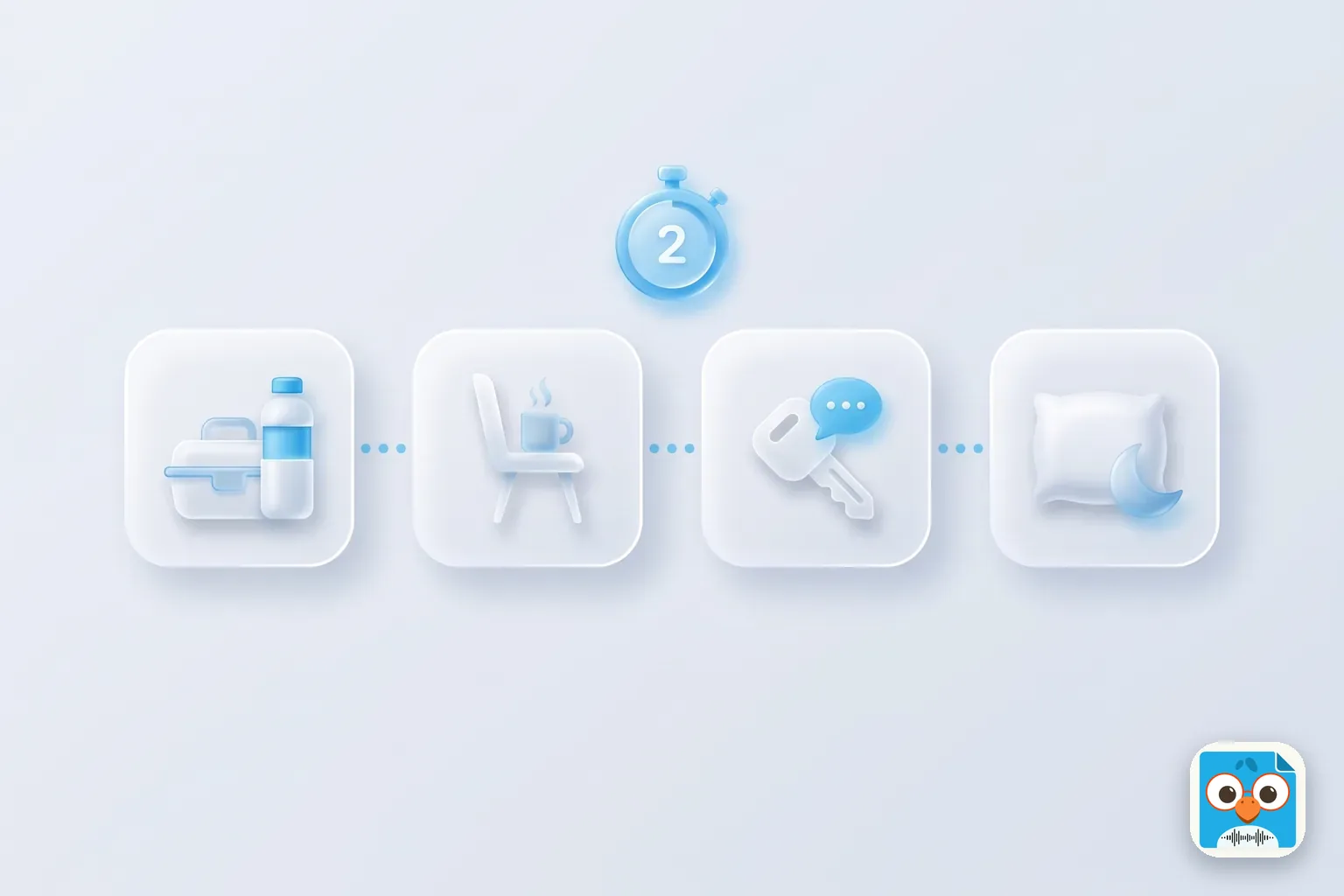
Table of Contents
- 1.What nurse self-care actually means
- 2.Why nurse self-care slips on 12-hour shifts
- 3.The two-minute floor: the rule that makes nurse self-care stick
- 4.Nurse self-care habits for each phase of a stretch
- 5.Your one-page nurse self-care plan
- 6.Where ParrotNotes fits in nurse self-care
- 7.When nurse self-care isn't enough
- 8.Nurse self-care, one floor at a time
It's 15:40 on Jess's third 12 in a row. Her water bottle is still full from the morning. Lunch was four crackers at the nurses' station, and she hasn't sat down since 11:00.
(Jess is a composite, not a real nurse.) She knows all the nurse self care advice. Drink water, take your break, sleep eight hours, try yoga.
She's read the lists of 50 ideas. None of them survive shift three.
That's the honest problem with most nurse self-care strategies: they're written for a normal week, and nursing doesn't have many of those. This guide takes a different route. You'll get eight habits instead of 50, each mapped to a phase of your stretch, and each with a two-minute floor: the smallest version you still do on the worst shift. Then you'll fill in a one-page plan.
This is practical guidance, not medical advice. If you're already running on empty, our guide to nurse burnout covers the signs and where to get help.
One habit below is a one-minute spoken check-out before you drive home. If you want a place to keep it, ParrotNotes is free to try (your own thoughts and to-dos only, never patient details).
What nurse self-care actually means
The American Association of Colleges of Nursing describes self-care as the "daily process of being aware of and attending to one's basic physiological and emotional needs" (AACN 5B Tool Kit). A 2021 review in the Journal of Radiology Nursing defines self-care practices as "behaviors that promote and maintain physical and psychological wellbeing" (Williams et al.).
Notice what's missing from both definitions of self-care for nurses: bubble baths, spa days and anything you have to buy. Nurse self care is mostly basic maintenance. Water, food, sleep, movement, people and limits.
It's also part of the job, not a break from it. The American Nurses Association's 2025 Code of Ethics says it plainly in Provision 5.1: "Nurses have a duty to take care of their own health and safety." It goes further: there is "no ethical expectation nor obligation" for nurses "to unreasonably sacrifice or trade their own safety or health for the benefit of others."
If you've ever felt guilty sitting down during a shift, read that line twice.
Why nurse self-care slips on 12-hour shifts
You don't skip self-care because you don't know better. You skip it because the shift takes the time first.
The Williams review cites a study of new graduate nurses that found four barriers to self-care: time, shift work, the work environment and work culture. A 2022 scoping review of 18 studies on nurses and midwives found something similar about permission: "Nurses needed permission from others and from themselves to be self-caring and self-compassionate" (Sist et al.).
The stakes are real. In the National Council of State Boards of Nursing's 2024 workforce survey, 35.4% of registered nurses said they felt burned out every day or a few times a week.
Some of that isn't yours to fix. Staffing, scheduling and break coverage belong to your unit and your manager. But the habits below protect the part of you that goes home, and they're built to hold up when the shift doesn't.
The two-minute floor: the rule that makes nurse self-care stick
Every habit in this guide has two versions:
- The full version: what you do on a decent day.
- The floor: a two-minute version you do no matter what.
The floor matters more than the full version. A habit you drop on bad shifts is a habit you drop, because bad shifts are exactly when you'll be tempted to skip it. A habit with a floor never fully breaks, so it's still there when the stretch ends.
Here's what that looks like in practice. Full version: a 30-minute walk on your day off. Floor: two minutes outside in daylight before you go back in.
Full version: a proper meal on your break. Floor: something with protein eaten sitting down.
You're allowed to do only the floor for a whole stretch. That still counts.
Nurse self-care habits for each phase of a stretch
A 3x12 stretch has four phases, and each needs something different. Two habits per phase is enough.
Before the stretch
1. Stock the stretch. Pack food and a water bottle for every shift the night before the first one, so tired-you doesn't have to decide anything. Floor: put a water bottle and one snack in your bag by the door.
2. Set your extra-shift limit in advance. Decide how many extra shifts you'll pick up this month before the texts arrive. The overtime calculator shows what an extra shift actually pays, so the choice is clear. A shift schedule generator shows where your recovery days fall across the month. Floor: write the number on your phone's lock screen note.
On shift
3. Take the break. The full break, sitting down, away from the unit if you can. Our nurse time management guide shows how to protect it like any other task. Floor: two minutes sitting down with water, even if it's in the supply room.
4. Drink on a cue, not on thirst. Tie water to something that already happens: every time you wash your hands before the break room, every hourly round of your own to-do list. Floor: finish one bottle before the halfway point of the shift.
The drive home
5. Close the shift before you start the car. Say or write three things: what went well, what's still bothering you, and what you're leaving at work. Keep it about you and your own to-dos. Patient information stays in your facility's EHR and approved systems. Floor: one sentence: "The thing I'm leaving here tonight is..."
6. Check you're safe to drive. After a long shift, drowsiness is a real risk. Our night shift nurse tips cover the warning signs and a plan B. Floor: if you're yawning hard or can't keep your eyes on the road, don't drive yet. Nap, call someone, or get a ride.
Days off
7. Recover before you catch up. Give the first day off to sleep and an easy pace, not errands. Mute the unit group chat for 24 hours. Floor: one hour on day one with no screens and no chores.
8. See one person who isn't from work. Nurses spend most waking hours with coworkers during a stretch. A friend or family member who doesn't talk shop resets you in a different way. Floor: a two-minute call or voice message to one person.
Andre, a med-surg nurse (a composite), used to spend his first day off running errands and feeling wrecked by Thursday. He kept only two habits for a month: the full break on shift and a screen-free first morning off. On his worst week he did the floors. By week four he noticed he wasn't dreading the first shift of the next stretch.
Your one-page nurse self-care plan
Copy this into your notes app or onto a card. Fill in one line per habit, and keep the floors short enough that you'd still do them on your worst shift.
| Phase | Habit | My full version | My two-minute floor |
|---|---|---|---|
| Before the stretch | Stock the stretch | ||
| Before the stretch | Extra-shift limit | ||
| On shift | Take the break | ||
| On shift | Drink on a cue | ||
| Drive home | Close the shift | ||
| Drive home | Safe to drive | ||
| Days off | Recover first | ||
| Days off | One person outside work |
My extra-shift limit this month: ____ One thing I'll ask my manager or council for: ____
A filled-in example: a three-shift stretch
Priya (a composite) works days, Tuesday to Thursday. Here's her plan for one stretch:
- Monday night: packs three lunches and three water bottles (full version). Extra-shift limit: two this month.
- Tuesday: full break at 12:30. Bottle one done by 13:00. Closes the shift in the car with a 90-second voice note.
- Wednesday: the unit is short two nurses. She gets the floor only: two minutes sitting with water in the med room alcove. Still counts.
- Thursday: floor for the break again, full version for the drive-home close. She says out loud what she's leaving at work and starts the car.
- Friday: sleeps in, no errands until the afternoon, phone on do not disturb. Calls her sister in the evening.
On paper Priya missed her full break twice. In practice she never dropped a habit, and that's the point.
If talking through your day helps, try ParrotNotes free for the drive-home close.
Where ParrotNotes fits in nurse self-care
ParrotNotes is a voice notes app for the phone you already carry. You tap record, talk for a minute, and get a transcript and an AI summary. For self-care, that's useful in two places:
- The drive-home close (habit 5). A spoken close-out takes less effort than writing at the end of a 12. Over a few weeks, the summaries show what keeps coming up, which is useful to bring to a one-on-one or a nursing reflective journal.
- Your own to-do list. Say the things you owe yourself: a free nursing CEU module you want to finish, a form for HR, a call to make on your day off. Getting them out of your head is self-care too.
Keep every note about you: your feelings, your plans, your learning. Never record patients or say patient details into a voice note. The free plan includes 100 minutes of recording a month and an AI summary on every recording, plenty for a short note after each shift.
Want an easy way to leave the shift at work? Download ParrotNotes free and try the drive-home close on your next stretch.
When nurse self-care isn't enough
Self-care habits help, but they can't fix a unit that's short-staffed every week, and they aren't treatment. If you feel numb, hopeless or unable to switch off even on days off, reach out:
- 988 Suicide and Crisis Lifeline (U.S.): call or text 988, or chat at 988lifeline.org. Free, confidential and open 24/7.
- Your employee assistance program (EAP): many employers offer free, confidential counseling. HR has the number.
- Your doctor or a licensed therapist: for anything that doesn't lift with rest.
- Healthy Nurse, Healthy Nation: the ANA's free wellness program for nurses, covering mental health, physical activity, nutrition, rest, quality of life and safety.
Asking for help is the same judgment you'd use for a coworker.
Nurse self-care, one floor at a time
Nurse self care doesn't need 50 ideas. It needs a few habits that survive your worst shift. To recap:
- Self-care is basic maintenance, and the ANA Code of Ethics calls it a duty, not a luxury.
- Pick two habits per phase of the stretch: before, on shift, the drive home and days off.
- Give every habit a two-minute floor, and let the floor count.
- Fill in the one-page plan and set your extra-shift limit before the month starts.
- If habits aren't enough, call or text 988 or use your EAP.
Self care as a nurse starts with one habit on your next shift. The floor is enough.
Frequently Asked Questions
What is nurse self-care?
Nurse self-care is the daily habit of looking after your own physical and emotional needs: water, food, sleep, movement, people and limits. The AACN calls it a "daily process of being aware of and attending to" those needs. The ANA Code of Ethics says nurses have a duty to care for their own health and safety.
Why is self-care important for nurses?
Long shifts, short staffing and emotional strain wear nurses down, and in NCSBN's 2024 survey 35.4% of RNs felt burned out every day or a few times a week. Steady self-care habits protect your energy and judgment. They don't replace safe staffing, which is your unit's job.
How can nurses practice self-care during a 12-hour shift?
Keep it small. Take your break sitting down, even if it's only two minutes. Tie drinking water to a cue that already happens, and eat something with protein sitting down. Before you drive home, close the shift by saying what you're leaving at work.
What are some self-care ideas for nurses on days off?
Give the first day off to recovery, not errands. Mute the unit group chat for 24 hours, keep one screen-free hour, and see or call one person who isn't from work. Save bigger plans for the second day off.
What if self-care isn't helping?
Self-care can't fix a problem that comes from staffing or scheduling, and it isn't treatment. Raise unit issues with your manager or council, and talk to your doctor, a therapist or your EAP if you're struggling. In the U.S., call or text 988 if you're in crisis.
Related Posts

Zoom AI Companion Meeting Summary: How It Works and Its Limits
Zoom AI Companion meeting summary, checked on Zoom's own pages in Oct 2026: plans, setup, who receives it, 33 languages and limits. Try ParrotNotes free.

Value Engineering: How Suppliers Win Specs Without Cutting Value
Value engineering explained: the SAVE job plan, function analysis, and how suppliers answer a VE swap, with a worked example and a proposal template. Try free.

Samsung Voice Recorder: Transcribe, Share and Organize Recordings
How to use the Samsung voice memo app: record, transcribe with Transcript assist, share and organize recordings, with menu paths checked on Samsung's pages.