
What Is a Gemba Walk? How to Run One and What to Write Down

Sarah Johnson
Writes about field sales, meeting notes and voice-first workflows at ParrotNotes. Every article is reviewed by the ParrotNotes product team before it goes live.

Table of Contents
- 1.What is a gemba walk?
- 2.Where the gemba walk came from
- 3.Gemba walk vs audit vs plant tour
- 4.How to run a gemba walk in six steps
- 5.What to write down on a gemba walk
- 6.Voice notes and phones: follow the site's rules first
- 7.After the gemba walk: turn notes into action
- 8.Gemba walks for sales engineers and manufacturers' reps
- 9.Make your next gemba walk count
Elena walks Line 3 at 6:40 on a Tuesday morning. She spots an operator making long trips for labels, a pallet that arrives late, and a stack of cases set aside for rework.
By the 10:00 meeting, her notebook says "Line 3, labels??" and she can't remember how many trips, or who told her why. (Elena is made up, but you may know the feeling.)
A gemba walk gets you to where the work happens. You probably already believe that beats reading a report. The trouble is that a vague note can't start an improvement.
This guide explains what a gemba walk is, where the idea came from, and how to run one in six steps. It also covers the part many guides skip: exactly what to write down, with a filled-in log to copy, and how to capture notes when a site restricts phones. If you'd rather talk through your walk than write it up, you can try ParrotNotes free for the debrief.
What is a gemba walk?
A gemba walk is a management practice where you go to the place the work happens, watch it, and ask questions before you decide anything. The Lean Enterprise Institute (LEI) defines it as "a management practice for grasping the current situation through direct observation and inquiry before taking action."
The word itself is simple. LEI says gemba is Japanese for "actual place", often used for the shop floor or anywhere value-creating work occurs. You'll also see it spelled genba, and you'll hear people say "walk the gemba." It's all the same idea.
The purpose of a gemba walk is learning, not checking. LEI's entry credits James Womack, author of Gemba Walks and LEI's founder, with a useful way to frame it. Gather the people who touch a process, walk it together, and discuss three things:
- Purpose: what problem does this process solve for the customer?
- Process: how does it actually work?
- People: are they engaged in creating, sustaining, and improving it?
None of those questions asks who's at fault. That's what separates this from an inspection.
Where the gemba walk came from
The habit grew out of Toyota. LEI notes that Japanese companies pair gemba with "genchi gembutsu," which roughly means "go and see," to stress the importance of empiricism. Two ideas tied to Taiichi Ohno, the Toyota executive most associated with the Toyota Production System, still shape how people walk today: his seven wastes and the 5 Whys.
Then there's the chalk circle. As lean professor Christoph Roser tells it, Ohno would draw a circle on the shop floor, put someone with a problem inside it, and say "Watch!" He'd come back later and ask what they had seen, and if the answer fell short, they kept watching.
Treat this as a widely told lean story rather than a documented procedure, since accounts differ on the details. The lesson still holds: most of us stop looking long before we've seen anything.
The term also gives Womack's essay collection its title. LEI describes Gemba Walks as reflecting his practice to "go and see, ask why, and show respect." That's a fair summary of the whole method.
Gemba walk vs audit vs plant tour
If the people on the floor think you're auditing, you'll get the tidy version of the work. So be clear which one you're doing.
| Activity | Main goal | Who it's for | What you leave with |
|---|---|---|---|
| Gemba walk | Understand how the work really runs | Leaders and the team doing the work | Facts, questions, and small experiments |
| Audit | Check conformance to a standard | Quality, safety, or a third party | Findings against a checklist |
| Customer plant tour | Win or keep business | A customer or prospect | Agreed next steps on a deal |
Selling is the tour's job, and our guide to running a manufacturing plant tour covers it. Hazards you spot on any walk still belong in your formal process, such as a safety committee hazard log.
How to run a gemba walk in six steps
There's no single official procedure. These six steps build on LEI's entry and leave room for your plant's own rules.
1. Pick one process and one question
Don't walk "the plant." Walk one flow from start to finish, with one question in mind, such as "Why does Line 3 miss its first-hour count?" Thirty to 60 minutes is a sensible starting point, though there's no official number.
2. Tell the area and check the site rules
Tell supervisors and operators when you're coming and why. Say plainly that you're studying the process, not grading people.
Ask what the site allows: PPE, walkways, phones, photos, and audio. In a customer's plant or a regulated area, get the answer before you arrive.
3. Walk the flow with the people who touch it
Follow the work in order, and bring people from each step. It's easy to skip, but without them one department's fix can become another department's problem.
4. Stand still and watch before you ask
Pick a safe spot out of the way and watch several full cycles. Count things: steps to the rack, minutes the line waited. This is your chalk circle, and it feels awkward at first.
5. Ask open questions
Ask the person doing the job, then listen. These are starting points for the three topics from LEI's entry:
| Topic | Gemba walk questions to try |
|---|---|
| Purpose | What does the next step need from you? What would the customer notice if this went wrong? |
| Process | Can you walk me through it? What happens when it doesn't go to plan? Where do you wait? |
| People | What's the workaround you wish you didn't need? If you could change one thing here, what would it be? |
Ask "why" more than once when you hit a real problem. LEI's 5 Whys entry uses Ohno's example of a stopped machine to show how repeated questions get past the first answer.
6. Close out before you leave
Thank people, read back what you heard, and say what happens next. Resist fixing things on the spot, because the team loses the chance to solve it.
The exception is safety. An immediate hazard gets handled right away under your site's rules.
Want a record that doesn't depend on your memory? Download ParrotNotes and talk through your walk the moment you're somewhere you're allowed to record.
What to write down on a gemba walk
Many guides stop at "take detailed notes." Here's what that means in practice: record what you saw so accurately that someone who wasn't there could picture it.
The seven-field gemba walk log
Use a pocket card, a notebook, or a gemba walk template on a tablet. What matters is filling in the same seven fields each time:
- Time: when you saw it, because the start of shift and the end of shift are different plants
- Place: the station or step, in the words the floor uses
- What I saw: facts and counts, with no conclusions
- Waste type: which of the seven wastes it looks like, if any
- What they said: their words, with their name only if they're fine with that
- My question: what you still don't know
- Owner and date: who follows up, and by when
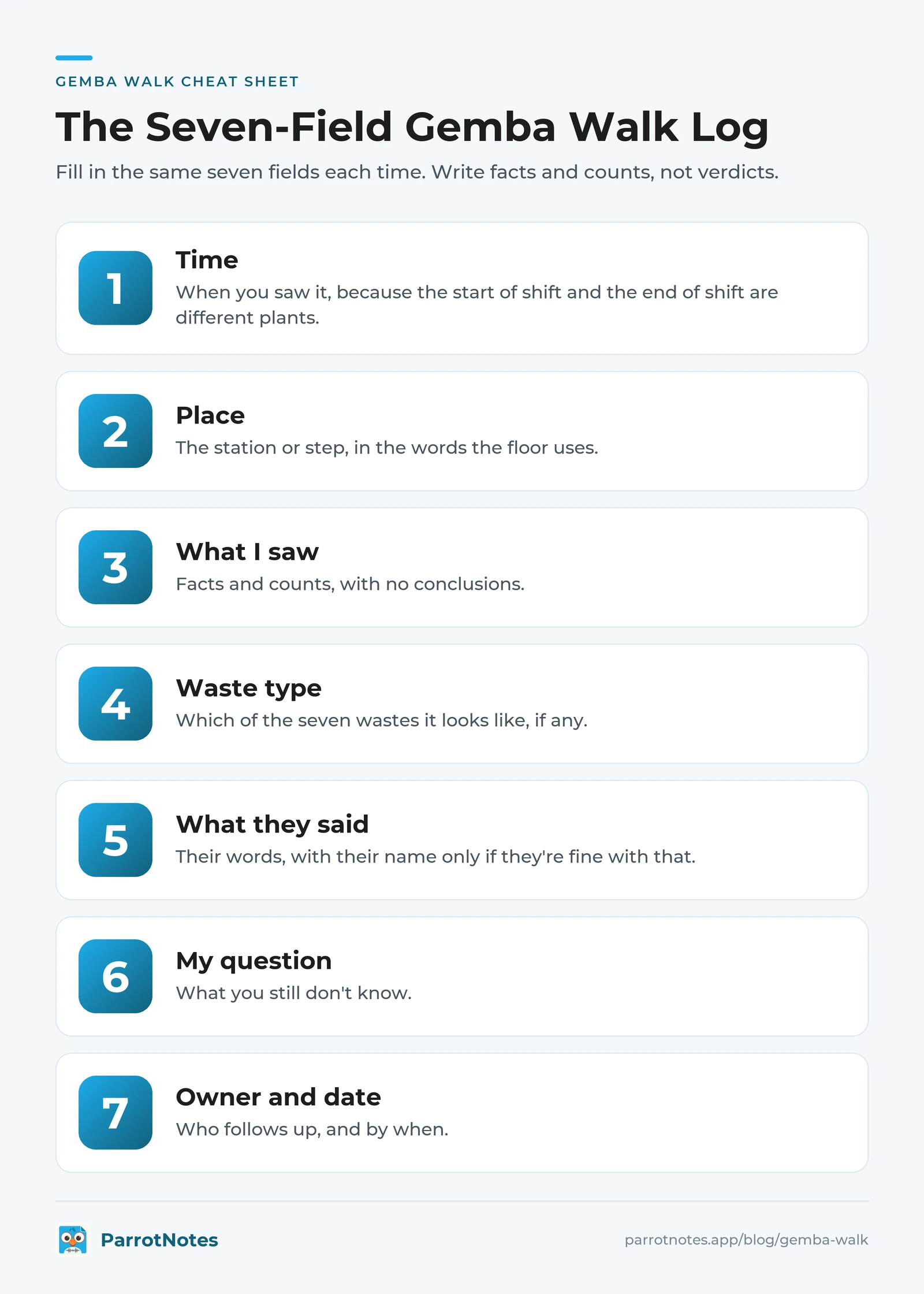
Write facts, not verdicts
A verdict shuts the conversation down. A fact gives everyone something to test.
| Weak note | Useful note |
|---|---|
| Operator is slow | Three trips to the label rack in 20 minutes, about 60 steps each way |
| Bad flow at infeed | Line stopped 4 minutes at 6:55 waiting on cartons |
| Quality issue | 11 cases set aside for relabeling at end of line |
What to look for: the seven wastes
LEI lists Ohno's seven wastes, and they make a handy gemba walk checklist. The right-hand column is our suggestion for what to measure, so each waste ends up in your log as a number or a specific example.
| Waste | What to write down |
|---|---|
| Overproduction | Quantity built ahead, and what the next step actually needs |
| Waiting | Minutes waited, and what people or parts waited for |
| Conveyance | Number of moves between two steps, and distance |
| Processing | The extra step, and why people say it's there |
| Inventory | Count on hand, and what triggered it |
| Motion | Trips or steps per cycle, when searching for parts, tools, or documents |
| Correction | Units inspected, reworked, or scrapped, and where the defect started |
If you know the line's demand, our takt time calculator helps you judge how much a four-minute stop matters.
A filled-in example
Here's Elena's walk again, with the log. The plant, people, and numbers are invented to show the format. Her question was "Why does Line 3 miss its first-hour count?"
| Time | Place | What I saw | Waste | What they said | Next step and owner |
|---|---|---|---|---|---|
| 6:48 | Case packer | Three trips for labels in 20 minutes, about 60 steps each way | Motion | "The rack moved when the new pallet lanes went in." | Dee tries a label cart at the packer, Thursday |
| 6:55 | Infeed | Line stopped 4 minutes waiting on cartons | Waiting | "The forklift runs tickets in the order they come in." | Elena asks the materials lead how the first delivery is set, Wednesday |
| 7:02 | End of line | 11 cases set aside for relabeling | Correction | "One printer still has the old template." | Dee confirms the template with quality, today |
At 10:00, Elena doesn't have to say "labels are a problem." She can say three trips, 60 steps, a rack that moved, and a fix Dee is about to test.
Voice notes and phones: follow the site's rules first
A phone is a good capture tool on some floors and a banned item on others. Ask first, and take the plant's answer as final.
| Situation | How to capture |
|---|---|
| Phones or recording not allowed | Pocket card on the floor, then a voice debrief off site or wherever recording is allowed |
| Phones allowed, loud area | Short written notes at the line, then step somewhere quieter for a voice note |
| Phones allowed, quiet area away from the line | Speak your own observations into a voice note |
| Talking with an operator or a customer | Don't record by default. Ask first, and write it down instead if anyone says no |
| Photos of a process or parts | Only with approval, and never other customers' parts or drawings |
Noise is a practical limit too. NIOSH says that sounds at 85 dBA often mean raising your voice to be heard by someone 3 feet away, which is no setting for a clean recording. And stop in a safe spot before you touch your phone. Nobody should be reading a screen in a forklift aisle.
Recording people also raises legal questions that vary by place, and our guide to one-party consent states covers the US rules. The practical habit is simpler: record your own voice, and get a clear yes before recording anyone else.
A 90-second voice debrief
Do this straight after the walk, in the office or in your parked car. Answer each prompt aloud:
- Which process, what time, and who walked with me?
- What question did I come with?
- What three things did I see, with the counts?
- What did people tell me, and is anyone happy to be named?
- What surprised me?
- Who's doing what next, and by when?
ParrotNotes turns that into a transcript and an AI summary, and it can pull out the action items. Recording keeps going with the screen off, so you can set the phone down and just talk.
The Free plan includes 100 minutes of recording a month and 5 AI-powered recordings with action items and key points. Pro, as of November 2026, costs $19.99 a month or $14.99 a month billed annually. It adds AI chat, so you can ask "What did we see at the case packer last month?"
After the gemba walk: turn notes into action
A walk that changes nothing teaches people that walks don't matter. Within 24 hours, do three things:
- Send the short version. List the facts, the questions, and who owns what. One screen is enough.
- Pick one problem for the 5 Whys. Run it with the people who do the work, not in a conference room without them.
- Tell the floor what happened. Go back to the operator who explained the label trips and say what you tried. That's the "show respect" part in practice.
Then walk again, and compare logs to see whether the three trips became one.
Three mistakes undo a lot of gemba walks: turning up with the answer already decided, correcting people in front of their team, and collecting notes that never go anywhere. A simple log and a debrief fix the last one.
Gemba walks for sales engineers and manufacturers' reps
This isn't only a plant manager's tool. If you sell into plants, the same habits show you what a customer really needs.
Picture Priya, a fictional manufacturers' rep selling conveyor components. A customer invites her to walk a line ahead of a retrofit quote.
She's a guest, so she asks about phone and photo rules in advance and carries a pocket card. She watches six cycles at a transfer point, counts two jams, and writes down the operator's words about when they happen.
She dictates a debrief in the parking lot, and her quote addresses the jam the operator described, not just the emailed spec sheet. For the numbers themselves, our sales engineer guide has a technical meeting record and a spec read-back script.
You can also walk your own gemba. In sales, the "actual place" might be the route an RFQ takes from your inbox to estimating to the quote. Follow one real RFQ, and count the handoffs and the days it sat waiting. Our manufacturing sales process guide shows where that step sits in the wider deal.
Make your next gemba walk count
A gemba walk is simple to describe and easy to waste. Here's the short version:
- Walk one process, with one question, alongside the people who touch it
- Watch before you ask, and ask before you suggest
- Log facts and counts in the same seven fields, not verdicts
- Follow the site's phone and recording rules, and debrief as soon as you can
- Report back to the floor within 24 hours, then walk again
Think back to Elena's "Line 3, labels??" With a log and a 90-second debrief, that note becomes three trips, a rack that moved, and a fix to test on Thursday.
Copy the seven fields onto a card for your next walk. When you're done, download ParrotNotes free and talk through what you saw before the detail fades.
Frequently Asked Questions
How long should a gemba walk take?
There's no official length. Thirty to 60 minutes is a sensible starting point for one process, with time to watch several full cycles and talk with the people doing the work. A short, focused walk you repeat regularly teaches more than a long tour you do once.
Is a gemba walk an audit?
No. An audit checks work against a standard and produces findings. A gemba walk is about understanding how the work really runs, so you can improve the process with the people who do it. If people on the floor feel audited, they're likely to show you the tidy version.
Is gemba the same as kaizen?
No. Gemba is the place where the work happens, and kaizen means continuous improvement. A gemba walk often feeds kaizen, since what you see and hear on the walk points to what's worth improving next.
Is a gemba walk part of Lean Six Sigma?
It comes from lean thinking and Toyota, rather than Six Sigma. Many Lean Six Sigma teams use it, because direct observation is a good way to understand a process before measuring or changing it.
What should I write down on a gemba walk?
Record the time, the place, what you saw as facts and counts, the type of waste, what people told you, your open question, and the owner and date for the next step. Write "three trips in 20 minutes" rather than "operator is slow."
Can I record audio during a gemba walk?
Only if the site allows it, and only with permission from anyone you're recording. Many plants restrict phones, and loud areas make poor recordings anyway. A safe default is to write short notes on the floor, then dictate your own debrief somewhere recording is allowed.
Related Posts

What Is a Byline? Meaning, Examples and Who Gets One
The meaning of byline explained with examples: byline vs dateline, who gets one under AP and NPR rules, plus a freelancer credit email to copy. Learn more.
SDR vs BDR: What Each Role Does and Why Companies Mix Them Up
SDR vs BDR compared: what each role does, the pay employers state and why titles get mixed up, from 154 live job ads. Try ParrotNotes free for hand-off notes.
Sales Email Subject Lines: Examples by Situation and What to Avoid
Sales email subject lines for every situation: 40 short examples, what to avoid, and a five-question check. Build yours from your meeting notes. Try it free.