
Incoterms Explained for Sales Reps: What to Quote and When

Sarah Johnson
Writes about field sales, meeting notes and voice-first workflows at ParrotNotes. Every article is reviewed by the ParrotNotes product team before it goes live.
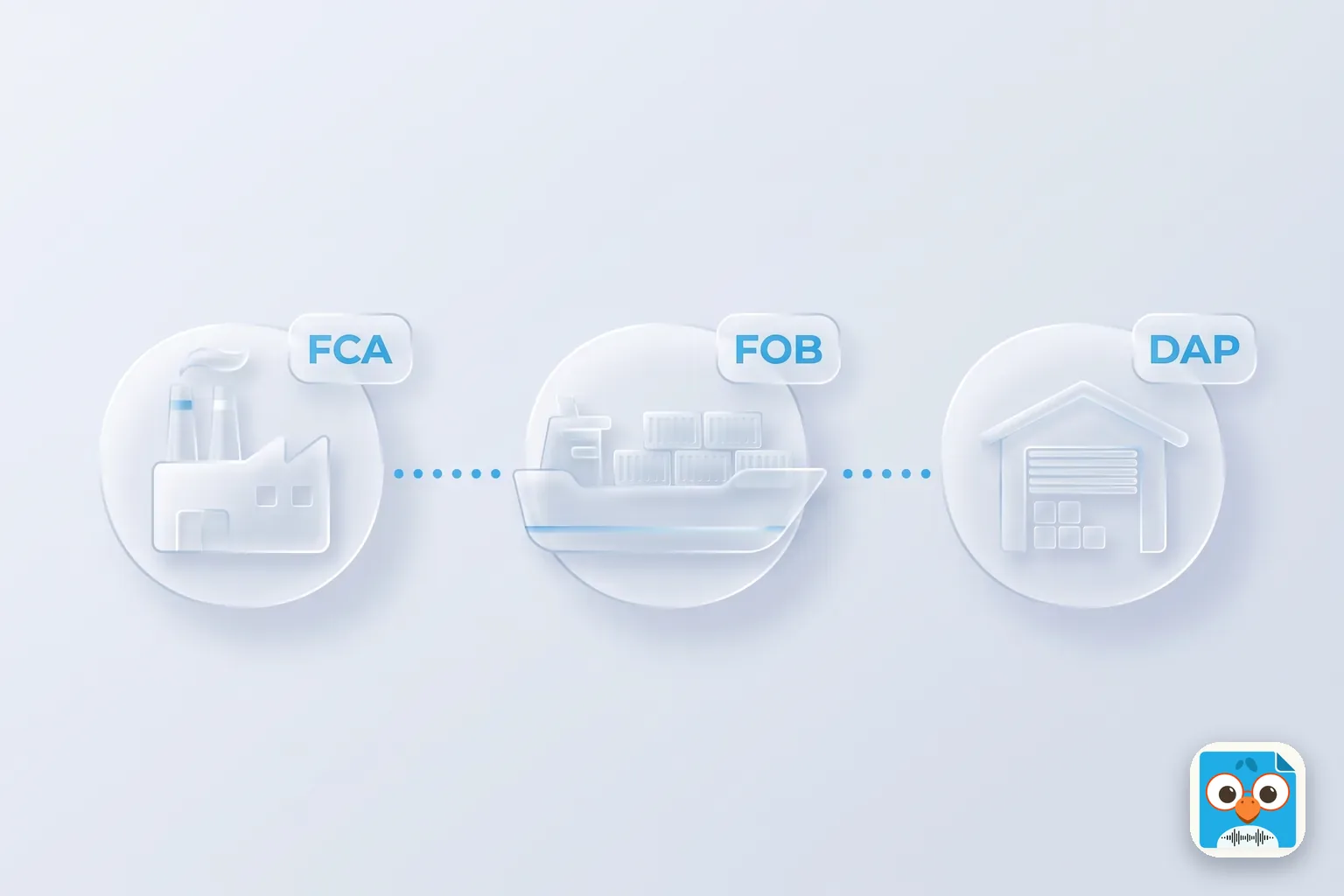
Table of Contents
- 1.What are Incoterms?
- 2.The 11 Incoterms 2020 rules at a glance
- 3.What Incoterms don't cover
- 4.Which Incoterms rule to quote, and when
- 5.FCA, DAP and three rules to handle with care
- 6.What each Incoterms rule does to your price
- 7.Five questions to ask before you write the terms
- 8.Is there an Incoterms 2030?
- 9.Put the rule on the quote before the argument starts
Dan sells valves for a plant in Columbus, Ohio. Last spring he quoted a buyer in Germany $48,000, "FOB Columbus." He meant the buyer's truck picks it up at his dock.
The buyer's forwarder read it as Dan's company getting the goods to the port. The crate sat for six days while both sides argued over who owed a $2,100 trucking bill. (Dan is an illustration, like every rep in this guide, not a real person.)
Nobody lied. Two short words just meant different things to two people, and that's the problem Incoterms exist to solve. You probably know the letters from RFQs and purchase orders. You may also have copied "FOB" from an old quote without being sure what you were promising.
This guide is for the person typing the terms on the quote. You'll get all 11 Incoterms 2020 rules in one table, then a chart of which rule to quote in eight common situations with a line to copy, a worked example of what each rule does to your price, and five questions to ask the buyer first.
One limit: this is sales guidance, not legal, tax or customs advice. Check your terms with whoever owns your contracts, and use a forwarder or customs broker for real costs.
Those five questions usually come up in a plant walk or on a call, so it helps to catch the answers. You can try ParrotNotes free and record them on your phone instead of trusting your memory.
What are Incoterms?
Incoterms are a set of eleven three-letter trade terms published by the International Chamber of Commerce (ICC), first in 1936. The current edition, Incoterms 2020, took effect on January 1, 2020. Written into a sales contract, each rule answers three questions:
- Tasks: who books the freight, loads the truck and clears customs?
- Costs: who pays for each of those?
- Risk: at what exact point does loss or damage become the buyer's problem?
A rule only works with a place attached. "FCA" alone tells nobody much, but "FCA 1200 Dock Street, Columbus, Ohio, USA, Incoterms 2020" tells everyone where your job ends. Always name the place and the version, because the 2010 and 2020 editions differ.
Here's the idea that makes the rest easy: risk and cost don't always move at the same spot. Under some rules you pay for freight all the way to the buyer's country, yet the goods are at the buyer's risk from the moment your carrier takes them. That's where most surprises come from.
The 11 Incoterms 2020 rules at a glance
ICC splits the rules by transport. Seven work for any mode, and four are for sea and inland waterway only. Read this table from your side of the deal: the further down each group you go, the more you're taking on.
| Rule | Risk passes to the buyer | Main freight paid by | Clearance |
|---|---|---|---|
| Any mode of transport | |||
| EXW Ex Works | Goods made available, not loaded, at the named place | Buyer | Buyer: export and import |
| FCA Free Carrier | Handed to the buyer's carrier at the named place | Buyer | Seller: export. Buyer: import |
| CPT Carriage Paid To | Handed to the first carrier, at origin | Seller | Seller: export. Buyer: import |
| CIP Carriage and Insurance Paid To | Handed to the first carrier, at origin | Seller, plus insurance | Seller: export. Buyer: import |
| DAP Delivered at Place | At the named place, on the truck, ready to unload | Seller | Seller: export. Buyer: import |
| DPU Delivered at Place Unloaded | At the named place, unloaded | Seller | Seller: export. Buyer: import |
| DDP Delivered Duty Paid | At the named place, cleared, ready to unload | Seller | Seller: export and import |
| Sea and inland waterway only | |||
| FAS Free Alongside Ship | Alongside the ship at the named port | Buyer | Seller: export. Buyer: import |
| FOB Free on Board | On board the ship at the named port | Buyer | Seller: export. Buyer: import |
| CFR Cost and Freight | On board the ship at the loading port | Seller | Seller: export. Buyer: import |
| CIF Cost, Insurance and Freight | On board the ship at the loading port | Seller, plus insurance | Seller: export. Buyer: import |
Two insurance details matter. Under the 2020 edition, CIP calls for the higher level of cover (Institute Cargo Clauses A or similar), while CIF stays at the lower default (Clauses C). The other nine rules don't require either side to insure the goods for the other, so ask who's covering the shipment rather than assume.
This table is a summary from ICC's public pages and national trade sources. The full wording sits in ICC's paid Incoterms 2020 book, so check it, or ask someone who has, before you rely on a fine point.
What Incoterms don't cover
Plenty of reps treat a rule as if it were the contract. It's one line of it. According to the U.S. International Trade Administration, Incoterms don't deal with:
- The price, or how and when you get paid
- When ownership of the goods passes
- Liability for wrong goods or late delivery
- How a dispute gets resolved
So a quote that says "DAP Stuttgart" still needs payment terms, a lead time and a warranty position. Our RFQ template has a supplier response with fields for delivery terms, lead time, payment and price validity.
Which Incoterms rule to quote, and when
Most glossaries stop at definitions, but your real question is which one to put on this quote. Start from who's booking the freight and how much the buyer wants handled. Each row below is a common starting point, and your company's policy or a principal's terms can overrule it.
| The situation | Quote | Line to copy |
|---|---|---|
| Buyer has a forwarder or freight account | FCA | FCA [your plant address], Incoterms 2020 |
| Buyer wants a delivered price and handles import | DAP | DAP [buyer's plant address], Incoterms 2020 |
| Same, and you've agreed to get it off the truck | DPU | DPU [buyer's plant address], Incoterms 2020 |
| You book freight, buyer takes transit risk | CPT | CPT [buyer's city], Incoterms 2020 |
| Same, and the buyer's asked for insurance too | CIP | CIP [buyer's city], Incoterms 2020 |
| Buyer collects in your own country, no export | EXW | EXW [your plant address], Incoterms 2020 |
| Duty-paid request, approved by finance and a broker | DDP | DDP [buyer's plant address], Incoterms 2020 |
| Buyer asks for "FOB" on a container | FCA | FCA [container terminal, port], Incoterms 2020 |
Bulk or loose cargo that's loaded directly onto a ship is the one case where FOB, CFR or CIF fit as written: "FOB [port of loading], Incoterms 2020."
If a buyer's RFQ names a rule, copy it exactly or say plainly what you've changed. Our guide to answering an RFQ puts this on the checklist, and for good reason: a changed place changes your price. If a buyer pushes back later, the quote follow-up email guide covers how to check that a competing quote is on the same terms.
FCA, DAP and three rules to handle with care
Two rules cover a large share of what most reps need. Three others cause most of the trouble.
FCA: your safe default when the buyer ships
FCA Incoterms suit the buyer who has a forwarder, and they work for any mode of transport. There's one detail worth learning. If the named place is your premises, you load the buyer's truck.
If it's anywhere else, such as a terminal, you bring the goods there and you aren't responsible for unloading. Your job ends once the buyer's carrier has them, and you clear export, so you stay in control of your own export filing.
DAP: the delivered price, with a line you don't cross
DAP Incoterms give the buyer one number to the door. You carry the risk and the freight all the way, and the buyer unloads and handles import. DPU is the only rule where the seller has to unload, so don't offer it unless someone on your side can actually lift a two-ton machine off that truck.
FOB: the old habit that doesn't suit containers
Lena sells packaging lines and quotes everything FOB Savannah, as her predecessor did. A container of hers is delivered to the terminal in good shape and damaged in the yard four days before loading. It wasn't on board yet, so under FOB it's still her company's risk. Under FCA at that terminal, risk would've passed when the carrier took it.
That's why the standard advice is to keep FOB for non-containerized sea freight and use FCA for containers. If the buyer's bank needs an on-board bill of lading, the 2020 edition lets the parties agree that the buyer's carrier issues one under FCA.
U.S. reps have a second FOB to watch. "FOB our dock" or "FOB destination" on a domestic quote comes from the Uniform Commercial Code, not from Incoterms. If you mean the UCC version, don't write "Incoterms" beside it. That's Dan's mistake from the top: a domestic habit on an export quote.
EXW: fine at home, awkward for export
EXW looks like the lowest-effort option, since the goods aren't even loaded. But on an export, the buyer has to clear goods out of your country, and a foreign buyer may not be able to. You also may not get the proof of export you need. If someone asks for EXW on an international order, offer FCA at your plant instead. You'd add little more than loading and export paperwork.
DDP: winning the deal, inheriting the duty
Marcus quotes DDP to beat a rival on a $30,000 order into a country he's never shipped to.
A customs broker then explains the problem: under DDP, his company is responsible for import clearance, duty and taxes, and it may need to register for tax there. The surprise bill and the admin swallow most of his margin.
DDP can be a real selling point when your company has done it before in that country. Otherwise, take it to finance before you take it to the customer.
What each Incoterms rule does to your price
The same order costs different amounts to quote, because each rule hands you more of the journey. Here's an example with made-up numbers: one container of valves from a plant in Ohio to a buyer's plant in Stuttgart. These figures show the structure only, so get real rates from your forwarder and broker.
| Rule | What you add | Your quote |
|---|---|---|
| EXW Ohio plant | Goods only | $48,000 |
| FCA Ohio plant | Loading, export filing: $350 | $48,350 |
| DAP Stuttgart plant | Truck to port $1,900, ocean $3,800, destination handling and truck $1,950 | $56,000 |
| DPU Stuttgart plant | Unloading: $400 | $56,400 |
| DDP Stuttgart plant | DAP plus duty, import taxes and broker: $9,600 | $65,600 |
Three things follow from that table.
You can't compare quotes on different rules. A rival at $51,000 FCA may or may not beat you at $56,000 DAP. You can't tell until you've added the buyer's freight to theirs. Say so when a buyer quotes a competitor's number at you.
Your margin is on more than the goods. Freight you front is money at risk. Run each version through a margin calculator before you commit, and ask how long the freight rate you're relying on stays valid. Tie your quote's validity to that date.
The paperwork has to agree. Once the rule's chosen, it should read the same on the quote, the order and the shipping documents. Our free commercial invoice template has a field for the Incoterm, and the proforma invoice template is useful when the buyer needs a document for import or payment before shipping.
Five questions to ask before you write the terms
Terms usually get settled in passing, so make them part of discovery. These five questions settle the rule on almost any quote, and they fit naturally into selling to procurement or a plant visit.
- Who's booking the freight? Do you have a forwarder or a freight account, and may I have the contact?
- Where exactly should the goods end up? A street address or a terminal, not just a city.
- Who's the importer? Whose name goes on the customs entry, and do they want us involved?
- What's on site to unload it? Is there a dock or a forklift, or does this need a crane?
- What does your bank or insurer require? Does a letter of credit call for an on-board bill of lading or proof of insurance?
Priya, a rep for a pump maker, asks these on a plant walk with her phone recording in her pocket.
In the car, her ParrotNotes transcript shows the buyer's forwarder's name, the receiving dock on the far side of the site, and a comment she'd missed: "our bank will want an on-board bill." The AI summary and action items turn those into a to-do list, and the drafted follow-up email restates them for the buyer.
She quotes FCA with the right place the same afternoon, and three months later she can search "bill of lading" and find the exact words. Ask before you record, and follow your local consent rules.
If freight terms keep slipping through your notes, ParrotNotes is free to try on your next customer visit. It's one piece of a longer manufacturing sales process, where a term agreed in month two has to survive until the purchase order in month twelve.
Is there an Incoterms 2030?
Not yet. Incoterms 2020 is still the current edition as of November 2026, and ICC's rules page doesn't list a newer one.
A revision is on the way, though. ICC's 2026 workplan lists this goal: "Begin work on the revision of the Incoterms® rules, laying the groundwork for Incoterms® 2030." We found no published draft or launch date from ICC, so treat any blog announcing an "Incoterms 2026" with suspicion. For now, keep writing "Incoterms 2020" on your quotes and look again when ICC publishes something.
Put the rule on the quote before the argument starts
If you only keep a few points from this guide, make them these:
- Always write the rule, the exact place and "Incoterms 2020" together
- Default to FCA when the buyer ships and DAP when you deliver
- Use FCA, not FOB, for containers, and FCA, not EXW, for exports
- Treat DDP as a finance decision, not a sales one
- Compare competing quotes only on the same rule
Dan's second quote to that German buyer read "FCA, Columbus plant, Incoterms 2020," with the address spelled out. It took him ten extra seconds, and nobody argued about the truck.
Take your last three quotes and check them against the table above. You may find a term that doesn't say what you meant.
One last reminder that this is sales guidance rather than legal, tax or customs advice. Incoterms is a registered trademark of the International Chamber of Commerce, which publishes the full rules.
Frequently Asked Questions
What are Incoterms in simple terms?
Incoterms are 11 standard three-letter trade terms from the International Chamber of Commerce. Written into a sales contract with a named place, each one says who arranges and pays for transport, insurance and customs, and the point where risk passes from seller to buyer.
What is the difference between FOB and FCA?
Under FOB, the seller delivers and the risk passes once the goods are on board a ship at the named port, so it's for sea and inland waterway only. Under FCA, delivery happens when the goods are handed to the buyer's carrier at a named place, for any mode of transport. FCA is the usual advice for containers, which get handed over at a terminal before loading.
What is the difference between DAP and DDP?
Under both, the seller pays for and carries the risk of getting goods to the named place, ready for unloading. Under DAP the buyer clears import and pays duties and taxes. Under DDP the seller does all of that, which is the most a seller can take on.
Do Incoterms say when ownership transfers?
No. Incoterms cover tasks, costs and risk, not ownership. They also don't cover price, payment terms or liability for wrong goods. Your contract and the law that applies to it deal with those.
Is there a newer edition than Incoterms 2020?
Not as of November 2026. ICC's 2026 workplan says work is beginning on a revision that lays the groundwork for Incoterms 2030, but we found no published text or launch date from ICC.
Can I use Incoterms on a domestic sale?
Yes, ICC's material covers domestic sales where relevant, and rules such as EXW or DAP work without a border. In the U.S., many domestic quotes use "FOB" in the Uniform Commercial Code sense instead, so make clear which you mean.
Related Posts
Best Talk to Text App for iPhone and Android
The best talk to text app for your phone: Apple Dictation and Siri on iPhone, Gboard and Gemini on Android, with free plans compared and a voice phrase sheet.

How to Use Speech to Text on iPhone
Turn on speech to text on iPhone in 3 steps, dictate in any app, switch languages, turn it off, and record when the mic stops. Checked on iOS 27, Nov 2026.
How to Record Calls on Samsung
Samsung call recording, step by step: record or auto record calls, find the files, get Galaxy AI transcripts, or turn it all off. Checked November 2026.