
What Is an Executive Session? Board Meeting Rules

Sarah Johnson
Writes about field sales, meeting notes and voice-first workflows at ParrotNotes. Every article is reviewed by the ParrotNotes product team before it goes live.

Table of Contents
- 1.What is an executive session?
- 2.Which rules apply to your board?
- 3.Can a board vote in executive session? Five rulebooks compared
- 4.What can you discuss in executive session?
- 5.Who can attend an executive session?
- 6.How to run an executive session in 6 steps
- 7.How to record an executive session in minutes
- 8.Should you record an executive session?
- 9.Executive session rules: the short version
Picture Renee, the staff secretary for a nine-member foundation board. Halfway through Tuesday's meeting, the chair says, "Let's go into executive session to talk about the director's contract." Renee keeps her pen moving, and by 8 p.m. she has half a page on who said what about a colleague's pay. Nobody told her she should have left the room, or that those notes shouldn't exist in that form.
So what is an executive session? An executive session is a private part of a meeting, where a board or other body shuts out everyone except the people it chooses, so it can discuss something sensitive. The name misleads. It doesn't mean a session for executives, and the CEO is often the person asked to step out.
No single rule covers every board. A city council, a homeowners' association, and a nonprofit can use the same phrase under very different rules. This guide shows which rules apply, compares five side by side, and gives you the wording for the chair and the minutes.
This is general information, not legal advice. Laws and bylaws vary, so check yours, and ask a lawyer before closing a meeting of a public body. Statutes were read in November 2026.
What is an executive session?
A body votes or announces its way in, deals with one sensitive matter, and comes back. You'll also hear it called a closed session, the term California's public bodies use. Under Robert's Rules, the core of it is secrecy: the official FAQ says proceedings in an executive session "are secret, but are not restricted in any other way."
You still need a quorum, and our guide to what a quorum is shows how to count it.
If you keep the minutes, the wording of the motion to close is what people ask about later. ParrotNotes can record the open part of the meeting, with everyone's agreement, so you can check that wording against a transcript. Stop the recording before the doors close.
Which rules apply to your board?
Start here, because the answer changes everything below.
| Your organization | What sets the rules |
|---|---|
| City council, school board, public agency | Your state's open-meeting law, usually with a fixed list of allowed topics |
| HOA or condo association | Your state's association statute, if it has one, plus your bylaws |
| Private nonprofit | Your bylaws, your state's nonprofit law, and your parliamentary authority |
| Company listed on a US exchange | Exchange rules, plus your bylaws and committee charters |
| Private company or club | Your bylaws and any parliamentary authority they adopt |
Public bodies have the least room. In Florida, meetings are "open to the public at all times," and a session with the body's lawyer about pending litigation must be recorded by a certified court reporter, with the transcript made public once the case ends.
Some company boards have to hold executive sessions. Under NYSE rules, non-management directors must meet in regularly scheduled executive sessions without management. Nasdaq's guidance is at least twice a year for independent directors, per Weil's August 2026 chart. Many private companies and nonprofits hold them voluntarily.
Can a board vote in executive session? Five rulebooks compared
Many guides say a board can never vote behind closed doors. That's true under some rules and false under others.
| Rulebook | How you go in | Can you vote inside? | What record is required |
|---|---|---|---|
| Robert's Rules | Usually a motion, second, and majority vote | Yes: "votes can be taken in executive session" | Minutes, taken and approved only inside the session, per Diligent's summary |
| New York public bodies | Motion naming the general subject, majority of the total membership, in open meeting | Yes, but no formal vote to appropriate public money | Minutes of any formal vote, public within one week, minus what can be withheld |
| Texas public bodies | Quorum meets in open, chair announces it and names the legal section | No: final action must happen in an open meeting | Certified agenda or a recording, except a private consultation with a lawyer |
| Oregon public bodies | Presiding officer identifies the legal authority | No: no session may be held to take final action | Minutes or a sound, video, or digital recording |
| California local agencies | Disclose the items in open meeting first | Yes, and you report the action and each member's vote publicly | Public report, with timing that varies by topic |
Read together, they show three different answers. Robert's Rules allows votes inside, so a private board's default may be looser than its members assume. Texas and Oregon won't let a public body finish a decision there. California allows the vote but makes you report it.
These are examples, not a survey, and each statute has exceptions the table can't hold. If your bylaws say votes happen in open session, follow your bylaws.
What can you discuss in executive session?
Public bodies only get the topics their statute lists. New York has eight categories, including litigation and particular personnel matters. Private boards have more freedom, though the reasons tend to match.
Good reasons to close the door:
- One named person's hiring, pay, discipline, or review
- Advice from your lawyer, or a dispute that may end up in court
- A real estate price or contract you're still negotiating
- A merger or crisis that isn't public yet
- Conflicts between directors
Poor reasons:
- General pay policy or staffing plans, which aren't about one person
- A budget fight that the members or the public should hear
- Avoiding an awkward question from a donor or a resident
Oregon draws this line in law. Its Department of Justice checklist says the employment ground can't be used for general employment policies, and the performance ground can't be used for a general review of an agency's goals. A useful test for any board: if the topic isn't about a specific person, deal, or legal risk, it probably belongs in the open.
California HOAs must generally note the matter in the minutes of the next open meeting. Our HOA meeting minutes template has the wording.
Who can attend an executive session?
On a private board, voting directors attend, and the board decides who else stays. OnBoard's guide lists the usual exclusions: the CEO unless invited, staff, advisers, observers, and guests.
Legal counsel is the common invitation. Directors with a conflict on the item should step out, and if the chair is the subject, someone else should preside.
New York lets members and anyone the body authorizes attend. Oregon is the surprise: news media must be allowed into most executive sessions, though the body can tell reporters what they may not disclose, and they stay out of labor negotiation sessions.
Back to Renee. She wasn't a director, so the chair should have thanked her and asked one director to take any notes. That half page would never have existed.
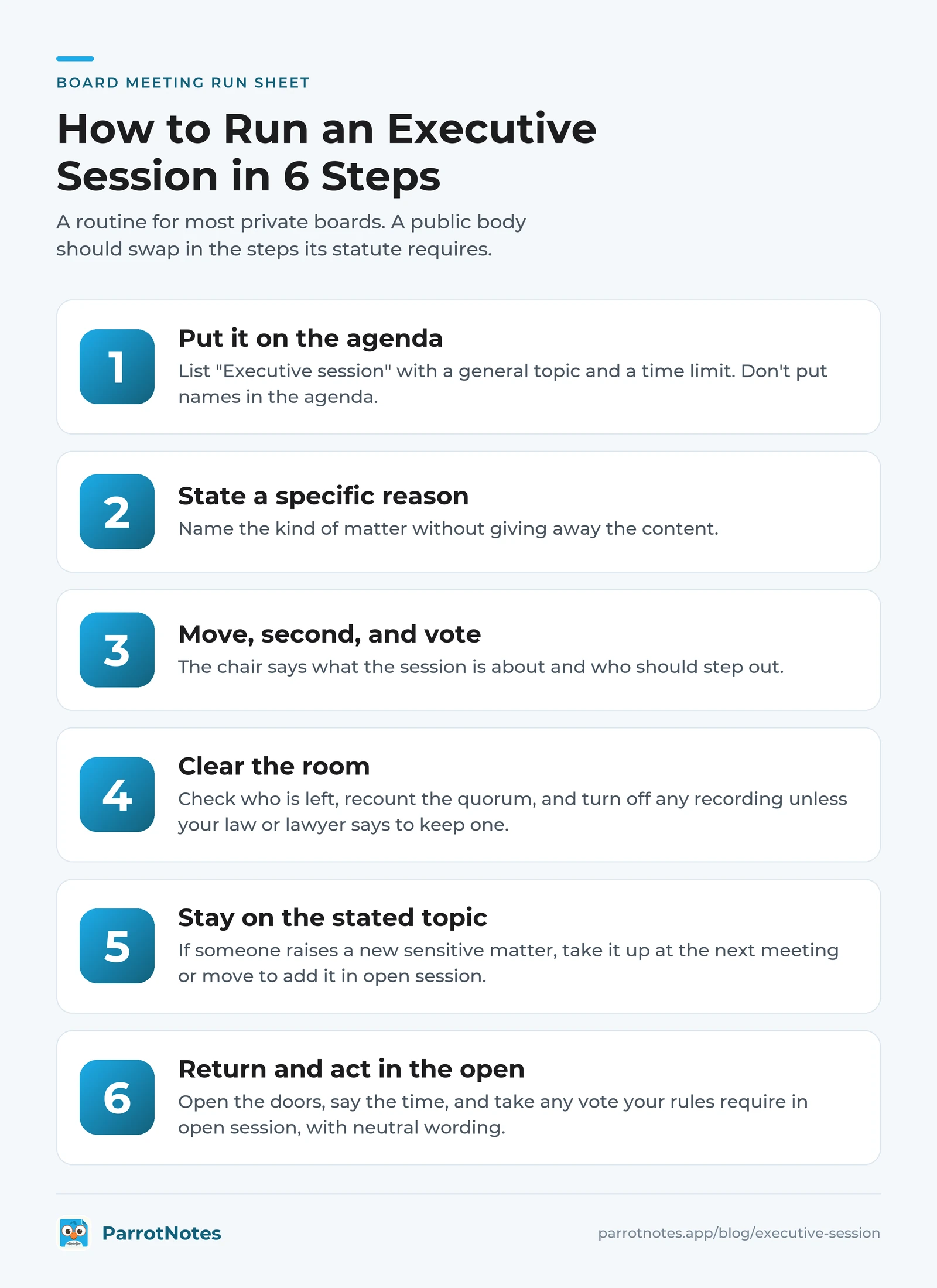
How to run an executive session in 6 steps
This routine fits most private boards. A public body should swap in the steps its statute requires.
1. Put it on the agenda
List "Executive session" with a general topic and a time limit. Our nonprofit board meeting agenda template shows where it sits. Routine votes go on a consent agenda instead. Don't put names in the agenda.
2. State a reason that's specific enough
Name the kind of matter without giving away the content. Take Marcus, a village board clerk in New York, whose trustee moves to close "to discuss personnel." New York's Committee on Open Government said in a 1999 opinion that wording like that is inadequate. It suggests something like "the employment history of a particular person."
3. Move, second, and vote
Here's a script for the chair:
"The chair will entertain a motion to go into executive session to discuss a personnel matter involving a particular employee."
Once the motion carries:
"We expect to take about 20 minutes. Anyone who isn't a director, please step out, except counsel, who has been asked to stay."
4. Clear the room and stop any recording
Check who is left, including anyone on the call. Recount the quorum, and turn off any recording unless your law or your lawyer says to keep one.
5. Stay on the stated topic
If someone raises a new sensitive matter, the chair can say, "That wasn't in our motion. Let's take it up at the next meeting, or move to add it in open session." Public bodies have less room here: in California, a local agency may consider only the items it disclosed beforehand.
6. Return and act in the open
Open the doors, say the time, and take any vote your rules require in open session, with neutral wording.
How to record an executive session in minutes
Think of two records: the open minutes, which show the session happened, and any confidential minutes, which show what was decided. Neither is a transcript of the argument.
For the open minutes, record the motion, the time, a general topic, who left, when the board returned, and any action:
Executive session:
Motion by D. Okafor, seconded by S. Tran, to enter executive session
at 7:30 p.m. to discuss a personnel matter. Carried 7-0.
R. Alvarez (staff) left the room.
The board returned to open session at 7:52 p.m.
No action was taken.
If the board acts when it returns, keep the motion neutral:
Motion by S. Tran, seconded by D. Okafor, to authorize the chair to
settle the matter discussed in executive session on the terms the
board reviewed. Carried 6-1.
For confidential minutes, if your board keeps them, write the outcome and leave out the debate:
CONFIDENTIAL. Executive session of [board], [date], [start] to [end].
Present: [names]. Invited: [counsel].
Topic: [matter, one line].
Action: [motion and vote], or "No action was taken."
Recorded by: [director].
Why does the second block matter? Picture Elena, treasurer of a condo board. The directors agreed in a closed session to settle a contractor's $18,000 claim, then moved on. A month later, she had a check to sign and no minute authorizing it.
Approving confidential minutes is the awkward part. Diligent's summary of Robert's Rules says they're approved only inside an executive session. The Oregon School Boards Association points out the loop this creates, since reviewing them may call for another closed session, and says most boards don't review or vote on them at all. Pick a method with your lawyer and write it down.
These entries drop straight into our board meeting minutes template. Our Robert's Rules of Order minutes template covers the general format, and city clerks can use our city council meeting minutes guide.
Should you record an executive session?
For most private boards, no. A recording can become the one document holding everything you meant to keep private. Some public bodies are the exception: Texas requires a recording or a certified agenda, and Oregon accepts a recording as the record.
Treat it as a decision for your counsel, not a habit. For the open part of the meeting, download ParrotNotes, get everyone's agreement, and let the transcript back up your notes on each motion. Then paste your rough notes into our meeting minutes generator for a first draft. Follow local recording law, and if anyone objects, don't record.
Executive session rules: the short version
- An executive session is the closed part of a meeting, and its name doesn't mean it's for executives.
- Find your rulebook first: public bodies follow state law, and private boards follow their bylaws.
- Votes inside are allowed under Robert's Rules, and barred for final action in Texas and Oregon.
- State a specific reason, and stay on that topic.
- Minute that it happened, never what anyone said.
Before your next meeting, find the rule that covers executive sessions in your bylaws or state law, and copy the chair's script onto your agenda. Then try ParrotNotes free to catch every motion in the open part of the meeting.
Frequently Asked Questions
What is an executive session in simple terms?
It's a private part of a meeting. A board or other body closes the room to everyone except its members and anyone it invites, so it can discuss a sensitive matter such as one person's pay or a legal dispute. Public bodies can only do this for reasons their state law allows.
What is an executive session in Robert's Rules of Order?
The official Robert's Rules FAQ says proceedings in an executive session are secret but aren't restricted in any other way, and that votes can be taken. Your bylaws or the law can be stricter than that, and they come first.
Can a board vote in executive session?
It depends on your rules. Robert's Rules allows it. California local agencies can vote but must report the action and each member's vote. Texas requires final action in an open meeting, and Oregon doesn't allow a session held to take final action. Check your own law and bylaws.
Who can attend an executive session of a board meeting?
On a private board, voting directors attend, and the board decides who else stays, often counsel. The CEO, staff, and guests usually leave unless invited. Public bodies follow their statute, and Oregon even allows news media into most sessions.
How do you record an executive session in minutes?
In the open minutes, record the motion to enter, the time, the general topic, who left, when the board returned, and any action taken. Leave out what was said. If your board keeps confidential minutes, record the outcome and the vote, not the debate.
What is an executive session in a city council meeting?
It's a closed part of a council meeting, allowed only for the reasons your state's open-meeting law lists, such as litigation or a particular personnel matter. The council usually has to announce it in public first, and some states, such as Texas and Oregon, don't allow final votes inside.
Do CEOs usually attend executive sessions?
Often not for the whole session. A board may invite the CEO for part of it, then meet without them. NYSE rules require non-management directors to hold regular sessions without management present.
Is an executive session the same as a closed session?
In most everyday use, yes. Both mean a part of a meeting closed to the public or non-members. Some states' laws use one term or the other, so use the wording in your own statute or bylaws.
Related Posts

Best Talk to Text App for iPhone and Android
The best talk to text app for your phone: Apple Dictation and Siri on iPhone, Gboard and Gemini on Android, with free plans compared and a voice phrase sheet.

How to Use Speech to Text on iPhone
Turn on speech to text on iPhone in 3 steps, dictate in any app, switch languages, turn it off, and record when the mic stops. Checked on iOS 27, Nov 2026.

How to Record Calls on Samsung
Samsung call recording, step by step: record or auto record calls, find the files, get Galaxy AI transcripts, or turn it all off. Checked November 2026.