
Channel Sales: How Manufacturers Sell Through Partners

Sarah Johnson
Writes about field sales, meeting notes and voice-first workflows at ParrotNotes. Every article is reviewed by the ParrotNotes product team before it goes live.
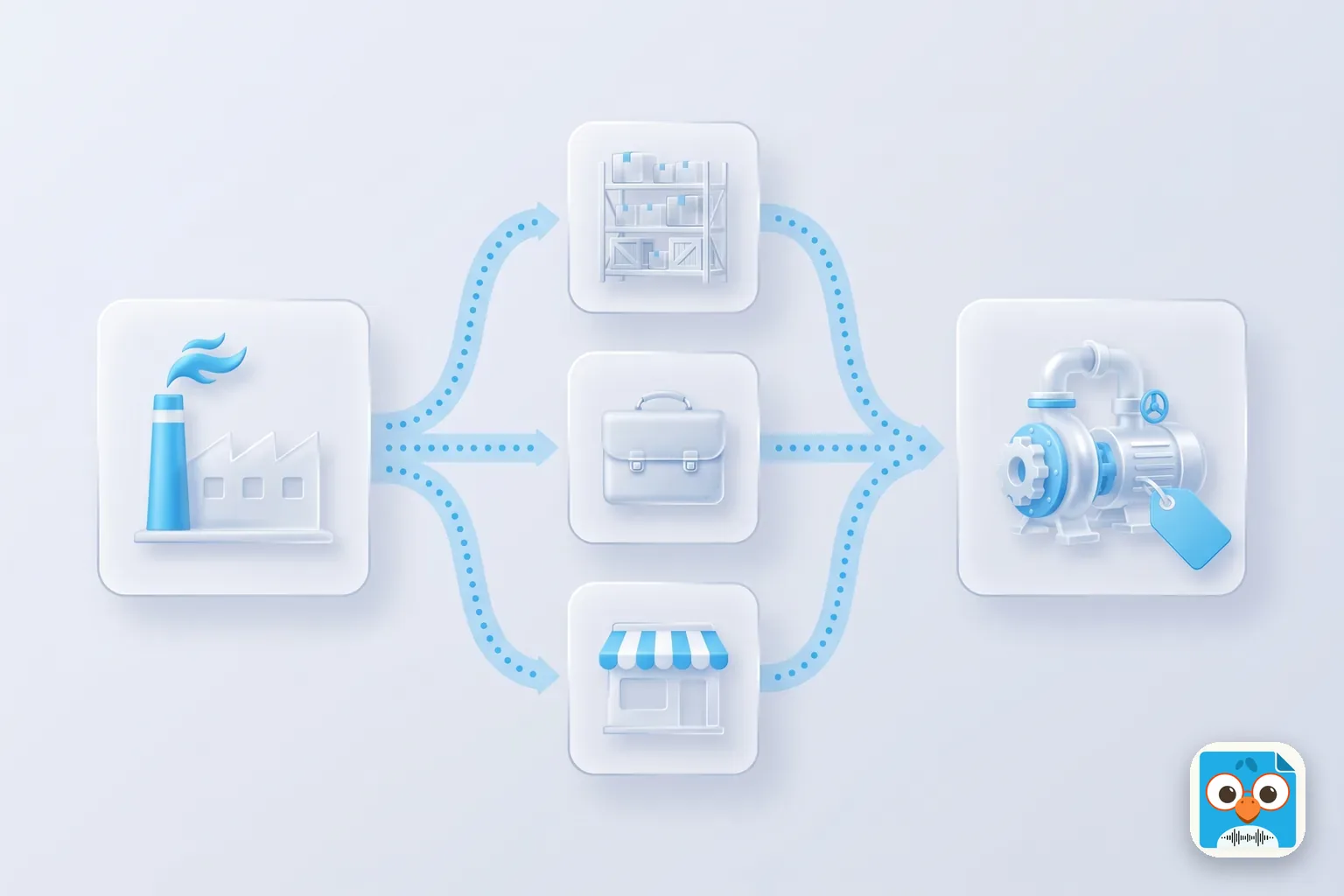
Table of Contents
- 1.What is channel sales?
- 2.Channel sales partners: who's in a manufacturer's channel
- 3.How the money moves: one pump, three routes
- 4.Pros and cons of channel sales for manufacturers
- 5.How to build a channel sales program
- 6.Channel conflict: six rules to write down before it starts
- 7.Running the channel week to week
- 8.What does a channel sales manager do?
- 9.Make your partners want to sell your line
Karen runs channel sales for a mid-sized pump manufacturer. On a Monday in March she got two quotes forwarded by the same contractor.
Both were for her pumps, on the same job, from two of her own partners. One came from a stocking distributor, the other from a rep agency working with a second distributor across town. The contractor's question was short: "Which one of you is real?" (Karen is a composite example, not a real person.)
If you make a physical product and sell it through anyone other than your own employees, you'll know that feeling. Channel sales lets a manufacturer reach thousands of buyers it could never visit. It also means your price, your promises and your reputation are in other people's hands.
This guide explains channel sales from the manufacturer's side. You'll see who sits in a typical channel, how the money moves from list price to end user in one worked example, how to build a partner program, six conflict rules to write down before trouble starts, and a quarterly review template for each partner.
Most channel problems start as a promise someone forgot to write down after a joint call. If you'd rather talk the visit through in the truck than type it up later, try ParrotNotes free.
What is channel sales?
Channel sales is selling your products through outside partners, such as distributors, dealers, manufacturers' reps and resellers, instead of only through your own sales team. The partner finds, serves or supplies the end customer, and earns a margin or a commission for it. It's also called indirect sales, and a company's set of partners is its sales channel.
The opposite is direct sales: your employees sell to the end customer, and you ship, invoice and support them yourself.
Most manufacturers do both. A valve maker might sell direct to its 20 biggest OEM accounts and run everything else through distributors and reps. The question is rarely "direct or channel?" It's "which customers go through which route, and who gets paid when?"
The scale of the channel is easy to underestimate. US merchant wholesalers, the distributors that buy, stock and resell goods, had sales of $11.4 trillion ($11,382.3 billion) in 2022, according to the Census Bureau's Annual Wholesale Trade Survey. A lot of what manufacturers make reaches its buyer through someone else's warehouse.
Channel sales partners: who's in a manufacturer's channel
"Channel partners" covers very different businesses. The two questions that sort them are: do they buy and hold your stock, and who pays them?
| Partner | Holds your stock? | How they're paid | Best for |
|---|---|---|---|
| Stocking distributor | Yes, buys and resells | Margin between their cost and their sell price | Fast delivery, credit, local inventory, many small buyers |
| Manufacturers' rep (rep agency) | No | Commission from the manufacturer on sales in their territory | Spec-in work, technical selling, territories you can't staff |
| Dealer | Usually yes | Margin, often with an exclusive or protected area | Equipment that needs local sales, install and service |
| Value-added reseller or integrator | Sometimes | Margin plus their own services | Products sold inside a system or a project |
| OEM | Buys your part to build into theirs | You sell to them; they resell their finished product | Components and subassemblies |
| Referral partner | No | A referral fee per closed deal | Occasional introductions from adjacent trades |
Two of these get confused most often. A distributor owns the stock and the customer relationship on each order. A rep never takes title: the order goes to you or to a distributor, and the rep earns a commission on it. Our guides to the industrial distributor and the manufacturers' rep model go deeper on each.
Many manufacturers use reps and distributors together. The rep creates demand and gets your product written into the spec. The distributor stocks it, delivers it and extends credit to the contractor. When the two work as a team, you get the reach of the rep and the logistics of the distributor.
When they don't, you get Karen's Monday.
How the money moves: one pump, three routes
Here's a worked example for one product. Every number below is an illustration, not an industry benchmark: discounts and commission rates vary by industry, product and agreement.
The product is a commercial circulator pump with a list price of $1,000. The end customer is a mechanical contractor.
| Route A: direct | Route B: stocking distributor | Route C: rep plus distributor | |
|---|---|---|---|
| Who finds the job | Your own field rep | Distributor's inside and outside sales | Independent rep gets it specified |
| Who holds stock | You | Distributor | Distributor |
| Contractor pays | $920 | $920 | $920 |
| Distributor buys at | n/a | $700 (list less 30%) | $700 (list less 30%) |
| Distributor's gross margin | n/a | $220 | $220 |
| Rep commission (6% of your $700 sale) | n/a | n/a | $42 |
| You receive, before your own sales costs | $920 | $700 | $658 |
| Your own costs on the sale | Salesperson, freight on small orders, credit risk, collections | Distributor programs, channel manager time | Rep management, commission, distributor programs |
Route A looks best on paper: you keep $920. But you pay for the field rep, the car, the small shipments, the credit checks and the unpaid invoices. On one order to a new contractor, that can cost more than the $220 a distributor earns.
Route B gives up $220 per pump for local stock, same-day pickup, credit, and a counter staff that already knows every contractor in town.
Route C gives up another $42 for someone who'll sit with the engineer and get your pump into the drawings. Without that, the contractor might never ask for your brand.
Run this math with your own discount and commission rates. Every route has a price; know it before you decide which customers go where.
Pros and cons of channel sales for manufacturers
What you gain
- Reach without headcount. Ten distributors with 40 branches reach buyers you couldn't afford to visit.
- Local stock and credit. Buyers want parts today, on account. Distributors already do that.
- Technical selling. A good rep agency brings years of relationships with engineers in its territory.
- Faster market entry. A partner already selling in a region can start quoting in weeks.
What you give up
- Margin. Every partner takes a share, as the pump example shows.
- Control. The partner decides how hard to push your line next to the others it carries.
- Customer knowledge. You may not know who bought your product unless partners report it.
- Conflict. Two partners, or a partner and your own team, chasing the same order.
How to build a channel sales program
A channel program is the set of choices and rules that tells every partner what they sell, where, at what price and what they get for it. Here's the order to build it in.
1. Decide which customers go through which route
Start from the customer, not the partner. Sort your buyers by size, how often they order, how technical the sale is and how fast they need delivery.
Big OEM programs often stay direct. Small, frequent maintenance orders usually belong with distributors. Projects that need spec-in work suit reps. Write the split down: it becomes your house account list.
2. Choose partners for coverage, not just size
Check what's already on each candidate's line card. A distributor that carries your direct competitor won't push you hard. Look at branch locations against where your customers are, the industries they serve and whether they have outside salespeople or only a counter.
For reps, ask which principals they already represent and whether your line fits next to them. A manufacturer line card tells you a lot about a partner before the first meeting.
3. Put the terms in a written agreement
Cover territory, which products, discount or commission, payment terms, stocking levels, pricing policy, who handles warranty and returns, house accounts, reporting, and how either side can end it. Vague agreements are where conflict starts.
4. Enable partners to sell
Partners sell what they understand. Train their staff, give them samples, application guides and price files, and make technical answers easy to get. A short sales enablement plan per partner beats a big portal nobody opens.
5. Register deals and track the pipeline
Deal registration means a partner tells you about a project early, and you protect their price on it if they're first. It's the single best tool against two partners quoting the same job. It only works if you answer registrations quickly and honor them.
6. Review each partner every quarter
Look at what they bought, what they sold, what's in their pipeline and what both sides promised. The template is further down.
Want the notes from every partner meeting in one place? Download ParrotNotes free, record a two-minute recap after each joint call or branch visit, and get a transcript and summary you can search later.
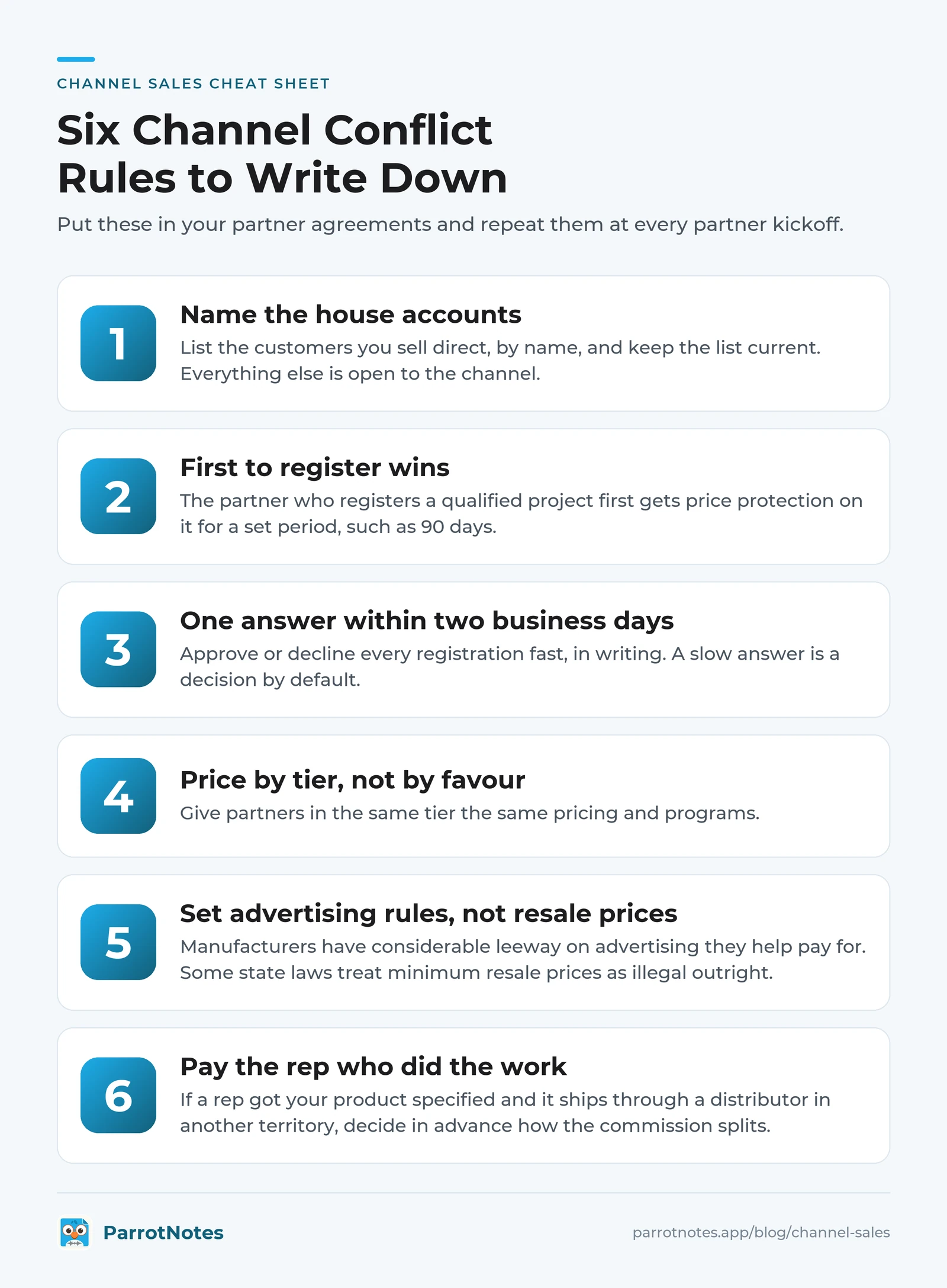
Channel conflict: six rules to write down before it starts
Channel conflict is when your partners, or your partners and your own team, compete for the same customer or order. Some overlap is normal. Unwritten rules turn it into lost trust. Put these six in your agreements and repeat them at every partner kickoff.
- Name the house accounts. List the customers you sell direct, by name, and keep the list current. Everything else is open to the channel.
- First to register wins. The partner who registers a qualified project first gets price protection on it for a set period, such as 90 days. Say what "qualified" means.
- One answer within two business days. Approve or decline every registration fast, in writing. A slow answer is a decision by default.
- Price by tier, not by favour. Give partners in the same tier the same pricing and programs. In the US, the FTC explains that the Robinson-Patman Act can make it illegal to charge competing buyers different prices for the same goods, and that promotional allowances must be available to competing customers on proportionately equal terms. Get legal advice for your own price structure.
- Set advertising rules, not resale prices, unless your lawyer agrees. The FTC notes that manufacturers have considerable leeway on the terms of advertising they help pay for, and may set territories on their own. It also notes that some state laws treat minimum resale prices as illegal outright.
- Pay the rep when the rep did the work. If a rep got your product specified and the order ships through a distributor in another territory, decide in advance how the commission splits. Many agreements split it between the specifying and the delivering territory.
Back to Karen. Her two quotes came from a registration nobody answered. The rep agency had sent it by email; it sat in a shared inbox for three weeks while the distributor quoted the same job off the drawings.
After rules 2 and 3 went into the agreements, she answered every registration within two days. The next quarter, the same two partners came to her with one quote between them.
Running the channel week to week
Agreements set the rules. The week-to-week work is joint calls, branch visits, training sessions and phone calls with partners. That's where promises get made: a stocking commitment, a price for a job, a sample for an engineer, a training date.
Sell-in vs sell-through
Two numbers tell you how a distributor is doing with your line:
- Sell-in is what the distributor bought from you.
- Sell-through is what the distributor sold to its customers, usually from its point-of-sale (POS) reports.
Sell-in alone can fool you. A distributor that stocked up for a rebate deadline will look great on sell-in and then order nothing for two months. Ask for sell-through in your agreement, and look at both side by side.
The quarterly partner review template
Use one page per partner, every quarter. Fill it in before the review meeting, then update it with what was agreed. Copy it into your CRM or a shared document.
QUARTERLY PARTNER REVIEW
Partner: ____________   Type: distributor / rep / dealer   Quarter: ____
Territory: ____________   Our channel contact: ____________

1. NUMBERS
   Sell-in this quarter: ______   Same quarter last year: ______
   Sell-through (POS): ______     Stock on hand (our line): ______

2. PIPELINE
   Registered deals open: ___   Approved: ___   Won: ___   Lost: ___
   Biggest open project, stage and next step: ____________

3. ACTIVITY
   Joint calls this quarter: ___   Branch visits: ___   Training sessions: ___
   Top 3 customers they called on with us: ____________

4. PROMISES (both sides)
   What we promised them: ____________   Done? Y / N
   What they promised us: ____________   Done? Y / N

5. CONFLICTS OR ISSUES
   House-account or territory questions: ____________
   Pricing, stock or warranty problems: ____________

6. NEXT QUARTER
   One goal for the partner: ____________
   One thing we will do for them: ____________
   Next review date: ____________
Section 4 is the one most reviews skip and the one partners remember. If you promised a training day in March and never showed up, they won't mention it in the meeting. They'll just push someone else's line.
Capture the joint call before you drive off
Section 4 is only as good as your notes. After a joint call with a distributor rep or a plant visit with your rep agency, park, open your phone and talk it through for two minutes: who was there, what the customer needs, what each side promised and the next step. Never take notes or dictate while you're driving.
That recap is what ParrotNotes is built for. You get a transcript and an AI summary on every recording; AI-powered recordings add action items and key points. Recording works without signal, and the transcript and summary arrive once you're back online. When the quarterly review comes round, you search the transcripts for the partner's name instead of trying to remember March.
Dev, an illustrative regional manager for a building-products maker, rides with six distributor reps a month. He used to fill in his partner reviews from memory the night before.
Now he records a recap after each ride-along and pastes the promises from each summary straight into section 4. In his first review using it, he found two sample requests he'd forgotten to send, and sent them before the meeting.
For the joint call itself, our distributor sales guide covers the plan card, who does what in the room and the parking-lot split.
What does a channel sales manager do?
A channel sales manager (also called a channel account manager or partner manager) is the manufacturer's employee responsible for a group of partners. They don't usually close end-customer deals themselves. Their job is to make the partners sell more of your line.
A typical week mixes joint calls with distributor and rep salespeople, answering deal registrations and pricing requests, training partner staff, reading sell-through and stock reports, and settling territory questions. Success is measured on partner revenue and on your share of each partner's business. If you sell components into equipment builders, the program side looks different again; see our guide to OEM sales. For the stages a single industrial deal goes through, see the manufacturing sales process.
Make your partners want to sell your line
Channel sales lets a manufacturer reach far more buyers than its own team ever could, as long as every partner knows the rules and trusts you to keep them.
- Pick routes by customer. Decide who goes direct, who goes through distributors and where reps add value.
- Know the price of each route. Run the pump math with your own discounts and commissions.
- Write the conflict rules down. House accounts, deal registration, fast answers, tiered pricing.
- Track sell-through, not just sell-in.
- Review every partner every quarter, and keep the promises section honest on both sides.
Partners remember who kept their word. Download ParrotNotes free: you get 100 minutes of recording a month and an AI summary on every recording, enough to capture every joint call this month and walk into your next partner review with the facts.
Frequently Asked Questions
What is channel sales in simple terms?
Channel sales is when a company sells its products through outside partners, such as distributors, dealers, resellers or manufacturers' reps, instead of only through its own salespeople. The partner reaches or supplies the end customer and earns a margin or commission. It's also called indirect sales.
What is the difference between channel sales and direct sales?
In direct sales, your own employees sell to the end customer and you ship and invoice them. In channel sales, a partner does some or all of that. Most manufacturers use both: direct for a short list of large house accounts, and partners for everyone else.
What is an indirect sales channel?
An indirect sales channel is any route to the customer that runs through a third party. For a manufacturer, that usually means stocking distributors, dealers, manufacturers' rep agencies, value-added resellers and OEMs that build your part into their product.
What is channel conflict?
Channel conflict happens when two of your partners, or a partner and your own sales team, compete for the same customer or order. Clear house-account lists, deal registration with fast answers and consistent pricing by partner tier prevent most of it.
What does a channel sales manager do?
A channel sales manager looks after a group of partners for a manufacturer. They run joint calls, train partner staff, answer deal registrations and pricing requests, review sales and stock reports and hold quarterly partner reviews. They're measured on how much the partners sell.
Related Posts

Zoom AI Companion Meeting Summary: How It Works and Its Limits
Zoom AI Companion meeting summary, checked on Zoom's own pages in Oct 2026: plans, setup, who receives it, 33 languages and limits. Try ParrotNotes free.
Value Engineering: How Suppliers Win Specs Without Cutting Value
Value engineering explained: the SAVE job plan, function analysis, and how suppliers answer a VE swap, with a worked example and a proposal template. Try free.
Samsung Voice Recorder: Transcribe, Share and Organize Recordings
How to use the Samsung voice memo app: record, transcribe with Transcript assist, share and organize recordings, with menu paths checked on Samsung's pages.