
Walking Meetings: How to Hold One and Keep the Notes

Sarah Johnson
Writes about field sales, meeting notes and voice-first workflows at ParrotNotes. Every article is reviewed by the ParrotNotes product team before it goes live.
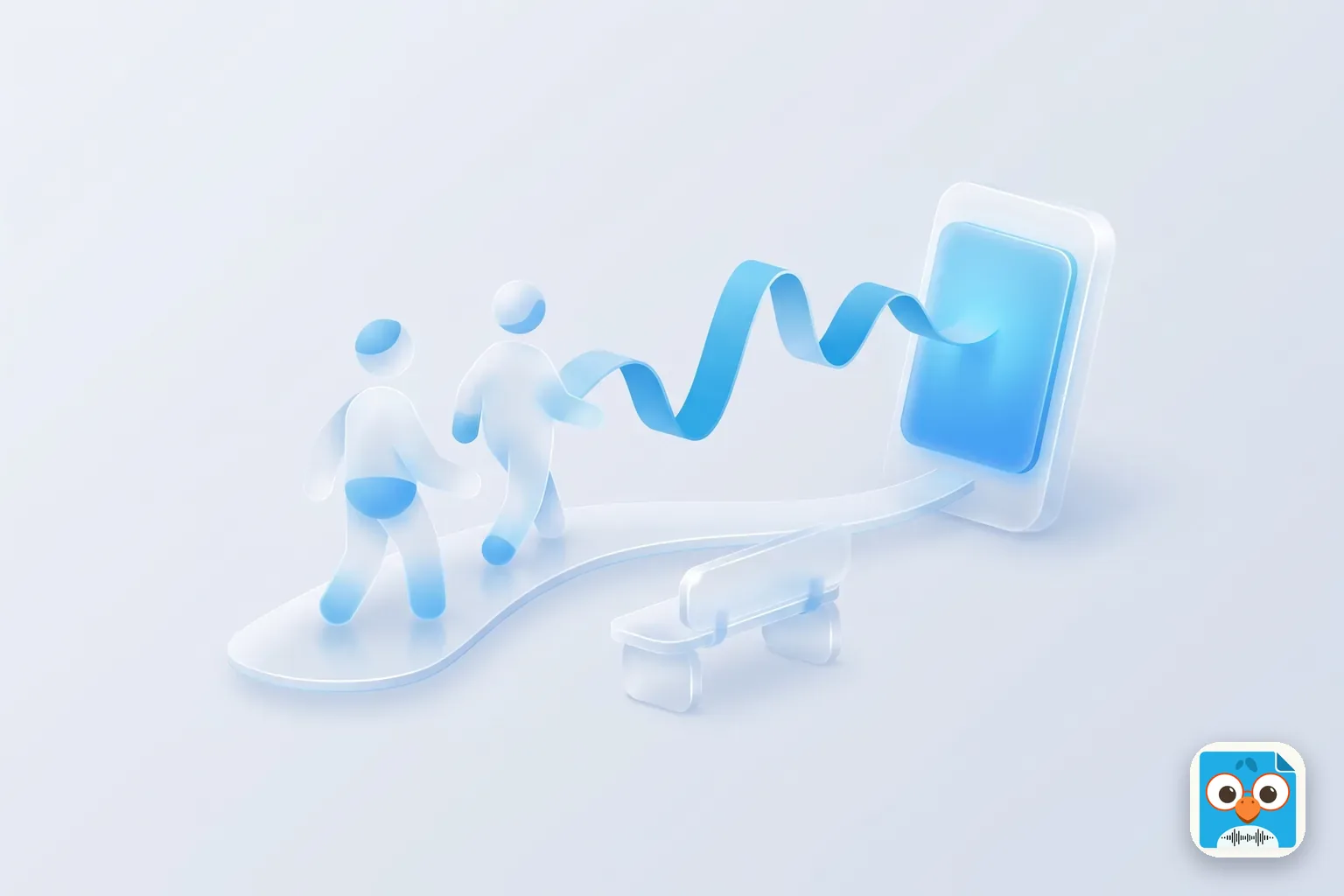
Table of Contents
Lena and her co-founder solved their pricing problem somewhere between the coffee cart and the river. Three good ideas, one clear favorite, a plan for the test. By the time they were back at their desks, they could each remember two of the ideas. Not the same two. (Lena is a composite, not a real person.)
That's the walking meeting in a nutshell. The walk is the easy part. Keeping what you said is where most of them fall apart.
You probably already suspect that walking helps you think. It does, for some kinds of thinking, and research is specific about which kind. This guide covers when a walking meeting beats a room, how to hold one (route, group size, safety, accessibility), a one-card plan you can copy, and two hands-free ways to keep the notes.
If you'd rather talk your notes than type them, ParrotNotes is free to try on the phone already in your pocket.
What a walking meeting is
A walking meeting is a meeting held while the participants walk, usually two or three people, outdoors or along a planned indoor route, with no slides and no laptop. It replaces a room booking with a route.
The idea got a wide audience from Nilofer Merchant's 2013 TED talk, "Got a meeting? Take a walk", which suggested making your next one-on-one a walking meeting. Since then it has become a common option for check-ins, brainstorms and the kind of conversation that goes better side by side than across a table.
What the research says about walking meetings
Most articles say walking "boosts creativity" and stop there. The best-known study says something more useful.
In 2014, Stanford researchers Marily Oppezzo and Daniel Schwartz ran four experiments on walking and thinking, published in the Journal of Experimental Psychology: Learning, Memory, and Cognition. In the first, 48 people did two kinds of task, once sitting and once walking on a treadmill:
- Coming up with ideas (list new uses for an everyday object). 81% did better walking, and creative output rose by around 60% on average.
- Finding one right answer (a word puzzle with a single solution). Only 23% did better walking, and scores dropped slightly overall.
Later experiments found the same idea boost walking outdoors, and a boost that carried over when people sat back down shortly after the walk.
So the honest summary is: walking helps you generate ideas, not close them. It's a good format for "what could we do?" and a poor one for "which exact number goes in the contract?"
There's a health side too. The Physical Activity Guidelines for Americans recommend at least 150 to 300 minutes a week of moderate activity such as brisk walking, and say adults should move more and sit less. A 30-minute walking meeting a few times a week chips away at that without finding extra time.
When a walking meeting fits (and when to sit)
Use the study's split to decide.
| Meeting goal | Walk or sit? | Why |
|---|---|---|
| Brainstorm options, name a problem, explore an idea | Walk | Idea generation is what walking helped |
| One-on-one check-in, career talk, coaching | Walk | Side by side feels easier for hard topics |
| Getting to know a new hire or a peer | Walk | Low pressure, no screen between you |
| Choosing between options you already have | Walk, then sit | Generate on the walk, decide at a table |
| Numbers, contracts, line-by-line review | Sit | One-right-answer work did worse walking |
| Anything with a screen, a document or more than three people | Sit | You can't share a slide on a sidewalk |
| Confidential HR or legal matters | Sit, in a private room | Public paths have ears |
A good pattern is walk to open the problem, sit for ten minutes at the end to decide.
How to hold a walking meeting: seven steps
- Write one question. "How do we cut onboarding from three weeks to two?" beats "catch up." A walk without a question turns into a chat.
- Invite with an easy opt-out. Say it's a walking meeting in the invite and offer a seated version in the same message. Nobody should have to explain why they'd rather sit.
- Pick a loop, not a line. A loop of 15 to 20 minutes for a 30-minute meeting brings you back on time without checking the clock. Flat, paved, quiet, with a bench near the end.
- Keep it to two or three people. Four people on a sidewalk is two conversations.
- Agree on roles. One person owns the question and keeps time. One person owns the notes (see below).
- Mind safety and privacy. Single file at crossings, no talking over traffic, a route with shade or cover, and no names or confidential details where strangers can hear.
- End at the bench. Spend the last three to five minutes stopped: say the decision, the next steps, and capture them.
Make it accessible
Walking meetings shouldn't quietly exclude anyone. Offer the choice every time, not just once. Choose step-free routes and a pace the slowest walker sets.
Tell people the distance in advance. For a colleague who uses a wheelchair, ask what works for them: a smooth, step-free loop may suit, and a seated meeting by a window keeps the change of scene for anyone who'd rather not walk.
The remote version: walk and talk by phone
Two people on a call can both walk. Use earbuds, audio only, each on your own loop. It suits remote one-on-ones especially well, and the one-on-one meeting template still works as the agenda: read the topics before you leave, fill in the actions after.
The one-card walking meeting plan
Copy this into your calendar invite.
WALKING MEETING PLAN
Question:    [one sentence we want to answer]
Who:         [2-3 names]   Seated option: [room / call link]
Route:       [loop name, start/end point]   Length: [~15-20 min loop]
Time:        [30 min] = [25 walking] + [5 at the bench]
Roles:       Question + time: [name]   Notes: [name]
Capture:     Bench debrief voice note / recording (everyone agreed: yes/no)
Out of scope: [anything that needs a screen or a document]
The last line matters. When someone says "let me check the spreadsheet," it goes on a list for the seated follow-up, not into your hand mid-crossing.
Want to save the plan where you'll find it later? ParrotNotes keeps unlimited manual notes on the Free plan, next to your recordings.
How to keep notes from a walking meeting
You can't type while you walk, and you shouldn't try. There are two hands-free options.
Option 1: the three-minute bench debrief
When you reach the bench, the note-taker opens a voice note and talks through five prompts out loud, with the others correcting as they go:
- "The question was..."
- "Ideas we raised: one, two, three..."
- "We're going with... because..."
- "Next steps: [name] will [task] by [day]."
- "Still open, for the seated follow-up..."
Five signposts, under three minutes. Speaking in signposts like "next steps" makes the transcript easy to scan later; our guide to speech to text notes goes deeper on that habit. In ParrotNotes, every recording gets a transcript and an AI summary, and AI insights pull out the action items, so the debrief turns into a list you can paste into chat.
Option 2: record the walk, with consent
For a brainstorm where the ideas fly fast, you can record the whole walk. Ask first, every time, and say what happens to the recording. Recording laws differ by state; our guide to one-party consent states covers the rules. Keep the phone in a chest pocket or your hand, mic side up, and pick the quieter side of the path. Recording works offline, and the transcript and summary arrive once you're back on a connection.
Skip recording for sensitive one-on-ones. For those, the bench debrief, said together, gives both people the same record without a tape running. If the walk is a skip-level, the skip-level meeting questions post explains how to note answers without breaking trust.
A walking meeting, start to finish (composite example)
Marcus manages a support team of eight. On a Thursday he takes Priya, a team lead, on the 18-minute loop behind their office. The question on the card: "How do we stop weekend tickets piling up for Monday?" (Marcus and Priya are composites.)
Over 25 minutes they raise four ideas: a weekend rotation, a better auto-reply, a Friday triage hour, a self-help page for the top ten questions. At the bench, Priya records the debrief in two minutes and forty seconds.
Back at his desk, Marcus has the summary and three action items: Priya drafts the rotation by Tuesday, Marcus checks the overtime budget, both meet seated on Wednesday to choose. The ideas came on the walk. The decision waits for the table.
Take your next one-on-one outside
Walking meetings work when you use them for the right job. Walk to open a problem and generate ideas, sit to choose and check numbers. Keep it to two or three people, a loop with a bench at the end, and a seated option for anyone who wants it. Then stop and say the outcome out loud before you go back inside, so the best idea of the day doesn't stay on the path.
Pick one meeting on next week's calendar, copy the plan into the invite, and try it.
Download ParrotNotes free and record your first bench debrief: transcript, AI summary and action items, on the phone you already carry.
Frequently Asked Questions
What is a walking meeting?
A walking meeting is a meeting held while walking, usually with two or three people and no screens. It suits brainstorming, one-on-ones and coaching better than detailed reviews.
Are walking meetings good for creativity?
For idea generation, yes. In a 2014 Stanford study, 81% of participants came up with more creative ideas walking than sitting. The same study found walking didn't help, and slightly hurt, puzzles with one right answer.
How long should a walking meeting be?
Thirty minutes works well: about 25 minutes walking a 15 to 20 minute loop, plus five minutes stopped at the end to confirm decisions and capture notes.
How many people should be in a walking meeting?
Two or three. Beyond that, the group splits into separate conversations and someone always ends up walking behind.
How do you take notes in a walking meeting?
Don't type while walking. Stop at the end and record a three-minute voice debrief covering the question, ideas, decision, next steps and open items, or record the whole walk with everyone's consent and use the transcript.
Related Posts

Value-Based Selling: How to Sell Value Instead of Price
Value-based selling for reps who meet buyers in person: five steps, questions to ask, value math from the buyer's own numbers and a notes sheet. Try it free.
Transcription Software for Journalists: 8 Tools Compared
Transcription software for journalists compared: 8 tools with prices checked October 4, 2026, where your audio is stored, and which fits each interview.
Tactiq Alternative: 5 Options for Meetings Outside the Browser
Looking for a Tactiq alternative? Compare 5 tools for in-person meetings, desktop calls and mixed languages, with every price checked in October 2026.