
Nursing Informatics: What It Is, What Informatics Nurses Do and How to Get Started

Sarah Johnson
Writes about field sales, meeting notes and voice-first workflows at ParrotNotes. Every article is reviewed by the ParrotNotes product team before it goes live.
Table of Contents
- 1.What is nursing informatics?
- 2.What informatics nurses do day to day
- 3.Nursing informatics education: what you actually need
- 4.Nursing informatics certification: the ANCC NI-BC
- 5.What informatics nurses earn
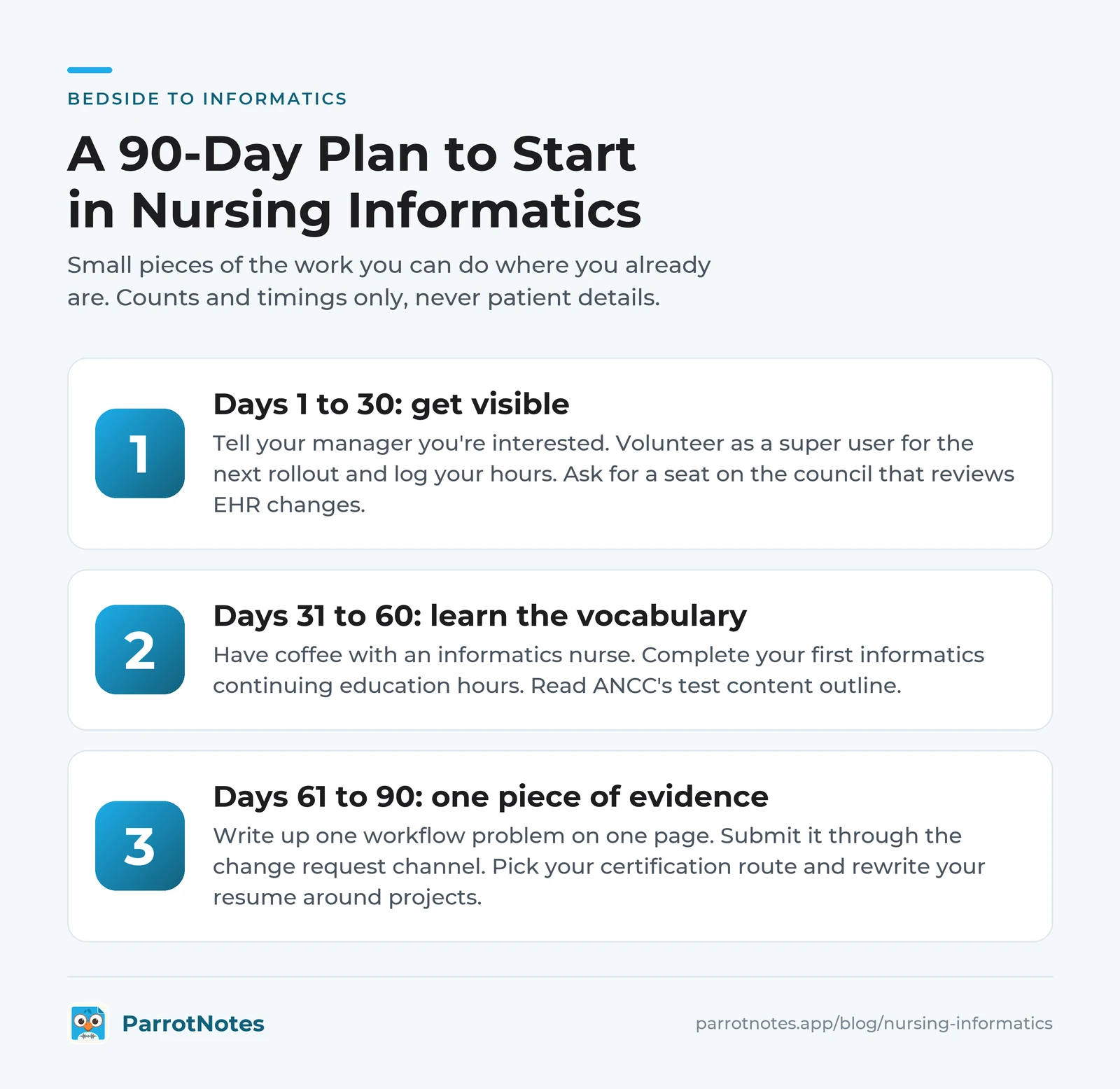
- 6.How to move from the bedside into nursing informatics: a 90-day plan
- 7.Keep project and class notes without patient data
- 8.Start with one project, not one degree
Every unit has one. The nurse who gets pulled aside when the new barcode scanner won't read, who knows why the admission screen has 14 clicks and which three could go. On Priya's med-surg floor, that nurse is Priya.
Last spring her manager asked her a question she couldn't answer: "Have you thought about informatics?" (Priya is a composite, not a real person.)
If you're that nurse, you already do a small piece of the job. Nursing informatics is the specialty that turns it into a career: nurses who design, build and improve the systems other nurses chart in.
This guide covers what informatics nurses do, the education and certification you need, what the work pays according to named surveys, and a 90-day plan for getting there from the bedside. US facts were checked on November 17, 2026.
Sitting in on your first informatics committee meeting soon? Try ParrotNotes free and get a summary of the decisions without writing through the hour. Project meetings only, never patient information.
What is nursing informatics?
Nursing informatics is the nursing specialty that joins nursing science with computer and information science, so the right information reaches the nurse at the right moment. The American Nurses Association (ANA) defines it as the "integration of nursing science, computer science, and information science" to manage and communicate data, information, knowledge and wisdom in nursing practice, in its nursing informatics overview.
In plain words: an informatics nurse speaks both languages. They know what a night shift with six patients feels like, and they know how the electronic health record (EHR) is built.
It isn't an IT job that happens to hire nurses. ANA says you need to be a registered nurse to work in the specialty, and the clinical background is the point.
Job titles vary. In the HIMSS 2022 Nursing Informatics Workforce Survey of 1,118 nurse informaticists, the most common title was Nursing Informatics Specialist (17%), followed by Clinical Informatics Specialist (12%). You'll also see clinical analyst, informatics nurse consultant, and at the top of the ladder, chief nursing informatics officer (CNIO).
What informatics nurses do day to day
The same HIMSS survey asked respondents to pick their top responsibilities. Five led the list:
| Responsibility | Share of respondents | What it looks like |
|---|---|---|
| Systems implementation | 41% | Rolling out a new EHR module or device, and supporting nurses on go-live day |
| System optimization | 35% | Fixing what annoys people: fewer clicks, clearer alerts, better order sets |
| Project management | 30% | Timelines, stakeholders, testing plans, status updates |
| Systems development | 29% | Designing screens, forms and workflows with the build team |
| Quality initiatives and reporting | 26% | Pulling data for quality measures and showing units their numbers |
Teaching runs through all of it: classes before a go-live, tip sheets, at-the-elbow support. That's why the job overlaps with the nurse educator role.
A week in the job
Marcus is two years into a clinical informatics specialist post at a 300-bed hospital. (Marcus is a composite, built from the survey's responsibility list, not a real schedule.)
On Monday he rounds on two units that went live last week and logs 11 issues. On Tuesday he argues in a build meeting that a new required field will cost every nurse 20 seconds per admission. Wednesday is the informatics council: nine agenda items, four decisions, six action items. Thursday he teaches new hires, and Friday he tests next month's upgrade.
Notice what's missing: a patient assignment. A post like this is office-hours project work, so direct care, shift differentials and three 12s usually go. For some nurses that's the appeal. For others it's the cost.
Where does this happen? In the HIMSS survey, 62% worked for a hospital or multi-facility health system. Other workplaces in the survey include vendors and payers, government, ambulatory care and universities.
Nursing informatics education: what you actually need
School websites often make it sound as if you need a master's degree to start. You don't.
The floor is an RN license and, for certification, a bachelor's degree in nursing. In the HIMSS survey, 40% of respondents reported a bachelor's in nursing, 28% a master's in nursing informatics, and 63% held a master's of some kind.
So a master's is common, not required. It buys you two things:
- A faster route to certification. A graduate program with a supervised practicum removes the need to build 2,000 practice hours first (see the table below).
- Higher pay over time. HIMSS found that 25% of respondents with a doctorate or NP earned $176,000 or more, against 12% of those with a master's and 8% with a bachelor's.
You can also start the other way round: take a super-user role or a first informatics job with a BSN, then study once you know you like the work. A written nursing professional development plan helps you pick one goal for the year.
Nursing informatics certification: the ANCC NI-BC
The main nursing informatics certification in the United States is the Informatics Nursing Certification from the American Nurses Credentialing Center (ANCC). The credential is now written NI-BC. Older articles, and some nurses' badges, still say RN-BC.
According to ANCC's certification page, read on November 17, 2026, you need all of these:
- A current, active RN license
- A bachelor's or higher degree in nursing
- The equivalent of two years of full-time practice as a registered nurse
- 30 hours of continuing education in informatics nursing within the last three years
- One of three practice-hour options (the table below)
The exam gives you three hours for 150 questions, of which 125 are scored. ANCC's test content outline, effective May 3, 2023, splits the scored questions into Foundations of Practice (36%), System Design Lifecycle (35%) and Data Management and Healthcare Technology (29%).
The fee is $395, or $295 for ANA members and $340 for members of the American Nursing Informatics Association (ANIA). The credential lasts five years. Check ANCC's page before you apply, because fees change.
Which NI-BC route fits you?
ANCC lists three ways to meet the practice requirement. We turned them into a route-finder. The weekly figures are our arithmetic (hours divided by 156 weeks in three years), not ANCC's wording.
| If this is you | ANCC option | What it works out to |
|---|---|---|
| You already work in an informatics role | 2,000 hours in informatics nursing in the last three years | About one year full time, or roughly 13 hours a week across three years |
| You do informatics work part time and have started a graduate program | 1,000 hours in the last three years, plus 12 semester hours of graduate informatics courses | Roughly 6.5 hours a week across three years, plus the courses (four, if each carries three credits) |
| You're a bedside nurse going back to school | A graduate informatics nursing program with at least 200 hours of faculty-supervised practicum | No prior informatics job needed; the practicum is the practice |
One caution: ANCC decides what counts as informatics nursing practice. Don't assume super-user shifts or committee time qualify. Ask ANCC before you count them.
The 30 continuing education hours are the easiest piece to start now. Our list of free nursing CEUs shows where to look, and the free CEU tracker keeps the certificates in one place.
Is it worth it? In the HIMSS survey, holding an informatics-related certification was associated with higher salaries, and 58% of certified respondents had moved into a new role since certifying.
What informatics nurses earn
Many pay figures online are job-board averages with no date. Two named sources are better.
HIMSS. The HIMSS salary guide reports US base salaries as of June 2022. It's the most recent edition we could find. The largest group, 27%, reported $101,000 to $125,000, and 24% reported $76,000 to $100,000.
In total, 60% earned more than $100,000, and 18% earned $151,000 or more. That 60% was 49% in 2020 and 33% in 2014, so pay has been climbing.
BLS. The Bureau of Labor Statistics doesn't publish a separate figure for informatics nurses. For comparison, its registered nurses page puts the median annual wage for all RNs at $97,550 in May 2025.
Now the part most career pages skip: experience drives the number. Among HIMSS respondents with five years or less in informatics, 60% earned between $51,000 and $100,000. Among those with 11 or more years, 66% earned more than $150,000.
So a first informatics job can pay less than a bedside job with night and weekend differentials. The gain comes later. In the same survey, 76% said they were highly satisfied with their choice of career.
How to move from the bedside into nursing informatics: a 90-day plan
The quickest way in is to do small pieces of the work where you already are. Here's a plan we built for a working bedside nurse.
Days 1 to 30: get visible.
- Tell your manager you're interested, in those words.
- Volunteer as a super user for the next upgrade or device rollout, and log it: date, project, what you did, hours.
- Ask who runs the nursing informatics council or the shared governance council that reviews EHR changes. Ask for a seat or a guest invite.
Days 31 to 60: learn the vocabulary.
- Book a 20-minute coffee with an informatics nurse at your hospital. Ask how they got the job.
- Complete your first informatics continuing education hours and file the certificates.
- Read ANCC's test content outline, which doubles as a map of the field. Then look at ANIA, which reports an estimated 3,000 members and offers chapters and a certification review course.
Days 61 to 90: produce one piece of evidence.
- Write up one workflow problem on your unit on one page: the current steps, the cost in time, a proposed fix. Counts and timings only, never patient details.
- Submit it through the proper change request channel and offer to present it to the council.
- Pick your route from the table above, then rewrite your resume around projects: go-lives supported, classes taught, requests submitted.
That one-page write-up matters most. In an interview, "I cut two steps from our admission workflow" beats "I'm good with computers."
Keep project and class notes without patient data
Informatics work happens in meetings. A council session can produce four decisions and six action items in an hour. That's the moment a recorder helps: the project meeting, the vendor training day, the informatics class.
Elena handles it like this. Before the monthly council meeting she asks the chair and the room whether she can record for the minutes. The agenda is build requests and training dates.
She records on her phone, gets a summary and action items from ParrotNotes, and sends the list to the chair that afternoon. When a case review or a live patient chart comes up on screen, she stops recording. (Elena is a composite, not a real person.)
The rules are short:
- Never patient information. No names, room numbers, diagnoses or screenshots of real charts, spoken or typed. ParrotNotes is a general note-taking app. It makes no HIPAA claim and isn't a clinical system.
- Ask first. Get the room's agreement and follow your employer's recording policy.
- Record the work, not the ward. Project meetings, vendor training, classes and your own recaps.
The Free plan gives you 100 minutes a month, up to 30 minutes per recording, with an AI summary on every recording. Pro is $19.99 a month, or $14.99 a month billed annually, with 3,000 minutes a month and up to 3 hours per recording, so a full council meeting fits in one file. Download ParrotNotes to try it on your next project meeting.
For the rest of your phone, our guide to the best apps for nurses compares 12 apps by the job they do, and AI for nurses covers the safe uses of AI tools.
Start with one project, not one degree
Nursing informatics is an established specialty with its own certification and its own salary curve. You need an RN license to enter, two years of RN practice and a bachelor's in nursing to certify, and proof that you can improve a workflow.
You don't need a master's to begin, the first job may not beat bedside pay, and a logged super-user role with a one-page workflow fix says more than a course list.
Pick the next rollout on your unit and put your hand up. Then get ParrotNotes free and keep every project meeting's decisions where you can find them.
Frequently Asked Questions
What is nursing informatics in simple terms?
Nursing informatics is the nursing specialty that combines nursing knowledge with computer and information science. Informatics nurses help choose, design, roll out and improve the systems nurses use, such as the electronic health record, and train staff to use them.
What does an informatics nurse do?
In the HIMSS 2022 Nursing Informatics Workforce Survey, the top responsibilities were systems implementation (41%), system optimization (35%), project management (30%), systems development (29%) and quality initiatives and reporting (26%). Teaching and supporting staff during rollouts is part of the work too.
Do you need a master's degree for nursing informatics?
No. ANCC's Informatics Nursing Certification requires a bachelor's or higher degree in nursing, not a master's. A graduate program is one of three ways to meet the practice requirement, and HIMSS data shows higher degrees are linked to higher pay, but a master's is not an entry requirement.
How much do informatics nurses make?
In the HIMSS survey, which reports US base salaries as of June 2022, 60% of respondents earned more than $100,000 and 18% earned $151,000 or more. Among those with five years or less in informatics, 60% earned between $51,000 and $100,000. For comparison, BLS puts the median wage for all registered nurses at $97,550 in May 2025.
What is the NI-BC certification?
NI-BC is the credential awarded by ANCC's Informatics Nursing Certification. As of November 2026 it requires an active RN license, a bachelor's or higher in nursing, two years of full-time RN practice, 30 informatics continuing education hours in the last three years and one of three practice-hour options. The exam has 150 questions and the credential is valid for five years.
Related Posts
Wave AI Note Taker Review: The iPhone and Android App, Plans and Limits
Wave AI Note Taker review from its own pages, checked November 2026: the 30 free minutes, Pro prices, iPhone and Android limits. Try ParrotNotes free.
Transcript With Timestamps: How to Get One From Any Recording
Get a transcript with timestamps from an audio or video file, a phone recording, Zoom, Teams, Google Meet or YouTube, with format examples you can copy.
tl;dv Review: The Meeting Recorder, Its Free Plan and Mobile App
tldv review from tl;dv's own pages, checked November 2026: the meeting bot, the bot-free desktop app, the iPhone and Android app, free limits and prices.