
Meeting Norms: Examples and How to Set Them

Sarah Johnson
Writes about field sales, meeting notes and voice-first workflows at ParrotNotes. Every article is reviewed by the ParrotNotes product team before it goes live.
Table of Contents
There's a laminated poster on the wall of Room 114. It lists six meeting norms the fourth-grade team agreed in August: "Be present," "Assume good intent," "Stay on topic," and three more nobody can recite. By October the team still meets there every Thursday, and nobody has looked at the poster since week two.
That's the usual life of meeting norms. A team writes them once, pins them up, and goes back to the habits it had before. (The team in Room 114 is a composite, an illustration rather than a real school.)
This guide is for teams that meet again and again: office teams, PLCs, IEP teams, departments, project groups. You'll get meeting norms examples for each, a 45-minute session to set them, a template to copy, and a simple scorecard that keeps them alive past October.
If you're running the meeting and taking the notes too, ParrotNotes can record on the phone on the table, with everyone's agreement, and hand you the summary and action items afterwards.
What are meeting norms?
Meeting norms are the working agreements a standing team sets together about how it behaves in its meetings: how people speak, listen, decide, and follow through. The team writes them, checks them, and changes them as it learns.
Duke's Bass Connections program puts it well in its guide to setting team norms: norms are expected behaviors that define a team's culture, and they let members "name and discuss actions that violate the norms." That last part is the point. A norm is something you can point to.
People often mix norms up with three neighbors. Here's how they differ:
| Who sets it | How long it lasts | Example | |
|---|---|---|---|
| Meeting norms | The standing team, together | Months, reviewed on a schedule | "We decide who owns each action before we leave" |
| Ground rules | The facilitator and group of one meeting or workshop | That meeting | "Phones down for today's session" |
| Team charter | The team and its sponsor | The life of the team | Purpose, goals, roles, decision rights |
| Etiquette | Nobody in particular | Always | Arrive on time, don't talk over people |
If you're running a one-off workshop or a single meeting, you want meeting ground rules, which a group can agree in five minutes at the start. Norms take longer because they have to survive dozens of meetings.
Meeting norms examples that teams keep
The best norms describe something you could see or hear. "Be respectful" fails that test. "We let a speaker finish before we respond" passes. Duke's guide suggests five to seven norms, and no more than 10.
Here are 12 meeting norms examples written as behaviors. Pick the five or so that fix problems your team actually has.
- We start on the minute and end five minutes early. The timekeeper calls both.
- We come having read the pre-read. If we haven't, we say so and listen.
- One voice at a time, including the chat.
- Everyone speaks on every decision. The facilitator asks the quiet half of the room first.
- We disagree here, not in the hallway afterwards.
- We assume good intent and ask before we judge. "Help me understand" beats "That won't work."
- We bring data, not just opinions. Student work, numbers, the customer's own words.
- We say how we'll decide before we discuss. Consensus, vote, or the lead decides.
- Decisions stay made unless there's new information.
- Every action leaves with an owner and a date.
- What's personal stays in the room; decisions go in the notes.
- We check our norms in the last three minutes.
"Trust" and "collaboration" are fine goals. They aren't norms until you say what they look like on a Thursday afternoon.
Meeting norms by team type
The trouble spots differ by team. Use these sets as a first draft, then rewrite them in your team's own words.
Office or department team (weekly meeting)
- Updates go in the shared doc before the meeting; meeting time is for problems.
- Problems get an owner, then get solved outside the meeting.
- Laptops closed unless you're presenting or taking the notes.
- The staff meeting agenda goes out 24 hours ahead, or the meeting is cancelled.
PLC or grade-level teacher team
PLC meeting norms are among the most searched, and for good reason: teacher teams meet weekly for a whole school year. WestEd's protocol for establishing PLC norms opens with seven norms of collaboration: pausing, paraphrasing, posing questions, putting ideas on the table, providing data, paying attention to self and others, and presuming positive intentions. Turn them into team-specific behaviors like these:
- We bring the common assessment data, already scored.
- We talk about students' work, not students' families.
- Every meeting ends with what we'll each try in class this week.
- Roles rotate monthly: facilitator, timekeeper, notetaker.
IEP team
- The family is a full member of the team; we explain every acronym the first time.
- Everyone gets the draft goals before the meeting.
- One person speaks for the school on each commitment.
- We end by reading back services, owners and dates.
Faculty or staff meeting (large group)
- Information that could be an email is an email.
- Questions go in the parking lot if they affect fewer than half the room.
- Small-group work has a reporter who shares one sentence back.
Remote or hybrid team
- Cameras on for discussion items, optional for updates.
- Remote people speak first on each decision.
- We use the raise-hand button, in the room too.
- See our hybrid meeting guide for the setup side.
Project or agile team
- We raise blockers the day we find them, not at the next meeting.
- The retro talks about the process, never the person.
- Scope changes are logged, with who asked and why. A decision log helps.
How to set meeting norms in a 45-minute session
Norms that a leader hands out get polite nods. Norms the team builds get used. This session plan draws on the Center for Creative Leadership's 10 steps for establishing team norms and the WestEd PLC protocol, squeezed into one meeting.
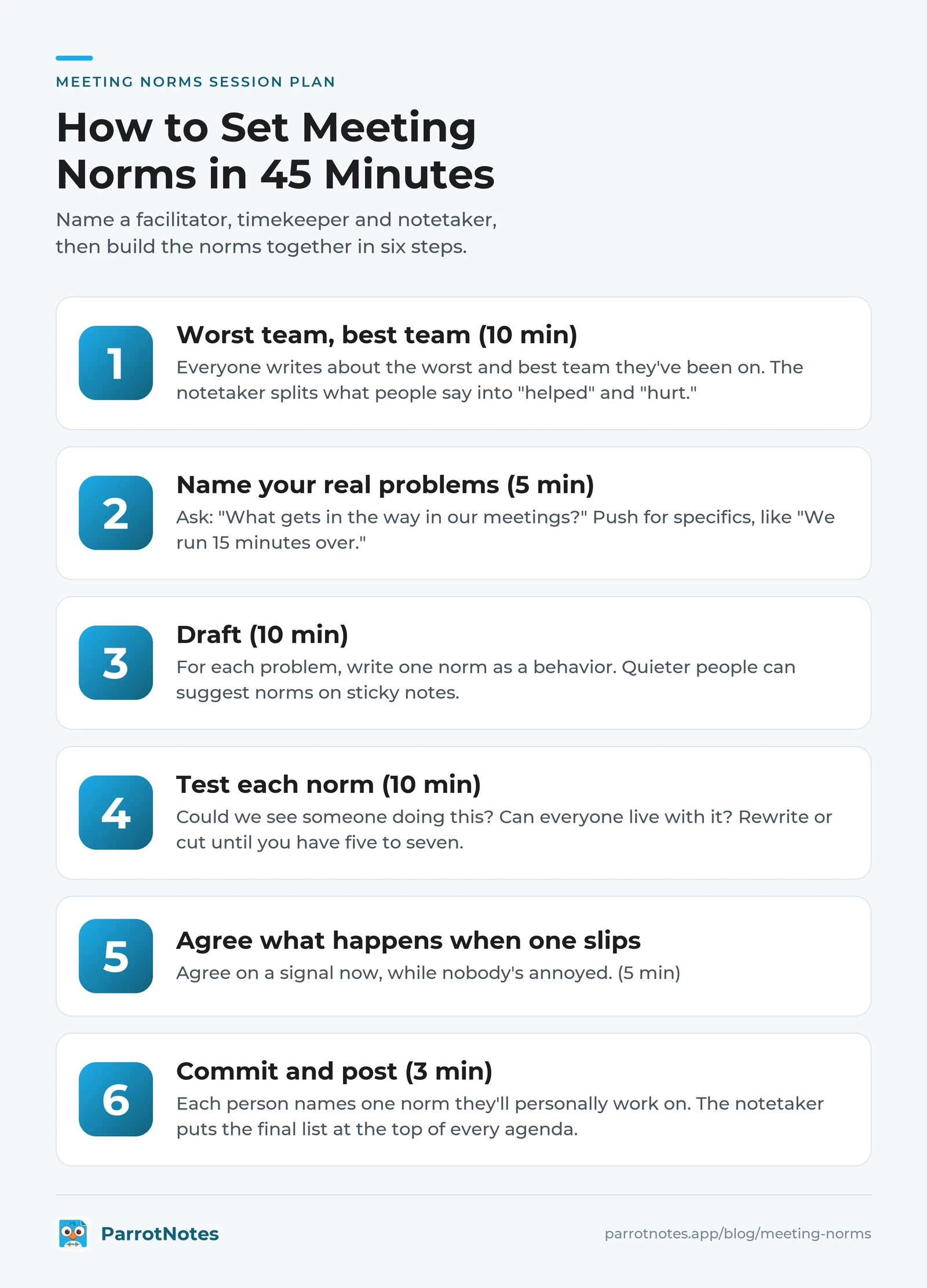
Before you start (2 minutes). Name three roles: facilitator, timekeeper and notetaker. Say why you're here: "We're going to agree how we work together for the rest of the year."
Step 1: Worst team, best team (10 minutes). Everyone spends two minutes writing about the worst team they've been on and what made it bad, then the best. Share round the table. The notetaker splits what people say into "helped" and "hurt."
Step 2: Name your real problems (5 minutes). Ask: "What gets in the way in our meetings?" CCL warns that vague norms don't fix specific problems, so push for specifics: "We run 15 minutes over," "Two people do all the talking."
Step 3: Draft (10 minutes). For each problem, write one norm as a behavior. Offer the examples above as a starting menu. People who'd rather not speak up can suggest norms on sticky notes, as the WestEd protocol suggests.
Step 4: Test each norm (10 minutes). Read each one aloud and ask two questions. "Could we see someone doing this?" and "Can everyone live with it?" Rewrite or cut until you have five to seven.
Step 5: Agree what happens when one slips (5 minutes). CCL's step 9 is the one most teams skip: discuss how to respond when someone doesn't follow the norms. Agree on a signal now, while nobody's annoyed.
Step 6: Commit and post (3 minutes). Each person names one norm they'll personally work on. The notetaker puts the final list at the top of every agenda.
Priya leads a seven-person finance operations team that met every Monday and ran over every Monday. She ran this session in January. The team's biggest problem turned out not to be talking too long. It was arriving without the numbers. Their first norm became "We post our figures in the doc by Friday noon." The team now finishes its Monday meeting early most weeks. (Priya is a composite, not a real person.)
Want help keeping the record of that session? Try ParrotNotes free: it records from your phone with no meeting bot, and the summary lists the norms you agreed.
A team norms template you can copy
Paste this into the first page of your team's shared doc, or the top of your meeting agenda template.
TEAM MEETING NORMS: [Team name]
Agreed: [date]        Next review: [date, about 3 months later]
Roles this term: Facilitator [name]  Timekeeper [name]  Notetaker [name]

NORM                              WHAT IT LOOKS LIKE                    IF IT SLIPS
1. [Norm, as a behavior]          [What you'd see or hear]              [Agreed signal or step]
2. Every action leaves with       Notetaker reads back owners and       Facilitator holds the
   an owner and a date            dates before we close                 meeting 2 extra minutes
3.
4.
5.

NORMS CHECK (last 3 minutes of every meeting)
Which norm did we do best today?  Which one slipped?

SIGNED OFF BY: [every member's initials]
The middle column matters most. If the team can't fill it in, the norm is still a value, not a behavior.
How to review and enforce meeting norms
Here's where most norms quietly die. CCL is blunt about it: setting norms "shouldn't be skipped over, nor a one-time activity." Three habits keep them working.
1. A three-minute norms check at every meeting
In the last three minutes, the facilitator asks two questions: which norm did we do best, and which one slipped? Short answers are fine. Rotating who answers first stops it from becoming the leader's report card.
2. A quarterly norms scorecard
Every three months, each member rates every norm from 1 (we rarely do this) to 4 (we always do this), privately, then answers four questions:
- Which norm do we follow best?
- Which norm do we break most?
- Is there a problem in our meetings no norm covers?
- Which norm could we drop because it's now a habit?
Average the scores. Any norm under 2.5 needs a conversation. Duke's guide suggests asking why a norm keeps getting broken, then deciding whether to keep it or change it. Sometimes the norm is wrong, not the people.
3. A response everyone agreed in advance
Use the signal you chose in Step 5: a card on the table, or just "norm check." Because the team chose it, calling a norm isn't personal, and anyone can do it. If one person keeps breaking the same norm, the team lead raises it one to one, not in the meeting.
The fourth-grade team from Room 114 tried the scorecard in November. "Stay on topic" scored 1.8. When they talked about why, it turned out the agenda had no slot for the problems teachers actually wanted to raise. They added a 10-minute "open issues" item and rewrote the norm as "Off-agenda items go to open issues." At the next review it scored 3.4. (Again, a composite.)
Keep the record of your norms checks
Reviews go faster with evidence: "we ran over in four of the last six meetings" beats a vague feeling. With the room's agreement, ParrotNotes records the meeting and gives you a transcript, a summary and action items, so the notetaker can join the discussion. As of November 2026 the free plan includes 100 minutes of recording a month; download ParrotNotes to try it at your next norms check.
For more on running the room itself, see our meeting facilitation guide and the retrospective meeting guide.
Meeting norms that last past October
Good meeting norms are few, written as behaviors and owned by the team that uses them. To recap:
- Keep it to five to seven norms that fix your team's real problems.
- Write what it looks like for every norm, or it's only a value.
- Set them together in one 45-minute session, including how you'll respond when one slips.
- Check them every meeting in three minutes, and score them every quarter.
- Retire norms that have become habits and add one for each new problem.
Start with the template above at your next meeting. In three months, run the scorecard and see which norms your team has earned the right to drop.
Frequently Asked Questions
What are meeting norms?
Meeting norms are working agreements a standing team sets together about how it behaves in meetings, such as how people speak, decide and follow through. Good norms describe behavior you could see, like "every action leaves with an owner and a date," and the team reviews them every few months.
What is the difference between meeting norms and ground rules?
Ground rules usually cover one meeting or workshop and can be agreed in a few minutes at the start. Meeting norms belong to a team that meets again and again: the team builds them together, checks them at each meeting and revises them over the year.
How many meeting norms should a team have?
Five to seven is a good range, and Duke's Bass Connections guide suggests no more than 10. Fewer norms that people remember work better than a long list on a poster.
What are good PLC meeting norms?
Good PLC norms focus on student work and data: bring the common assessment data already scored, talk about students' work rather than their families, rotate the facilitator, timekeeper and notetaker roles, and end with what each teacher will try in class that week.
How often should a team review its meeting norms?
Do a short norms check at the end of every meeting and a fuller review about every three months, or whenever a new member joins. Drop norms that have become habits and add one for each new problem.
Related Posts

Best Talk to Text App for iPhone and Android
The best talk to text app for your phone: Apple Dictation and Siri on iPhone, Gboard and Gemini on Android, with free plans compared and a voice phrase sheet.
How to Use Speech to Text on iPhone
Turn on speech to text on iPhone in 3 steps, dictate in any app, switch languages, turn it off, and record when the mic stops. Checked on iOS 27, Nov 2026.
How to Record Calls on Samsung
Samsung call recording, step by step: record or auto record calls, find the files, get Galaxy AI transcripts, or turn it all off. Checked November 2026.