
Contract Negotiation for Sales Reps: Terms and Tactics

Sarah Johnson
Writes about field sales, meeting notes and voice-first workflows at ParrotNotes. Every article is reviewed by the ParrotNotes product team before it goes live.
Table of Contents
- 1.What contract negotiation is (and where it starts for a rep)
- 2.Who owns which terms: you, your manager, or legal
- 3.The contract terms give-get sheet
- 4.Contract negotiation tactics for the paper stage
- 5.The redline log
- 6.A worked redline round: three changes, one call
- 7.When to bring in legal (and how to hand it over)
- 8.Contract negotiation mistakes reps make
- 9.Close the deal on paper, not just in the room
Marco shook hands on a 96,000 deal on Friday afternoon. On Monday morning the customer's paper came back with 31 tracked changes, a 60-day payment window, a termination-for-convenience clause and a liability cap rewritten in language he had never seen. The buyer wanted it signed by Thursday. Marco forwarded the whole thing to legal with "can you look at this?" and the deal sat in a queue for three weeks. (Marco is a composite, not a real person.)
The handshake isn't the close. Contract negotiation is where a won deal keeps its margin, or gives it back one redline at a time.
This guide is the rep's side of the table: plain-language explanations of the terms that come back most often, a give-get sheet for what you can trade on each, a redline log, and a clear line for when to bring in legal. This is general information for salespeople, not legal advice. Your company's lawyers own the legal wording.
What contract negotiation is (and where it starts for a rep)
Contract negotiation is the stage where two sides turn an agreed deal into binding written terms. Price may already be settled. What's left is everything around it: payment, length, renewal, service levels, what happens if something goes wrong, and who pays for it.
For a rep, it usually starts in one of three ways:
- You send your standard agreement and the buyer's procurement or legal team sends it back with redlines (tracked changes).
- The buyer sends their own paper, a master agreement or purchase terms, and asks you to sign it.
- Terms come up in the room before any paper exists: "we only do Net 60" or "we'll need a 30-day exit clause."
Our guide to sales negotiation covers the price conversation across the table: the prep sheet, anchoring and the concession log. This article picks up where that one stops, when the deal turns into paper. If terms first come up in the room, ParrotNotes can keep the buyer's exact words for when the redlines arrive.
The terms that get fought over are predictable. World Commerce & Contracting's 2024 Most Negotiated Terms research, run with 937 organisations, found that "terms like limitation of liability, price, and indemnification remain top priorities" (WorldCC webinar summary). The same study reported that only 16% of negotiators believe they're prioritising the right terms (report summary). So the clauses that take up the most time are not always the ones that decide whether the deal works.
Who owns which terms: you, your manager, or legal
Contracts stall when a rep negotiates something they can't approve, or sends legal something they could have settled in five minutes. Split every term into three buckets before the first redline call:
- Commercial terms you can settle within your limits. Start date, delivery schedule, payment terms inside your standard, small scope clarifications, who the contacts are.
- Commercial terms that need your manager or deal desk. Discounts above your limit, longer payment windows, multi-year price locks, renewal caps, service credits, free extras.
- Legal terms that always go to legal. Limitation of liability, indemnification, intellectual property, data protection, warranty wording, governing law and termination rights.
The third bucket is about consequences, not trust. A changed liability cap can cost far more than a 5% discount. Your job on legal terms is to understand what the buyer wants and why, then hand it over cleanly.
The contract terms give-get sheet
Here are 10 commercial terms that come back in redlines most often, with the usual buyer ask and a trade you can propose. Treat the gives as examples to check against your own approval limits, not as permission.
| Term | What it means | Buyer usually asks | A give you can offer | Get to ask back | Who decides |
|---|---|---|---|---|---|
| Scope / specification | What you deliver, in detail | More included for the same price | Clarify wording, add a small listed item | A change-order process for anything new | Rep, with delivery |
| Price and increases | Price now and how it can rise | Lower price, no increases | A cap on annual increases | Longer term or larger volume | Manager / deal desk |
| Payment terms | When invoices are due | Net 60 or Net 90 | Net 45 | Annual payment up front, or a shorter window later | Manager / finance |
| Term and renewal | Contract length, auto-renewal | Shorter term, no auto-renewal | Renewal notice reminder, renewal price cap | Multi-year commitment | Manager / deal desk |
| Termination | How either side can exit | Exit for convenience on 30 days' notice | Longer notice period, exit after year one | Fees for work done, no refund of setup | Legal |
| Service levels | Promised uptime or response times | Higher targets, bigger credits | Credits capped at a share of the monthly fee | Credits as the sole remedy for misses | Manager + legal |
| Warranty | Promises about quality | Longer warranty, broader promises | Longer period on a defined item | Clear limits on what's covered | Legal |
| Limitation of liability | Cap on what either side owes | Higher or no cap | Nothing on your own | Usually mutual caps (legal decides) | Legal |
| Indemnification | Who covers which third-party claims | Broad, one-way indemnity | Nothing on your own | Mutual, narrow wording (legal decides) | Legal |
| Intellectual property / data | Who owns work and data | Ownership of everything created | Nothing on your own | Clear licence wording (legal decides) | Legal |
Four rows deserve a sentence more:
- Payment terms move money, not just dates. Going from Net 30 to Net 60 doubles the time your company carries the invoice. Run the dates in the free invoice due date calculator before you agree, and ask for something back.
- Price increases are cheaper to cap than to cut. A buyer who wants a lower price may accept a capped annual increase instead. It protects them from surprises and protects your list price.
- Liability and indemnity are not yours to trade. Cornell's Legal Information Institute describes indemnity as "a type of insurance that covers a wide range of damages and losses." That's why legal treats it carefully. Find out what the buyer is worried about, write it down, and pass it on.
- Scope is where reps give away the most without noticing. "Can you include training?" sounds small. A written scope and a change-order process keep it small. If you don't have a clean agreement to start from, the free service agreement template lays out services, fees, payment terms, term and termination in one document, and the statement of work template pins down the deliverables.
If the contract carries a late charge, the free late fee calculator shows what 1.5% a month adds to an invoice paid weeks late.
Want every term the buyer raises on the call captured word for word, so legal gets their exact concern and not your summary? Try ParrotNotes free on your next redline call.
Contract negotiation tactics for the paper stage
The tactics that win price talks still apply. A few matter more once there's a document on the table.
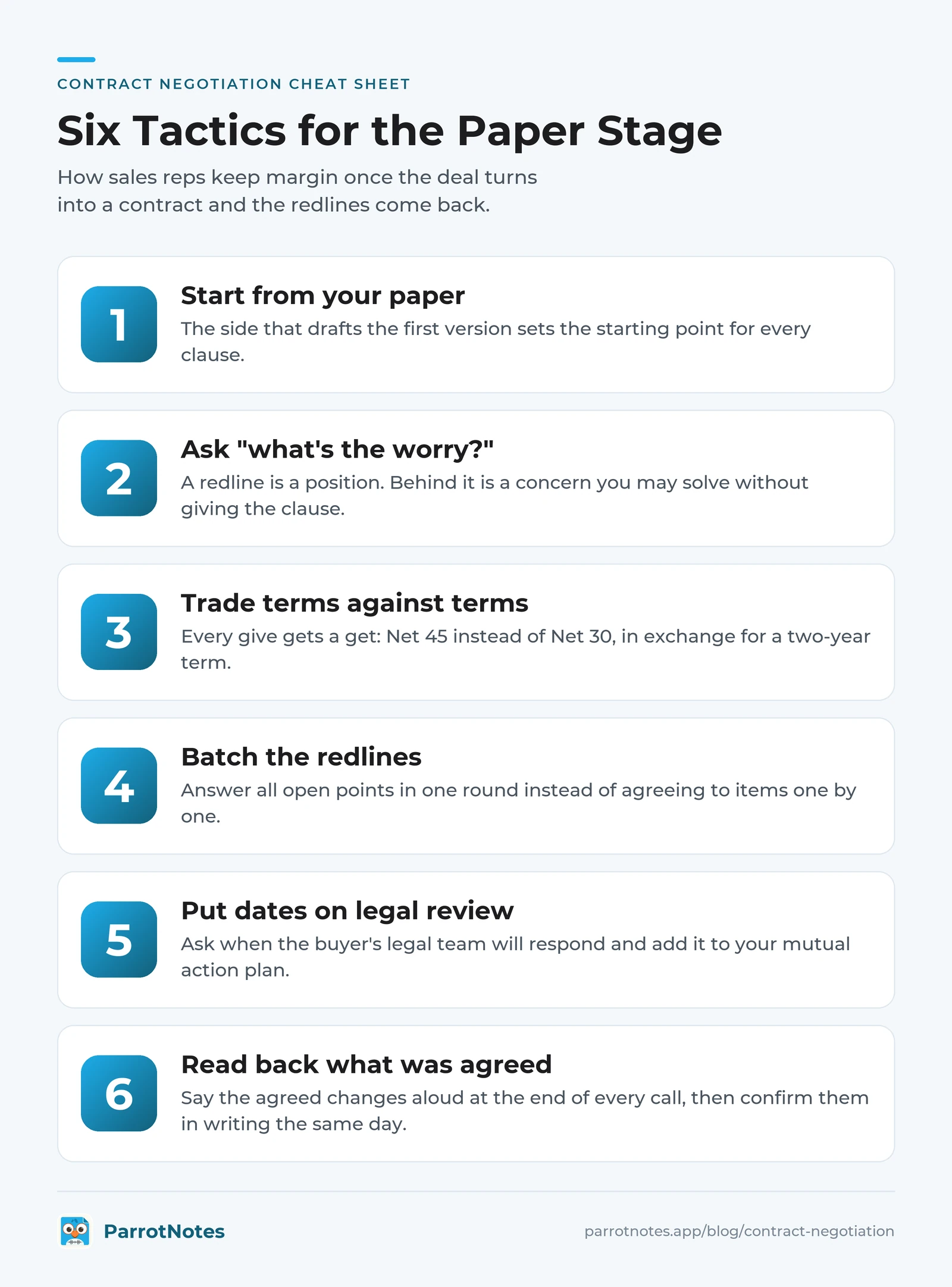
1. Start from your paper when you can
The side that drafts the first version sets the starting point for every clause. Offer your standard agreement early, ideally with the proposal.
2. Ask "what's the worry?" before you answer a redline
A redline is a position. Behind it is a concern. "We need termination for convenience" might mean "our budget gets reviewed in March." A budget-review clause or a phased order may solve the real worry without giving an open exit.
3. Trade terms against terms
Every give gets a get, the same rule as in price talks. Net 45 instead of Net 30, in exchange for a two-year term. A renewal price cap, in exchange for auto-renewal staying in. Our discount calculator helps when a buyer tries to turn a term into a price cut: in Harvard Business Review's "Managing Price, Gaining Profit", McKinsey's Michael Marn and Robert Rosiello found that a 1% price decrease would destroy 11.1% of operating profit for a company with average economics.
4. Batch the redlines, don't drip them
Answer all open points in one round. Agreeing to items one by one gives the buyer a free run at the rest, and it makes the contract negotiation process feel endless to both sides.
5. Put dates on legal review
Ask when the buyer's legal team will respond and add it to your mutual action plan. Contracts drift when nobody owns the next step.
6. Read back what was agreed on every call
End every redline call by saying the agreed changes aloud, then confirm them in writing the same day. That one habit prevents most "that's not what we agreed" moments in the next round.
The redline log
Version history shows what changed. It doesn't show why, who agreed, or what you got back. Keep a log alongside the contract:
REDLINE LOG
Account:                     Contract / version:
Our legal contact:           Their legal contact:

#  | Clause | Their change      | Their reason        | Our response       | Get in return     | Owner  | Status
1  |        |                   |                     |                    |                   |        |
2  |        |                   |                     |                    |                   |        |
3  |        |                   |                     |                    |                   |        |

Open items for legal (exact buyer wording):
Next call date:              Signature target date:
Two rules keep it useful. Write the buyer's reason in their own words, because legal can often solve the reason without accepting the change. And never mark a row "agreed" without a name next to it.
A worked redline round: three changes, one call
Priya sells packaging equipment to a regional food manufacturer. The deal is agreed at 142,000. The buyer's procurement manager, Tom, sends back her standard agreement with three redlines. (Priya and Tom are composites, not real people.)
Redline 1: payment terms from Net 30 to Net 75. Tom's reason, from the call: "Our capital purchases run on a 75-day cycle." Priya's limit is Net 45; her manager can approve Net 60. She offers Net 60, with 30% of the price invoiced on order. Tom agrees. Logged with her manager's approval.
Redline 2: termination for convenience on 30 days' notice. Tom's worry is a plant closure planned for next year. Priya doesn't touch the clause. She writes down the reason word for word and sends it to legal, who propose an exit if the named plant closes, with equipment already delivered paid for. Logged as "legal", with Tom's exact words.
Redline 3: two days of on-site training added to scope. Priya can give one day; it's already priced into her standard package. She offers one day now and a second day at the listed rate. Tom accepts. Logged.
Priya reads the three outcomes back at the end of the call and emails the log within the hour. The contract signs eight days later. Nothing moved without a reason, a get and a name.
Recording the redline call, with everyone's consent, makes the log easy (rules vary by state; see our guide to one-party consent states). ParrotNotes records from your phone with no meeting bot, then gives you a transcript, a summary and the action items. On Pro you can ask the recording "What reason did Tom give for Net 75?" and get his exact words. Download ParrotNotes free and keep every redline call on the record.
When to bring in legal (and how to hand it over)
Bring legal in straight away when a redline touches liability, indemnity, intellectual property, data, warranties, governing law or termination rights, or when the buyer sends their own paper. Bring them in early on any deal that's large or unusual for your company, too.
A clean handover saves days:
- The redline log, with every open legal item marked.
- The buyer's exact words on why they want each change.
- The commercial context: deal size, term, what you've already traded.
- The deadline and the buyer's legal contact.
Legal owns the wording; you own the relationship and the timeline. If procurement is driving the redlines, find out what they're measured on, because a lot of "legal" asks are really procurement policy.
Contract negotiation mistakes reps make
- Agreeing to legal terms on a call. Say "I'll take that to our legal team today" instead.
- Giving a term without a get. Net 60 for nothing teaches the buyer that redlines are free.
- Letting the paper sit. No date for the next round means no signature date.
- Repricing through the contract. Service credits, extra scope and long payment windows are discounts in disguise.
Close the deal on paper, not just in the room
Contract negotiation is where reps either protect a deal or quietly reprice it. Know which terms you own, which belong to your manager, and which go straight to legal. Use the give-get sheet so every term you move buys something. Keep a redline log with reasons, gets and names, and read the agreed changes back on every call.
The Free plan includes 100 minutes of recording a month, an AI summary on every recording and 5 AI-powered recordings. Pro ($19.99/month, or $14.99/month billed annually) adds 3,000 minutes a month and AI chat across your recordings, so the next renewal starts from what was agreed, not what anyone remembers.
Print the give-get sheet before your next redline call, then try ParrotNotes free and let your phone keep the record while you negotiate.
Frequently Asked Questions
What is contract negotiation?
Contract negotiation is the stage where two sides turn an agreed deal into written, binding terms. Beyond price, it covers payment terms, contract length and renewal, termination, service levels, warranties, limitation of liability, indemnification and intellectual property.
What terms are most negotiated in contracts?
World Commerce & Contracting's 2024 Most Negotiated Terms research found that limitation of liability, price and indemnification remain top priorities. In sales contracts, payment terms, renewal and termination rights also come up often in redline rounds.
What contract terms can a sales rep negotiate?
Usually commercial terms within the rep's approval limits, such as start dates, delivery schedules, standard payment terms and small scope clarifications. Bigger discounts, longer payment windows and renewal caps go to a manager or deal desk, and legal terms go to legal.
When should sales bring in legal during contract negotiation?
As soon as a redline touches limitation of liability, indemnification, intellectual property, data, warranties, governing law or termination rights, or when the buyer sends their own contract. Hand over the redline log, the buyer's exact reasons and the deadline.
What are good contract negotiation strategies for sales?
Start from your own agreement, ask what worry sits behind each redline, trade terms against terms, answer all redlines in one round, put dates on legal review and read back what was agreed on every call. This is general information, not legal advice.
Related Posts

Best Talk to Text App for iPhone and Android
The best talk to text app for your phone: Apple Dictation and Siri on iPhone, Gboard and Gemini on Android, with free plans compared and a voice phrase sheet.

How to Use Speech to Text on iPhone
Turn on speech to text on iPhone in 3 steps, dictate in any app, switch languages, turn it off, and record when the mic stops. Checked on iOS 27, Nov 2026.

How to Record Calls on Samsung
Samsung call recording, step by step: record or auto record calls, find the files, get Galaxy AI transcripts, or turn it all off. Checked November 2026.