
What Is Citizen Journalism? Examples and How to Do It Well

Sarah Johnson
Writes about field sales, meeting notes and voice-first workflows at ParrotNotes. Every article is reviewed by the ParrotNotes product team before it goes live.

Table of Contents
On January 15, 2009, Janis Krums was on a commuter ferry when US Airways Flight 1549 came down in the Hudson River. He took a photo on his iPhone of passengers standing on the wing and posted it to TwitPic. According to CNN, it was one of the earliest images of the landing, and it spread around the world from an account with about 170 followers.
Krums wasn't a reporter. He was a witness with a camera, and that's the simplest answer to what is citizen journalism: ordinary people gathering and sharing news, without being employed or trained as journalists.
Anyone with a phone can break news. The harder part is doing it well, so what you post is accurate and fair rather than one more rumor. This guide covers the definition, nine real examples (one that went badly wrong), the pros and cons, and a checklist to run before you post. If your reporting involves talking to people, try ParrotNotes free so every interview becomes a searchable transcript.
What is citizen journalism?
Citizen journalism is news gathered, reported or shared by members of the public rather than by professional journalists.
Wikipedia's entry on citizen journalism describes it as the public "playing an active role in the process of collecting, reporting, analyzing, and disseminating news." The press scholar Jay Rosen put it more memorably: it's what happens "when the people formerly known as the audience employ the press tools they have in their possession to inform one another."
Penn State's News Literacy Initiative adds a useful detail. Citizen journalists include people who set out to report the news "as well as those who simply share information on social media that is newsworthy."
In practice, citizen journalism comes in three forms:
- Eyewitness capture. Someone at the scene records what happens and shares it. Most famous examples are this kind.
- Participatory platforms. A news site invites readers to send stories, photos and tips, and editors check them before publishing.
- Independent reporting. Residents or volunteers cover a beat on purpose: council meetings, local schools, or open-source investigations built from public footage and records.
You'll also hear it called participatory journalism or user-generated content (UGC), the newsroom term for material sent in by the public.
Citizen journalism vs traditional journalism
The line is blurrier than it used to be, since newsrooms now rely on footage from the public. The main differences are training, editing and accountability.
| Citizen journalism | Traditional journalism | |
|---|---|---|
| Who does it | Anyone: witnesses, residents, volunteers | Trained, paid reporters and editors |
| Editing | Often none before publishing | An editor checks the story before it runs |
| Speed | Can be instant, from the scene | Usually slower, because of checks |
| Verification | Up to the person posting | Fact-checking and sourcing standards |
| Accountability | Personal reputation | Ethics codes, corrections policies, legal review |
| Legal protection | Uncertain; shield laws may not cover you | Clearer, though still varies by place |
Citizen journalism wins on speed and access: a resident is already at the council meeting or the flooded street. Traditional journalism wins on checking and context. The best results combine both.
Citizen journalism examples
These cases come up again and again in journalism classes, and each teaches something different.
Abraham Zapruder, 1963. Zapruder filmed President Kennedy's motorcade in Dallas on a home-movie camera and captured the assassination. It's often presented as an early ancestor of citizen journalism: a bystander's footage that became a key record of a major news event.
George Holliday, 1991. In the early hours of March 3, 1991, Holliday, a plumber in Los Angeles, stood at his apartment building with a camcorder he had recently bought and filmed police officers beating Rodney King. He took the tape to the local station KTLA, which aired it first, as NBC News later recalled. The footage put police violence in front of a national audience.
OhmyNews, 2000. Founded in South Korea by Oh Yeon Ho with the motto "every citizen is a reporter," OhmyNews published articles written by readers. The key step came before publication: professional staff checked and edited every submission.
The BBC and the London bombings, 2005. The BBC launched a three-producer User Generated Content unit on July 1, 2005. A week later, bombs hit London's transport network. Early reports talked about a power surge on the Underground, but photos and calls from the public helped the newsroom see it was an attack. The BBC's own lesson, quoted by the Reuters Institute, was: "The audience knew more than us on the story."
Janis Krums, 2009. The Hudson River photo from the introduction showed how fast one post from the scene could reach the world.
Bellingcat, 2014. Eliot Higgins started out blogging as "Brown Moses," analyzing videos from the Syrian civil war. In July 2014 he founded Bellingcat, whose first major investigation, into the downing of Malaysia Airlines Flight 17, was done mainly by volunteers working from public photos, videos and satellite images. It's citizen journalism grown into open-source investigative journalism.
Documenters, 2018 to today. City Bureau, a nonprofit in Chicago, launched Documenters in 2018. It "equips and pays local residents to attend public meetings," and their notes are fact-checked before they're published. The program reports more than 6,000 trained Documenters and more than 14,000 public meetings covered.
Darnella Frazier, 2020. Frazier was 17 when she filmed the murder of George Floyd by a Minneapolis police officer on May 25, 2020. In 2021 the Pulitzer board gave her a special citation "for courageously recording the murder of George Floyd," noting "the crucial role of citizens in journalists' quest for truth and justice." Her video and testimony helped convict the officer, Derek Chauvin, in 2021.
When it goes wrong: Boston, 2013
After the Boston Marathon bombing in April 2013, users on Reddit tried to identify the bombers from photos and wrongly named Sunil Tripathi, a missing Brown University student. His family had to take down the Facebook page they had set up to find him. Reddit's general manager, Erik Martin, later apologized publicly, writing that activity on the site "fueled online witch hunts and dangerous speculation," as reported by NBC News. It's the case every citizen reporter should remember.
What each example teaches
| Case | Form | What made it work, or fail |
|---|---|---|
| Zapruder, 1963 | Eyewitness | Original footage of the event itself |
| Holliday, 1991 | Eyewitness | Handed to a TV station, which aired it first |
| OhmyNews, 2000 | Platform | Readers wrote, editors checked |
| BBC, 2005 | Platform | Public material verified before broadcast |
| Krums, 2009 | Eyewitness | Showed what he saw, claimed nothing more |
| Bellingcat, 2014 | Independent | Every claim traced to public evidence anyone can check |
| Documenters, 2018 | Independent | Trained, paid residents, notes fact-checked |
| Frazier, 2020 | Eyewitness | A steady record of the whole event, later evidence at trial |
| Reddit, 2013 | Crowd speculation | Guessed at identities and named an innocent person |
The examples that held up showed evidence or had someone check it. The one that failed jumped from evidence to accusation.
Pros and cons of citizen journalism
The benefits
- Speed and presence. Witnesses are there before any reporter can be.
- Local coverage. Where a town has lost its paper, residents can still document council and school board meetings.
- Accountability. Footage from the public has exposed abuses that official accounts left out.
- More voices. People can report on their own communities in their own words and languages.
The drawbacks
- No editor. Mistakes go out unchecked, and corrections rarely travel as far.
- Missing context. A 30-second clip shows what happened in those 30 seconds, not what came before.
- Harm to people. Naming suspects or showing victims can hurt people who never agreed to be in a story.
- Legal and safety risk. Citizen reporters may lack the legal support and training professionals have.
How to do citizen journalism well
You don't need a press pass. You need the habits professionals use, scaled down.
1. Separate what you saw from what you heard. Write "I saw police stop a car" rather than "police stopped a man for no reason," unless you know the reason. Say how you know each thing.
2. Capture the context. The human rights group WITNESS advises filming the date, time and location, plus street signs or landmarks, and narrating what's happening as you record. Keep the original file, not only the version you posted.
3. Check before you share. Confirm names, numbers and claims with a second source. Our fact-checking guide has a claim log you can use for this.
4. Don't name or accuse on a hunch. Leave identification to evidence, and blur or crop people who aren't the story.
5. Know your rights and your limits. In the US, the ACLU says taking photos and video of things plainly visible in public spaces is a constitutional right, including police carrying out their duties. Recording a conversation is different: several states require consent from everyone in it. See our guide to one-party consent states.
6. Ask permission for interviews. If you sit down with someone, tell them you're recording and what you'll do with it. An interview consent form puts that agreement in writing.
7. Correct openly. If you get something wrong, say so where you posted it. A clear correction builds more trust than a quiet deletion. The journalism code of ethics used by professionals is a good model.
The publish-or-hold check
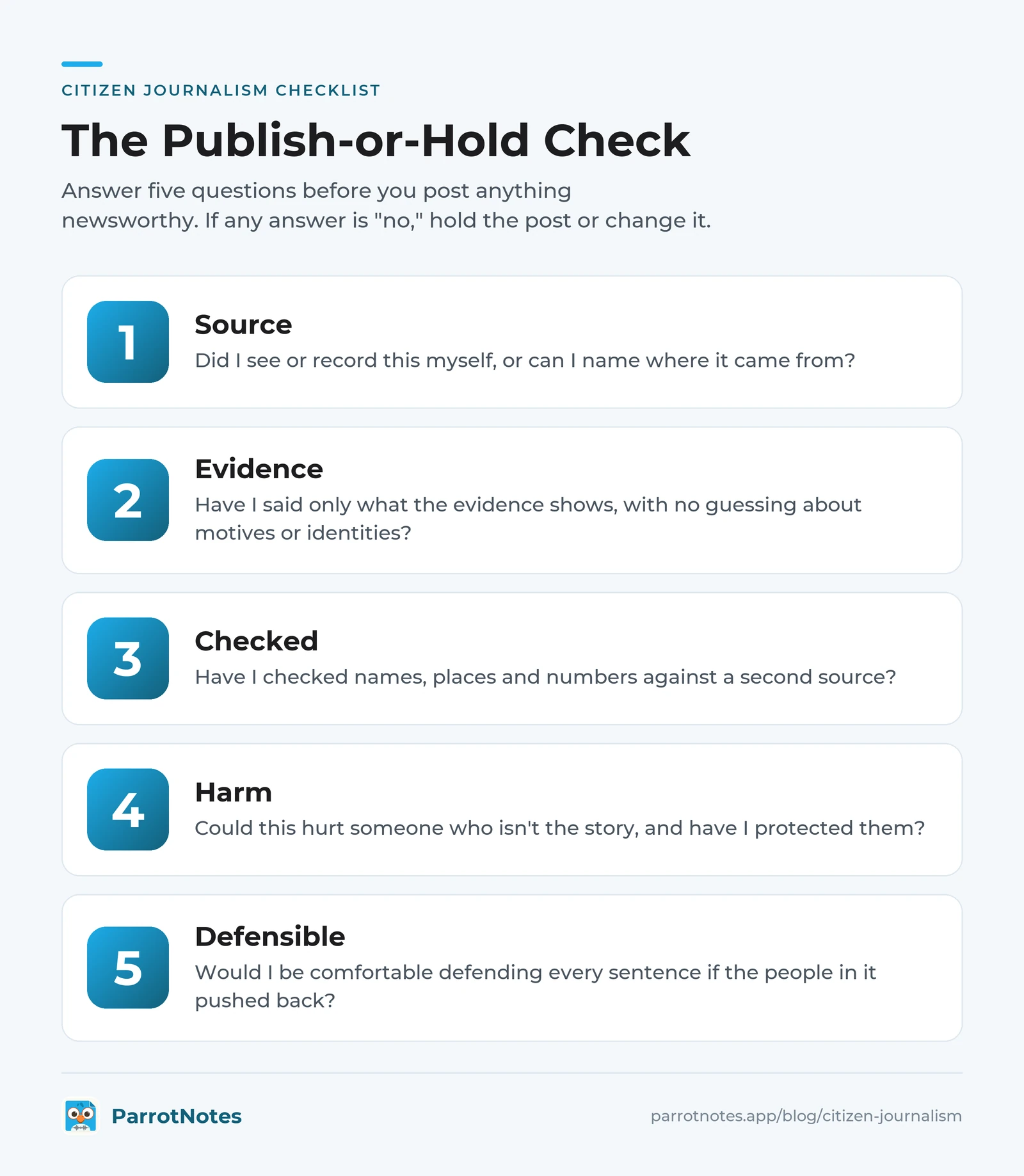
Before you post anything newsworthy, answer five questions. If any answer is "no," hold the post or change it.
- Did I see or record this myself, or can I name where it came from?
- Have I said only what the evidence shows, with no guessing about motives or identities?
- Have I checked names, places and numbers against a second source?
- Could this hurt someone who isn't the story, and have I protected them?
- Would I be comfortable defending every sentence if the people in it pushed back?
Leah, a parent, filmed a heated school board meeting and almost posted it with the caption "Board ignores parents again." Question 2 stopped her. She posted the clip with the agenda item and the vote count instead, and the local paper picked it up because it was checkable. (Leah is a composite, not a real person.)
Scene notes template
Copy this into a note on your phone and fill it in on the spot:
- What happened (in one sentence, only what you saw)
- Where (address or landmark) and when (date and time)
- Who was there (roles, not guesses at names)
- How I know (saw it, recorded it, told by someone: name them if they agree)
- What I recorded (files, times, length)
- What I still need to check
- Consent (who agreed to be recorded or quoted)
Recording interviews as a citizen reporter
Much citizen journalism starts with a clip, but the stories that last are built on conversations with neighbors, witnesses and officials. Then the quote you need is somewhere in 40 minutes of audio.
ParrotNotes records in-person interviews on the phone you already carry, with no bot joining a call. Recording works offline, so a basement meeting room is fine, and you get the transcript once you're connected. Every recording gets an AI summary, and keyword search on the free plan (100 minutes of recording a month) takes you straight to a name or a number. To check a quote against the audio before you publish, see how to quote an interview.
On Pro ($19.99 a month, or $14.99 a month billed annually), speaker identification separates your questions from the answers, and transcription in 99+ languages with translation helps when your community speaks more than one language.
Sam, a retired teacher, started covering his town's planning meetings when the local paper closed. He records each meeting and his interviews afterwards, then searches the transcripts when residents ask what was decided.
When a developer disputed one of his posts, he found the exact passage in a minute. (Sam is a composite, not a real person.) Download ParrotNotes free and set up your first beat the same way.
Citizen journalism in short
Citizen journalism is news gathered and shared by the public rather than by professionals. Its best moments, from Holliday's tape to Darnella Frazier's video and the Documenters' meeting notes, came from showing evidence clearly and letting it be checked. Its worst, like Boston in 2013, came from guessing.
Stick to what you saw, capture context, check before you share, respect consent and correct openly. Run the five-question check before every post. When your reporting moves from clips to interviews, try ParrotNotes free so every conversation is transcribed, summarized and easy to search.
Frequently Asked Questions
What is citizen journalism in simple words?
Citizen journalism is news reported by ordinary people instead of professional journalists. It includes a witness filming an event on a phone, a resident writing up a council meeting, and volunteers investigating with public photos and records.
What are some examples of citizen journalism?
Well-known examples include Abraham Zapruder's 1963 film of the Kennedy assassination, George Holliday's 1991 video of police beating Rodney King, Janis Krums's 2009 photo of the Hudson River plane landing, Bellingcat's volunteer MH17 investigation and Darnella Frazier's 2020 video of George Floyd's murder.
What is the difference between citizen journalism and traditional journalism?
Traditional journalists are trained and paid, and an editor checks their work against ethics and accuracy standards before it runs. Citizen journalists are members of the public who often publish directly, which makes them faster and closer to events but leaves checking up to them.
What are the disadvantages of citizen journalism?
The main drawbacks are unchecked mistakes, missing context, harm to people who are named or shown without consent, and legal or safety risk. The 2013 Reddit misidentification after the Boston Marathon bombing is the best-known example of it going wrong.
Is citizen journalism legal?
Reporting and sharing news is generally protected, and in the US the ACLU says photographing things plainly visible in public is a constitutional right. Recording private conversations is different: several states require everyone's consent, so check the law where you are before you record.
Related Posts

Tactiq Review: Features, Pricing and Limits
Tactiq review from Tactiq's own pages, checked Oct 2026: capture paths, caption rules, two credit meters, plans and a 10-question fit test. Try ParrotNotes.

Superwhisper Review: Features, Pricing and Alternatives
Superwhisper review from its own pages, checked Oct 2026: plans, the free plan, lifetime math, offline limits and a 10-question fit test. Try ParrotNotes free.

Sales Performance Improvement Plan: A Template and How to Run It
A sales performance improvement plan template for field teams: diagnose the cause, set goals reps control, run weekly check-ins. Try ParrotNotes free.