
Brainstorming Meeting Agenda: Run a Session That Produces Decisions

Sarah Johnson
Writes about field sales, meeting notes and voice-first workflows at ParrotNotes. Every article is reviewed by the ParrotNotes product team before it goes live.
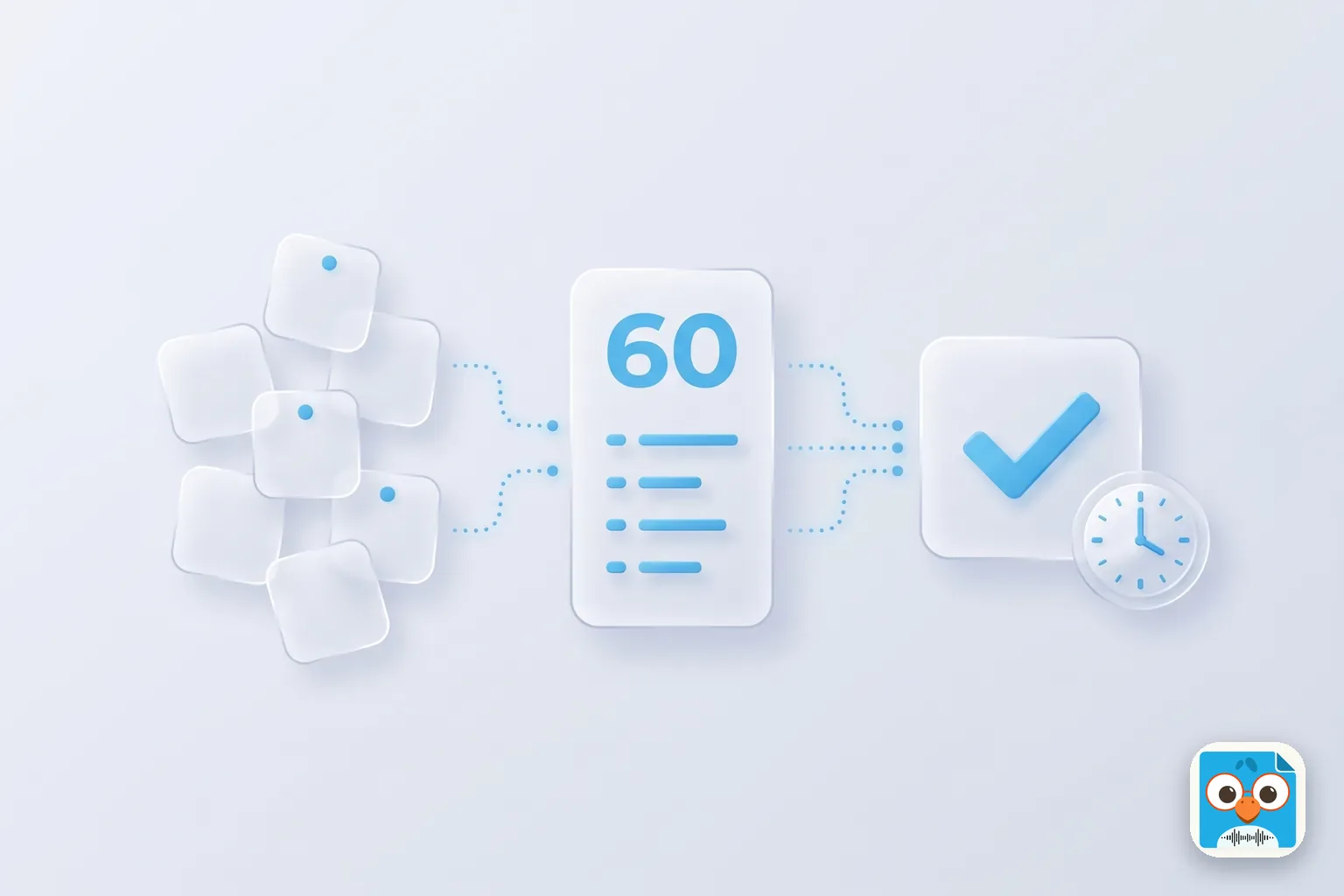
Table of Contents
- 1.The 60-minute brainstorming meeting agenda
- 2.Before the meeting: one problem, sent early
- 3.Ground rules, and what to say when they break
- 4.Generate: start silent, then go round the room
- 5.Converge: from 40 ideas to three decisions
- 6.A filled-in example
- 7.Capturing the session so the note-taker can join in
- 8.Run the second half
Forty-one sticky notes. Two hours. Everyone left Priya's "ideas for cutting onboarding time" session feeling energised, and nobody could say on Monday what the team had decided to do. The notes went into a drawer. (Priya is a composite, not a real person.)
That is the normal ending for a brainstorm, and it isn't a people problem. It's an agenda problem. Most brainstorming meeting agendas stop at "vote on the best ideas". The session needs a second half that turns the vote into decisions with owners, and a note format that keeps the ideas, the decisions and the tasks apart.
This guide gives you a 60-minute brainstorming meeting agenda you can copy, a script for the ground rules, one technique that gets quiet people's ideas on the table, a convergence step that ends in three decisions, a filled-in example and a note template for the whole thing.
The 60-minute brainstorming meeting agenda
Copy this into your calendar invite. Timings assume six to ten people and one facilitator who is not also the note-taker.
BRAINSTORMING MEETING AGENDA (60 min)
Problem statement (one sentence, sent 48 h before):
Decision we need by the end:
Facilitator:              Note-taker / recording:
Attendees:

 0:00  Frame (5 min)      Restate the problem, the constraints and what "done" looks like today
 0:05  Ground rules (3)   Read the four rules; agree the signal for "that's evaluating"
 0:08  Brainwriting (10)  Silent: everyone writes ideas, one per card, no talking
 0:18  Round robin (12)   Each person reads one card per turn; build, don't judge
 0:30  Cluster (8)        Group duplicates into themes; name each theme
 0:38  Vote (5)           Three dots each, placed on themes or single ideas
 0:43  Converge (12)      Top 5 on the impact / effort grid; pick up to 3 decisions
 0:55  Decisions (5)      For each: what, owner, first step, date; parking lot for the rest
 1:00  Close
The first 30 minutes diverge: more ideas, no judgement. The last 30 converge: fewer ideas, clear owners. Teams that skip the second half get Priya's drawer.
If you want other formats for recurring staff or project meetings, our meeting agenda template covers five of them. This post stays on the brainstorm.
Want the ideas and decisions captured without a note-taker typing through the session? Try ParrotNotes free and record the room from your phone.
Before the meeting: one problem, sent early
A brainstorm with a vague prompt produces vague ideas. Write the problem as one sentence with a number in it and send it 48 hours ahead, so people arrive with their first ideas already formed.
- Weak: "How can we improve onboarding?"
- Usable: "New hires take 31 days to close their first ticket alone. How do we get that under 20 by Q2 without adding headcount?"
Add the constraints (budget, headcount, deadline) and what you will decide at the end ("three things we will try this quarter"). Invite six to ten people. Alex Osborn, who introduced brainstorming in Applied Imagination in 1953, had groups of roughly 5 to 12 in mind, according to Regent University's history of the method. Above that, people wait too long for a turn.
Ground rules, and what to say when they break
Osborn's four rules still hold: go for quantity, hold the criticism, welcome wild ideas, and build on each other's ideas. Reading them out is easy. Enforcing them in minute 14, when the finance lead says "that would never get approved", is the part most agendas leave out. Agree a light signal before you start (a raised hand, or just the word "parking") and use these lines.
| Rule | What breaks it | What the facilitator says |
|---|---|---|
| Quantity first | Long explanations of one idea | "Great, card it in five words and keep going." |
| No criticism yet | "That won't work because..." | "Hold that for the converge step at 0:43. Write it on a card so we don't lose it." |
| Wild ideas welcome | Nervous laughter, self-editing | "What would we do with ten times the budget? Put that one down too." |
| Build on ideas | Silence after a good one | "Who can add to Sam's card? Same theme, different angle." |
Why so strict about judgement? R. Brent Gallupe and William H. Cooper, writing in MIT Sloan Management Review, named two problems that plague spoken brainstorming. Production blocking: you have an idea while someone else is talking and have lost it, or talked yourself out of it, by the time you get a turn. Evaluation apprehension: people censor ideas for fear of how they'll be judged, especially when the boss is in the room. Both get worse in big groups and with talkative people. Your ground rules and your technique are there to beat those two problems.
Generate: start silent, then go round the room
Put brainwriting first on the agenda and discussion second. Brainwriting is the silent, written generation of ideas: everyone writes at the same time, one idea per card, no talking, for about ten minutes. Creativity at Work's instructions describe the basic form and a "pin cards" variant where you pass each card to the person on your right, who builds on it, changes it or passes it on. Because everyone writes at once, nobody is blocked by the person speaking, and nobody has to say a half-formed idea out loud to a room.
Then run a round robin: each person reads one card per turn, the facilitator pins it to the wall or board, and the only permitted response is a build ("and we could also..."). Go around until the cards run out or the clock hits 0:30.
Marcus, a composite operations manager at a 60-person logistics firm, used to open with "Who has ideas?" and got the same three voices every time. Switching to ten minutes of silent writing first gave him 38 cards from nine people, including six from the dispatcher who had never spoken in a brainstorm before. Two of the three decisions that day came from her cards.
Other techniques (mind mapping, SCAMPER, six thinking hats) are fine for a second session. For a first one, brainwriting plus round robin is enough, and it fits in 22 minutes.
Converge: from 40 ideas to three decisions
This is the half that produces decisions. Four steps, 25 minutes.
- Cluster (8 min). Move duplicate and near-duplicate cards together. Name each theme in three words or fewer. Forty cards usually become six to nine themes.
- Vote (5 min). Three sticky dots per person. Dots can go on a theme or on a single card. Count, and take the top five.
- Grid (12 min). Draw two axes on the board: impact on the problem statement (low to high) and effort to try it (low to high). Place the top five. Decide, out loud, up to three to pursue, starting with high impact and low effort. A high-impact, high-effort idea can be a decision too, as long as someone owns a first step.
- Record (5 min). For each decision, write four fields before anyone leaves: what we will do, who owns it, the first step, and the date of the first step. Everything else that got votes goes on the parking lot with a date to revisit, so people see it was kept, not killed. Our guide to the parking lot in meetings covers how to run that sweep.
A decision without an owner and a date is an idea with better lighting. If you keep a decision log for the team, the four fields drop straight into it.
A filled-in example
Here is the session that fixed Priya's drawer problem, run with the agenda above. (The company and people are composites.)
Problem: New hires take 31 days to close a first ticket alone. Under 20 by Q2, no new headcount.
Decision by the end: three things we try this quarter.
Attendees: 8 (support lead, 2 senior agents, 2 new hires, HR partner, ops manager, facilitator)

Brainwriting: 34 cards
Round robin: 7 builds added
Clusters (7): Shadowing · Ticket sandbox · Docs rewrite · Buddy system · Slower queue · Weekly check-in · Tooling

Votes (24 dots): Ticket sandbox 7 · Buddy system 6 · Shadowing 4 · Docs rewrite 4 · Weekly check-in 2 · Slower queue 1

Grid:
  Ticket sandbox   high impact / medium effort
  Buddy system     high impact / low effort
  Shadowing        medium impact / low effort
  Docs rewrite     high impact / high effort
  Weekly check-in  low impact / low effort

DECISIONS
1. Buddy system: every new hire paired with a senior agent for 4 weeks
   Owner: Dev (support lead) · First step: pairing list for the Nov cohort · Due: Oct 24
2. Ticket sandbox: 20 closed real tickets re-opened in a training queue
   Owner: Lena (senior agent) · First step: pick the 20 tickets · Due: Oct 31
3. Shadowing: day 2 and day 3 spent on live calls with a senior
   Owner: Priya · First step: update the week-one schedule · Due: Oct 21

PARKING LOT: Docs rewrite (revisit Jan planning) · Weekly check-in (fold into buddy system)
Nobody left asking what had been decided. The three owners had a first step small enough to do that week.
Capturing the session so the note-taker can join in
A brainstorm moves fast. Cards get read out, builds get shouted across the table, and the convergence discussion is where the reasoning lives. Whoever is typing misses most of it and contributes none of their own ideas. Use this note template and let a recording do the heavy lifting.
BRAINSTORM NOTES
Date:               Problem statement:
Attendees:          Facilitator / note-taker:
IDEAS (all cards, by cluster):
VOTES (top 5 with counts):
DECISIONS (what / owner / first step / date):
PARKING LOT (idea / revisit date):
ACTION ITEMS (task / owner / due):
Keep ideas, decisions and action items in separate blocks. Mixing them is how a 40-idea list turns into a 40-item to-do list that nobody owns.
Before you press record, ask the room. Say why you're recording, who will hear it and when it will be deleted, and stop if anyone objects. Recording consent rules vary by state; see our guide to one-party consent states.
If the team agrees, ParrotNotes records from the phone or Mac already on the table, in the background, with no meeting bot joining anything. When the session ends you get a transcript, a summary and the action items pulled out. Paste the decisions into the template, ask the transcript "which ideas were about the sandbox?" to rebuild a cluster, and copy the owners and dates into your action items template.
The Free plan includes 100 minutes a month, up to 30 minutes per recording, with an AI summary on every recording and 5 AI-powered recordings a month. A 60-minute session needs Pro ($19.99 a month, or $14.99 a month billed annually): 3,000 minutes a month, up to 3 hours per recording, speaker identification so you know whose build it was, and AI search across every past session. Download ParrotNotes free and try it on a 30-minute brainstorm first.
Run the second half
A brainstorming meeting agenda earns its hour in the last 30 minutes. Send one sharp problem statement early, read the four rules and enforce them with a script, start with ten silent minutes of brainwriting, then cluster, vote, grid and record. Leave with up to three decisions, each with an owner, a first step and a date, and a parking lot that shows the rest were kept.
Copy the agenda for your next session and record it so the note-taker can think instead of type. Get ParrotNotes free.
Frequently Asked Questions
How long should a brainstorming meeting be?
Sixty minutes works for six to ten people: 30 minutes to generate ideas and 30 to cluster, vote and decide. Ninety minutes is the sensible maximum. Longer sessions produce more cards but no more decisions, because the convergence step gets squeezed at the end.
What should a brainstorming meeting agenda include?
A one-sentence problem statement sent in advance, the decision you need by the end, ground rules, a timed idea-generation block (brainwriting, then round robin), a clustering and voting step, a convergence step with criteria, and a closing block that records each decision with an owner, a first step and a date.
What are the four rules of brainstorming?
Alex Osborn's rules from Applied Imagination (1953): aim for quantity, hold criticism until later, welcome wild ideas, and combine or build on other people's ideas. The facilitator's job is to enforce them in the moment, with an agreed signal and a short line for each.
What is brainwriting?
Silent, written idea generation: everyone writes ideas at the same time, one per card, for about ten minutes, with no discussion. It avoids production blocking (losing an idea while waiting to speak) and evaluation apprehension (self-censoring in front of the group), the two problems researchers found in spoken brainstorming.
How do you turn brainstorming ideas into decisions?
Cluster the cards into themes, give everyone three votes, put the top five on an impact-versus-effort grid, and choose up to three to pursue. Record each as what, owner, first step and date. Put the remaining voted ideas on a parking lot with a revisit date.
Related Posts
User Research Interview: Questions and a Note-Taking System
Run a user research interview that holds up: 30 questions by stage, the ones to avoid, a one-page note sheet and a 10-minute debrief. Try ParrotNotes free.

Trial Close Questions: When to Ask and What to Listen For
Trial close questions for five moments in a sales meeting, a green-amber-red guide to the answers and a note template for the follow-up. Try ParrotNotes free.
Nursing Professional Development: A Plan You'll Actually Keep
Nursing professional development without the binder: a six-step plan, a one-page template, ANCC renewal categories and a monthly review. Try ParrotNotes free.