Audit Trail in Qualitative Research: What to Keep From Every Interview

Sarah Johnson
Writes about field sales, meeting notes and voice-first workflows at ParrotNotes. Every article is reviewed by the ParrotNotes product team before it goes live.
Table of Contents
- 1.What an audit trail in qualitative research is
- 2.Why an audit trail matters: dependability and confirmability
- 3.The six categories of an audit trail
- 4.What to keep from every interview
- 5.A folder structure for your qualitative research audit trail
- 6.The decision log: template and example rows
- 7.Storage, consent and ethics approval
- 8.Writing the audit trail into your methods section
- 9.Common audit trail mistakes
Three months after her last interview, Priya gets an email from a reviewer. It asks: "Where did the theme 'workarounds for the scanner' come from?" She knows the answer is somewhere in 12 recordings, 300 pages of transcript and two versions of a codebook.
What she needs is a path from the theme back to the words a participant said. That path is the audit trail in qualitative research, and building one doesn't need special software.
(Priya is an illustration, not a real researcher. The question is real enough: it is what a supervisor, an ethics board or a journal reviewer asks.)
You probably already keep most of the pieces. The trouble is that they sit in different apps, with names like "final_v3_REAL.docx". This guide shows what to keep from every interview, how to file it so anyone can follow it, and how to describe it in your methods section. The method claims come from named, published sources, linked as you go.
The trail starts the moment you press record. If your interviews happen in person with your phone on the table, ParrotNotes records the conversation and drafts the transcript in one step, so the first two records exist the same day.
What an audit trail in qualitative research is
An audit trail is the documented record of how a study was done: the raw data, the decisions you made along the way, and how you got from the data to the findings. Its job is to let another person follow your route and judge whether the conclusions can be traced to their sources.
Marian Carcary, in a widely cited 2009 paper in the Electronic Journal of Business Research Methods, splits it in two:
- A physical audit trail: the key stages of the study and the methodological decisions taken at each.
- An intellectual audit trail: how your thinking about the data changed over the study.
Most researchers need both. The recordings, transcripts and logs form the physical trail. Your memos form the intellectual one.
The term also has a business meaning, the record of who changed what in accounts or software. This guide covers only the research meaning.
Why an audit trail matters: dependability and confirmability
Lincoln and Guba's Naturalistic Inquiry (1985) proposed four criteria for judging the trustworthiness of qualitative work: credibility, transferability, dependability and confirmability. The audit trail serves the last two.
- Dependability asks whether the findings would be repeated if the study were run again with similar participants in a similar context. An outsider can only judge that if the process is written down.
- Confirmability, as the University of Connecticut's Research Basics page on trustworthiness puts it, is "the degree to which the findings are the product of the focus of the inquiry and not of the biases of the researcher."
The same page sums up Lincoln and Guba's point: "An adequate trail should be left to enable the auditor to determine if the conclusions, interpretations, and recommendations can be traced to their sources." One audit, they add, can check dependability and confirmability at the same time.
Not everyone agrees the trail proves much. Cutcliffe and McKenna (Journal of Advanced Nursing, 2004) argue that treating audit trails as the route to confirmability is "an exaggeration of the case for method," and that a missing trail doesn't by itself make findings less credible. That's a fair warning against box-ticking. It's also a reason to keep a trail you actually use, not one assembled the week before submission.
The six categories of an audit trail
Lincoln and Guba drew on Edward Halpern's 1983 work, which sorted audit trail material into six classes. Here they are as listed on the UConn Research Basics page, with what each looks like in an interview study.
| Halpern's category | In an interview study |
|---|---|
| Raw data | Audio recordings, raw transcripts, field notes, documents participants shared |
| Data reduction and analysis products | Coded transcripts, codebook versions, analytic memos, summaries |
| Data reconstruction and synthesis products | Themes, theme maps, the findings and the report, with how they connect |
| Process notes | Methodological decisions and why: the decision log |
| Material relating to intentions and dispositions | The research proposal, your reflexive journal, expectations before fieldwork |
| Instrument development information | Interview guide versions, pilot interview notes, recruitment screener |
Not every category will apply to every study. Use the table as a check that nothing large is missing, not as a form to fill. If a pilot shows a question needs rewording, our guide to open-ended questions in qualitative research has eight weak-to-strong rewrites; save the new wording as a new guide version.
What to keep from every interview
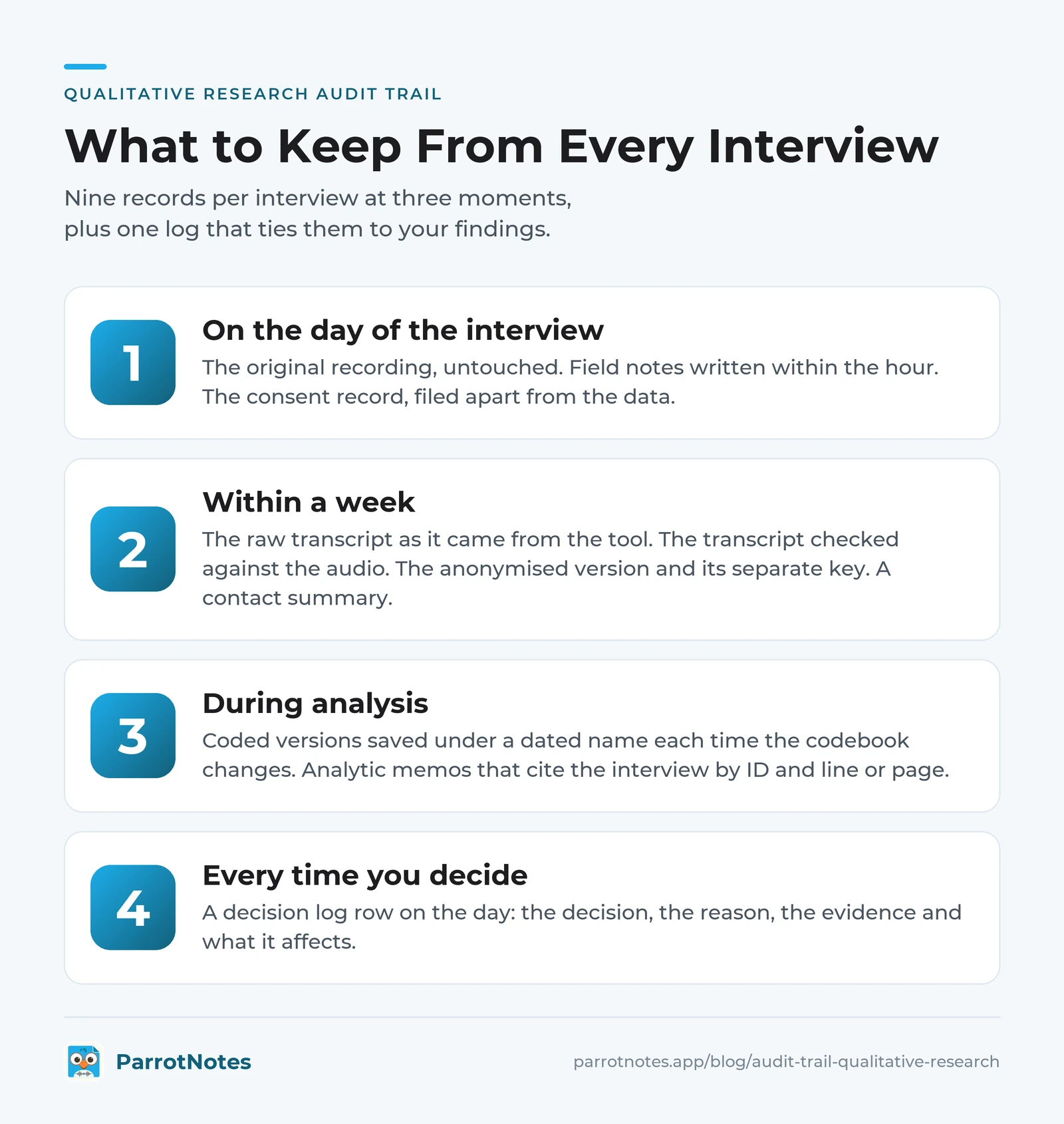
This is the core of the trail for a study built on interviews. Keep nine records per interview, at three moments.
On the day of the interview
- The original recording, untouched. Never edit the only copy. Save it under the participant's ID, not their name.
- Field notes written within the hour: setting, who was present, anything the recording can't show (a document they pointed at, a pause before an answer).
- A consent record: the signed form or the recorded verbal consent, filed apart from the data.
Within a week
- The raw transcript, exactly as it came from the transcriber or the AI tool. Keep it even after you correct it: it shows what the machine heard.
- The checked transcript, corrected against the audio, with your transcription conventions applied. Our guide to qualitative interview transcription has a protocol you can copy, and the speaker labels guide covers labelling who said what.
- The anonymised transcript, plus a separate key that links participant IDs to real names. The key lives in a different, restricted folder.
- A contact summary: half a page on what stood out, early hunches and questions for the next interview.
During analysis
- Coded versions of the transcript, saved under a dated name each time the codebook changes, or exported from your coding software at each milestone.
- Analytic memos that cite this interview by ID and line or page, so a theme can be followed back to a quote.
Take Daniel, a market researcher interviewing small-shop owners (also an illustration). He ran 10 interviews in three weeks.
For the first five he only kept the cleaned transcripts. When a colleague questioned a quote, the edited version no longer matched the audio, and he couldn't show which was right.
From interview six on he kept the raw transcript next to the checked one. That one extra file per interview settled the next dispute in two minutes.
A folder structure for your qualitative research audit trail
A trail only works if someone else can find things in it. This tree is a starting point; rename the folders to match your ethics approval's wording.
study-2026-depot-interviews/
  00-admin/            proposal, ethics approval, consent form versions
  01-instruments/      interview guide v1, v2, pilot notes, screener
  02-raw-audio/        P01_2026-11-03_audio.m4a ... (restricted)
  03-transcripts/
    raw/               P01_transcript_raw.docx
    checked/           P01_transcript_checked.docx
    anonymised/        P01_transcript_anon.docx
  04-field-notes/      P01_fieldnotes.docx, P01_contact-summary.docx
  05-analysis/
    codebook/          codebook_v1_2026-11-10.xlsx, codebook_v2_2026-11-24.xlsx
    coded/             export_2026-11-24.nvpx (or your tool's format)
    memos/             memo_2026-11-18_workarounds.docx
  06-logs/             decision-log.xlsx, reflexive-journal.docx
  07-outputs/          theme-map_v3.pdf, report-draft_v2.docx
  key/                 participant-key.xlsx (separate, restricted location)
Three naming rules keep it readable: participant ID first, date in YYYY-MM-DD so files sort in order, and a version number instead of words like "final".
The decision log: template and example rows
The decision log is the process-notes part of the trail, and the part most often missing. Log any choice that changes the data, the sample, the instrument or the analysis, on the day you make it.
| Date | Decision | Reason | Evidence | Affects |
|---|---|---|---|---|
| 2026-11-04 | Added a probe on handheld scanners to the guide (v2) | Raised unprompted in P01 and P02 | Field notes P01, P02 | Guide v2, from P03 on |
| 2026-11-07 | Dropped P05 from analysis | Participant withdrew consent by email | Consent record P05 | Sample now 11 |
| 2026-11-12 | Switched from verbatim to intelligent verbatim for P06 onward | Fillers added no meaning for the research question | Protocol v2 note | Transcripts P06-P12 |
| 2026-11-18 | Merged codes "slow scanner" and "scanner errors" into "scanner reliability" | Both coders applied them to the same passages | Memo 2026-11-18 | Codebook v2 |
| 2026-11-24 | Theme "workarounds for the scanner" promoted from sub-theme | Present in 8 of 11 interviews | Coded export 2026-11-24 | Report section 3 |
That last row answers Priya's reviewer in one line, and the Evidence column points to the files that prove it.
Pair the log with a reflexive journal: short dated entries on what you expected, what surprised you and how your position might shape what you hear. Carcary's 2020 follow-up paper offers a checklist for building both parts of the trail, drawn from ten years of using it in information systems research.
Storage, consent and ethics approval
Your ethics approval or data management plan usually says where recordings may be stored, who can open them and when they must be deleted. That document, not this guide, is the rule. What follows is general information, not legal advice.
- Consent covers the recording. Say in the consent form that you'll record, transcribe and keep the files for audit; our interview consent form template has wording to adapt. Never record anyone without their knowledge. Recording law varies by place: for the US, see our list of one-party consent states.
- Keep the identity key apart from the data, with tighter access than the transcripts.
- Name every tool in the trail. If an AI service drafted your transcripts, write down which one and where it stores data.
If you use ParrotNotes, here is what its security page states:
- Transcriptions are stored on Amazon Web Services with server-side encryption (SSE-S3).
- Data in transit is encrypted with TLS.
- Your data isn't used to train AI models.
- You can delete any transcription at any time.
On the Free plan, audio files are kept for 30 days and then deleted automatically, while transcripts stay. So move the original recording into your study's approved storage well before then. Check all of this against what your approval allows.
When you're choosing a transcription tool for a study, our comparison of transcription software for qualitative research sets ten options side by side on storage, export formats and price.
Writing the audit trail into your methods section
Reviewers want to know the trail exists and what it holds. A short paragraph is enough. Adapt this one:
"An audit trail was maintained throughout the study (Lincoln & Guba, 1985). For each interview it holds the original audio recording, field notes, the raw automated transcript, the transcript checked against the audio, and the anonymised version. Analytic memos, dated codebook versions and a decision log recording changes to the interview guide, sample and coding, with the reason for each, are kept with the data. [Name] reviewed the trail at [stage]. All files are stored in [approved location] in line with [ethics approval reference]."
Only write the review sentence if someone did review it. An internal audit by a colleague or supervisor is common; a full external audit is rarer.
Common audit trail mistakes
- Rebuilding it at the end. A trail written from memory in week twelve is a story, not a record.
- Overwriting files. Save versions; storage is cheaper than a lost decision.
- Keeping only clean transcripts. The raw version shows what changed and why.
- Logging what, not why. "Merged codes" means nothing a year later without the reason.
- Mixing names into the data folders. One misplaced key file can breach your approval.
Back to Priya. Had she kept the decision log from the first week, the reviewer's question would have taken her one row and one file to answer. If your next round of interviews is in person, download ParrotNotes and let the recording and first-draft transcript land the same day, then file them into your trail. For the interview itself, our semi-structured interview guide and the free interview guide template cover the instrument side.
Frequently Asked Questions
What is an audit trail in qualitative research?
It's the documented record of how a study was carried out: raw data such as recordings and transcripts, the analysis products such as codes and memos, and a log of the decisions made along the way. It lets another person trace the findings back to the data and judge the study's dependability and confirmability.
What should an audit trail include?
Halpern's six categories, as listed by Lincoln and Guba (1985), are a good check: raw data, data reduction and analysis products, data reconstruction and synthesis products, process notes, material relating to intentions and dispositions, and instrument development information. For an interview study that means recordings, raw and checked transcripts, field notes, memos, codebook versions, a decision log and interview guide versions.
What is an example of an audit trail in qualitative research?
A decision log row is the simplest example: "2026-11-18, merged codes 'slow scanner' and 'scanner errors' into 'scanner reliability', because both coders applied them to the same passages, see memo of 2026-11-18." Together with the files it points to, that row shows how one finding was reached.
Who reviews an audit trail?
Often a colleague, co-author or supervisor reviews it as an internal audit. Lincoln and Guba described an external auditor, a researcher outside the study who examines the trail. Many studies keep a trail without a formal audit and make it available on request.
Is an audit trail required in qualitative research?
It's widely recommended rather than universally required. Some journals, supervisors and ethics boards expect one, and critics such as Cutcliffe and McKenna (2004) argue its value for confirmability is overstated. Keeping one costs little if you start on the first day.
Related Posts
RFQ Email Format: How to Request a Quote and Answer One
RFQ email format for buyers and suppliers: subject lines, a request to copy, and the supplier's acknowledgment, clarifying email and quote reply, with samples.
Production Meeting Agenda and Minutes for Manufacturing Plants
Run a 15-minute production meeting at the board: a timed agenda, a minutes template to copy, and sample minutes showing how open actions carry to the next day.
Open-Ended Questions in Qualitative Research: 40 Examples
40 open-ended questions in qualitative research, grouped by type, with weak-to-strong rewrites and an interview order. Record and quote the answers free.