
Annuity Sales: How Advisors Run the Conversation

Sarah Johnson
Writes about field sales, meeting notes and voice-first workflows at ParrotNotes. Every article is reviewed by the ParrotNotes product team before it goes live.

Table of Contents
- 1.What annuity sales looks like in 2026
- 2.The rules behind every annuity sales conversation
- 3.The annuity sales conversation in six stages
- 4.The consumer profile question bank
- 5.Replacements and exchanges: the extra questions
- 6.What to write down: the basis-of-recommendation note
- 7.Where ParrotNotes fits, and where it doesn't
- 8.Run every annuity sales conversation the same way
Lena has a 10 a.m. appointment at a kitchen table in a quiet suburb. The couple, both 63, have a CD maturing next month and a neighbor who keeps talking about his annuity. They've already decided they want "one of those." Lena knows that's where the hard part starts. (Lena is a composite agent, an illustration rather than a real person.)
If you work in annuity sales, you know the product is rarely the problem. The conversation is.
Rules in most states now require you to act in the client's best interest, explain the costs before the sale, and keep a written record of why you recommended what you did.
Get the conversation right and the paperwork almost writes itself. Rush it, and you've got a file you can't defend.
This guide covers the market in numbers, the rules behind the meeting, a six-stage client conversation, a question bank built from the regulation's own list, and a note template for afterwards. It's general information, not financial, legal or compliance advice. It doesn't say which annuity anyone should buy. Your carrier, broker-dealer and state insurance department have the final word on forms and process.
If your meeting notes are what fall behind, try ParrotNotes free for the debrief you give yourself in the car.
What annuity sales looks like in 2026
Demand is high. LIMRA reported on July 27, 2026 that total U.S. annuity sales reached $123.9 billion in the second quarter of 2026, a quarterly record and up 4% from a year earlier. First-half sales were $231.3 billion.
| Product type (LIMRA category) | Q2 2026 sales |
|---|---|
| Fixed-rate deferred | $44.7 billion |
| Fixed indexed | $30.7 billion |
| Registered index-linked (RILA) | $23.3 billion (record) |
| Traditional variable | $17.9 billion |
| Single premium immediate income | $4.0 billion (record) |
| Deferred income | $1.3 billion |
For the person across the table, those numbers mean one thing: lots of people are having this conversation, and many of them arrive with a product already in mind. Your job is to slow it down and find out whether it fits.
Who sells them matters too. Fixed and fixed indexed annuities need a state life insurance license with annuity training. Variable annuities and RILAs are also securities, so you need securities registration through a broker-dealer as well, and FINRA's rules apply on top of your state's.
The rules behind every annuity sales conversation
Most annuity suitability questions come down to two sets of rules. Check the current text with your state and your firm, because adoption and details vary.
The annuity best interest rule (NAIC Model #275)
The NAIC Suitability in Annuity Transactions Model Regulation was revised in 2020 to require producers to act in the consumer's best interest when recommending an annuity. The NAIC's topic page, last updated February 10, 2025, says 48 states have adopted the revisions. The standard is met through four obligations:
| Obligation | What it asks of you, in plain words |
|---|---|
| Care | Know the client's financial situation, insurance needs and objectives. Understand the options you're licensed to offer. Have a reasonable basis to believe your recommendation addresses their needs over the life of the product. Tell them why. |
| Disclosure | Before you recommend or sell, give a disclosure (a form like the model's Appendix A) saying what you're licensed to sell, which insurers you work with, and how you're paid. Make sure they've been told about surrender charges, fees, rider costs, tax penalties and market risk. |
| Conflict of interest | Identify material conflicts and avoid them, or manage and disclose them. |
| Documentation | Make a written record of the recommendation and its basis. Get a signed form if the client won't give profile information, or buys something you didn't recommend. |
Three details agents often miss. The model says it doesn't create a fiduciary duty. It doesn't require you to recommend the lowest-commission product. And you only have to consider the products you're licensed and authorized to sell, not every product on the market.
FINRA Rule 2330 for deferred variable annuities
If you recommend a deferred variable annuity, FINRA Rule 2330 adds steps. You need a reasonable basis to believe the customer has been told about the key costs and risks. These include the surrender period and charge, the tax penalty on withdrawals before 59½, mortality and expense fees, rider charges and market risk.
You document and sign your determination. A registered principal then reviews the application no later than seven business days after the complete application reaches the supervising office. For broker-dealer reps, SEC Regulation Best Interest applies to the recommendation too, and Model #275 treats meeting a comparable standard like it as compliance.
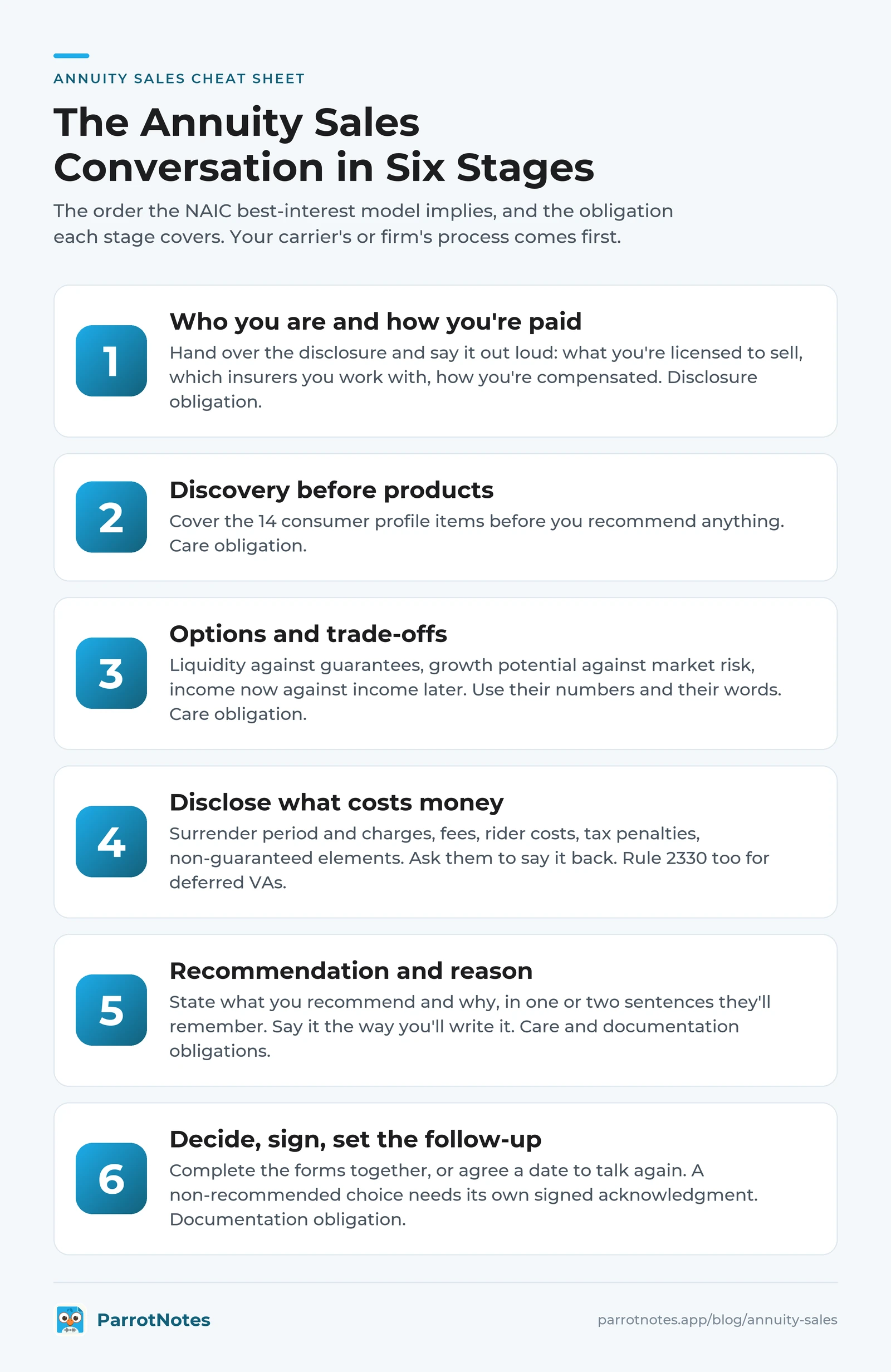
The annuity sales conversation in six stages
This is the order the rules imply, and the heart of how to sell annuities without a file you can't defend. Your carrier's or firm's process comes first if it differs.
Stage 1: Open with who you are and how you're paid
Before any product talk, hand over the disclosure and say it out loud: what you're licensed to sell, whether you work with one insurer or several, and how you're compensated. Tell clients they can ask for more detail on your pay.
It feels awkward the first few times. Clients rarely mind, and it settles the "what's in it for you" question before it sours the meeting. (Disclosure obligation.)
Stage 2: Discovery before products
This is the longest stage, and it should be. Model #275 lists 14 items of consumer profile information you make reasonable efforts to collect before you recommend anything. The question bank below covers all of them. If the clients have arrived wanting a product, park it politely: "We'll get to that. First I need to understand what the money is for." (Care obligation.)
Stage 3: Talk through options and trade-offs
Explain the types of products you can offer that might fit what you heard, and what each gives up. Liquidity against guarantees. Growth potential against market risk. Income now against income later.
Use their numbers and their words. A sentence like "you told me you might need $20,000 for the roof in two years" does more than any brochure. (Care obligation.)
Stage 4: Disclose the features that cost money
Before they decide, walk through the surrender period and charges, fees, rider costs, potential tax penalties and anything that isn't guaranteed. Ask them to say back what happens if they need the money in year three. If they can't, you're not done. (Disclosure obligation; Rule 2330 for deferred VAs.)
Stage 5: Give the recommendation and the reason
State what you recommend and why it addresses their situation, in one or two sentences they'll remember. That sentence is also the core of your written record, so say it the way you'll write it. (Care and documentation obligations.)
Stage 6: Decide, sign and set the follow-up
If they're ready, complete the carrier's suitability forms and application together. If they want time, agree a date and how you'll contact them. If they choose something you didn't recommend, that needs its own signed acknowledgment. (Documentation obligation.)
Back at the kitchen table, Lena spent 40 minutes on stage 2. The couple's real worry turned out to be the husband's pension decision, not the CD. The CD money had a job already: a new roof in 18 months. She wrote that down, and the conversation about a long surrender period ended there.
Running back-to-back appointments? Stage 6 is where details slip. Download ParrotNotes free and say your two-minute debrief out loud before you start the car.
The consumer profile question bank
Each row is one of the 14 items Model #275 lists, with a plain question that opens it. Rephrase to suit your style, and follow your carrier's fact-finder for the exact fields.
| Profile item | A question that opens it |
|---|---|
| Age | "When were you each born?" |
| Annual income | "What comes in each year, from all sources?" |
| Financial situation and needs, including debts | "What do you owe, and what are you still paying off?" |
| Financial experience | "What have you invested in before, and how did that go?" |
| Insurance needs | "If something happened to one of you, what would the other need?" |
| Financial objectives | "What do you want this money to do for you?" |
| Intended use of the annuity | "When you picture using this money, what are you spending it on?" |
| Financial time horizon | "When might you need to touch it?" |
| Existing assets and products | "What accounts, policies and annuities do you already have?" |
| Liquidity needs | "What could come up in the next few years that would need cash?" |
| Liquid net worth | "If you needed money next month, how much could you reach without penalties?" |
| Risk tolerance | "How would you feel if this was worth less next year than you put in?" |
| Source of funds | "Where is the money for this coming from?" |
| Tax status | "How do you file, and is this money in a retirement account?" |
The answers you'll lean on most later are the clients' own words for objectives and intended use. Write those down verbatim. For more on asking follow-ups that get past short answers, see our guide to discovery questions in sales.
Replacements and exchanges: the extra questions
Replacing an existing annuity gets extra scrutiny. Model #275 asks you to weigh whether the client would pay a surrender charge, start a new surrender period, lose existing benefits or pay higher fees. You also consider whether the new product would substantially benefit them over its life, and whether they've had another exchange or replacement in the past 60 months. Rule 2330 has a similar check for deferred VAs, with a 36-month look-back.
So add three questions when an existing contract comes up:
- "Can I see the current contract or a recent statement?"
- "What would you lose by surrendering it now?" (benefits, riders, the remaining surrender schedule)
- "Have you moved any annuity in the last five years?"
Marcus, a composite agent, met a client who wanted to move a seven-year-old annuity into something "newer." The statement showed a death benefit worth more than the account value. Moving it would have given that up. The conversation ended with a review date, not an application, and a note saying exactly why.
What to write down: the basis-of-recommendation note
The model regulation asks for a written record of the recommendation and its basis, and its recordkeeping section mentions "summaries of oral disclosures." Your carrier's or firm's system is the official record. The note is what you write into it.
Client(s): first names + last initial (full record in the firm system)
Date / meeting type: in person / video / phone
Disclosure given: yes, Appendix A form or firm's version
Objectives (client's words): "..."
Intended use and time horizon: ...
Liquidity needs: ...
Risk tolerance (client's words): "..."
Source of funds: ...
Options discussed: product types, not marketing names
Features disclosed out loud: surrender period/charges, fees, riders, tax, non-guaranteed elements
Replacement? yes/no; if yes: what is lost, what is gained, last exchange date
Recommendation and basis (one or two sentences): ...
Client decision: proceeded / thinking it over / declined / chose a non-recommended option (form signed)
Forms signed and copies given: ...
Next contact: date, method, topic
Keep out of loose notes: SSNs, account numbers, health details
Here's how Lena's note might read (composite, simplified):
Objectives: "Keep the roof money safe, and stop worrying about the pension choice."
Intended use: roof in ~18 months; rest undecided pending pension decision
Liquidity: needs about $20k within 2 years
Options discussed: short-term fixed options vs. longer-surrender products
Disclosed: surrender schedules and charges, tax on early withdrawal
Recommendation and basis: no annuity purchase today; roof money needs to stay
  reachable. Revisit after pension decision.
Next contact: Nov 19, phone, review pension paperwork
That last line is the point. A good note shows why you recommended something, even when the answer was "not yet."
Where ParrotNotes fits, and where it doesn't
Be careful here. Annuity sales is regulated, and your firm sets the rules on tools:
- Your firm's or carrier's system is the record. ParrotNotes is a capture tool. File the finished note where compliance tells you to.
- Recording the meeting needs permission. Check your firm's policy on recording and AI tools first. Then ask the client and get a clear yes. Some states require everyone's consent; our one-party consent states guide covers the basics.
- The safest habit is a debrief. Right after the meeting, dictate the note template out loud from memory, using first names only and no account or Social Security numbers.
Done that way, ParrotNotes turns a two-minute ramble into a summary you can check and paste. AI-powered recordings add action items and key points (5 a month on the Free plan, unlimited on Pro, as of October 2026). It records on the phone you already carry, with no meeting bot. Search finds "roof money" weeks later when the client calls back.
The same habit works across your book. The insurance agent client notes guide has a life and annuity add-on, and the financial advisor meeting notes template covers reviews.
Run every annuity sales conversation the same way
Strong annuity sales come down to a few habits:
- Disclose first. Who you are, what you can sell and how you're paid, before any product talk.
- Discover before you recommend. Cover all 14 profile items, in the client's own words.
- Explain what it costs to get out. Surrender charges, fees and tax, said back to you.
- Write down the basis. One or two sentences on why, filed the same day.
If clients push back along the way, the insurance objection handling scripts help. For the life side of the table, see the life insurance sales script. And if your debriefs keep slipping, download ParrotNotes free: the Free plan includes 100 minutes of recording a month and an AI summary on every recording.
Frequently Asked Questions
What is annuity sales?
Annuity sales is helping clients decide whether an annuity fits their goals, and if so, completing the application with an insurer. It's done by licensed insurance producers. Variable annuities and RILAs also require securities registration through a broker-dealer.
What are the suitability rules for annuity sales?
Most states have adopted the NAIC's 2020 best-interest revisions to Model #275. Producers must meet care, disclosure, conflict of interest and documentation obligations. Deferred variable annuities also fall under FINRA Rule 2330. Check your state's version and your firm's procedures.
What information do you need before recommending an annuity?
Model #275 lists 14 items of consumer profile information: age, income, financial situation and debts, experience, insurance needs, objectives, intended use, time horizon, existing assets, liquidity needs, liquid net worth, risk tolerance, source of funds and tax status.
How big is the annuity market?
LIMRA reported total U.S. annuity sales of $123.9 billion in the second quarter of 2026, a quarterly record, and $231.3 billion in the first half of the year.
Can I record an annuity sales appointment?
Only within your firm's policy and with the client's permission. State consent laws differ, and some require everyone's consent. Many agents dictate a short debrief after the meeting instead, keeping out account numbers and Social Security numbers.
Related Posts

Voice Reminders on iPhone: Set Them With Siri and Never Forget
Set voice reminders on iPhone with Siri: 18 copy-ready phrases for time, place and follow-up reminders, plus quick fixes for when Siri gets them wrong.

tl;dv vs Fathom: Free Meeting Recorders Compared
tldv vs Fathom: free-plan limits, prices and phone apps checked in October 2026, plus what each free plan leaves you after a year. See which one fits.

Student Newspaper Ideas: Stories Your Readers Will Actually Read
40 student newspaper ideas by beat, each with the first source to call or record to request, plus a pitch test and a story budget template for your next issue.