
Nurse Retention Strategies That Work for Nurse Managers

Sarah Johnson
Writes about field sales, meeting notes and voice-first workflows at ParrotNotes. Every article is reviewed by the ParrotNotes product team before it goes live.

Table of Contents
- 1.What nurse retention means, and what turnover costs your unit
- 2.Why nurses leave, and why they stay
- 3.Seven nurse retention strategies a unit manager can run
- 4.The stay interview question bank: 10 questions
- 5.Nurse retention strategies to take upstairs
- 6.A 90-day nurse retention plan
- 7.Keep patient details out of retention notes
- 8.Nurse retention is a unit-level habit
Dana opens her email at 06:40 and finds the resignation before the coffee's done. It's from Jess, ten months on the unit, the new grad everyone liked. The letter says "personal reasons." Dana suspects it's the schedule, but she never asked.
(Dana and Jess are composites, not real people.) If you manage a nursing unit, you already know turnover isn't an HR statistic. It's the empty line on next month's schedule and the overtime you'll ask of the nurses who stayed.
The good news: a lot of what keeps nurses is in a unit manager's hands. This guide covers the nurse retention strategies you can run yourself, the ones you need to take upstairs, and a kit to start this week: a 10-question stay interview bank, a follow-through log, a cost worked example and a 90-day plan. Every figure is sourced and linked.
If you'd rather talk than type after each conversation, try ParrotNotes free and dictate your notes in two minutes (your words about staff, never patient details).
What nurse retention means, and what turnover costs your unit
Nurse retention is the share of your nurses who are still on the unit a year from now. Turnover is the other side of the same number.
The 2026 NSI National Health Care Retention & RN Staffing Report, which covers 527 hospitals and calendar year 2025, found:
- Staff RN turnover was 17.6%, up 1.2 points from the year before.
- The average cost of turnover for one bedside RN was $60,090, so the average hospital lost between $4.2 million and $6.2 million.
- Each 1% change in RN turnover costs or saves the average hospital about $295,000 a year.
- 22.7% of newly hired RNs left within a year, and first-year leavers made up 29.0% of all RN separations.
- Recruiting an experienced RN took 78 days on average.
Here's what those numbers mean for one unit. This is a worked example, not data from a real hospital.
| 60-RN unit | Nurses leaving per year | Turnover cost per year |
|---|---|---|
| At the national average (17.6%) | 10.6 | about $634,000 |
| At NSI's 75th percentile (13.8%) | 8.3 | about $498,000 |
| Difference | 2.3 nurses kept | about $137,000 |
Keeping two or three more nurses a year is a realistic goal for one unit. It's also a number your director will listen to.
Why nurses leave, and why they stay
The reasons nurses leave are well documented. In the National Council of State Boards of Nursing's 2024 workforce survey, released in April 2025, 39.9% of RNs said they intend to leave the workforce or retire within five years. Among those leaving for reasons other than retirement, about 41.5% named stress and burnout.
A 2021 study in JAMA Network Open found 31.5% of nurses who left a job in 2017 cited burnout. Of those, 68.6% reported a stressful work environment and 63.0% inadequate staffing. If burnout is already on your unit, the signs and causes of nurse burnout guide sorts it into what a nurse can change and what the manager has to fix.
Why nurses stay is less often asked. When leaders at Allegheny General Hospital ran 75 stay interviews with cardiothoracic nurses, the nurses said unit culture, their team and peers, and scheduling kept them. Salary, growth and travel opportunities were what tempted them away.
A 2023 systematic review of 34 studies reached a similar conclusion: nurses stay when they have job satisfaction and feel committed to their organization, and what they need differs by age and career stage. So one retention plan won't fit a new grad and a 25-year veteran equally.
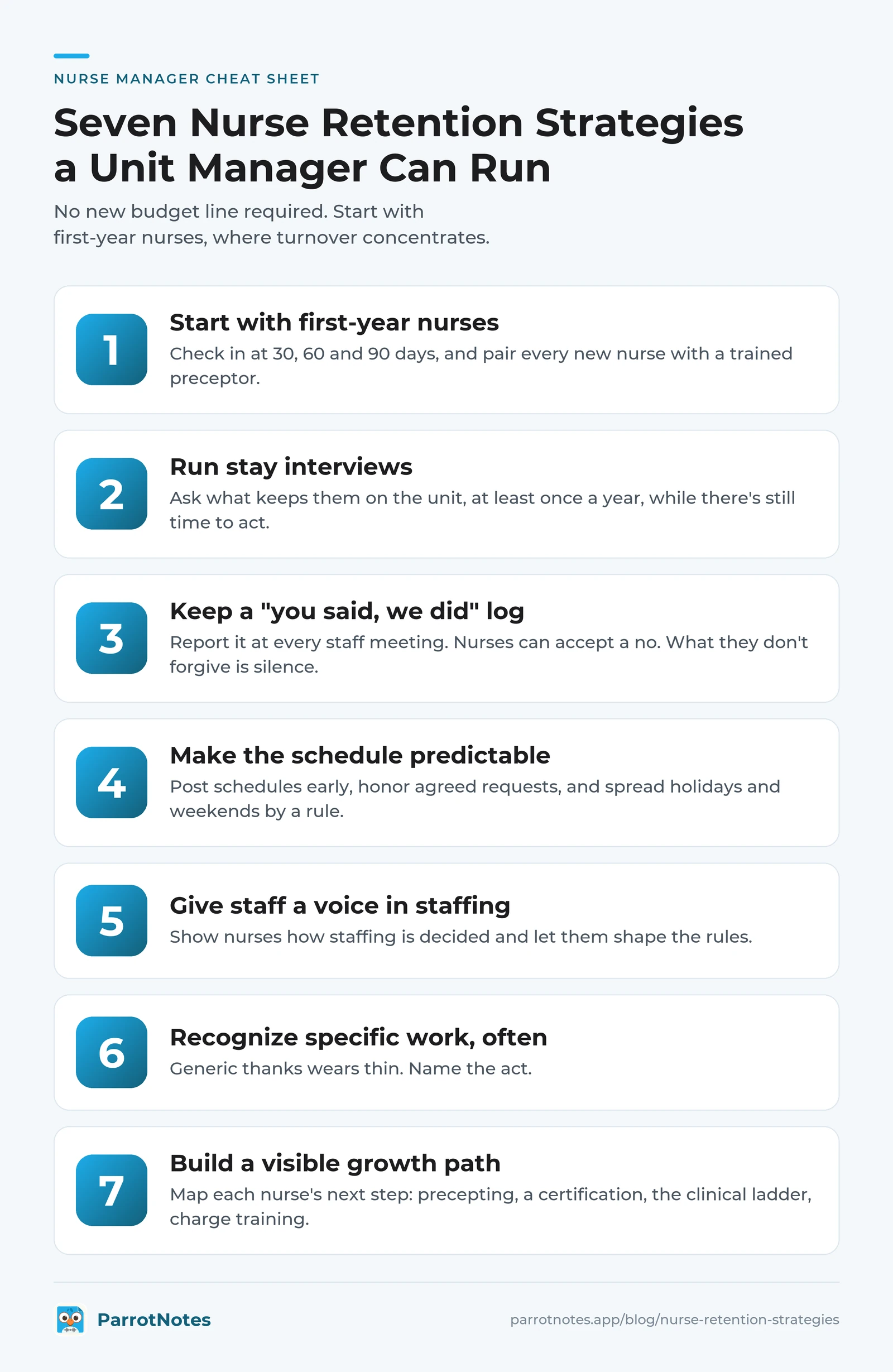
Seven nurse retention strategies a unit manager can run
If you're asking how to improve nurse retention without new budget, start here. All seven are within a unit manager's reach.
1. Start with first-year nurses
The NSI data points to where the losses concentrate: nearly a quarter of new RN hires leave inside a year. Put your first retention hours there. Check in at 30, 60 and 90 days, pair every new nurse with a trained nurse preceptor, and ask the new nurse directly what's harder than they expected.
2. Run stay interviews, not just exit interviews
An exit interview tells you why someone left. A stay interview asks while there's still time to act. Hold one with each nurse at least once a year, and use the question bank below. The nurse manager one-on-one guide covers timing around work anniversaries and how to keep the notes.
3. Close the loop with a "you said, we did" log
Stay interviews fail when nothing happens after them. Keep a simple log and report on it at every nursing staff meeting:
| Date | What staff said (no names, no patient details) | What we did | Status | Owner |
|---|---|---|---|---|
| 3 Nov | Night shift learns about schedule changes too late | Post the schedule six weeks out | Done | Manager |
| 3 Nov | Break relief is unreliable on 7 West | Charge nurse assigns break buddies at huddle | Trial | Charge RN |
| 17 Nov | No clear path to a clinical ladder step | Ask the educator for a ladder session | Asked | Manager |
A row marked "can't change, and here's why" still counts. Nurses can accept a no. What they don't forgive is silence.
4. Make the schedule predictable
Scheduling was one of the three reasons nurses gave for staying in the Allegheny study. Post schedules early, honor agreed requests, and spread holidays and weekends by a rule people can see. Cap how often one nurse is asked to stay late, and track it.
5. Give staff a voice in staffing decisions
You can't hire beyond your budget, but you can show nurses how staffing is decided and let them shape the rules. A unit practice council is the usual place for that. The shared governance guide shows how to run one and keep minutes people trust.
6. Recognize specific work, often
Generic thanks wears thin. Name the act: "You took the extra admission at 03:00 and still got your nurse on break." A shout-out board and peer recognition were among the tactics senior leaders used in a case study of retention strategies, alongside stay interviews.
7. Build a visible growth path
Growth was a top reason nurses considered leaving in the stay interview study. Map the next step for each nurse in your one-on-ones: precepting, a certification, the clinical ladder, charge training. A nurse residency program can carry new grads through their first year if your hospital offers one.
The stay interview question bank: 10 questions
Pick four or five per conversation. Ask, then listen more than you talk.
- What keeps you working on this unit?
- What's the best part of your week here?
- What's one thing that makes a shift harder than it needs to be?
- If you could change one thing about the schedule, what would it be?
- Who on the team makes your shifts better?
- When did you last think about leaving, and what prompted it?
- What would tempt you to take another job?
- What do you want to be doing two years from now?
- Do you get the recognition you think your work deserves?
- What's one thing I could do differently as your manager?
Close with the follow-through: tell the nurse what you'll do, by when, and when they'll hear back. Then add it to the log.
Mateo, a composite night-shift manager, asked question 4 in twelve stay interviews over a month. Seven nurses gave the same answer: schedules posted two weeks out made childcare impossible. He moved posting to six weeks, reported it at the next staff meeting, and logged it as "done." It cost nothing.
Want your stay interview notes in one place? Download ParrotNotes and dictate a recap after each conversation. Search later shows every time "schedule" came up.
Nurse retention strategies to take upstairs
Some causes sit above the unit. Pay scales, mandatory overtime policy, nurse-to-patient ratios, travel-nurse contracts and workplace violence policy need your director or CNO.
Bring numbers, not just concern. The NSI report found 27.6% of hospitals have no measurable turnover goal, and less than half track the cost of turnover. Your worked example gives you both.
Priya, a composite medical-surgical manager, took her unit's figures to her director: 14 RNs lost in a year, five of them first-year nurses. She asked for one thing, protected preceptor time. Framed against NSI's $60,090 per departure, it was an easy yes.
A 90-day nurse retention plan
Days 1 to 30: measure and listen
- Count last year's RN departures and how many were in their first year
- Run your cost worked example
- Start stay interviews with every nurse under two years' tenure
Days 31 to 60: act on what you heard
- Open the "you said, we did" log and report it at the staff meeting
- Fix one scheduling irritant
- Confirm every new hire has a preceptor and a 30/60/90 check-in
Days 61 to 90: make it routine
- Book stay interviews for the rest of the team
- Take one escalation upstairs with your numbers
- Set a measurable goal for next year, for example two fewer departures
Keep patient details out of retention notes
Nurses explain their frustrations through cases. When a story heads toward a patient, steer it back to the work pattern: "So the problem is admissions stacking up after 02:00?" Your notes are about staff and the unit. They never include patient names, room numbers or anything that could identify a patient.
If you use a voice app, dictate your own recap after the conversation rather than recording the nurse, unless they agree and your hospital's policy allows it. ParrotNotes is for your notes about staff, meetings and huddles, not for patient information.
Nurse retention is a unit-level habit
Nurse retention strategies work when they're small, steady and visible:
- Start with first-year nurses, because that's where turnover concentrates
- Ask why people stay, with stay interviews, before they decide to leave
- Close every loop in a "you said, we did" log
- Take the system causes upstairs with cost numbers attached
Pick one strategy and one nurse this week. Ninety days from now, you'll have a log that shows the unit what changed.
Ready to keep your stay interview and staff meeting notes in one searchable place? Try ParrotNotes free. Speak your recap in the car or at your desk, and the summary and action items are waiting when you need them.
Frequently Asked Questions
What are the most effective nurse retention strategies?
The best-supported nurse retention strategies are adequate staffing, predictable scheduling, a supportive unit culture, recognition and visible growth paths. For a unit manager, the highest-value moves are supporting first-year nurses, running stay interviews and acting visibly on what staff say.
What is the nurse turnover rate in 2026?
NSI's 2026 report, covering 2025, put staff RN turnover in US hospitals at 17.6%, up 1.2 points from the year before. It also found that 22.7% of newly hired RNs left within their first year.
How much does nurse turnover cost?
According to NSI's 2026 report, replacing one bedside RN costs $60,090 on average, and the average hospital loses $4.2 million to $6.2 million a year. Each 1% change in RN turnover costs or saves about $295,000 a year.
What is a stay interview in nursing?
A stay interview is a short one-on-one where a manager asks a nurse what keeps them on the unit and what might make them leave. Unlike an exit interview, it happens while there's still time to act on the answers.
How can nurse managers improve retention without a bigger budget?
Focus on what you control: check in with new nurses at 30, 60 and 90 days, post schedules early, recognize specific work, and keep a "you said, we did" log. Take pay and staffing ratios to leadership with cost figures.
Related Posts

Tactiq Review: Features, Pricing and Limits
Tactiq review from Tactiq's own pages, checked Oct 2026: capture paths, caption rules, two credit meters, plans and a 10-question fit test. Try ParrotNotes.

Superwhisper Review: Features, Pricing and Alternatives
Superwhisper review from its own pages, checked Oct 2026: plans, the free plan, lifetime math, offline limits and a 10-question fit test. Try ParrotNotes free.

Sales Performance Improvement Plan: A Template and How to Run It
A sales performance improvement plan template for field teams: diagnose the cause, set goals reps control, run weekly check-ins. Try ParrotNotes free.