
Nurse Mentorship Program: How to Set One Up

Sarah Johnson
Writes about field sales, meeting notes and voice-first workflows at ParrotNotes. Every article is reviewed by the ParrotNotes product team before it goes live.

Table of Contents
- 1.What a nurse mentorship program is (and isn't)
- 2.What the evidence says about nurse mentoring
- 3.How to set up a nurse mentorship program in 7 steps
- 4.The launch blueprint: six months from idea to first cohort
- 5.Nursing mentorship program templates
- 6.Keep mentoring notes useful and free of patient details
- 7.Why a nurse mentorship program stalls (and the fix)
- 8.Start your first cohort this quarter
Rachel's unit lost three of its five new grads in a year. In her exit conversations, two of them said the same thing: "I didn't have anyone to talk to once orientation ended."
Her director's answer was a single line in an email: "Let's start a mentorship program." Rachel had no budget, no template and a schedule that was already full. (Rachel is a composite, not a real person.)
If that's you, you're not alone. The National Council of State Boards of Nursing says "approximately 25% of new nurses leave a position within their first year of practice". A nurse mentorship program is one of the few fixes a unit can start without a new hire or a new budget line.
This guide shows you how to set one up: how mentoring differs from precepting, what research says about length and matching, seven steps, a six-month launch plan and four templates to copy.
Running the planning meetings yourself? Try ParrotNotes free to record your committee meetings and get a summary with action items, so the program doesn't stall between meetings.
What a nurse mentorship program is (and isn't)
A nurse mentorship program pairs a less experienced nurse with an experienced one for regular, voluntary conversations about growth, confidence and career, over months rather than weeks. The mentor doesn't teach the unit's tasks or sign off skills. They listen, share what they've learned and help the mentee set goals.
It's often confused with two other programs.
| Preceptorship | Nurse residency | Mentorship program | |
|---|---|---|---|
| Purpose | Teach the job on the unit and assess readiness | Structured transition year for new RNs | Long-term support, confidence and career growth |
| Length | Weeks to months of orientation | 12 months or more | Set by the program; 12 months is a sound default for new grads |
| Who leads | A nurse preceptor sharing the assignment | A program coordinator and cohort | A mentor who may work on another unit |
| Assessment | Yes, competencies and sign-off | Yes, curriculum and project | No, the relationship is confidential and non-evaluative |
A preceptor and a mentor should ideally be two different people. The preceptor has to judge whether the new nurse is ready. The mentor is the person the new nurse can admit doubts to without that being on the record.
If your hospital already runs a nurse residency program, a mentorship program sits alongside it and can carry on after the residency year ends.
What the evidence says about nurse mentoring
You don't need to invent the design.
A program evaluation. In the Mentorship ReSPeCT study (Gularte-Rinaldo and colleagues, Nurse Leader, 2023), 96 of 151 mentees in one California program answered a survey.
Of those who answered, 58.9% said mentorship positively influenced their decision to remain in nursing. The figure rose to 70% among mentees who had been mentored for one to two years. Self-confidence showed the same pattern: 64.2% overall, 84.2% in the one-to-two-year group.
It's one self-reported program, but the lesson is clear: short programs leave value on the table.
A review of 14 reviews. A 2025 scoping meta-review in the Journal of Advanced Nursing (Giltenane and colleagues) concluded that "formal, structured mentorship programmes produce consistent benefits." It also found four things that decide whether a program works:
- Length. "For new graduates, extended programmes of 12–24 months are advised."
- Contact. One included review recommended "at least twice‐monthly meetings for a minimum of 3 months" (that one was for midwives).
- Mentor training. "Proper training for mentors is required for effective mentorship programmes."
- Matching. "Mismatched pairs can negatively affect programme outcomes and mentee satisfaction."
Its barriers are the expected ones: "time constraints, lack of resources and difficulty balancing clinical duties." Plan for them from day one.
How to set up a nurse mentorship program in 7 steps
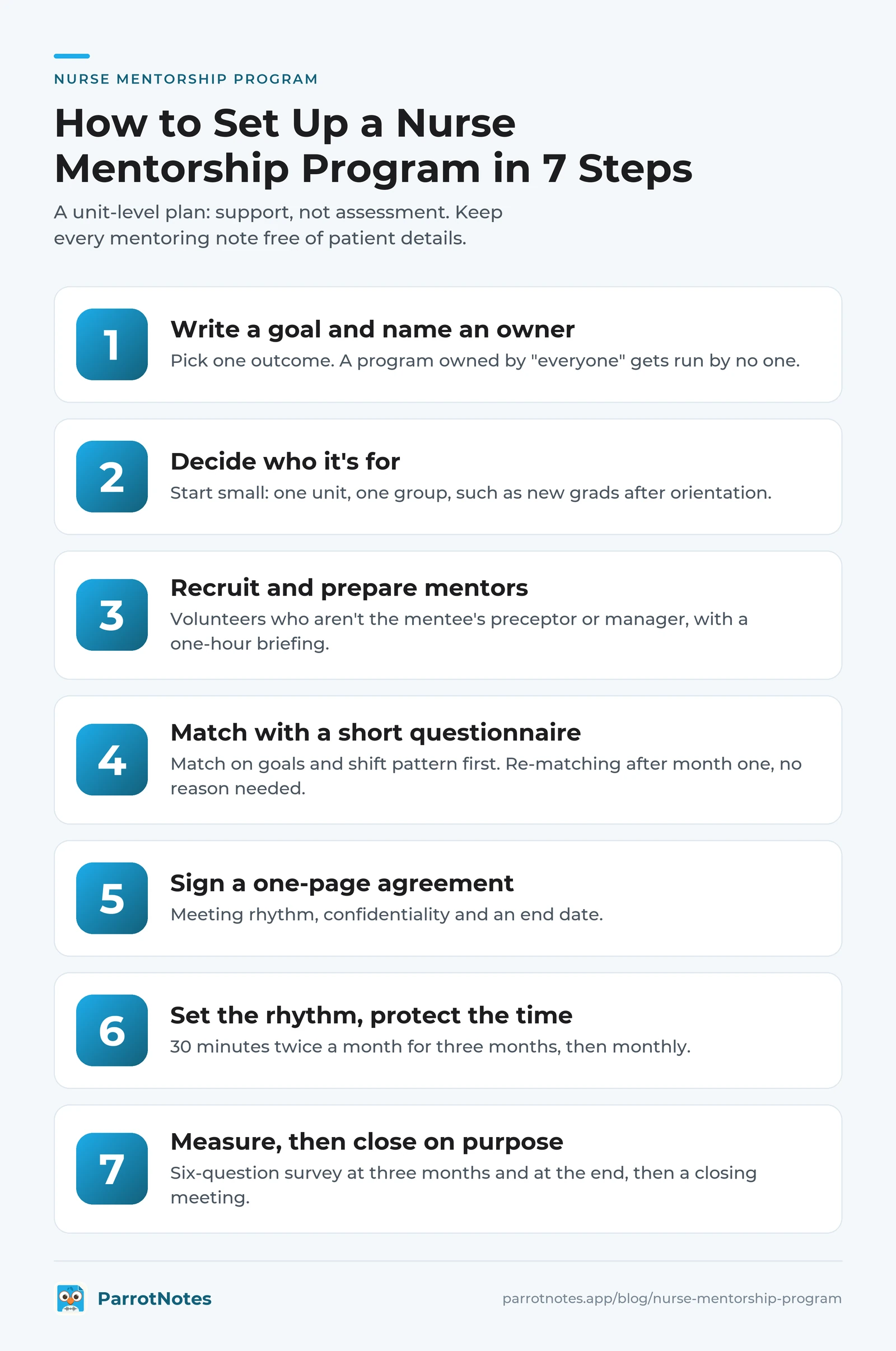
1. Write a one-line goal and name an owner
Pick one outcome: keep first-year nurses, support new charge nurses, or grow future leaders. Then name one owner, such as a nurse educator or a professional development council. A program owned by "everyone" gets run by no one.
2. Decide who it's for
Start small. One unit, one group: new grads after orientation, or nurses in their first two years. You can widen it after the first cohort.
3. Recruit and prepare mentors
Ask for volunteers with at least two years on the unit or in the specialty, and who aren't the mentee's preceptor or manager. Give them a one-hour briefing on listening, confidentiality, goal setting and when to refer a problem to the manager or employee assistance.
4. Match with a short questionnaire
Use the matching questionnaire below. Match on goals and shift pattern first and personality second. Let either person ask for a re-match after the first month, no reason needed.
5. Sign a one-page agreement
It sets meeting rhythm, confidentiality and an end date, and it's your best guard against pairs that fade out.
6. Set the meeting rhythm and protect the time
Twice a month for the first three months, then monthly. Thirty minutes is enough. Ask your manager to schedule it as paid time where possible, because "on your own time" is where most programs die.
7. Measure, then close each cycle on purpose
Run the six-question survey at three months and at the end. Each pair then holds a closing meeting and decides whether to continue informally.
The launch blueprint: six months from idea to first cohort
Here's a realistic timeline for a unit-level nurse mentorship program. Adjust the months, not the order.
| Month | What happens | Owner's checklist |
|---|---|---|
| 1 | Goal, owner and scope agreed with the manager | One-line goal, target group, end date for cohort one |
| 2 | Mentor call-out and briefing | Six to 10 volunteers, one-hour briefing held |
| 3 | Matching | Questionnaires in, pairs announced, agreements signed |
| 4 | First meetings | Every pair has met once, using the first-meeting agenda |
| 5 | Twice-monthly meetings continue | Check-in with mentors as a group, swap any mismatched pairs |
| 6 | Three-month survey and adjust | Survey results shared, rhythm moves to monthly |
The cohort then runs on monthly meetings to the 12-month mark, with the closing survey at the end.
Nursing mentorship program templates
Copy these and edit them for your unit.
Matching questionnaire (both mentors and mentees)
- What do you most want from this mentorship in the next six months?
- Which areas interest you: confidence on shift, specialty or certification, education, leadership, work-life balance?
- What's your usual shift pattern (days, nights, rotating)?
- Do you prefer to meet in person, by phone or by video?
- How do you like feedback: direct and quick, or talked through?
- Is there anyone you'd rather not be matched with? (Kept confidential.)
One-page mentoring agreement
- We'll meet twice a month for three months, then monthly, for 30 minutes.
- We'll start on [date] and review the mentorship on [date, 12 months later].
- What we discuss stays between us, except a safety concern, which the mentor will raise with the program owner.
- No patient details in our conversations or notes. We talk about growth, not cases.
- Either of us can end or re-match at any time by telling the program owner, no reason needed.
- The mentee's top goals: 1. ___ 2. ___ 3. ___
First-meeting agenda (30 minutes)
- Introductions: how each of you got into nursing (5 min)
- The mentee's best and hardest moment so far, without patient details (10 min)
- Two or three goals for the next three months (10 min)
- Agree the next date and how to reach each other (5 min)
Goals are easier to track when they're specific. Our guide to SMART goals for nurses has examples a mentee can adapt in the first meeting.
Six-question evaluation survey (1 to 5 scale)
- I meet with my mentor or mentee as agreed.
- I feel more confident at work than when we started.
- I have clearer career goals than when we started.
- I'd recommend this program to a colleague.
- Our meetings fit my schedule.
- (Open) What one change would make the program better?
Keep mentoring notes useful and free of patient details
Mentoring works when both people remember what they agreed last time. A short note habit helps, with patient privacy first.
Here's how Tomas, a mentor on a surgical unit, keeps up. After each meeting he records a 90-second recap in the parking lot: the mentee's goals, what they tried, and what he promised to look up.
ParrotNotes gives him a summary and action items, and he reads the last one before the next meeting. He never names patients, rooms or cases. (Tomas is a composite, not a real person.)
A few rules keep this clean:
- Recap afterward, in your own words. Don't record the mentoring conversation itself. The relationship depends on it feeling private.
- Talk about the nurse, not the patient. Goals, confidence, skills to practice, people to meet. Never patient names, diagnoses or room numbers.
- Record program meetings only with everyone's agreement, within your facility's policy, and only off the unit.
- Mentees can reflect the same way. A nursing reflective journal kept by voice is a good companion to mentoring.
ParrotNotes' Free plan includes 100 minutes of recording a month, an AI summary on every recording, and five AI-powered recordings a month for action items and chat. Recording works offline, so a recap in a hospital garage still saves and processes when you're back online. Pro is $19.99 a month, or $14.99 a month billed annually, with 3,000 minutes a month.
Want a recap habit for your mentoring meetings? Download ParrotNotes and record your first 90-second recap after your next meeting.
Why a nurse mentorship program stalls (and the fix)
Most programs don't fail at launch. They fade in month three.
Take Priya and Joan, a pair in a med-surg unit's first cohort. They met twice in the first month, then Joan moved to nights.
Neither wanted to be the one to cancel, so they just stopped. The program owner only found out at the three-month survey. (Priya and Joan are composites, not real people.)
Three fixes stop that from happening:
- Match on shift pattern first. It's question three on the questionnaire for a reason.
- Give the owner a monthly 15-minute mentor check-in. Group check-ins surface quiet pairs early.
- Make re-matching normal. If the agreement says "no reason needed", people actually use it.
Managers can also ask about mentoring in regular nurse manager one-on-ones, without asking what was said.
Start your first cohort this quarter
A nurse mentorship program doesn't need a budget. It needs:
- An owner and a small first group, on one unit.
- Trained mentors who aren't the mentee's preceptor or manager.
- A one-page agreement, a 12-month plan and protected time.
- Matches on goals and shift pattern, with easy re-matching.
- Notes that never contain patient details.
Copy the four templates, book your first planning meeting and pick your mentors. Ready to keep your program meetings and mentoring recaps in one place? Get ParrotNotes free and record your first recap today.
Frequently Asked Questions
What is a nurse mentorship program?
A nurse mentorship program pairs a less experienced nurse with an experienced one for regular, voluntary, confidential meetings about confidence, goals and career. Unlike precepting, the mentor doesn't assess the mentee's skills or sign off competencies.
How long should a nurse mentorship program last?
Plan for at least 12 months for new graduates. A 2025 meta-review advises 12 to 24 months for new graduates, and the ReSPeCT study found the strongest reported effects among mentees mentored for one to two years.
What is the difference between a mentor and a preceptor in nursing?
A preceptor teaches the job on the unit during orientation and assesses readiness. A mentor offers longer-term personal and career support, doesn't evaluate the mentee, and may work on a different unit.
Related Posts

Tactiq Review: Features, Pricing and Limits
Tactiq review from Tactiq's own pages, checked Oct 2026: capture paths, caption rules, two credit meters, plans and a 10-question fit test. Try ParrotNotes.

Superwhisper Review: Features, Pricing and Alternatives
Superwhisper review from its own pages, checked Oct 2026: plans, the free plan, lifetime math, offline limits and a 10-question fit test. Try ParrotNotes free.

Sales Performance Improvement Plan: A Template and How to Run It
A sales performance improvement plan template for field teams: diagnose the cause, set goals reps control, run weekly check-ins. Try ParrotNotes free.