
NCLEX Study Plan: A Schedule You Can Follow

Sarah Johnson
Writes about field sales, meeting notes and voice-first workflows at ParrotNotes. Every article is reviewed by the ParrotNotes product team before it goes live.
Table of Contents
- 1.What the NCLEX looks like in 2026 (so your study plan fits the exam)
- 2.How long should you study for the NCLEX?
- 3.The five parts of an NCLEX study plan that holds up
- 4.The 4-week NCLEX study plan
- 5.The 8-week NCLEX study plan
- 6.The daily review routine (90 minutes, minute by minute)
- 7.Weekly check-in checklist
- 8.What to do if you're retaking the NCLEX
- 9.The last three days and exam day
- 10.Your NCLEX study plan, starting this week
The Authorization to Test email arrives on a Tuesday afternoon, and suddenly the exam has a date. Maya, a May graduate working nights as a nurse tech, opens her question bank, sees 2,100 questions she hasn't touched, and closes the laptop.
She has a subscription and three review books. What she doesn't have is a plan that fits around four shifts a week.
Most people preparing for the NCLEX don't need more material. They need an NCLEX study plan that says what to do today, what to do tomorrow, and what to skip. This guide gives you two schedules to copy (4 weeks and 8 weeks, with a version for people working three 12-hour shifts), a 90-minute daily review routine, a template for the note you write after every practice set, and a weekly check-in so you can tell whether the plan is working.
Every fact about the exam below comes from NCSBN, the body that writes the NCLEX, and was checked against its 2026 test plan and candidate bulletin. Nothing here is medical or nursing content advice. It's a schedule, and a way of reviewing, that you can start this week.
What the NCLEX looks like in 2026 (so your study plan fits the exam)
Before you plan the weeks, it helps to know what you're planning for, because an NCLEX-RN study plan written for the old exam wastes days on the wrong things. The 2026 NCLEX Candidate Bulletin states that the NCLEX-RN and NCLEX-PN run anywhere from 85 to 150 items, and that the time limit is five hours regardless of how many items you get. That five hours includes the introductory screen and every break.
The 2026 NCLEX-RN Test Plan, effective April 1, 2026, spells out what a minimum-length exam contains: 52 items from the eight content areas, 18 items that make up three clinical judgment case studies, and 15 unscored pretest items. Each case study is six items that walk through the six steps of NCSBN's Clinical Judgment Measurement Model: recognize cues, analyze cues, prioritize hypotheses, generate solutions, take action, and evaluate outcomes. Items with more than one correct answer are scored for partial credit using three methods NCSBN calls plus/minus, zero/one, and rationale scoring.
Three numbers from NCSBN's 2025 NCLEX Examination Statistics shape a sensible plan:
- The average NCLEX-RN ran 103 items and took 2 hours 14 minutes for first-time, U.S.-educated candidates. 59.1% of them stopped at the minimum of 85 items, and 20.5% went all the way to 150.
- 86.7% of first-time, U.S.-educated NCLEX-RN candidates passed in 2025 (192,916 tested). For the NCLEX-PN the figure was 86.6%.
- Repeat U.S.-educated RN candidates passed at 52.7%. The first attempt is the one to plan for.
Those numbers are context, not a promise. No schedule, book, or app changes what the exam is; a plan changes how ready you are for it.
Two dates matter for how long you have. NCSBN says the average Authorization to Test (ATT) is valid for 90 days, and the validity dates cannot be extended. If you don't pass, you must wait at least 45 test-free days before retaking, and you can test up to eight times a year, subject to your state board's own rules (NCLEX results and retake policy). Official results come from your nursing regulatory body within six weeks; in participating states, Quick Results are available two business days after the exam.
How long should you study for the NCLEX?
Most graduates plan four to eight weeks of focused NCLEX study, working back from the exam date inside the 90-day ATT window. Four weeks suits someone who finished school recently, isn't working full time, and can give three to four hours a day. Eight weeks suits someone working shifts, someone whose program ended months ago, or anyone whose first practice sets come back well under their target.
The honest answer is that the calendar is set by two things you already know: when your ATT expires and how many hours a week you can protect. Pick the NCLEX study schedule that matches the hours, not the one that sounds more impressive. A 4-week plan that you follow beats an 8-week plan that collapses in week three.
A quick way to decide: count the hours you can study in the next seven days, honestly, after shifts, sleep, and family. If it's 20 or more, the 4-week plan fits. If it's 10 to 15, take the 8-week plan. Under 10, and you need to move the exam date within your ATT window or free up time before you start.
Want the rationale notes from your review sessions in one searchable place before you begin? ParrotNotes is free to download, and the free plan gives you 100 minutes of recording a month with an AI summary on every recording.
The five parts of an NCLEX study plan that holds up
The schedules below share a structure. If you build your own instead, keep these five parts.
1. Questions first, content second. Practice questions with rationales are the engine of an NCLEX study plan. Content review is what you do to fix what the questions expose, not a phase you finish before you're allowed to practice. A review of ten study techniques by Dunlosky and colleagues (Psychological Science in the Public Interest, 2013) rated practice testing and distributed practice as the two high-utility methods, and rated rereading and highlighting as low utility. That's the whole argument for a plan built on daily question sets.
2. Spaced review, not one big review. Every rationale you write today gets re-read three days later and again the following week. That's the "distributed practice" half of the finding above, and it's the part most study calendars leave out.
3. One longer set every week. A weekly set of 85 items in one sitting, timed, teaches you the pace and the fatigue of the real exam. The average candidate's 103 items in 2 hours 14 minutes works out to roughly 78 seconds an item. Use that as a pace check, not a rule.
4. Rest days that are really rest. Both schedules have them. Skipping rest days feels productive in week one and costs you in week three.
5. A written weekly check-in. Ten minutes on Sunday to look at your numbers and change next week. Without it, a plan is a wish.
The 4-week NCLEX study plan
This NCLEX study schedule assumes about 3.5 hours a day, six days a week, with the daily review routine below as the core of every study day. Question counts are a target for the session, not a minimum you must hit before you're allowed to stop.
| Week | Focus | Study days | Questions per day | Weekly long set | Rest |
|---|---|---|---|---|---|
| 1 | Baseline and habits: mixed-topic sets, learn the rationale note, find your weak areas | Mon to Sat | 60 to 75 | Saturday: 85 items, timed | Sunday |
| 2 | Weak areas from week 1 (two per day) plus mixed sets; case studies daily | Mon to Sat | 75 | Saturday: 85 items, timed | Sunday |
| 3 | Mixed sets only, case studies daily, re-read every rationale note from weeks 1 and 2 | Mon to Sat | 75 to 100 | Saturday: 100 items, timed | Sunday |
| 4 | Taper: shorter sets, rationale notes only, one full-length set early in the week, two easy days before the exam | Mon to Thu | 50, then 25 | Monday or Tuesday: 100 items, timed | Fri and Sat before a Sunday or Monday exam |
How a study day runs in week 2. A 40-item mixed set (about 50 minutes), the rationale-note routine (25 minutes), a short content fix on the day's weak area (30 minutes), a second 35-item set with rationales (60 minutes), and a five-minute spoken recap of what you got wrong and why. That's about three hours; the extra half hour is your spaced re-read.
If you're working three 12-hour shifts a week
Shift work breaks the six-day pattern, so use a rolling one instead. On shift days, do 20 questions and their rationale notes, nothing else (about 40 minutes, before the shift rather than after). On your four off days, do the full 3.5-hour day, and put the weekly long set on the first off day when you're most rested. Over four weeks you'll still cover about 1,400 questions, and you'll protect sleep, which matters more the closer the exam gets.
Priya, a fictional example, graduated in May and started nights on a med-surg floor as a graduate nurse in June. She tried a "study after every shift" plan for a week and gave up: 20 questions at 8 a.m. after a night shift produced answers she couldn't remember by lunch. Switching to 20 questions before each shift and full days on her off days gave her the same weekly count with rationales she could re-read.
The 8-week NCLEX study plan
This plan assumes about two hours a day, five days a week, and suits anyone working full time or whose program ended a while ago. It follows the same shape as the 4-week plan, stretched, with a content block in the first three weeks for people who need it.
| Week | Focus | Study days | Questions per day | Weekly long set | Rest |
|---|---|---|---|---|---|
| 1 | Baseline: mixed sets, learn the rationale note, list your weak areas | 5 | 40 | Saturday: 75 items, untimed | 2 days |
| 2 | Weak area 1 and 2 (alternate days) plus mixed sets | 5 | 40 | Saturday: 85 items, timed | 2 days |
| 3 | Weak area 3 and 4 plus mixed sets; start daily case studies | 5 | 40 to 50 | Saturday: 85 items, timed | 2 days |
| 4 | Mixed sets; re-read all rationale notes from weeks 1 to 3; drop any weak area you've now fixed | 5 | 50 | Saturday: 85 items, timed | 2 days |
| 5 | Mixed sets with case studies every day; pharmacology and calculations sets twice this week | 5 | 50 | Saturday: 100 items, timed | 2 days |
| 6 | Mixed sets; second full re-read of rationale notes; note what still trips you | 5 | 50 to 60 | Saturday: 100 items, timed | 2 days |
| 7 | Mixed sets, lighter content work, spoken recaps of your notes | 5 | 60 | Saturday: 100 items, timed | 2 days |
| 8 | Taper: 30 to 40 questions a day for three days, rationale notes only, then two easy days | 3 | 30 to 40 | None (the full set was week 7) | The two days before the exam |
Notice the long set is untimed in week 1 and timed from week 2. The first one is for finding out what you don't know; the timing comes once you have something to measure.
If week 3 looks the same as week 1. Don't push on to week 4 as written. Repeat week 2 for the weak areas that haven't moved, and drop the long set that week. Falling one week behind on an 8-week plan is fine. Studying the wrong thing on schedule isn't.
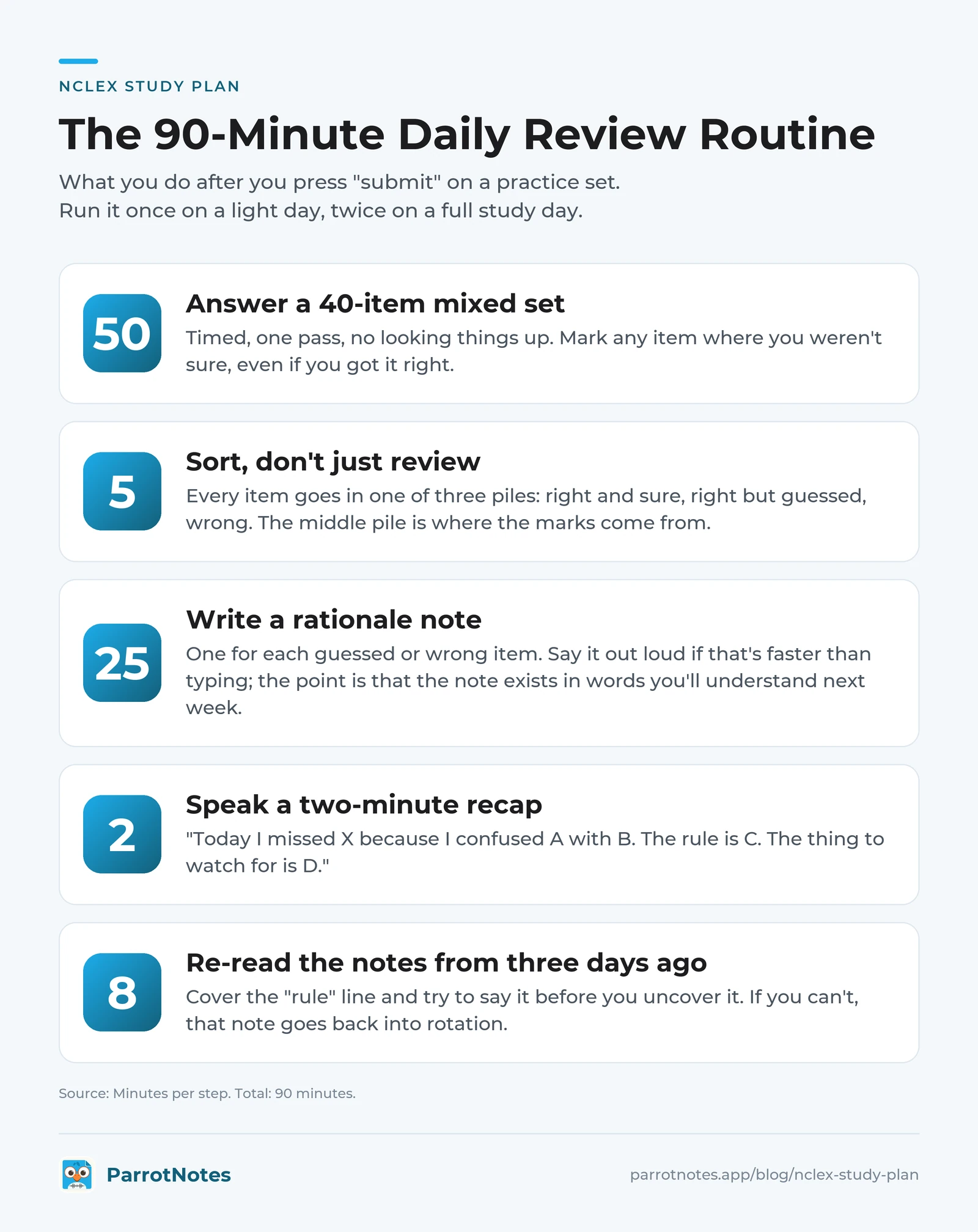
The daily review routine (90 minutes, minute by minute)
This is the engine of both schedules, and it's what most study calendars leave out: what you do after you press "submit" on a set. Most people read the rationale, nod, and click next. The routine below turns that into something you can re-read a week later.
- Answer a 40-item mixed set (about 50 minutes). Timed, one pass, no looking things up. Mark any item where you weren't sure, even if you got it right.
- Sort, don't just review (5 minutes). Every item goes in one of three piles: right and sure, right but guessed, wrong. The middle pile is where the marks come from.
- Write a rationale note for each guessed or wrong item (25 minutes). Use the template below. Say it out loud if that's faster than typing; the point is that the note exists in words you'll understand next week.
- Speak a two-minute recap (2 minutes). "Today I missed X because I confused A with B. The rule is C. The thing to watch for is D." Recording this in your own words is the fastest form of self-testing there is.
- Re-read the notes from three days ago (8 minutes). Cover the "rule" line and try to say it before you uncover it. If you can't, that note goes back into rotation.
Run it once on a light day, twice on a full study day. On an off-shift 40-minute day, do steps 1 to 3 with a 20-item set.
Spoken self-quizzing and the rationale note
Writing rationale notes by hand is where daily plans die. After 40 questions, nobody wants to type 12 paragraphs. Speaking them is different: 90 seconds of talking about why you missed a question is faster than writing, and it forces you to explain the rule in a full sentence instead of copying the answer key.
This is where ParrotNotes fits into an NCLEX study plan. Open a recording after the set, say each note in the template order, and stop. The transcript is your written rationale note, the AI summary gives you the short version for re-reads, and the action items pull out the "watch for" lines. Tag the recording with the topic (say, #fluids or #priority) and search the transcript later when the same trap shows up in a set.
Two rules. First, record only your own voice and your own study. Never record a review class, a lecture, or a study group without the instructor's and everyone's permission. Rules on recording vary by state and by school, this isn't legal advice, and asking first is always the right call. The nurse educator guide has a consent script if you want one.
Second, keep it to practice questions. If you're working clinically while you study, real cases and patient details from your shifts don't belong in a study note. Practice questions use invented clients; keep your notes the same way.
The rationale note template (with an example)
Five lines, in this order. The order matters because the "rule" line is what you'll test yourself on later.
Topic: [content area or system]
The trap: [what I thought, and why it was tempting]
The rule: [one sentence I can re-say without the question in front of me]
Watch for: [the word or cue in the stem that should have pointed me right]
Re-test on: [today + 3 days], [today + 10 days]
A filled-in example, spoken after a set. It's about exam technique rather than a clinical rule, because the notes that repeat most are usually about how you read the question:
Topic: Select-all-that-apply items, safety and infection control set
The trap: I stopped reading after I found two options I was sure of, and missed the fourth
The rule: Every option in a select-all item is its own true-or-false question; judge each one alone
Watch for: "Select all that apply" in the stem, and any option I skimmed because I'd already decided
Re-test on: Sep 25, Oct 2
Read that back in a week with the "rule" line covered and you'll know within five seconds whether it stuck. Twenty notes like this, re-read on schedule, do more than another 200 questions clicked through without them.
Try the routine tonight. Do one 20-item set, speak your rationale notes into ParrotNotes, and read the transcript tomorrow morning. The free plan covers 100 minutes of recording a month, with a 30-minute cap per recording and an AI summary on every one.
Weekly check-in checklist
Every Sunday (or your first off day), ten minutes, in writing. Copy this list.
- Questions answered this week: number, and whether it matched the plan
- Score on the weekly long set: and the number of items you guessed on, which matters more than the score
- Weak areas: which two or three content areas produced the most rationale notes
- Notes re-read on schedule: yes or no; if no, that's the first fix for next week
- Pace: minutes per item on the long set, against the 78-second average from NCSBN's 2025 data
- Sleep and rest days: did you take them, honestly
- One change for next week: swap a weak area, move the long set, cut the daily count, or add a rest day
Then change one thing, not five. A plan you adjust weekly is still a plan. A plan you rewrite from scratch every Sunday is a way of avoiding questions.
Jordan, another fictional example, spent his first three weeks reading a review book cover to cover before "earning" the question bank. His week-4 check-in showed 210 questions answered in total and a long-set score that hadn't moved. Flipping the order, questions first with a 30-minute content fix on whatever the rationales exposed, took his weekly count from 70 to 350. No blog post can promise what that does to a result; what it did was give his check-in numbers to look at.
What to do if you're retaking the NCLEX
If this is a second attempt, your plan starts with the Candidate Performance Report (CPR). NCSBN describes it as a two-page document sent to candidates who fail, showing your performance in each content area and clinical judgment category as Below, Near, or Above the passing standard. NCSBN's own advice is to concentrate first on the areas listed as Below, then work up to the Near ones.
That maps directly onto the 8-week plan. Put your Below areas in weeks 2 and 3, your Near areas in weeks 4 and 5, and keep the mixed sets running throughout so the Above areas don't slide. The 45-day minimum gap between attempts fits the 4-week plan with room to spare, but the 8-week plan gives a retake the time it usually needs. Contact your state board early: NCSBN notes some boards set longer waits or fewer attempts than the eight-a-year policy.
The last three days and exam day
In the last three days, questions go down and re-reads go up. Read your rationale notes, cover the rule line, say it aloud. Do one short set a day to stay warm, nothing timed, nothing new.
The day before the exam is for the bulletin, not the question bank. Check the candidate bulletin for what ID you need, and confirm the appointment time and route.
On the day, remember what NCSBN's statistics say about length. Most first-time candidates stopped at 85 items, but one in five went to 150, and the exam gives you five hours including breaks. A long exam is not a sign you're failing; it means the computer needs more items to be 95% sure either way. Plan your breaks as if you'll be there for the full five hours.
After the exam, your first job brings its own note-taking habits. The nurse manager one-on-one guide shows what your manager is likely to ask in your first check-ins.
Your NCLEX study plan, starting this week
An NCLEX study plan that works has a small number of parts: questions before content, a rationale note for everything you guessed, re-reads three and ten days later, one long timed set a week, real rest days, and a ten-minute Sunday check-in. The 4-week and 8-week schedules above are those parts laid on a calendar. Copy the one that fits your hours, not your hopes.
Speaking your rationale notes instead of typing them is the habit that keeps the plan alive after 40 questions. Download ParrotNotes free, record your first recap after tonight's set, and start week 1 with a note you'll be able to test yourself on by Friday.
Frequently Asked Questions
How many hours a day should I study for the NCLEX?
It depends on the plan length. The 4-week NCLEX study plan above assumes about 3.5 hours a day, six days a week, and the 8-week plan about two hours a day, five days a week. Shift workers should do 40 minutes on shift days and full days when off. Count your real free hours first, then choose the plan that fits them.
How many practice questions should I do before the NCLEX?
The 4-week plan lands at roughly 1,900 questions including its four long sets; the 8-week plan at roughly 2,400 including seven. The count matters less than what you do after each set. A rationale note for every guessed or missed item, re-read three and ten days later, is the part of an NCLEX study plan that makes the questions stick.
Is the NCLEX 75 questions in 2026?
No. NCSBN's 2026 Candidate Bulletin states the NCLEX-RN and NCLEX-PN run from 85 to 150 items, with a five-hour limit that includes breaks. The minimum-length RN exam has 52 content items, 18 case-study items in three case studies, and 15 unscored pretest items. In 2025 the average first-time, U.S.-educated RN candidate answered 103 items.
How long is the NCLEX authorization to test valid?
NCSBN says the average ATT is valid for 90 days and that the dates cannot be extended for any reason; if you don't test inside them, you reregister and pay again. Your state board sets the exact length. Schedule early: NCSBN warns that waiting to book can leave no seats before your ATT expires.
Related Posts

Voice Notes on iPhone: Everything You Can Do With Them
Voice notes on iPhone can do more than record. Learn to capture, tidy, transcribe, sync, and share them, and which iPhone voice tool fits each job. Try it free.
Sandler Pain Funnel Questions (With a Note-Taking Template)
The 8 Sandler pain funnel questions as Sandler publishes them, what to write down at each one, a note-taking template and a worked call. Copy it free.

Sales Meeting Agenda: Templates for Weekly Team Meetings
Running a weekly sales meeting that produces nothing? Copy four sales meeting agenda templates for field teams, plus a rep prep card and a record-ready run.